 SehatSphere.com
Morning Blood Pressure Spikes: The 5 Habits Making It Worse Before 9 AM
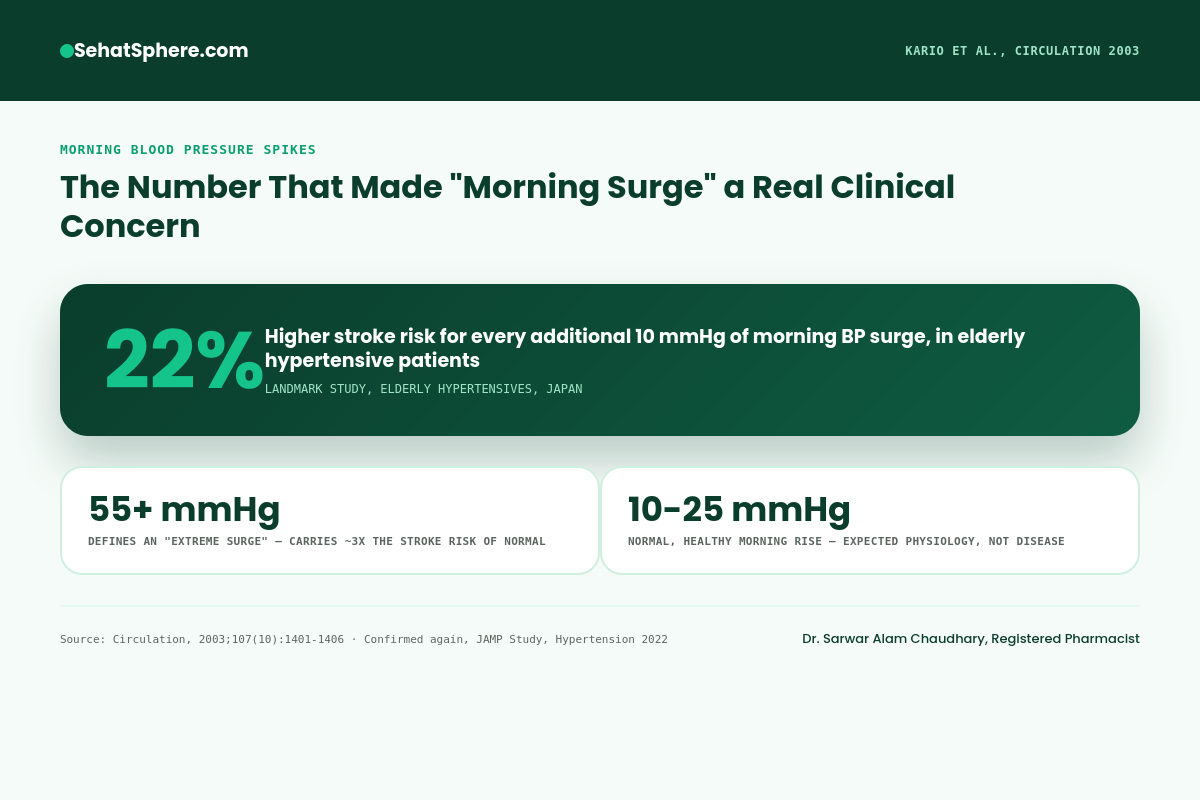
Your blood pressure is designed to rise every morning — that part is normal, healthy biology. What isn’t automatic is how much it rises, and a real 2003 study found that every extra 10 mmHg of morning surge raised stroke risk by 22% in older hypertensive patients. A handful of ordinary habits decide which side of that line you’re on.
Key takeaways:
- A normal morning rise is 10-25 mmHg — cortisol and adrenaline waking your body up. This is expected and not dangerous by itself.
- An “extreme surge” (over 55 mmHg) carries roughly 3x the stroke risk of a normal one, per the researcher who first defined this pattern.
- Empty-stomach caffeine, a salty dinner the night before, and jumping straight out of bed all add real, measurable mmHg on top of your natural surge.
- If your BP is high only in the morning and normal the rest of the day with no symptoms, that can simply be a personal trait — not automatically disease.
What the Morning Surge Actually Is
Blood pressure follows a 24-hour rhythm — it dips during sleep and rises in the hours before you wake, driven by a release of cortisol, adrenaline, and noradrenaline that’s preparing your body for the day. This is called the morning surge, and a rise of roughly 10–25 mmHg from your lowest nighttime reading is completely normal physiology, not a medical problem.
Cardiovascular events — heart attacks, strokes, sudden cardiac death — cluster disproportionately in these early morning hours, which is exactly why researchers started studying whether the surge itself was a trigger, not just a coincidence in timing. Chronic stress keeps this same hormone system on a higher baseline around the clock — our anger and blood pressure guide and stress reduction guide cover this same cortisol pathway from a different angle.
This isn’t a uniquely modern discovery, either — the diurnal pattern of blood pressure has been documented for decades, but it took ambulatory monitoring technology becoming widely available for researchers to actually measure it precisely across large groups of patients over months, rather than relying on single clinic readings that miss this entirely.
How Much Surge Is Actually Dangerous
Dr. Kazuomi Kario’s landmark 2003 study in Circulation followed elderly hypertensive patients and found that morning BP surge predicted stroke risk independently of a person’s average 24-hour blood pressure. The specific number: every 10 mmHg increase in morning systolic surge raised stroke risk by 22%. His earlier work defined an “extreme surge” — over 55 mmHg from the lowest nighttime reading — as carrying roughly 3 times the stroke risk of a normal surge.
A newer, larger 2022 study (JAMP, modern treated patients) found a similar but more modest signal — about an 8% increase in stroke risk per 10 mmHg, not statistically as strong as the original finding. This is worth stating honestly: better modern blood pressure treatment appears to have softened, not eliminated, this risk — which is a genuinely good sign, not a reason to dismiss the original research.
Dipper (normal): BP drops appropriately at night. Non-dipper: BP stays flat overnight — a recognized cardiovascular risk marker. Riser: BP is actually higher at night than during the day — the pattern linked to the highest risk of all three.
The 5 Habits Making It Worse
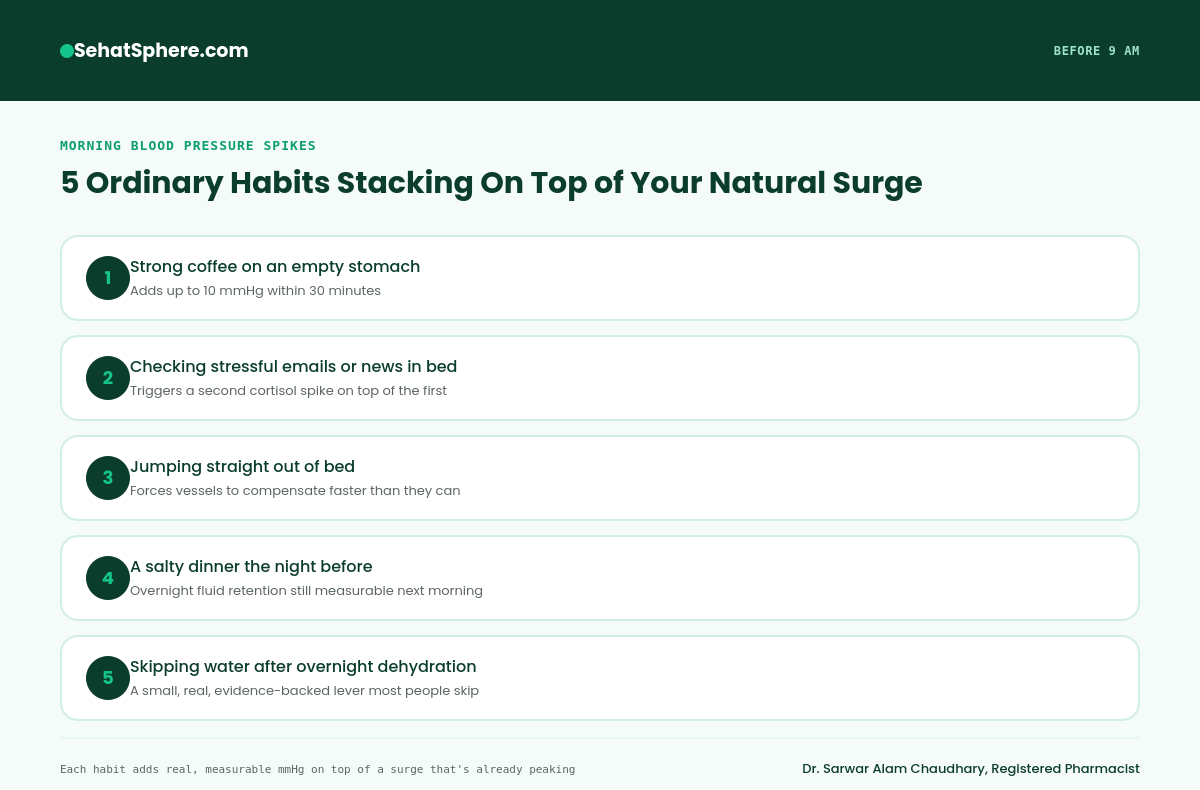
1. Strong coffee or tea on an empty stomach
Caffeine measurably raises blood pressure — up to 10 mmHg within 30 minutes, per cardiology sources — by stimulating your sympathetic nervous system and momentarily stiffening arteries. Stacked on top of your natural surge, this is additive, not separate. Delaying your first cup by 60–90 minutes, when your cortisol is already declining from its peak, softens this considerably. If you’re also on medication and wondering about the overlap, our Integrative Interaction Checker is a quick way to check.
2. Checking stressful news or emails in bed
Your amygdala doesn’t distinguish between a real physical threat and a stressful email — both trigger the same cortisol and adrenaline release that’s already elevated from waking. This stacks a second stress response directly on top of the first.
3. Jumping straight out of bed
A sudden postural change asks your blood vessels to instantly compensate for gravity shifting blood toward your legs. Ageing or stiffer vessels respond more slowly, causing the lightheadedness some people feel — sitting on the edge of the bed for 60 seconds first genuinely helps.
4. A salty dinner the night before
High sodium the evening before causes fluid retention that’s still measurable the next morning, adding to blood volume right when your surge is already peaking. This is a genuinely cumulative effect, not a same-day one. Heavily processed dinners are usually the real sodium source — our ultra-processed foods guide covers why these add up faster than people expect.
5. Skipping water after a night of mild dehydration
Ordinary overnight fluid loss through breathing and sweat mildly concentrates your blood by morning. A glass of water before anything else is a small, real, evidence-backed lever — not a wellness myth. If you’re also managing weight or metabolic health alongside this, our GLP-1 diet guide touches on hydration in the same context.
What To Read Next
- The BP Medicine Timing Myth, Busted: Why the morning-surge theory didn’t hold up in real trials.
- Why Does Blood Pressure Fluctuate? 12 hidden causes and a 7-day control plan.
- Normal Blood Pressure by Age: The real chart, and what your target actually is.
- Early Signs of a Weak Heart: Subtle symptoms worth not ignoring.
- Complete Guide to Medicine Safety: The broader framework this guide sits inside.
Why “Take It at Night” Isn’t the Fix Here
The morning-surge research is exactly what originally motivated advice to take blood pressure medication at bedtime — the theory being that evening dosing might blunt the surge more effectively. Our full timing myth guide covers why the largest trials (TIME, 2022; BedMed, 2024) found no real difference in cardiovascular outcomes between morning and evening dosing, despite this plausible mechanism. The surge itself is real; the fix for it turned out to be more about habits than pill timing.
Is It Just Your Trait, or a Warning Sign?
Not every strong morning reading means something is wrong. Some people are simply stronger “cortisol responders” — their morning readings run consistently higher while daytime and evening readings stay normal, with no other symptoms. If that describes you and you sleep well, exercise regularly, and your 24-hour average looks fine, this is more likely a personal trait than a disease process.
The distinction that actually matters: isolated morning elevation with a normal rest-of-day pattern is a different situation from elevated readings all day, or a genuinely extreme morning number. Sleep apnea is a real, well-documented cause of the second pattern — repeated overnight oxygen drops trigger large adrenaline surges, and treating it with CPAP has been shown to lower systolic pressure by 5–15 mmHg. Fatigue that doesn’t match your sleep hours can be a clue here too — our B12 deficiency guide and free Nutrient Deficiency Finder are worth ruling out alongside a sleep evaluation, since both can present similarly.
How to Measure It Correctly
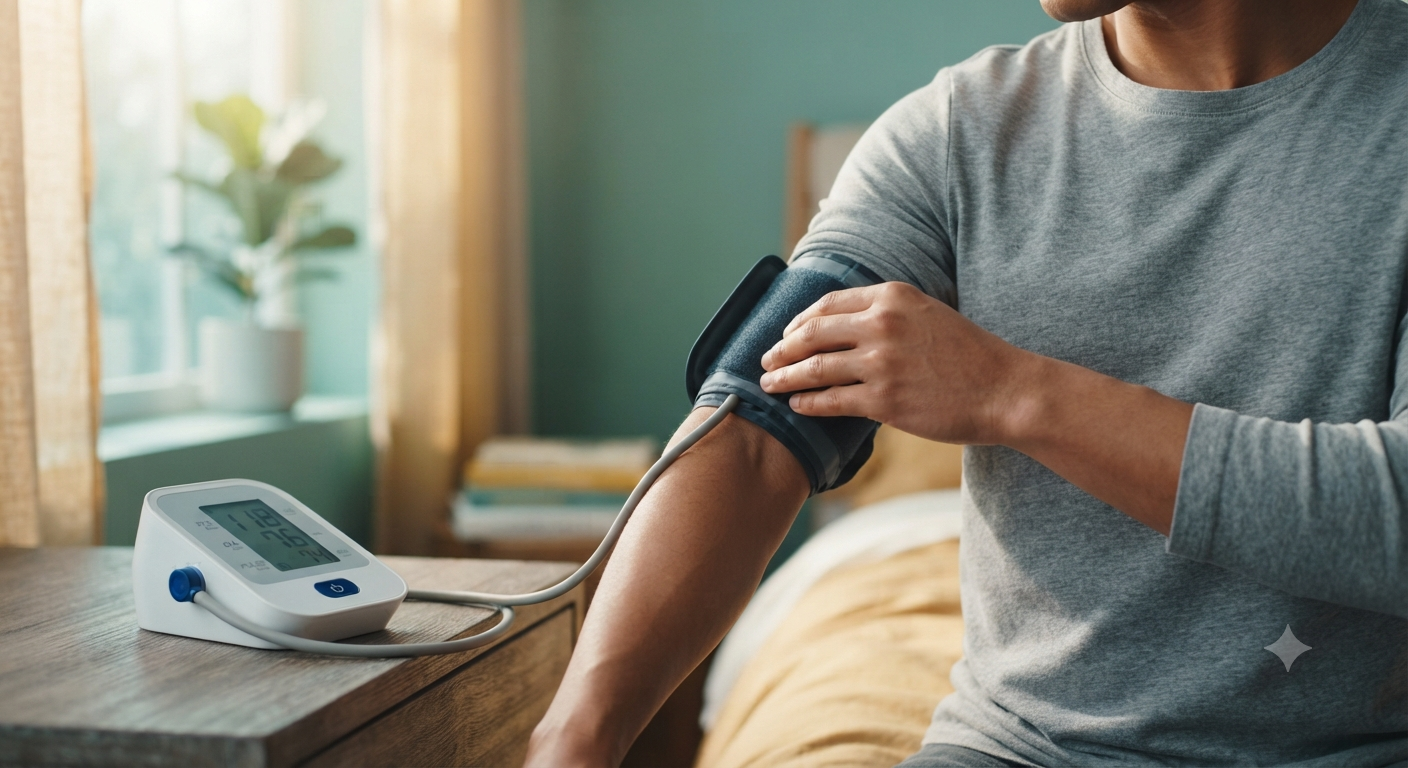
A huge share of “scary” morning readings are actually measurement artifacts. For a reading that reflects your real morning baseline: measure within an hour of waking, after using the bathroom, before coffee or medication, sitting quietly for 5 minutes first. Reading email or news first, or measuring right after a stressful shower, genuinely inflates the number beyond your real physiological baseline.
If you’re keeping a log for your doctor, our Complete Guide to Blood Pressure covers proper measurement technique in more depth, and the free Can I Take This With That tool is worth running your morning medications through if timing feels complicated.
If You’re Already Managing Other Conditions
Morning surge doesn’t happen in isolation for most people managing multiple prescriptions. If you’re also on a cholesterol medication, our statins guide covers what’s genuinely a side effect versus what isn’t. If acid reflux medication is part of your morning routine, both our pantoprazole guide and GERD and silent reflux guide are worth reading, since a few reflux medications genuinely interact with blood pressure regulation. And if magnesium or creatine are part of your supplement stack, our magnesium interactions guide and creatine and blood test guide cover the overlaps worth knowing, including how a routine lab result like high creatinine can sometimes be context, not disease. If cost is part of why you’ve been inconsistent with any of these, our generic medicine pricing guide is worth a look too.
Quick Self-Check
Tick anything that’s part of your actual morning routine, and see what it suggests.
Frequently Asked Questions
Why is blood pressure highest in the morning?
A natural circadian release of cortisol, adrenaline, and noradrenaline prepares your body for waking, causing a normal 10-25 mmHg rise. This is expected physiology, not a problem by itself.
How much of a morning BP surge is dangerous?
Research defines an “extreme surge” as over 55 mmHg from your lowest nighttime reading, carrying roughly 3 times the stroke risk of a normal surge. Every 10 mmHg increase was linked to a 22% higher stroke risk in the original landmark study.
Can drinking water lower morning blood pressure?
Yes, modestly. Overnight fluid loss mildly concentrates blood by morning, and rehydrating helps restore normal blood volume and vascular resistance.
Does coffee make morning blood pressure spikes worse?
Yes – caffeine can raise blood pressure by up to 10 mmHg within 30 minutes, adding to your natural surge rather than replacing it. Delaying your first cup by 60-90 minutes reduces this stacking effect.
Is 140/90 normal right after waking up?
A single elevated reading during the natural surge isn’t automatically alarming, but a consistently high morning reading of 140/90 or above deserves proper evaluation, not dismissal as “just the surge.”
Why does my heart race when I wake up suddenly?
A sudden awakening triggers an abrupt sympathetic nervous system response, releasing adrenaline that raises heart rate – part of the same mechanism behind the broader morning surge.
Should I take my BP medication at night instead of morning to control the surge?
This was the original theory, but the largest trials to test it (TIME, BedMed) found no meaningful difference in cardiovascular outcomes between morning and evening dosing. Take it consistently at whichever time you’ll remember.
Does sleep apnea affect morning blood pressure?
Yes, significantly. Repeated overnight oxygen drops from obstructive sleep apnea trigger large adrenaline surges, and treating it with CPAP has been shown to lower systolic blood pressure by 5-15 mmHg.
The Bottom Line
Your morning BP surge is normal biology doing its job – the danger isn’t the surge itself, it’s how large it gets and what you stack on top of it. Empty-stomach caffeine, a stressful phone check, jumping out of bed, and last night’s salty dinner all add real, measurable pressure to a system that’s already working hard. None of these need to be eliminated entirely – they need fifteen minutes of intention before you reach for your phone. If you’ve read this far wondering whether your own morning number is actually a problem, the honest answer is: measure it correctly first, track it for a week, and let the pattern – not one scary reading – decide whether it’s worth a doctor’s conversation.
- Kario K, et al. Morning Surge in Blood Pressure as a Predictor of Silent and Clinical Cerebrovascular Disease in Elderly Hypertensives. Circulation, 2003;107(10):1401-1406.
- Kario K, et al. Morning Surge in Blood Pressure and Stroke Events in a Large Modern Ambulatory Blood Pressure Monitoring Cohort (JAMP Study). Hypertension, 2022.
- American Heart Association. Understanding Blood Pressure Readings. heart.org
View All References (5) ▾
- Ali Y. Cardiology commentary on caffeine and acute blood pressure response. Vanderbilt University Medical Center.
- Kario K, Pickering TG. Clinical Implication of Morning Blood Pressure Surge in Hypertension. J Cardiovasc Pharmacol, 2003;42 Suppl 1:S87-91.