 SehatSphere.com
Statins Side Effects: Complete Guide to Muscle Pain, CoQ10 & Long-Term Risks
Millions of people take a statin every day, and a meaningful share stop because of muscle pain, often within the first few months of starting treatment. What most patients never hear: when the same people were tested blind — not knowing if they’d taken the statin or a placebo — roughly 90% of that muscle pain showed up either way.
Key takeaways:
- Blinded trials show statin and placebo cause nearly identical rates of muscle symptoms — a real, well-documented “nocebo” effect explains much of the real-world gap.
- Statins do measurably lower blood CoQ10 — that part is settled. Whether this causes muscle symptoms, and whether supplementing helps, remains genuinely debated.
- Genuinely serious reactions (rhabdomyolysis, immune myopathy) are real but rare — not a reason to fear the drug, but worth knowing the actual numbers.
- A landmark 2026 review found most side effects listed on statin labels — memory loss, depression, fatigue — aren’t actually supported by trial evidence.
What Statins Actually Do
Statins (HMG-CoA reductase inhibitors) are among the most widely prescribed medications in the world. They work by blocking an enzyme in the liver, HMG-CoA reductase, that’s the rate-limiting step in cholesterol production. Lowering LDL (“bad”) cholesterol this way genuinely reduces heart attacks and strokes — the cardiovascular benefit isn’t in question.
The complication: the same enzyme sits at the top of a broader biochemical pathway (the mevalonate pathway) that also makes several other molecules your cells use, including Coenzyme Q10. That shared pathway is where most of the genuine, and much of the overstated, concern about statin side effects comes from.
The Nocebo Effect, Proven
This is the single most important, least-reported fact about statin muscle pain. In the ASCOT-LLA trial (Lancet, 2017), muscle-related symptoms were reported at nearly identical rates whether patients were taking the actual statin or a placebo, while both groups were blinded: 2.03% vs. 2%. Once the same trial continued into an open-label phase — and patients knew they were taking a statin — reported muscle symptoms jumped 41% higher among statin users.
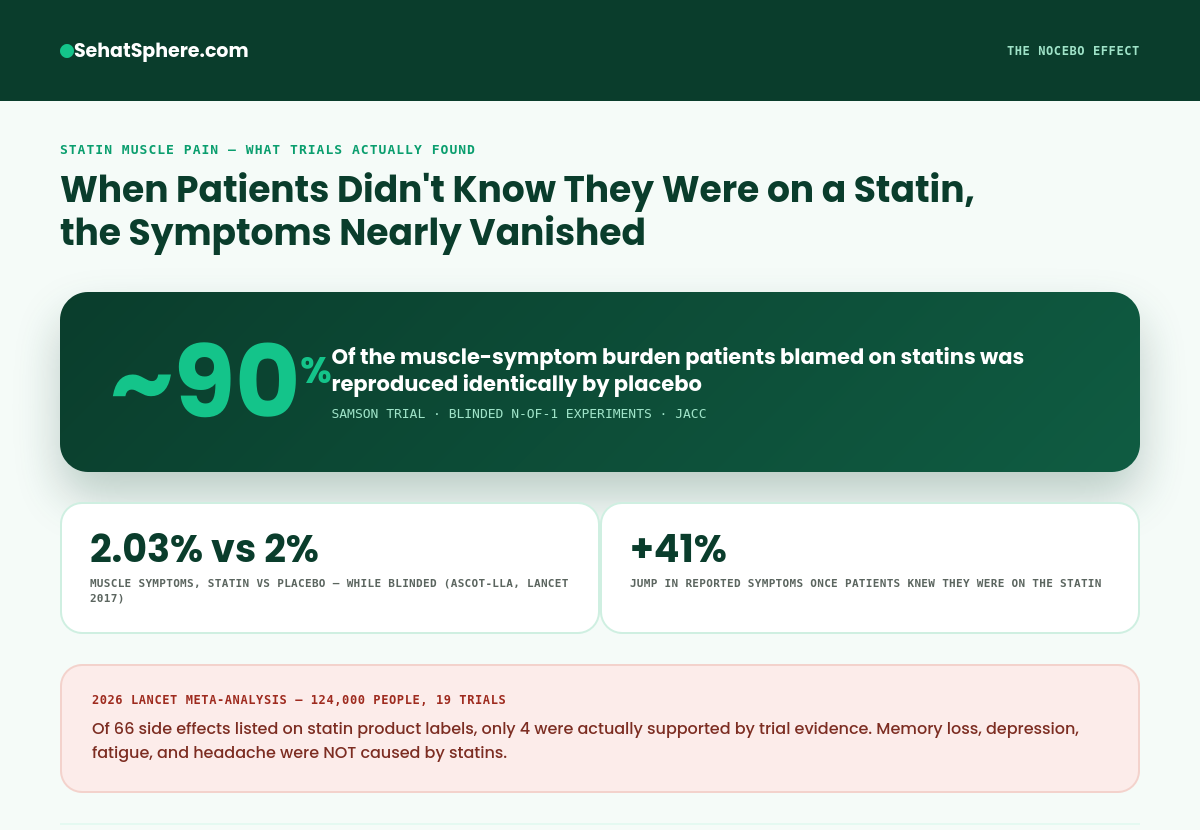
The SAMSON trial, published in JACC, went further with individual blinded n-of-1 experiments — each patient cycling through statin, placebo, and no-pill months without knowing which was which. The result: roughly 90% of the muscle-symptom burden patients attributed to their statin was reproduced just as strongly by the placebo.
Researchers have coined a specific term for this in statin research: the “drucebo” effect (drug + nocebo). A systematic review estimated that 38–78% of statin-associated muscle symptoms are attributable to expectation rather than the drug’s actual pharmacology. This doesn’t mean the pain isn’t real, or that you’re “making it up” — it means the cause is more complicated than the drug alone, and it’s a genuinely useful thing to know before assuming a statin is the culprit.
A landmark meta-analysis pooling 124,000 people across 19 double-blind trials (Lancet, 2026) checked every one of the 66 adverse effects listed on statin product labels against actual trial evidence. Only 4 were supported. Memory loss, depression, sleep disturbance, erectile dysfunction, fatigue, headache, and peripheral neuropathy were not caused by statins in the trial data.
The Real CoQ10 Story — More Nuanced Than Either Side Admits
Coenzyme Q10 is made via the same mevalonate pathway statins block, and it plays a genuine role in mitochondrial energy production inside muscle cells. Here’s what’s actually settled versus still debated:
| Claim | Evidence Status |
|---|---|
| Statins lower blood CoQ10 levels | Well-established (meta-analysis of 12 RCTs, 1,776 patients) |
| This blood drop reflects true muscle-tissue depletion | Genuinely debated — biopsy studies are inconsistent |
| CoQ10 supplements relieve symptoms in people already affected | Mixed — some meta-analyses positive at 200mg+/day, others (Harvard, Mayo Clinic) found no significant benefit |
| CoQ10 supplements prevent symptoms in people without complaints | Not supported by current evidence |
Part of the confusion: statins also reduce LDL and VLDL particles, which are exactly what carries CoQ10 through your bloodstream. A drop in blood CoQ10 partly reflects fewer delivery vehicles, not necessarily less CoQ10 actually available inside your muscle cells — which is why some researchers remain skeptical the mechanism fully explains muscle pain. If you do want to try CoQ10, the more consistent evidence supports doses of 200mg or higher daily, in people who already have symptoms, not as blanket prevention.
The Newer Muscle-Cell Mechanism
Beyond CoQ10, more recent research points to a second, more direct mechanism. A Columbia University study found that statins can bind to a specific muscle-cell protein (part of the ryanodine receptor complex, RyR1) and trigger a calcium leak inside muscle cells — independent of the cholesterol pathway entirely. Moderate exercise appeared to protect against this effect in the same research, while high-intensity exercise combined with statins has separately been flagged as a risk factor for symptoms — worth knowing if you’re both on a statin and training hard.
What To Read Next
- Nutrient Deficiency Symptom Finder: Free tool to check if fatigue has another cause.
- Why Does Blood Pressure Fluctuate? Cardiovascular health beyond cholesterol alone.
- Complete Guide to Medicine Safety: The broader framework this guide sits inside.
What’s Genuinely Rare But Serious
None of the nocebo research means statin side effects are all “in your head.” A small number of reactions are real, serious, and worth knowing the actual odds of.
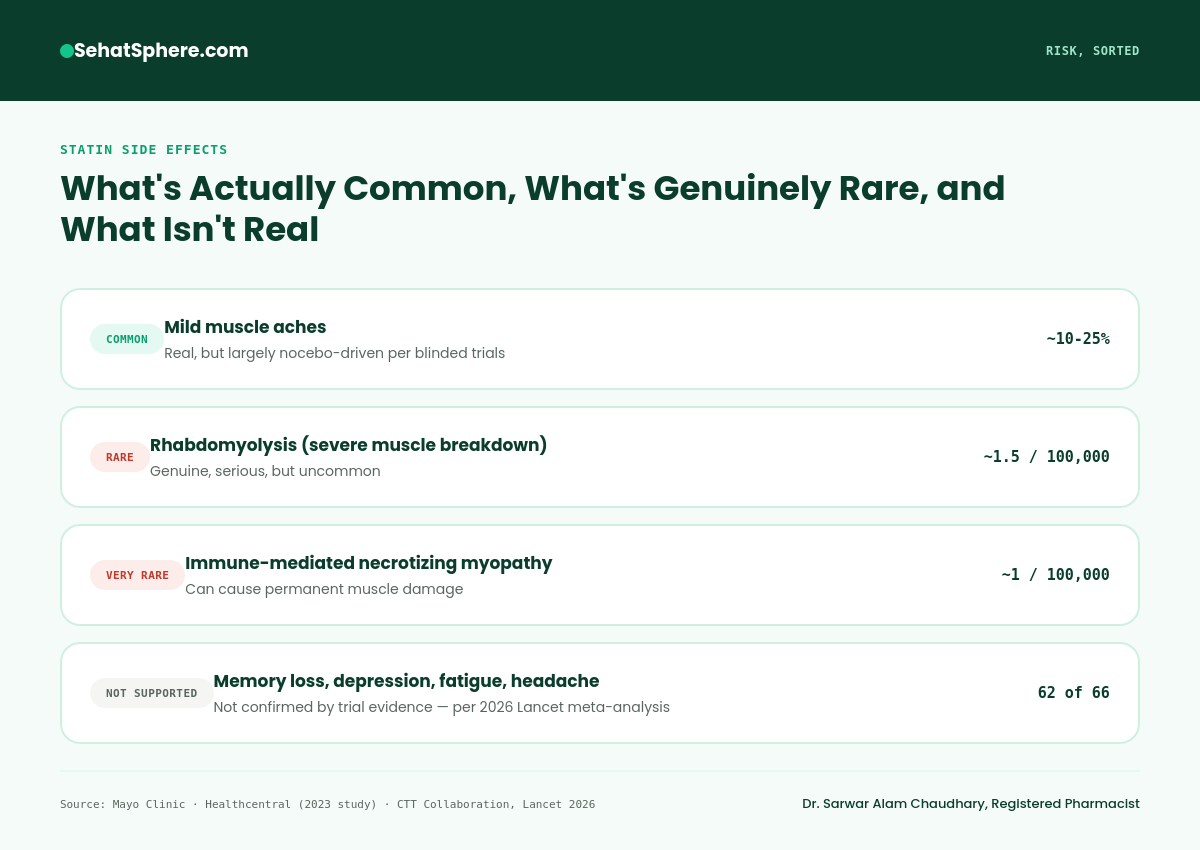
Severe, unexplained muscle pain with weakness, alongside dark or “cola-colored” urine — this can signal rhabdomyolysis (muscle breakdown), occurring in roughly 1.5 per 100,000 statin users. Rarer still, at about 1 in 100,000, is immune-mediated necrotizing myopathy — a condition where the immune system attacks muscle tissue and can cause lasting damage even after stopping the drug.
Not Every Statin Dose Is Doing the Same Job
Cardiology guidelines classify statin therapy by intensity — how much they’re expected to lower LDL cholesterol — rather than by brand name alone, and this matters for both benefit and side-effect risk.
| Intensity | Expected LDL Reduction | Example |
|---|---|---|
| High | ≥50% | Atorvastatin 40–80mg, Rosuvastatin 20–40mg |
| Moderate | 30–49% | Atorvastatin 10–20mg, Rosuvastatin 5–10mg |
| Low | <30% | Lower doses, typically for milder risk profiles |
Higher-intensity regimens generally carry a somewhat higher chance of muscle-related complaints, which is part of why “which statin has the least side effects” doesn’t have a single answer — it depends on the intensity your specific cardiovascular risk actually requires, not just which molecule you’re prescribed. A dose that feels aggressive isn’t a mistake; it’s often exactly calibrated to your risk level.
Atorvastatin vs. Rosuvastatin
One of the most common comparisons patients search for — and the underlying chemistry genuinely differs:
- Atorvastatin (Lipitor): Lipophilic (fat-soluble), which lets it penetrate cell membranes, including muscle cells, relatively easily.
- Rosuvastatin (Crestor): Hydrophilic (water-soluble) and highly potent at lower doses, processed somewhat differently by the liver.
Here’s the honest nuance most comparisons skip: a large pooled meta-analysis found both lipophilic and hydrophilic statins reduce circulating CoQ10 to a similar degree — there was no statistically meaningful difference between the two classes. The lipophilic/hydrophilic distinction is real pharmacology, but it hasn’t translated into a clearly proven difference in muscle-symptom rates in the way many “which statin is safer” articles imply.
Why You Shouldn’t Just Stop
A pooled analysis of 15 statin studies found that patients taking less than 80% of their prescribed statin therapy had a 45% higher rate of all-cause mortality and a 15% higher rate of cardiovascular events compared to patients who stayed consistent. Given how much of the muscle-pain story turns out to be nocebo-driven, stopping abruptly on suspicion — without checking with your doctor or trying a lower dose or different statin first — trades a real, proven cardiovascular benefit for a symptom that, in many people, wouldn’t have resolved anyway.
Safe Management, If You’re Having Symptoms
- Don’t stop on your own — talk to your doctor first, always, even if the symptoms feel manageable to ignore
- Ask about a dose reduction or switching statins — individual response genuinely varies, even without a fully understood reason why; many patients who react poorly to one statin tolerate another without issue
- Consider a supervised trial off the drug — if symptoms don’t improve within a few weeks of stopping, the statin likely wasn’t the cause, which is valuable information either way and worth documenting for future reference
- CoQ10 at 200mg+/day is reasonable to discuss if you have genuine symptoms, with realistic expectations about the mixed evidence rather than treating it as a guaranteed fix
- Get a baseline creatine kinase (CK) level checked if muscle pain is significant, to rule out the rare serious causes above and give your doctor an objective number to track
Quick Self-Check Before You Blame the Statin
If you’re experiencing muscle symptoms, this isn’t a diagnosis — but it’s worth reviewing before assuming the statin is definitely the cause.
Frequently Asked Questions
What are the most common statin side effects?
Muscle pain (myalgia), joint aches, mild digestive upset, and occasional liver enzyme elevation are the most frequently reported. Muscle pain specifically ranges from about 10-25% in observational reports, though blinded trials suggest a large share of this is nocebo-driven rather than caused by the drug itself.
Why do statins cause muscle cramps and pain?
Two proposed mechanisms: reduced CoQ10 affecting mitochondrial energy production, and a newer finding involving calcium leak in muscle cells via the ryanodine receptor. However, blinded trials show much of the real-world muscle pain occurs at similar rates with placebo, suggesting expectation plays a large role too.
Can statins cause muscle pain years after starting?
Yes, it can appear at any point, though it most often shows up within the first 4-6 weeks. Pain that develops suddenly after years of tolerance is worth mentioning to your doctor, since it could relate to a dose change, a new interacting medication, or an unrelated cause entirely.
Do statins cause fatigue and memory loss?
A 2026 meta-analysis of 124,000 people across 19 double-blind trials found no evidence supporting memory loss or fatigue as genuine statin side effects, despite both being listed on product labels historically.
Which statin has the least muscle side effects?
Evidence doesn’t clearly show one class is safer than another for muscle symptoms specifically – both lipophilic (atorvastatin) and hydrophilic (rosuvastatin) statins reduce CoQ10 and are linked to muscle complaints at broadly similar rates. Individual response varies more than the drug class does.
Can I take CoQ10 supplements while on statins?
It’s reasonable to discuss with your doctor, particularly if you already have muscle symptoms. Evidence is mixed – some trials at doses of 200mg or higher show benefit, while others, including a Harvard-reviewed analysis, found no significant effect. It doesn’t interfere with the statin’s cholesterol-lowering effect either way.
What is rhabdomyolysis and how common is it with statins?
A rare, serious breakdown of muscle tissue that can affect the kidneys, occurring in roughly 1.5 per 100,000 statin users. Warning signs include severe muscle pain with weakness and dark urine, which need prompt medical attention.
Is statin muscle pain all in my head?
No – the pain is genuinely felt. What blinded trials show is that a large share of it isn’t caused by the drug’s pharmacology specifically, since it occurs at similar rates with placebo. That’s different from the pain not being real.
Do statins affect blood pressure or cardiovascular stability?
Statins primarily manage cholesterol, not blood pressure directly, though both are part of overall cardiovascular risk. If your blood pressure has also been unstable, that’s usually a separate issue worth investigating on its own.
What’s the difference between statin muscle pain and rhabdomyolysis?
Ordinary statin-associated muscle pain is typically mild aching without weakness or dark urine, and usually doesn’t require stopping the drug immediately. Rhabdomyolysis involves severe pain, genuine muscle weakness, and dark urine from muscle breakdown, and needs urgent medical attention rather than a wait-and-see approach.
Should I get a CK blood test before starting a statin?
Routine baseline CK testing isn’t universally recommended for everyone starting a statin, but it’s reasonable if you have risk factors for myopathy or a family history of statin intolerance, and it becomes useful for comparison if you do develop symptoms later.
The Bottom Line
Statin muscle pain is real, but the full picture is more complicated than either “it’s a dangerous drug” or “it’s all in your head.” Blinded trials consistently show much of the reported pain occurs at similar rates with placebo — a genuine, well-documented nocebo effect. CoQ10 does drop in the blood, but whether that’s the real cause of symptoms, and whether supplementing reliably helps, remains honestly unresolved. What’s not in question: stopping a statin abruptly on suspicion carries real cardiovascular risk, while genuinely serious reactions like rhabdomyolysis remain rare. The right move is rarely “just stop” — it’s a conversation with your doctor about what’s actually happening.
- Gupta A, et al. Adverse events associated with unblinded, but not with blinded, statin therapy (ASCOT-LLA). Lancet, 2017. thelancet.com
- Herrett E, et al. Statin treatment and muscle symptoms: series of randomised, placebo controlled n-of-1 trials (StatinWISE/SAMSON). BMJ / JACC. PMC
- Cholesterol Treatment Trialists’ Collaboration. Assessment of adverse effects attributed to statin therapy in product labels. Lancet, 2026;407:689-703.
View All References (6) ▾
- Penson PE, et al. Introducing the ‘Drucebo’ effect in statin therapy. J Cachexia Sarcopenia Muscle, 2018. PubMed
- Qu H, et al. The effect of statin treatment on circulating coenzyme Q10: an updated meta-analysis of RCTs. PMC
- Mayo Clinic. Rhabdomyolysis from statins: What’s the risk? mayoclinic.org