
 SehatSphere
Medication Safety · Master Guide
Can I Take This With That? The Answers Nobody Puts in One Place
17 of the world’s most-searched “can I take” questions, answered together for the first time
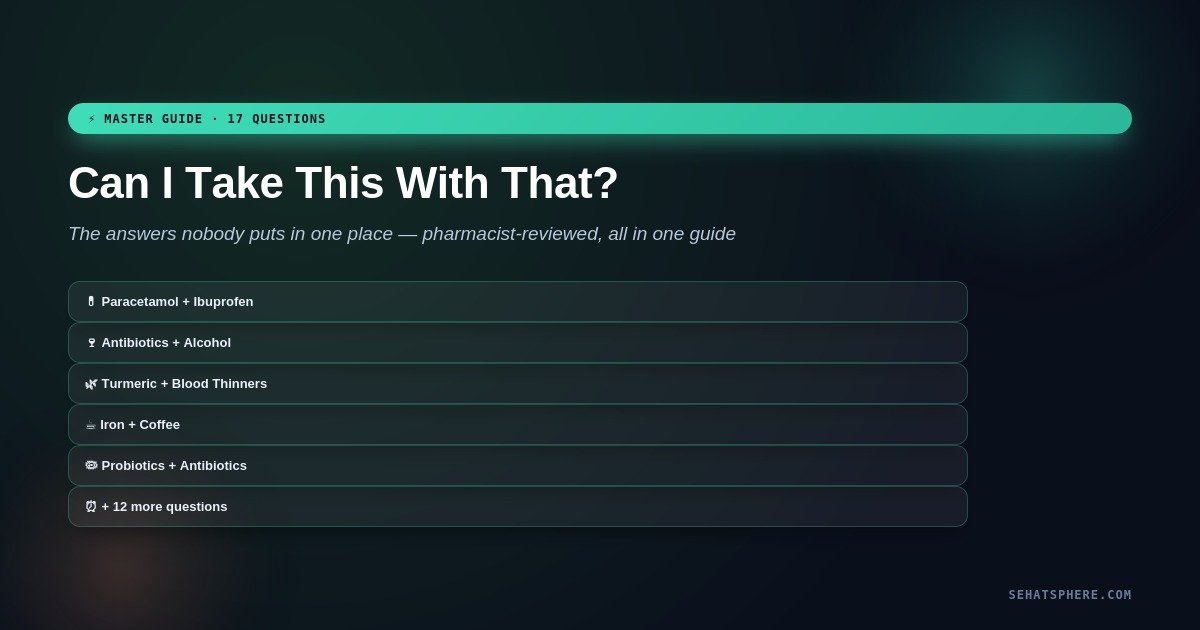
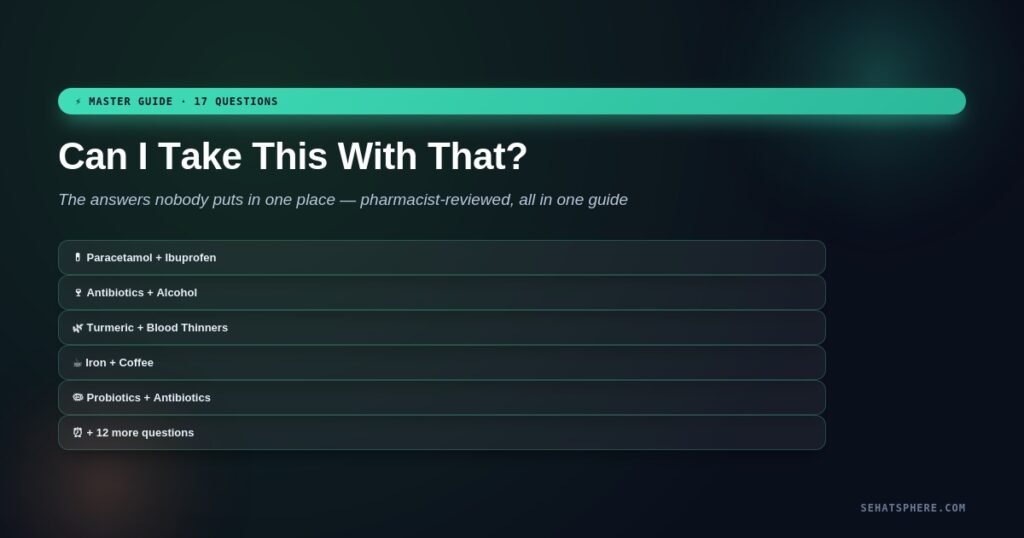
“Can I take this with that?” is one of the most-typed phrases in health search worldwide — millions of separate, near-identical questions typed into Google every single day, each one usually answered by a different blog with a different tone, sourcing style, and level of trust. Almost nobody puts a real, pharmacist-reviewed answer to more than two or three of these questions on the same page. This guide answers 17 of them, together, in one place, with the same standard of citation applied to every single one.
Jump to a category: Pain relief · Alcohol combinations · Supplement combinations · Practical questions · Test yourself
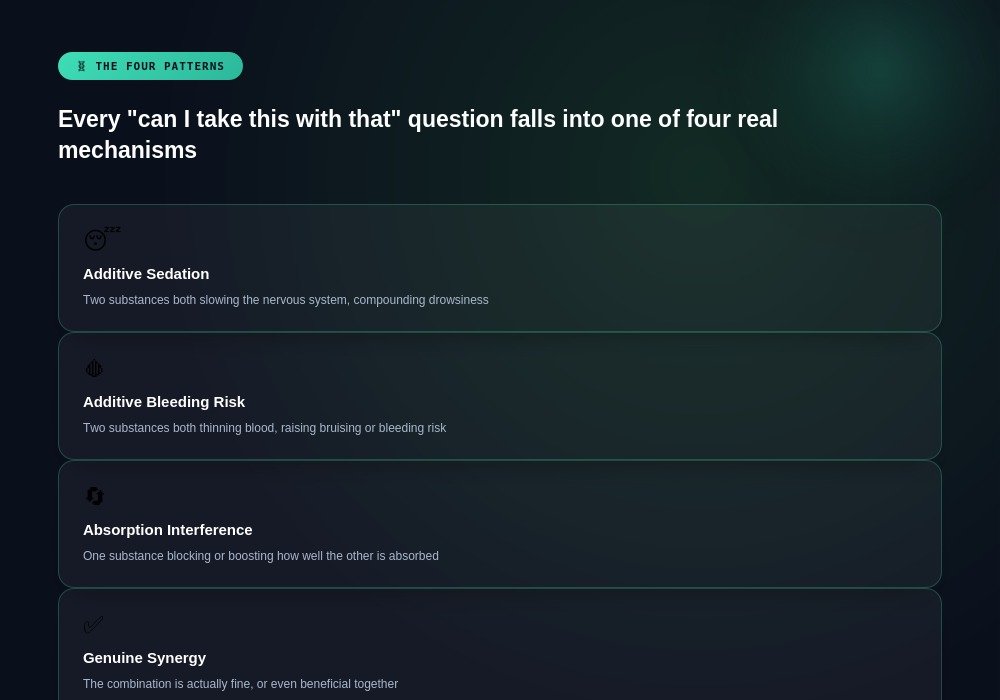
Quick answer: Most “can I take X with Y” questions fall into a small number of real, recurring mechanisms — additive sedation, additive bleeding risk, absorption interference, or genuine pharmacological synergy that’s actually fine. Once you understand which of these four buckets a combination falls into, most individual questions become far easier to reason through — this guide is organized to make that pattern visible rather than answering each question as an isolated fact.
Can I take this with that: pain relief combinations
Can I take paracetamol and ibuprofen together?
Generally yes — they work through different mechanisms and are commonly alternated or combined for pain that either alone doesn’t fully control.[1] The real risk isn’t the combination itself; it’s losing track of total daily dose of each one separately, especially with paracetamol, where the safety margin to liver toxicity is narrower than most people assume.
Can I take ibuprofen with blood thinners?
Use real caution. NSAIDs like ibuprofen have their own mild blood-thinning effect on top of irritating the stomach lining — combined with warfarin, a DOAC, or aspirin, this measurably raises bleeding risk.[2] Paracetamol is generally the safer first-choice pain reliever if you’re on a blood thinner.
Can I take paracetamol every day?
At standard doses, short-term daily use is generally considered low-risk for most healthy adults, but the margin between a normal dose and one that stresses the liver is narrower than people expect — this is one of the most common accidental-overdose medications precisely because it’s viewed as harmless.[1] Long-term daily use specifically warrants a conversation with a doctor.
Can I take this with that: alcohol combinations
Can I drink alcohol on antibiotics?
It depends specifically on which antibiotic — this is a genuinely under-explained nuance. Metronidazole and tinidazole cause a severe, specific “disulfiram-like” reaction with alcohol — flushing, rapid heartbeat, vomiting — and should be avoided entirely during treatment and for at least 48 hours after.[3] Most other common antibiotics don’t share this specific severe reaction, though alcohol can still worsen general side effects and slow recovery.
Can I take melatonin with alcohol?
Not recommended. Both are sedating through different mechanisms, and alcohol actually disrupts the sleep architecture melatonin is meant to support — the combination can produce excessive next-morning grogginess without the sleep-quality benefit either one offers alone.[4]
Can I drink alcohol with antihistamines?
Use caution, especially with older, more sedating antihistamines like diphenhydramine — both depress the central nervous system, and the combined effect on drowsiness and coordination is genuinely additive, not just theoretical.[5] Newer, non-sedating antihistamines carry lower — but not zero — risk.
Can I take this with that: supplement combinations
Can I take vitamin D and calcium together?
Yes — this is one of the few combinations on this list that’s genuinely beneficial rather than just neutral. Vitamin D directly improves calcium absorption in the gut, which is exactly why the two are frequently co-formulated in a single supplement.[6]
Can I take vitamin C with iron supplements?
Yes, and this is another genuinely beneficial pairing — vitamin C converts iron into a form your gut absorbs more efficiently, which is why many iron supplements already include it.[7]
Can I take probiotics with antibiotics?
Yes, but timing matters more than most sources mention clearly. Taking them at the same moment means the antibiotic can kill the probiotic bacteria before they do anything useful — spacing them roughly 2 hours apart lets the probiotic survive the antibiotic’s direct exposure window.[8]
Can I take zinc and copper together long-term?
Only with attention to ratio. High-dose zinc supplementation over weeks to months can genuinely deplete copper levels, which is why many quality multivitamins specifically include a small amount of copper alongside zinc.[9] This matters most for people taking zinc at therapeutic (not just multivitamin) doses.
Can I take turmeric with blood thinners?
Use caution. Curcumin, turmeric’s active compound, has documented mild blood-thinning and antiplatelet properties on its own — combined with warfarin, aspirin, or a DOAC, this can meaningfully compound bleeding risk, especially at supplement-level (not just culinary) doses.[10]
Can I take multivitamins with coffee?
Generally fine, with one specific exception worth knowing: coffee’s tannins and caffeine can measurably reduce iron absorption if taken at the same time.[7] If your multivitamin contains iron, separating it from your morning coffee by 30–60 minutes preserves more of the actual benefit.
Can I take this with that: practical questions almost nobody answers well

Can I take medicine on an empty stomach?
It depends on the specific drug, and this is where generic advice fails people. Some medications (many NSAIDs, certain antibiotics) genuinely need food to reduce stomach irritation or improve absorption; others (some thyroid medication, some antibiotics) specifically need an empty stomach for proper absorption.[11] “Take with food” versus “take on an empty stomach” is never a universal rule — it’s specific to the individual medication’s absorption and irritation profile.
Can I take expired medicine?
For many solid oral medications (tablets, capsules) stored properly, potency often degrades gradually rather than the drug becoming dangerous overnight past the printed date — a well-documented FDA shelf-life extension program found many drugs remained effective years past expiry.[12] The exceptions worth taking seriously: liquid antibiotics, insulin, nitroglycerin, and EpiPens, where degradation can meaningfully affect a time-critical dose.
Can I take two different painkillers at the same time?
Sometimes yes, sometimes genuinely dangerous — and this is exactly why a blanket answer fails. Paracetamol plus ibuprofen (different mechanisms) is generally fine within dose limits. Two different NSAIDs together (like ibuprofen plus naproxen) is not recommended, since you’re stacking the same stomach and kidney risks without added benefit.[1]
Can I take medication that’s not prescribed to me?
No — even if it’s “just” a leftover antibiotic or a family member’s blood pressure pill. Dosing, interaction checks, and the underlying diagnosis are all specific to the person the prescription was written for, and sharing prescription medication is a well-documented contributor to antibiotic resistance and adverse drug events specifically.[13]
Can I stop taking medication once I feel better?
For most prescribed courses — antibiotics especially — no. Stopping early is one of the most common, well-documented reasons treatments fail or resistant bacteria develop, even though the logic of “I feel better, so I’m done” feels intuitive.[13] For long-term chronic-condition medication, stopping should always go through the prescriber, since “feeling fine” is often the medication working, not the medication being unnecessary.
Can I take this with that: three myths worth retiring
Myth: “If it’s over-the-counter, it can’t seriously interact with anything.” Several combinations on this list — ibuprofen with blood thinners, antihistamines with alcohol — involve entirely OTC products and still carry real, documented risk. Myth: “Natural or supplement means automatically safer to combine.” Turmeric and zinc, both supplement-aisle staples, have genuine, mechanism-specific interactions worth knowing. Myth: “If a combination were dangerous, my pharmacy would refuse to sell me both.” Retail pharmacy systems flag prescription-to-prescription interactions reliably, but OTC-to-OTC and OTC-to-supplement combinations are rarely screened the same way — the responsibility genuinely falls on the person combining them.
Can I take this with that: test yourself
1. Which antibiotics cause a severe reaction specifically with alcohol?
2. Why should probiotics and antibiotics be spaced apart?
3. Which medications are the real exceptions to the “expired medicine is often still fine” pattern?
Frequently asked questions
Is it safe to Google “can I take X with Y” for medical questions?
It’s a reasonable starting point for general education, but search snippets have been found to be inaccurate or incomplete compared to official medication guides in published research — always confirm with a pharmacist for anything specific to your situation.
Why do so many “can I take” questions have different answers on different sites?
Many sites answer from a single narrow angle or with unclear sourcing. This guide applies the same citation standard across all 17 questions specifically to reduce that inconsistency.
Can I take supplements and prescription medication on the same schedule?
Often yes, but several combinations in this guide (magnesium and antibiotics, iron and coffee, probiotics and antibiotics) specifically benefit from timing separation.
What’s the safest way to check a combination not covered here?
Ask a pharmacist directly, or use a dedicated interaction-checking tool rather than a general web search.