 SehatSphere.com
Vitamin B12 Deficiency in Vegetarians: The 70% Crisis Hiding Behind Fatigue, Mood, and Even Psychosis
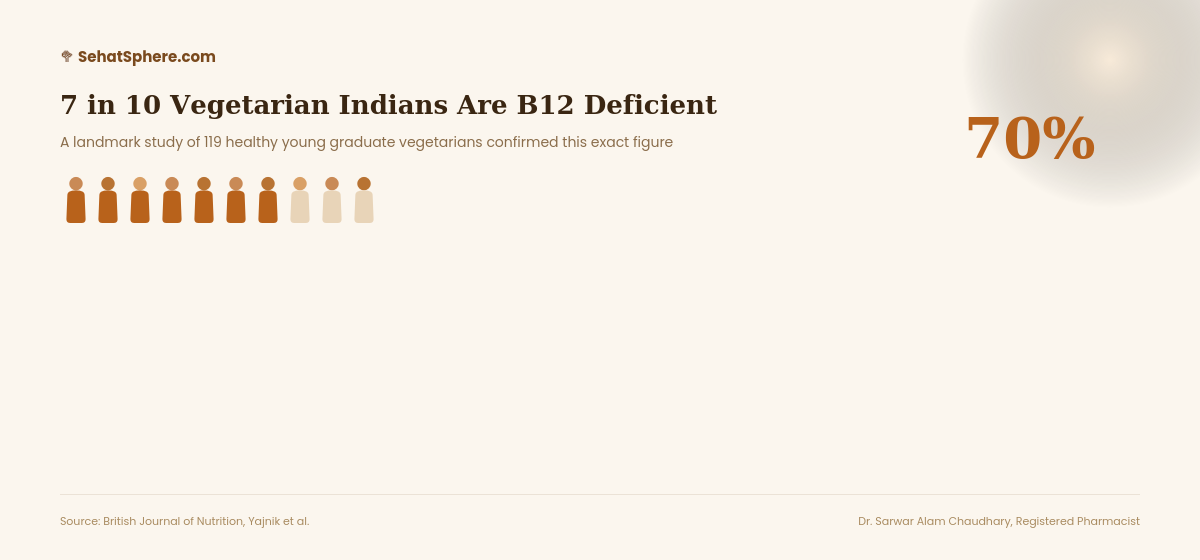
A landmark British Journal of Nutrition study measured this precisely: vitamin B12 deficiency in vegetarians affects 70% of healthy, young, well-fed Indian graduates — not a fringe group with poor access to food, but the exact demographic most people assume is nutritionally fine. In a genuinely striking, under-discussed finding, a separate Indian case series documented B12 deficiency presenting as acute psychosis, with 33.3% of one hospital’s psychiatric ward admissions turning out to have a correctable nutrient gap behind their symptoms, not a primary psychiatric illness at all. If fatigue, mood changes, or unexplained tingling have been part of your own experience, this is genuinely worth reading in full, not skimming for the food list at the bottom.
Key takeaways:
- Vitamin B12 deficiency in vegetarians affects roughly 70% of India’s vegetarian population, per a landmark British Journal of Nutrition study of 119 healthy graduates — and broader estimates put deficiency across India as high as 47-71%.
- Total serum B12 alone is an unreliable test; holotranscobalamin (active B12) and homocysteine give a genuinely more accurate picture of your actual status.
- B12 deficiency has been documented causing acute psychosis, with 33.3% of psychiatric ward admissions in one study explained by this single, correctable nutrient gap.
- No vegetable or fruit provides meaningful B12 — it’s the one essential nutrient genuinely absent from plant foods, making dairy, fortified foods, or supplementation non-negotiable for strict vegetarians.
- How common is this, genuinely
- Why plants can’t provide B12 at all
- The full symptom picture, not just fatigue
- When it looks like a psychiatric crisis
- Why the standard test can mislead you
- Diet isn’t the only cause
- Real food sources, by the microgram
- When supplementation is genuinely necessary
- How long recovery actually takes
- Pregnancy, breastfeeding, and children
- Quick self-check
- FAQs
How Common Is Vitamin B12 Deficiency in Vegetarians, Genuinely?
The numbers here are large enough that they deserve to be stated plainly rather than softened. Vitamin B12 deficiency in vegetarians was measured at 70% in the landmark Yajnik study, and broader research across the Indian population puts overall B12 deficiency prevalence anywhere from 47% to 71%, depending on the population studied and diagnostic threshold used.
A northern India tertiary care study of 220 confirmed B12-deficiency cases found 86.36% were strict vegetarians — and the demographic breakdown is worth knowing too: slightly more than half male, most cases aged 50-65, and nearly 60% from urban areas, undercutting the assumption that this is purely a rural or poverty-driven problem. This same pattern of widespread, underdiagnosed nutrient gaps shows up across our vitamin D deficiency guide and zinc deficiency guide too, suggesting a broader, connected pattern in how Indian diets fall short, not isolated, unrelated gaps.
Why Plants Can’t Provide B12 At All
This is worth understanding at the mechanism level, because it changes how seriously you take the “just eat healthier” advice. Vitamin B12 is produced exclusively by bacteria and archaea — it isn’t synthesized by plants, animals, or fungi themselves. Animals accumulate it in their tissues by consuming these bacteria (directly or through their own diet), which is why meat, fish, eggs, and dairy contain it, while fruits and vegetables genuinely don’t, regardless of how “nutrient-dense” or organic they are. This is the one essential vitamin a purely plant-based diet cannot provide, no matter how carefully planned — not a matter of eating the right vegetables, but a genuine, structural gap in plant-based nutrition.
What To Read Next
- Hair Fall & Vitamin Deficiency: B12 is one of the most overlooked nutrients behind hair thinning.
- Vitamin D Deficiency in India: A separate, equally widespread deficiency worth checking too.
- Is “Boosting” Immunity Even the Right Goal? Why correcting real gaps beats generic “boosting.”
The Full Symptom Picture, Not Just Fatigue
Most people associate B12 deficiency with tiredness alone, which genuinely undersells how far-reaching this deficiency’s effects actually are:
| System | Documented Symptoms |
|---|---|
| Neurological | Paraesthesia (tingling/numbness) — found in 98.18% of confirmed cases |
| Psychiatric | Head heaviness/headache in 95%; mood changes, cognitive difficulty |
| Blood | Anemia in 87.73%; macrocytosis (enlarged red cells) in 88.64% |
| Skin | Cutaneous changes (pallor, hyperpigmentation) in 38.18% |
| Digestive | Sore tongue, appetite loss, diarrhea or constipation |
Diabetes was the most common comorbidity in the same tertiary-care study, present in nearly 21% of cases — a genuinely important overlap, since metformin (a very commonly prescribed diabetes medication) independently reduces B12 absorption, compounding risk in anyone managing both conditions simultaneously.
When It Looks Like a Psychiatric Crisis
This is the single most dramatic, genuinely underappreciated finding in this entire topic, and it deserves real attention rather than a passing mention. A 2024 case series documented acute psychosis — genuine psychotic breaks, not mild mood symptoms — presenting as the primary manifestation of vitamin B12 deficiency in several patients, particularly those following vegetarian diets.
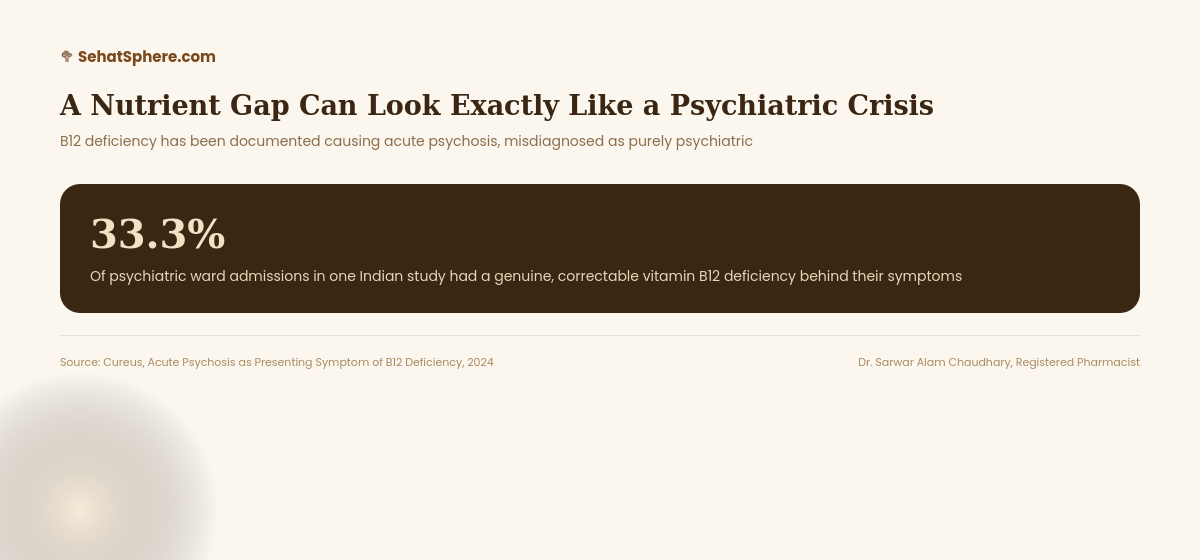
In the same body of research, 33.3% of indoor psychiatric ward admissions at one facility were found to have a genuine vitamin B12 deficiency underlying their presentation — not a coincidental finding, but a documented, correctable cause that had been treated as purely psychiatric until someone checked. A separate case involved a teenage girl on a vegetarian diet for four years (vegan for the last two months) presenting with anxiety, depression, nightmares, disturbed periods, and severe fatigue — all of which resolved once her genuinely low B12 and vitamin D were identified and corrected. This is precisely why current clinical guidance recommends routine B12 screening for anyone presenting with new or unexplained psychiatric symptoms, especially on a vegetarian or vegan diet.
Why the Standard Test Can Mislead You
This is a genuinely important, technical detail most people never hear from a standard checkup. Total serum vitamin B12 — the number on a routine lab report — does not reliably reflect your actual B12 status, particularly in early or borderline deficiency. A more accurate marker is holotranscobalamin (holo-TC), the biologically active fraction of B12 that cells can actually use, alongside homocysteine, a metabolic marker that rises when B12-dependent processes aren’t functioning properly.
In practical terms: someone can have a “normal” total B12 result and still be genuinely, functionally deficient at the cellular level — explaining why so many people with real symptoms get told their labs “look fine.” If you’ve been dismissed this way despite persistent symptoms, asking specifically for holo-TC or homocysteine testing, not just total B12, is a genuinely reasonable next step. The free Blood Report Decoder can help you interpret whichever results you do get.
Diet Isn’t the Only Cause
| Cause | Mechanism |
|---|---|
| Dietary (vegetarian/vegan) | No B12 in plant foods; insufficient dairy/fortified intake |
| Autoimmune (pernicious anemia) | Anti-intrinsic factor or anti-parietal cell antibodies block absorption |
| Malabsorption | Atrophic gastritis, Crohn’s disease, celiac disease |
| Medication-related | Long-term metformin or acid-reducing drugs (PPIs) reduce absorption |
| Rare genetic | Transcobalamin II transporter deficiency |
If pantoprazole or another acid-reducing medication is part of your routine long-term, our pantoprazole side effects guide covers this exact B12-absorption interaction in more depth, and if metformin is part of your diabetes management, our diabetes medicine safety guide is worth reading alongside this one.
Real Food Sources, By the Microgram
For lacto-vegetarians specifically, dairy remains the most reliable natural source — though “reliable” doesn’t automatically mean “sufficient” at typical consumption levels:
| Food (typical serving) | Approx. B12 |
|---|---|
| Cow’s milk, 250ml | ~1.1 mcg (nearly half daily need) |
| Curd/dahi, 1 cup | ~1.4 mcg |
| Swiss cheese, 50g | ~1.5 mcg |
| Fortified nutritional yeast, 1 tbsp | Up to 24 mcg |
| Fortified breakfast cereal | 25–100% of daily value |
A genuinely useful, lesser-known fact: B12 in milk is better absorbed by the body than B12 from standard oral supplements — making dairy a genuinely efficient source for those who consume it regularly. Vitamin B12 is also relatively heat-stable during normal cooking, though prolonged exposure to light and extended cooking times can meaningfully reduce potency, so lightly cooking dairy or adding nutritional yeast after cooking helps preserve content. Worth noting clearly: dry fruits, fermented pickles, and most fermented Indian foods (idli, dosa batter) contain negligible, unreliable amounts — not a dependable source despite occasional claims otherwise.
When Supplementation Is Genuinely Necessary
For strict vegetarians with low dairy intake, and for essentially all vegans, food alone rarely closes this gap reliably — supplementation isn’t an overcautious add-on, it’s the realistic, medically-recommended default. Oral tablets, sublingual forms, and injectable B12 are all genuine options, with the right choice depending on whether malabsorption is part of the picture — someone with pernicious anemia or significant gut absorption issues may need injections specifically, since oral forms depend on the same absorption pathway that’s already impaired.
Our protein deficiency in India guide and zinc deficiency guide are both worth reading alongside this one, since these nutrient gaps frequently coexist in the same vegetarian diets, sharing overlapping fatigue and immune-related symptoms. The free Nutrient Deficiency Symptom Finder and Integrative Interaction Checker are both genuinely useful before starting any new supplement, particularly if you’re already on regular medication.
A genuinely interesting historical note: before B12 was even identified as a distinct nutrient, severe deficiency was known as pernicious anemia — a condition that was reliably fatal within a few years of diagnosis. The 1934 Nobel Prize in Physiology or Medicine was awarded specifically for discovering that liver extract (rich in B12, though the vitamin itself wasn’t isolated until 1948) could treat it — transforming a death sentence into a manageable, correctable condition almost overnight. It’s worth remembering that a nutrient serious enough to have earned a Nobel Prize for its discovery is still, nearly a century later, something a majority of Indian vegetarians are quietly running low on.
How Long Recovery Actually Takes
| Marker | Typical Timeline |
|---|---|
| Blood B12 levels normalize | 2–3 months |
| Fatigue and anemia improve | Weeks to a few months |
| Neurological symptoms (tingling, etc.) | 6–12 months, sometimes longer |
| Severe/prolonged deficiency | Some neurological damage may be irreversible |
This timeline gap — blood levels normalizing in months while nerve-related symptoms take up to a year — is exactly why early detection matters so much more than most people assume. Waiting until symptoms are severe before testing genuinely risks slower, less complete recovery, not just a longer wait for normal labs.
Pregnancy, Breastfeeding, and Children: A Genuinely Higher-Stakes Picture
B12 deficiency during pregnancy carries stakes beyond the mother’s own symptoms — maternal B12 status directly affects fetal neural development, and severe maternal deficiency has been linked to neural tube defects, making this a genuine screening priority rather than a routine afterthought for vegetarian and vegan mothers specifically. Breastfed infants of B12-deficient mothers are themselves at real risk, since breast milk B12 content directly reflects maternal status. Our PCOS symptoms guide is worth reading too if you’re planning a pregnancy, since both conditions benefit from the same proactive, pre-conception nutrient screening approach rather than addressing gaps after symptoms appear. If heart health is also part of your family’s broader picture, our heart attack in young adults guide is worth knowing too, since elevated homocysteine — the same marker used to detect functional B12 deficiency — is independently linked to cardiovascular risk.
Quick Self-Check
Tick anything that applies to you, and see what it suggests.
Frequently Asked Questions
How common is vitamin B12 deficiency in vegetarians?
A landmark study found 70% of healthy young vegetarian Indian graduates were deficient, with broader Indian population estimates ranging from 47% to 71%.
Can vitamin B12 deficiency cause psychiatric symptoms?
Yes, documented cases show it can present as acute psychosis, anxiety, and depression, with 33.3% of one hospital’s psychiatric ward admissions explained by correctable B12 deficiency.
Why can’t vegetarians get B12 from plant foods?
Vitamin B12 is produced exclusively by bacteria, not plants, animals, or fungi themselves. It’s the one essential nutrient genuinely absent from all plant-based foods.
Is a normal B12 blood test enough to rule out deficiency?
Not always. Total serum B12 can appear normal while someone is functionally deficient; holotranscobalamin and homocysteine testing give a more accurate picture.
What vegetarian foods are highest in vitamin B12?
Fortified nutritional yeast (up to 24mcg per serving), fortified cereals, curd, Swiss cheese, and milk are the most reliable vegetarian sources.
How long does it take to recover from B12 deficiency?
Blood levels typically normalize in 2-3 months, but neurological symptoms like tingling can take 6-12 months or longer to fully resolve.
Does metformin cause B12 deficiency?
Long-term metformin use is independently associated with reduced B12 absorption, compounding risk in vegetarians managing diabetes.
Can B12 deficiency cause hair loss?
Yes, it’s a well-documented contributor to hair thinning, alongside iron, vitamin D, and zinc deficiency.
The Bottom Line
Vitamin B12 deficiency in vegetarians isn’t a niche concern affecting a small, poorly-fed minority — it’s a documented, majority-level reality across India’s vegetarian population, hiding behind symptoms as varied as tingling hands, unexplained anxiety, and in genuinely severe cases, acute psychosis mistaken for primary psychiatric illness. The fix isn’t complicated: know that plant foods alone cannot provide this nutrient, ask for the right test (not just total B12), and treat dairy, fortified foods, or supplementation as a genuine requirement, not an optional extra, if you follow a vegetarian or vegan diet. If cost has ever affected your consistency with testing or supplementation, our generic medicine pricing guide is worth reading, since this is one gap genuinely worth prioritizing within any health budget.
- Yajnik CS, et al. Identification of Vitamin B12 Deficiency in Vegetarian Indians. British Journal of Nutrition.
- Sahoo M, et al. Acute Psychosis as Presenting Symptoms of Vitamin B12 Deficiency: A Case Series. Cureus, 2024.
- PMC. Vitamin B12 Deficiency in Northern India Tertiary Care: Prevalence, Risk Factors and Clinical Characteristics.
View All References (7) ▾
- KEM Hospital Pune. Identification of Vitamin B12 Deficiency in Indian Vegetarians.
- PMC. Clinical and Hematological Characteristics of Vitamin B12 Deficiency.
- PMC. Vegan Diet as a Possible Cause of Mental and Physical Disorders Due to B12 Deficiency in an Adolescent.
- PubMed. Identification of Vitamin B12 Deficiency in Vegetarian Indians.