 SehatSphere.com
The Complete Guide to Medicine Safety: The 5 Moments, Hidden Mistakes, and the Cellular Risks Behind Every Pill You Take
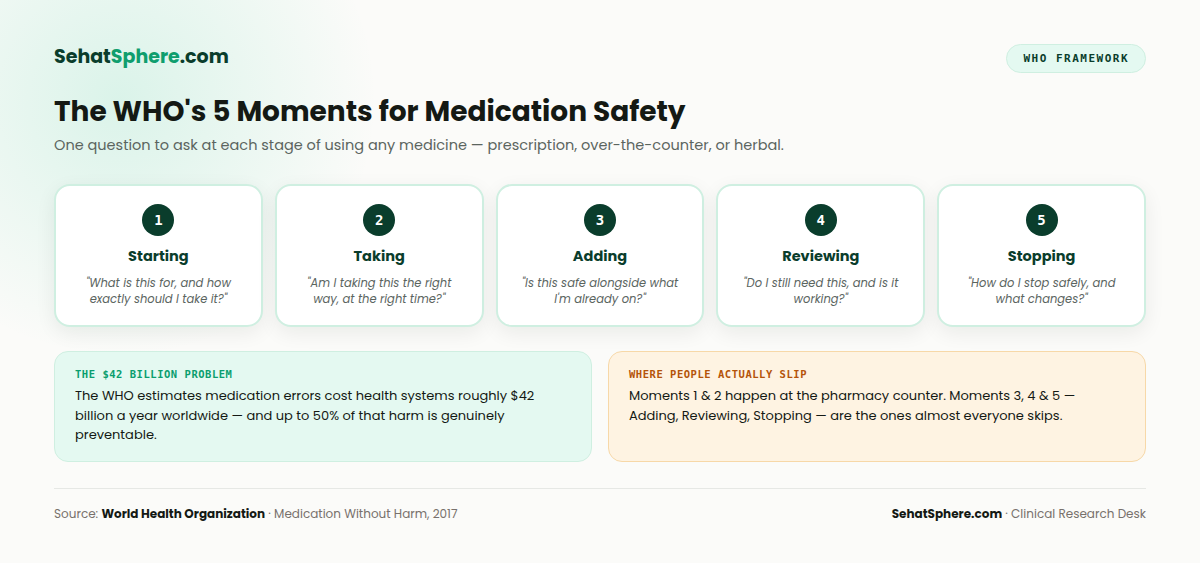
Most medicine-related harm has nothing to do with a bad drug. The World Health Organization estimates that avoidable medication errors cost health systems around US $42 billion every year worldwide, and that as much as half of all harm caused by medicines is genuinely preventable — not through better manufacturing, but through the ordinary, everyday handling of pills, strips, and bottles that almost nobody is ever taught properly. In nineteen years of dispensing, the mistakes I see aren’t exotic — they’re a cut strip with no batch number left on it, an antibiotic kept in a steamy bathroom cabinet, a “just one more” dose of paracetamol stacked on top of a cold-and-flu tablet that already contained it. This guide walks through exactly why each of those mistakes matters at a cellular level, using the World Health Organization’s own official framework as the backbone, so you finish this not just with a checklist but with the actual “why” behind it.
Key takeaways:
- The WHO estimates medication errors cost roughly $42 billion a year globally, and up to 50% of all medicine-related harm is preventable — the WHO’s flagship “Medication Without Harm” initiative exists specifically to cut this in half.
- The WHO’s “5 Moments for Medication Safety” — Starting, Taking, Adding, Reviewing, Stopping — gives you one question to ask at each stage of using any medicine, prescription or over-the-counter.
- Acetaminophen (paracetamol) overdose causes an estimated 46% of all acute liver failure cases in the US, through a specific toxic metabolite called NAPQI — and a genuinely toxic dose starts at just 7.5–10 grams in an adult.
- Expired tetracycline isn’t just “less effective” — its breakdown products have caused documented, published cases of acquired Fanconi syndrome, a real kidney tubule injury, as far back as 1963.
- Roughly 34% of adults aged 60–79 take five or more medications regularly, and that level of polypharmacy is linked to up to 4x the hospitalization risk and adverse-event rates of 35–40%.
- Everyday decongestants and NSAIDs can raise blood pressure and blunt your prescription BP medication’s effect — a genuinely common, rarely-explained interaction hiding in plain sight on pharmacy shelves.
- Pediatric liquid-medicine dosing errors are common specifically because a kitchen spoon is not a measuring device — always use the marked syringe or cup that ships with the bottle.
- Why medicine safety fails at home
- The WHO’s 5 Moments framework
- Reading your prescription and strip correctly
- Interactions that quietly cancel each other out
- Storage mistakes that destroy your medicine
- Expiry dates: what actually happens after
- Acetaminophen overdose: the silent liver killer
- OTC medicines that secretly raise blood pressure
- Pregnancy, elderly polypharmacy & pediatric dosing
- Medication reconciliation & generic vs. branded
- Safe disposal, your home kit & child-resistant caps
- When to call poison control or get help
- FAQs
Why Medicine Safety Fails at Home (the WHO Numbers)
When people picture a “medication error,” they usually imagine a hospital mix-up — the wrong vial, the wrong patient. In reality, the World Health Organization’s 2017 Global Patient Safety Challenge, Medication Without Harm, was launched precisely because the far larger share of harm happens quietly, at home, from medicines used exactly as bought — just handled, stored, timed, or combined incorrectly. The WHO’s own figures put the annual global cost of medication errors at approximately $42 billion, a number that excludes the human cost of the harm itself, and its stated ambition is to reduce severe, avoidable medication-related harm by 50% within a decade of the initiative’s launch — a target set specifically because the WHO’s own analysis found that level of harm was preventable in the first place.
That “preventable” framing matters more than the dollar figure. It means the single biggest lever most people have over their own medicine safety isn’t a better drug or a stricter doctor — it’s understanding the handful of places where ordinary daily handling quietly goes wrong: a strip cut for convenience that loses its expiry date, a bottle left in a hot car, a second cold-and-flu tablet stacked on top of a painkiller that already contained the same ingredient. Every section in this guide maps to one of those genuinely common, well-documented failure points, explained down to the mechanism so the “why” actually sticks.
In practice, most of what I see going wrong at the pharmacy counter isn’t a “bad medicine” — it’s a good medicine used the wrong way. That distinction matters because it means medicine safety is mostly a set of learnable habits, not a matter of luck or which brand you were prescribed.
The WHO’s 5 Moments for Medication Safety
To make “be careful with your medicines” concrete, the WHO built a simple framework worth memorizing: five specific points in a medicine’s life where a patient (or caregiver) should stop and ask one deliberate question. It’s designed to work for any medicine — prescription, over-the-counter, or herbal — and it’s the organizing skeleton for the rest of this guide.
| Moment | The Question to Ask |
|---|---|
| 1. Starting a medicine | What is this for, and how exactly should I take it? |
| 2. Taking a medicine | Am I taking this the right way, at the right time? |
| 3. Adding a medicine | Is this new medicine safe to take alongside what I’m already on? |
| 4. Reviewing a medicine | Do I still need this, and is it still working? |
| 5. Stopping a medicine | How do I stop safely, and is anything going to change? |
Notice that only the first two moments happen at the pharmacy counter. Moments 3, 4, and 5 are exactly the ones people skip — nobody re-checks an old prescription against a new one, reviews whether a six-month-old medicine is still necessary, or asks a pharmacist whether a drug can simply be stopped outright versus tapered. Each of the sections below effectively expands on one or more of these five moments with the specific mechanism, statistic, or real-world mistake behind it.
Photograph your full medicine list — including OTC and herbal products — on your phone and update it every time something changes. This single habit covers Moment 3 (“Adding”) and Moment 4 (“Reviewing”) more reliably than trying to remember everything out loud at an appointment.
Reading Your Prescription and Strip Correctly
A prescription label and a medicine strip each carry more safety information than most people ever read past the drug name. On a strip: the printed generic name, strength (watch the units — mg and mcg are not interchangeable, and a misread decimal point between the two is a genuine, documented category of dosing error), batch number, and expiry date all sit on the same foil, not just on the outer carton. On a prescription: abbreviations like OD (once daily), BD (twice daily), TDS (three times daily), and SOS (as needed, from the Latin si opus sit) look interchangeable at a glance but mean genuinely different dosing schedules.
Why cutting a strip is riskier than it looks
Cutting a blister strip into a smaller “travel” piece, or decanting pills into an old, unlabelled bottle for convenience, feels harmless — but it strips away the batch number and expiry date printed only on the intact foil. If that specific batch is later recalled for a manufacturing defect, or if you have an unexpected reaction, there is no longer any way to trace which lot you actually took. This is a purely avoidable, purely traceability problem, and it’s one of the most common things I see in patients’ bags at the counter.
Two medicines from different manufacturers, treating entirely different conditions, can be an identical size, shape, and color. If you’ve ever moved loose tablets between containers, there is no reliable way to tell them apart by sight alone. Keep tablets in their original, labelled packaging until the moment you take them — not “just for today.”
If dosing schedules or timing abbreviations are a recurring point of confusion for a blood pressure prescription specifically, our guide on the BP medicine timing myth covers exactly how much a shifted dosing window can change what your monitor shows.
Interactions That Quietly Cancel Each Other Out
An “interaction” isn’t always dramatic. Mechanistically, most fall into one of three categories, and understanding which one you’re dealing with changes how seriously to take it.
| Interaction Type | Mechanism | Example |
|---|---|---|
| Metabolic (CYP450) competition | Two drugs compete for the same liver enzyme, so one builds up to unexpectedly high levels | Certain antifungals raising statin levels |
| Additive (pharmacodynamic) | Two drugs push the same system in the same direction, and their effects stack | Two sedatives, or an NSAID plus a blood thinner |
| Antagonistic | One drug actively blunts another’s intended effect | An NSAID reducing a blood pressure medicine’s effectiveness (see below) |
Even substances marketed as “natural” aren’t automatically exempt from these three mechanisms. A documented mild additive blood-pressure-lowering effect from taurine is worth knowing if you’re already on antihypertensive medication — see our guide on taurine and your medications — and it’s exactly the kind of interaction that’s easy to miss because nobody thinks to mention a supplement at a doctor’s visit.
Cross-checking every prescription, OTC product, and supplement you take against each other covers Moment 3 (“Adding”) from the WHO framework above better than memory ever will.
Try the Integrative Interaction Checker →Ayurvedic and herbal remedies deserve the exact same scrutiny as prescription drugs — our Ayurvedic Herb Interaction Checker covers common combinations worth double-checking before assuming “natural” automatically means harmless alongside a prescription.
Storage Mistakes That Quietly Destroy Your Medicine
Most oral medicines are formulated and tested to remain stable within a specific temperature band — typically labelled “store below 25°C” or “store below 30°C,” with pharmacopeial standards generally permitting brief excursions in a 15–30°C (59–86°F) range. Outside that band, chemical degradation genuinely accelerates, not just theoretically.
The bathroom cabinet is the single worst place to store medicine
It’s also the most common. Every hot shower pushes the bathroom cabinet through repeated cycles of heat and humidity — exactly the two conditions that accelerate hydrolysis, the chemical breakdown reaction water triggers in many drug molecules. Aspirin is the classic teaching example: as it hydrolyzes, it breaks down into acetic acid (vinegar) and salicylic acid, which is why an old, humidity-exposed aspirin bottle develops a faint vinegar smell — a genuine, visible sign of active degradation, not just a curiosity.
Insulin (never freeze, and never leave in a hot car — even a short time), reconstituted liquid antibiotic suspensions (most require refrigeration and expire in as little as 7–14 days once mixed), nitroglycerin (sensitive to heat, light, and moisture simultaneously), and many thyroid hormone preparations all degrade meaningfully faster than a typical tablet when stored incorrectly.
A parked car in direct sun is an extreme, easily underestimated version of the same problem — cabin temperatures can climb dramatically above the outside air temperature within minutes, turning a glovebox or door pocket into one of the worst possible places to leave any medicine, even briefly. The safer default for almost everything: a cool, dry drawer or cupboard away from direct sunlight, kitchen steam, and bathroom humidity — not the medicine cabinet the name suggests.
Expiry Dates: What Actually Happens After
Here’s a genuinely underexplained “diagnostic secret”: an expiry date is a manufacturer’s guarantee of full potency under proper storage conditions up to that date — not a cliff-edge toxicity date for every drug. The FDA and US Department of Defense jointly ran the Shelf Life Extension Program (SLEP) for decades, testing large military stockpiles of medicines well past their labelled expiry, and found that roughly 90% of more than 100 different tested drug products remained stable and effective for years — in some cases over a decade — beyond their original expiry date, when stored properly. For most solid tablets, “expired” more often means “may have lost some potency,” not “has become actively dangerous.”
The exception that matters: tetracycline
Tetracycline is the specific, well-documented exception every pharmacy student learns, and it’s worth understanding at the mechanism level because it’s the clearest possible illustration of why “expired but probably fine” is not a universal rule. As tetracycline degrades — especially under heat and humidity, the exact conditions covered above — it breaks down into toxic degradation products, including compounds identified in the pharmacological literature as anhydrotetracycline and related epi-anhydro derivatives. These breakdown products are directly nephrotoxic: they damage the transport machinery of the kidney’s proximal tubule, producing an acquired form of Fanconi syndrome — a state where the kidney’s ability to reabsorb glucose, amino acids, and phosphate from the urine fails, causing them to spill out that shouldn’t.
Liquid antibiotics, insulin, eye drops (where preservative breakdown over time raises real infection risk with continued use), and nitroglycerin tablets are the other categories where the expiry date deserves to be treated strictly, not casually. If kidney function is a live concern for you for any reason — tetracycline-related or otherwise — periodically checking your numbers through our eGFR kidney function calculator is worth doing alongside the habits in this guide.
Acetaminophen Overdose: The Silent Liver Killer, Explained at the Cellular Level
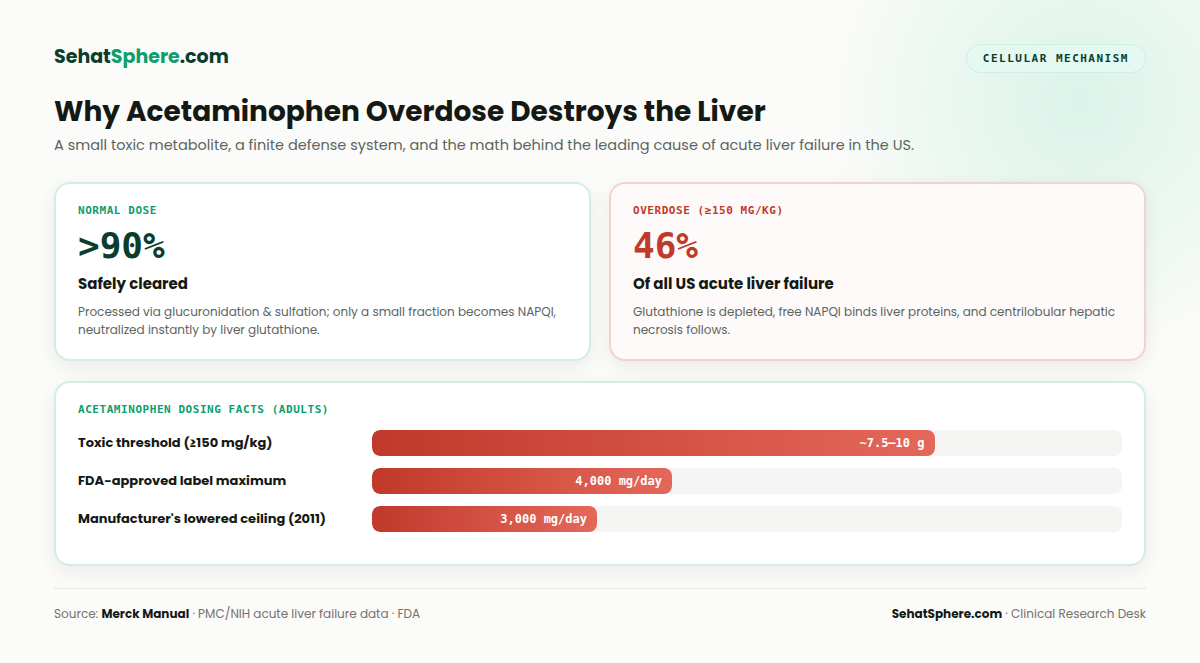
Acetaminophen (paracetamol) is one of the most widely used drugs on earth, sold over the counter almost everywhere, and precisely because it feels so routine, its actual toxicity mechanism is worth understanding in full — it is directly responsible for an estimated 46% of all acute liver failure cases in the United States, making it the single leading cause, ahead of viral hepatitis and every other drug combined.
The mechanism: how a normal painkiller becomes a liver toxin
At a normal, correctly-dosed level, well over 90% of the acetaminophen you take is safely processed by the liver through two routine pathways — glucuronidation and sulfation — and excreted harmlessly. A small remaining fraction is instead routed through a liver enzyme system called CYP450 (specifically CYP2E1), which converts it into a genuinely toxic, reactive metabolite called NAPQI (N-acetyl-p-benzoquinone imine). Under normal conditions, this small amount of NAPQI is immediately neutralized by the liver’s own antioxidant reserve, a molecule called glutathione, and cleared safely.
The entire danger of an overdose comes down to one thing: glutathione is a finite, exhaustible resource. Take enough acetaminophen at once, and the CYP2E1 pathway produces far more NAPQI than usual, at a rate that outpaces the liver’s glutathione supply. Once glutathione stores are depleted, free, unneutralized NAPQI accumulates and begins binding directly to proteins inside liver cells — particularly mitochondrial proteins — triggering a specific pattern of cell death called centrilobular (zone 3) hepatic necrosis. This is the exact mechanism behind acetaminophen-induced liver failure, and it’s also exactly why the antidote, N-acetylcysteine (NAC), works: it’s a glutathione precursor, and giving it early replenishes the liver’s depleted defenses before NAPQI can finish the damage.
| Acetaminophen Safety Fact | What the Data Shows |
|---|---|
| Share of US acute liver failure cases caused by APAP overdose | ~46% |
| Toxic single-overdose threshold in an adult | ≥150 mg/kg (~7.5–10 g) |
| FDA-approved adult maximum, per label | 4,000 mg/day |
| Manufacturer’s own voluntarily-lowered Extra Strength ceiling (since 2011) | 3,000 mg/day |
Very few overdoses happen from someone deliberately swallowing a whole bottle. Far more common is an unintentional “staggered” overdose: taking a standard paracetamol tablet for a headache, then separately taking a cold-and-flu combination product later the same day without noticing it also contains acetaminophen — the two doses stack, often without the person realizing it. Always check the active-ingredient line on every OTC product’s label, not just the brand name on the box.
McNeil Consumer Healthcare, the maker of Tylenol, voluntarily lowered its own Extra Strength product’s labelled maximum from 4,000 mg to 3,000 mg per day in 2011 specifically to build in a wider safety margin against exactly this kind of staggered, unintentional overdose — worth knowing even though the FDA’s own approved general maximum for the ingredient remains 4,000 mg/day.
The OTC Medicines That Secretly Raise Blood Pressure
Two entire categories of everyday, non-prescription medicines can independently raise blood pressure or actively work against a prescription BP medication — and almost nobody reads the fine print closely enough to catch it.
Decongestants: direct vasoconstriction
Pseudoephedrine and phenylephrine, found in most “cold and flu” or “sinus” combination products, work by directly constricting blood vessels to shrink swollen nasal tissue — the exact same alpha-adrenergic mechanism that, applied to blood vessels throughout the rest of the body, raises blood pressure. Mayo Clinic guidance specifically advises people with hypertension to avoid or strictly limit decongestants, or to choose an alternative formulation, for exactly this reason.
NSAIDs: sodium retention and blunted medication effect
Ibuprofen, naproxen, and diclofenac work by inhibiting prostaglandin synthesis — but some of those same prostaglandins (notably PGE2 and PGI2) normally help the kidneys excrete sodium and maintain blood flow. Blocking them causes measurable sodium and fluid retention and can directly blunt the effect of several major classes of blood pressure medication, including ACE inhibitors, ARBs, and diuretics. This is a genuinely underexplained interaction: a patient’s BP medication can be dosed correctly and still underperform simply because of a daily over-the-counter painkiller taken for an unrelated joint ache.
If you take a prescription blood pressure medicine, check every OTC cold, flu, or pain product’s label for pseudoephedrine, phenylephrine, ibuprofen, naproxen, or diclofenac before buying — acetaminophen alone, without an added decongestant, is generally the safer OTC pain and fever choice for this specific interaction.
If a reading still looks unexpectedly high after ruling this out, our guide on why your BP machine reads wrong covers seven purely technique-based reasons worth checking before assuming your medication has stopped working.
Special Populations: Pregnancy, Elderly Polypharmacy & Pediatric Dosing
Pregnancy: nothing is automatically “safe” by default
Every medicine, supplement, and herbal product taken during pregnancy deserves a direct conversation with a doctor, without exception — including products bought without a prescription. NSAIDs are a specific, well-documented example: taken in the third trimester, they carry a real risk of causing premature closure of the fetal ductus arteriosus, a blood vessel that’s supposed to stay open until birth. “Natural” and “over the counter” are not the same thing as “pregnancy-safe.”
Elderly polypharmacy: when the medicine list becomes the risk
Polypharmacy — commonly defined as taking five or more medications regularly — becomes its own, independent safety problem past a certain point, separate from whether any single medicine is being used correctly. A journal analysis of US adults found that roughly 34% of people aged 60 to 79 already meet that five-or-more threshold, and that polypharmacy is associated with up to a 4x higher risk of hospitalization, with adverse drug event rates reported between 35% and 40% in this group — driven largely by cumulative interaction risk and age-related changes in how the liver and kidneys clear drugs.
Polypharmacy risk climbs fastest when multiple prescribers each add a medicine without seeing the full picture. Bringing one complete, current medication list (see Moment 4, “Reviewing,” above) to every single appointment — including specialists — is the single most effective countermeasure available to a patient directly.
Pediatric liquid dosing: the kitchen-spoon problem
A “teaspoon” in your kitchen drawer is not a calibrated measuring device — real household spoons have been shown in published research to vary substantially in actual volume, commonly ranging anywhere from roughly 2.5 mL to over 9 mL despite all being called a “teaspoon.” Studies on pediatric liquid-medicine dosing errors consistently find that caregivers using a kitchen spoon make measurement errors far more often than those using the marked oral syringe or dosing cup that ships in the box — always use that specific device, never a kitchen utensil, and always dose by mL, not by “spoonfuls,” since that’s the unit the syringe is actually marked in.
What To Read Next
- BP Machine Reading Wrong? Seven technique errors — including two you’ve probably never heard of — behind a false-high home reading.
- Generic Medicines and the Price Truth: Why this pharmacist’s own family only takes generics, and the bioequivalence science behind it.
- Chronic Antacid Use and Mineral Malabsorption: Why long-term PPI use quietly drains magnesium, iron, and B12 — and causes fatigue nobody connects back to the pill.
- Statin Muscle Pain: The SAMSON Trial: What a landmark trial found about how much statin muscle pain is the drug versus expectation.
Medication Reconciliation & Generic vs. Branded Confusion
What “medication reconciliation” actually means
Medication reconciliation is the formal process — used by hospitals worldwide, including under the WHO’s own High 5s patient-safety initiative — of comparing what a patient is actually taking against what’s officially prescribed, at every transition of care: hospital admission, discharge, and any handoff between prescribers. It exists because medicine lists quietly go stale in a completely predictable way: a specialist adds a drug the primary doctor never hears about, an OTC product or supplement never gets mentioned because the patient doesn’t think of it as “medicine,” or a dose was changed verbally at one visit and never formally updated.
Generic vs. branded: the confusion that causes real errors
Bioequivalence testing requires a generic version to fall within 80–125% of the branded drug’s blood concentration curve (AUC and Cmax) — a tightly regulated standard, not a loose approximation — so switching between a properly-approved generic and its branded equivalent is not, on its own, a safety concern. Our opinion piece on generic medicines and the price truth covers exactly why this pharmacist’s own family relies on generics.
The genuine, common error isn’t taking a generic instead of a brand — it’s accidentally taking both, because a patient doesn’t recognize that “atorvastatin” and a branded statin sitting in two separate bottles are the exact same drug. This kind of unrecognized therapeutic duplication is precisely what Moment 4 (“Reviewing”) in the WHO framework above is meant to catch.
If cost is ever a reason a prescription gets skipped or stretched, that’s worth raising directly with your pharmacist — a switch to an equivalent generic is almost always the safer option compared with rationing doses on your own.
Safe Disposal, Your Home Medicine Kit & Child-Resistant Packaging
When to flush, and when never to
For the overwhelming majority of medicines, the correct disposal method is a community drug take-back program, or — if none is available — mixing the medicine with an unappealing substance like used coffee grounds or cat litter, sealing it in a bag, and placing it in household trash. Flushing is the FDA’s specific, narrow exception, reserved only for a defined flush list of high-risk medicines — including buprenorphine, fentanyl patches, and other opioid formulations — where the FDA explicitly states that “the known risk of harm, including toxicity and death, to humans from accidental exposure… far outweighs any potential risk to human health and the environment from flushing.” In plain terms: for these specific drugs, one dose left in a trash can within a child’s or pet’s reach is judged more dangerous than the environmental cost of flushing it.
Keep all medicines in one dedicated box — original containers intact, never decanted — stored in a cool, dry spot away from the bathroom and kitchen. Check it every six months for anything expired, and keep a printed or photographed contents list taped to the lid so anyone helping you in an emergency can see exactly what’s inside without opening every bottle.
Child-resistant packaging: effective, but not “childproof”
Child-resistant caps, mandated in the US under the Poison Prevention Packaging Act, are credited by a 1993 US Consumer Product Safety Commission review with saving an estimated 700 children’s lives and substantially reducing pediatric poisoning deaths from oral prescription medicines in the two decades after the law took effect. The name is deliberately precise, though: “child-resistant” means a cap that meaningfully slows a young child down, not one that’s impossible for a determined child to open — it buys time, it doesn’t guarantee safety, which is exactly why storage location still matters as much as the cap itself.
When to Call Poison Control or Get Emergency Help
Know the number before you need it — searching for it during an actual emergency wastes the minutes that matter most.
| Region | Poison Helpline |
|---|---|
| India (AIIMS National Poisons Information Centre, 24×7) | 1800-11-6117 (toll-free) |
| United States (Poison Help, 24×7) | 1-800-222-1222 |
Call a poison helpline for a suspected accidental ingestion where the person is awake, breathing normally, and not in obvious distress — the trained staff can tell you within minutes whether home observation is enough or whether you need to go in. Go straight to emergency services instead — do not wait on a helpline call first — if the person is unconscious, having a seizure, struggling to breathe, or was exposed to a highly dangerous substance such as one from the FDA’s flush list above. Bring the medicine’s container or strip with you to the hospital either way; it tells the treating doctor in seconds what would otherwise take much longer to work out.
Quick Self-Check
Before you close this guide, tick anything you haven’t already done:
Frequently Asked Questions
Is it safe to take expired medicine?
For most solid tablets stored properly, an expired medicine has usually just lost some potency rather than becoming dangerous — FDA/DoD shelf-life testing found roughly 90% of tested drugs remained stable years past their labelled expiry. Tetracycline, insulin, liquid antibiotics, and eye drops are documented exceptions where expiry should be treated strictly.
What happens if I accidentally take a double dose of my medicine?
It depends entirely on the specific drug and dose involved, so don’t guess — call your region’s poison control helpline or your pharmacist immediately with the exact medicine name and strength, and they can tell you within minutes whether it’s a genuine concern.
Can I cut a medicine strip in half without losing important information?
You lose the batch number and expiry date printed on the discarded portion, which matters if there’s ever a recall or a reaction. Keep at least one intact section of every strip, and avoid decanting loose tablets into unlabelled containers.
How do I know if two of my medicines interact?
Use a dedicated interaction checker rather than guessing or relying on memory — our free Integrative Interaction Checker cross-references prescription, OTC, and supplement combinations in one place.
What is the WHO’s medication safety framework?
The WHO’s “5 Moments for Medication Safety” gives one question to ask at each of five stages: Starting, Taking, Adding, Reviewing, and Stopping a medicine — designed to work for prescription, OTC, and herbal products alike.
Is generic medicine as safe and effective as the branded version?
Yes, when properly approved — bioequivalence testing requires a generic to fall within 80-125% of the branded drug’s blood concentration profile. The real risk isn’t the generic itself, but accidentally taking both the branded and generic version of the same drug without realizing they’re identical.
How much acetaminophen (Tylenol/paracetamol) is too much in a day?
A toxic single overdose starts at roughly 150 mg/kg, or about 7.5-10 grams in an adult. The FDA’s approved general maximum is 4,000 mg/day, though the maker of Tylenol voluntarily lowered its own Extra Strength label to a 3,000 mg/day maximum in 2011 for a wider safety margin.
Can I flush old medicines down the toilet?
Only medicines on the FDA’s specific flush list, mainly certain opioids and a few other high-risk drugs, where accidental child or pet exposure is judged more dangerous than the environmental impact. Everything else should go through a take-back program or be mixed with coffee grounds and sealed before disposal in household trash.
What is medication reconciliation, and why does my hospital keep asking for my full medicine list?
It’s the formal process of comparing what you’re prescribed against what you’re actually taking, done at every transition of care specifically because medicine lists drift out of date as different prescribers add or change things without a shared view.
Do decongestants and NSAIDs really raise blood pressure?
Yes. Decongestants like pseudoephedrine directly constrict blood vessels, and NSAIDs like ibuprofen cause sodium retention and can blunt the effect of several major blood pressure drug classes, including ACE inhibitors, ARBs, and diuretics.
How should I store insulin and liquid antibiotics?
Insulin should never be frozen or left in a hot car, and most reconstituted liquid antibiotic suspensions require refrigeration and expire in as little as 7-14 days once mixed — always check the specific pharmacy label rather than assuming standard room-temperature rules apply.
What should I do if a child swallows medicine accidentally?
Stay calm, do not induce vomiting unless a poison control professional specifically tells you to, and call your region’s poison helpline immediately with the medicine name, strength, and an estimate of how much was taken. Go straight to emergency services if the child is unconscious, seizing, or having trouble breathing.
The Bottom Line
Most medicine-related harm isn’t caused by a bad drug — it’s caused by ordinary, everyday handling that nobody was ever specifically taught: a strip cut without thought for its batch number, a bottle left in a hot bathroom, a second acetaminophen-containing product stacked on top of the first without checking the label, a kitchen spoon standing in for a real measuring device. The WHO’s own “5 Moments” framework — Starting, Taking, Adding, Reviewing, Stopping — gives you one deliberate question to ask at each stage, and every mechanism in this guide, from tetracycline’s kidney-damaging breakdown products to NAPQI’s glutathione-depleting path to liver failure, exists to make the “why” behind each of those questions concrete enough to actually remember. Save your region’s poison control number now, keep one honest, current medicine list, and treat expiry dates on insulin, liquid antibiotics, and eye drops as real deadlines even when most solid tablets can be more forgiving.
- World Health Organization. Medication Without Harm — Global Patient Safety Challenge. who.int
- World Health Organization. The 5 Moments for Medication Safety. who.int
- Frimpter GW, Timpanelli AE, Eisenmenger WJ, Stein HS, Ehrlich LI. Reversible “Fanconi Syndrome” caused by degraded tetracycline. Annals of Internal Medicine, 1963.
- Gross JB. Acquired Fanconi syndrome following degraded tetracycline. The Journal of Pediatrics, 1965.
- Merck Manual Professional Edition. Acetaminophen Poisoning. merckmanuals.com
View All References (10) ▾
- PMC/NIH. Acetaminophen-induced acute liver failure: percentage of US cases and NAPQI mechanism. pmc.ncbi.nlm.nih.gov
- Medical News Today / Pharmacy Times. Tylenol maximum daily dosage lowered to 3,000mg from 4,000mg (2011). medicalnewstoday.com
- US FDA. Drug Disposal: FDA’s Flush List for Certain Medicines. fda.gov
- American College of Osteopathic Family Physicians (ACOFP). Polypharmacy in the Elderly. Osteopathic Family Physician, Vol 14 No 6, 2022. acofp.org
- Mayo Clinic. Pain relievers and high blood pressure: which are safe? mayoclinic.org