 SehatSphere.com
Normal Blood Pressure by Age: The Real Chart
Search “normal blood pressure by age” and you’ll find dozens of charts showing your “normal” range creeping upward as you get older. Almost none of them tell you the most important fact: that’s not actually how the guidelines work.
Key takeaways:
- The healthy target is below 120/80 mmHg for every adult — 25 or 75, no age adjustment, per 2017 and 2025 ACC/AHA guidelines.
- What actually rises with age is the average reading and your risk of hypertension — not the healthy target itself.
- 44.5% of US adults have hypertension, and it climbs sharply after 40 — but only about 1 in 5 have it properly controlled.
- Kids and teens use a completely different system: percentiles based on height, age, and sex, not fixed numbers.
- The chart myth, corrected
- The 5 official categories
- Average readings, by age
- Why women and men differ
- Why the answer differs by country
- Pregnancy is different
- The frail-elderly exception
- Getting an accurate reading
- Decade-by-decade guidance
- Children and teens are different
- When a reading is an emergency
- Why “normal” and “controlled” aren’t the same
- FAQs
The Chart Myth, Corrected
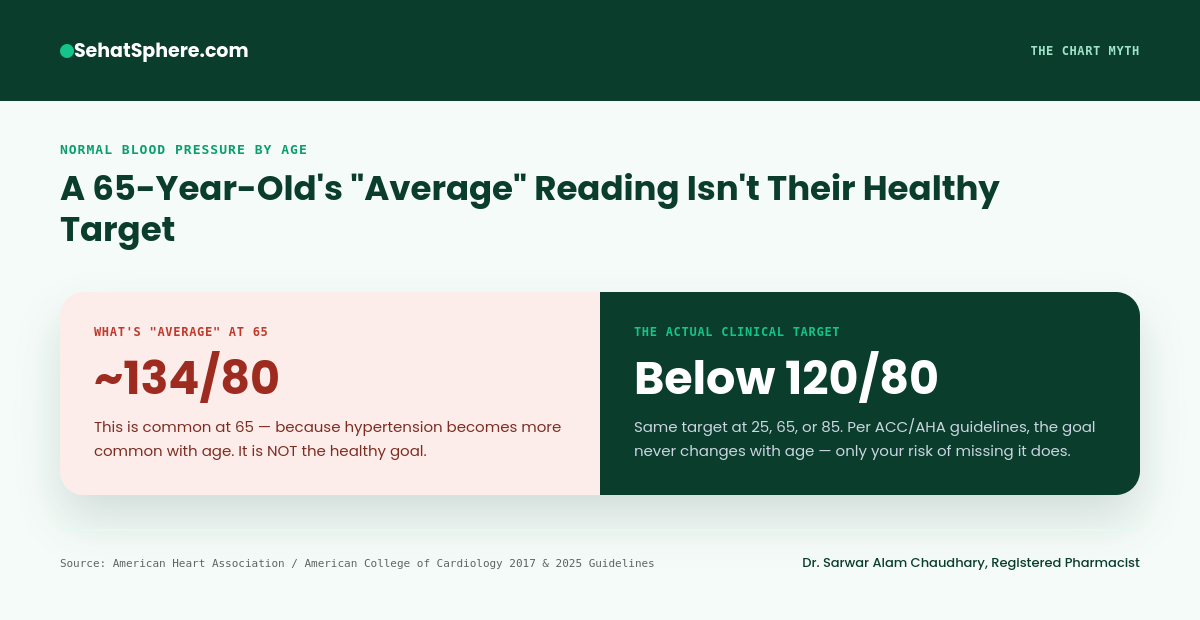
Here’s what almost every “blood pressure by age” chart gets wrong: it presents rising average readings as if they were a rising healthy target. They are not the same thing, and confusing them is genuinely consequential — it’s the difference between thinking 145/88 is “fine for your age” and knowing it’s actually Stage 2 hypertension at any age.
The 2017 ACC/AHA guideline — reaffirmed and extended by the 2025 update, which added a universal treatment target and a new risk calculator — is explicit: normal blood pressure is below 120/80 mmHg for every adult, regardless of age, sex, or how long you’ve lived with slightly elevated numbers. Averages rise with age because more people develop hypertension as they age — not because higher pressure becomes safe.
The 5 Official Categories (Same for Every Adult)
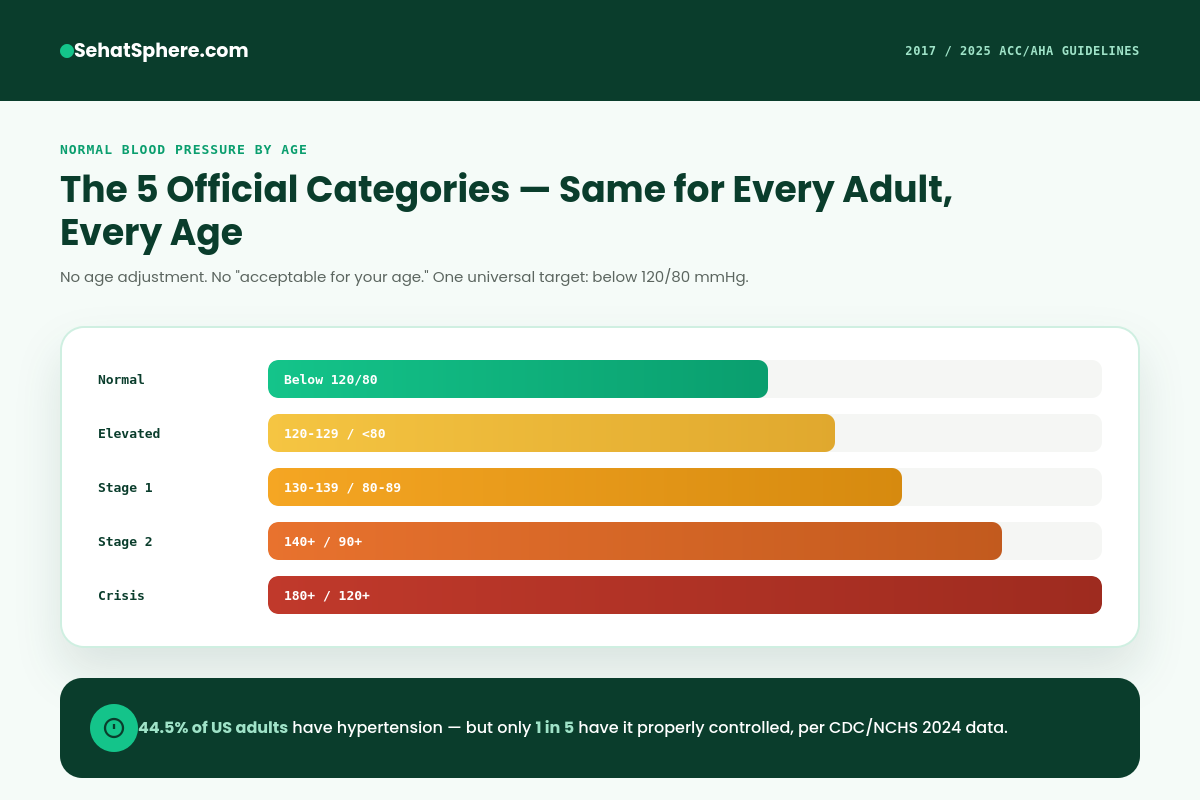
The American Heart Association and American College of Cardiology define five categories that apply to every adult, with no age or gender adjustment. Your reading falls into a category based on whichever number — systolic or diastolic — is higher.
| Category | Systolic | Diastolic |
|---|---|---|
| Normal | Below 120 | Below 80 |
| Elevated | 120–129 | Below 80 |
| Stage 1 Hypertension | 130–139 | 80–89 |
| Stage 2 Hypertension | 140+ | 90+ |
| Hypertensive Crisis | Above 180 | Above 120 |
Note how low the Stage 1 threshold is compared to older guidance: before 2017, the cutoff for high blood pressure was 140/90. Under current guidelines, 130/80 already counts as Stage 1 — a change that, per major analyses, reclassified tens of millions of previously “normal” adults into a treatable category. If you’ve been told for years that 135/85 is “a bit high but okay for your age,” that advice reflects the older standard, not the current one.
What People Actually Average, By Age
Knowing the target is one thing; knowing where you honestly stand relative to your peers is another. This is real population data, not a target — use it for context, not as a goal to “match.”
| Age Group | Have Hypertension |
|---|---|
| 18–39 | 23.4% |
| 40–59 | 52.5% |
| 60 and older | 71.6% |
According to the most recent CDC/NCHS data (NHANES survey, August 2021–August 2023), 47.7% of all US adults have hypertension — 50.8% of men, 44.6% of women. The jump by age bracket is stark: fewer than 1 in 4 adults under 40 have it, but by 60+, more than 7 in 10 do. Notably, the gap between men and women narrows sharply with age — men run meaningfully higher through their 40s and 50s, but by 60+, prevalence is statistically similar between sexes. This pattern is well-documented and primarily driven by arteries naturally stiffening with age, which increases resistance and pushes systolic pressure upward.
7 in 10 people over 60 having hypertension isn’t evidence that high readings are “normal” at that age — it’s evidence of how common undertreated hypertension is. The clinical target doesn’t move.
Why Readings Differ Between Women and Men
The target doesn’t change by sex, but the trajectory does. In women, systolic pressure tends to run lower than men’s and stays relatively stable through the reproductive years. After menopause, that changes — women typically see a substantial rise in systolic pressure and a more modest rise in diastolic pressure, often catching up to or exceeding male averages within a decade or two.
Population data reflects this directly: hypertension prevalence is meaningfully higher in men overall (50.8% vs. 44.6%), but this gap narrows considerably in older age brackets as postmenopausal women’s numbers rise. If your blood pressure was reliably normal for decades and starts climbing around perimenopause or menopause, that’s a well-documented pattern worth monitoring more closely, not something to dismiss as “just getting older.”
Why the Answer Can Differ by Country
Almost no single-country source explains this part: “high blood pressure” isn’t defined identically everywhere. The same 135/85 mmHg reading gets a genuinely different clinical label depending on which guideline your doctor follows.
| Guideline Body | Hypertension Diagnosed At |
|---|---|
| USA — ACC/AHA (2017) | 130/80+ |
| Europe — ESC (2024) | 140/90+ |
| UK — NICE (updated 2023) | 140/90+ |
The US lowered its diagnostic threshold in 2017, reclassifying tens of millions of previously “normal” adults as having Stage 1 hypertension. Europe and the UK still diagnose at the older 140/90 mark — but the 2024 ESC update added a new in-between category, “Elevated BP” (120–139/70–89 mmHg), explicitly acknowledging that cardiovascular risk rises well before the 140/90 diagnostic line, without moving the line itself.
A reading of 135/85 is “Stage 1 hypertension” under US guidelines but sits in the “elevated, not yet diagnosed” zone under European or UK ones. The practical advice converges either way — bring it down — but it’s worth knowing which threshold your doctor, home country, or health app is actually applying to your numbers.
Blood Pressure During Pregnancy Is a Different Conversation
Pregnancy is a case where the standard chart doesn’t directly apply — not because the numbers change, but because the stakes do. A reading of 140/90 mmHg or higher during pregnancy is flagged immediately, since it can signal gestational hypertension or pre-eclampsia — conditions specific to pregnancy that need prompt monitoring regardless of the mother’s age or prior blood pressure history. If you’re pregnant, share home readings with your OB-GYN as they happen rather than saving them for the next scheduled appointment.
The One Legitimate Exception: Frail, Elderly Patients
There is one genuine case where doctors intentionally set a less strict target: frail patients in their 80s with multiple health conditions, where aggressively lowering blood pressure can itself cause harm — falls, dizziness, or medication side effects that outweigh the benefit. Recent European guidance has formally acknowledged this, recommending doctors consider deprescribing BP medication in frail patients whose pressure drops as their frailty worsens.
This is a specific, individualized clinical decision made with a doctor based on someone’s overall health picture — not a general “different normal for seniors” rule the public should assume applies to them by default.
What To Read Next
- Why Does Blood Pressure Fluctuate? 12 hidden causes and a 7-day control plan.
- Does Anger Raise Blood Pressure? The scientific truth and a 5-step fix.
- The BP Medicine Timing Myth, Busted: What matters more than morning vs. night.
Why Your Home Reading Might Be Wrong
Before comparing your number to any chart, it’s worth asking whether the number itself is accurate. A meaningful share of “high” home readings are actually measurement error, not real hypertension — and getting this wrong in either direction has real consequences.
- Sit quietly for 5 minutes first — walking in and immediately measuring can inflate readings by 10–20 mmHg
- Feet flat on the floor, back supported — legs crossed can raise systolic pressure noticeably
- Arm at heart level, supported on a table — an unsupported arm held up raises readings
- Correct cuff size matters — a cuff that’s too small for your arm can overestimate pressure significantly
- No talking, no phone, no caffeine in the prior 30 minutes — all measurably shift the number
- Take two readings, one minute apart, and average them — a single reading is more noise than signal
This is also why a single high reading at a clinic doesn’t automatically mean you have hypertension — “white coat” elevation from the stress of a medical visit is well documented. Official diagnosis generally requires multiple elevated readings across separate occasions, ideally including some measured calmly at home.
What Actually Matters, Decade by Decade
The target never changes, but what’s worth focusing on practically does shift as you age.
In Your 20s and 30s
This is when you’re statistically most likely to be genuinely at or near the healthy target — and the ideal window to establish habits (regular activity, sodium awareness, healthy weight) before any upward drift begins. A normal reading now doesn’t guarantee one at 50, but the habits you build now measurably reduce that risk.
In Your 40s and 50s
This is typically when the cumulative effect of diet, weight, stress, and reduced activity starts showing up in the numbers for the first time. It’s also, not coincidentally, when routine screening becomes more important — annual checks are reasonable even without symptoms, since early hypertension is frequently silent.
In Your 60s and Beyond
This is where the “average vs. target” confusion causes the most real-world harm, since a genuinely high reading is most likely to be dismissed as expected for the age group. It’s also when isolated systolic hypertension — a high top number with a normal or low bottom number, from stiffened arteries — becomes common, and deserves the same treatment attention as any other elevated reading.
Children and Teens Are a Completely Different System
If you’ve ever tried applying the adult chart to a child’s reading, you’ve probably been confused — and for good reason. Kids under 13 aren’t measured against fixed numbers like 120/80 at all. Instead, pediatric blood pressure is plotted against percentile charts based on height, age, and sex, the same logic used for growth charts.
This matters because a reading that would be alarmingly high in an adult might be completely normal in a tall 10-year-old, and a reading that looks “fine” by adult standards could actually be elevated for a smaller child. Pediatricians track the trend across visits more than any single number. By the late teen years, targets gradually converge toward the standard adult ranges, with boys typically running slightly higher than girls during adolescence due to hormonal and muscle-mass differences.
When a Reading Is a Medical Emergency
A reading at or above 180/120 mmHg is a hypertensive crisis at any age. Wait five minutes and take a second reading to rule out a fluke. If it remains this high — especially alongside chest pain, shortness of breath, back pain, numbness, confusion, or vision changes — call your doctor immediately or go to an emergency room. This threshold does not shift for older adults; a reading that severe is never “expected for your age.”
Why “Normal” and “Controlled” Aren’t the Same
One more distinction that gets lost in most charts: if you’re already diagnosed with hypertension and taking medication, the goal isn’t to reach some age-adjusted number — it’s the same universal target, now called being “controlled.” Per the same NCHS data, control is defined as systolic below 130 and diastolic below 80 while on treatment.
The sobering part: even with effective medications widely available, only about 1 in 5 adults with hypertension have it properly controlled. This isn’t usually because the medication doesn’t work — it’s more often inconsistent dosing, undiagnosed cases, or people assuming their slightly-high reading is “normal for their age” and not pursuing treatment at all. If our guide on the BP medicine timing myth resonated with you, this control gap is exactly the kind of everyday inconsistency that matters more than timing ever did.
Hypertension prevalence also varies meaningfully by ethnicity in population data — age-adjusted rates run notably higher among Black adults compared to White or Hispanic adults in the same NHANES surveys — a pattern researchers attribute to a mix of genetic, socioeconomic, and healthcare-access factors rather than any single cause.
If Your Numbers Are Above Target
A single elevated reading isn’t a diagnosis, but a consistent pattern above 120/80 is worth acting on rather than waiting out. Reasonable first steps: confirm with proper home-measurement technique over several days, reduce sodium intake, increase physical activity, and bring the readings — not just a vague “it’s been a bit high” — to your next doctor’s visit. If you’re already on medication and still above target, that’s specifically a “controlled vs. not controlled” conversation worth having, not something to adjust yourself.
Quick Self-Check
Tick anything that applies to you — if several do, it’s worth bringing your home readings to your next doctor’s visit rather than assuming they’re “normal for your age.”
Frequently Asked Questions
What is normal blood pressure by age?
The healthy target is below 120/80 mmHg for every adult, regardless of age, per current ACC/AHA guidelines. There is no official age-adjusted “normal” — what rises with age is the population average and your risk of hypertension, not the healthy target itself.
Is 130/85 normal for a 60-year-old?
No. Under current guidelines, 130/85 falls into Stage 1 hypertension at any age, including 60. It may be common at that age, but common isn’t the same as healthy or the clinical target.
What percentage of adults have high blood pressure?
An estimated 44.5% of US adults 18 and older have hypertension, according to the most recent CDC/NCHS data (2021-2023), with men at 48.8% and women at 40.1%.
Why does blood pressure rise with age?
Primarily because arteries naturally stiffen over time, which increases resistance and pushes systolic pressure upward. Lifestyle factors like diet, weight, and stress compound this effect but aren’t the sole cause.
Do men and women have different normal blood pressure ranges?
The clinical target is identical for both sexes. However, women’s systolic pressure tends to run lower and stay stable until menopause, after which it often rises substantially, sometimes catching up to male averages.
How is blood pressure measured differently in children?
Children under 13 are assessed using percentile charts based on height, age, and sex, rather than fixed numbers like the adult 120/80 standard. This accounts for normal variation in body size during growth.
What blood pressure reading is a medical emergency?
180/120 mmHg or higher is a hypertensive crisis at any age. Recheck after five minutes; if it remains that high, especially with chest pain, vision changes, or confusion, seek emergency care immediately.
What does it mean for blood pressure to be “controlled” versus just “treated”?
Controlled means systolic below 130 and diastolic below 80 while on treatment — the same universal target. Only about 1 in 5 adults with hypertension currently meet this bar, even though effective medications are widely available.
Did the definition of high blood pressure change recently?
Yes. Before 2017, high blood pressure was defined as 140/90 or above. The 2017 ACC/AHA guideline lowered Stage 1 to 130/80, reclassifying millions of previously “normal” adults into a treatable category. The 2025 update reaffirmed this and added a universal treatment target.
Why does the UK say 140/90 is high, but the US says 130/80?
Different expert bodies drew the line differently. US guidelines (2017 ACC/AHA) lowered the diagnostic threshold to flag risk earlier. UK (NICE) and European (ESC 2024) guidelines still diagnose hypertension at 140/90, though the 2024 ESC update added a new “Elevated BP” category to flag risk earlier without moving the diagnostic line itself.
Is 140/90 dangerous during pregnancy even if I’m otherwise healthy?
Yes. Pregnancy changes the stakes regardless of age or prior health. A reading of 140/90 or higher during pregnancy needs prompt medical attention, as it can signal gestational hypertension or pre-eclampsia.
Why might my home blood pressure reading be wrong?
Common causes of inaccurate readings include not resting for 5 minutes beforehand, an unsupported arm, crossed legs, an incorrectly sized cuff, or talking during measurement. Taking two readings a minute apart and averaging them gives a more reliable number.
What is isolated systolic hypertension?
It’s a pattern common in older adults where the top (systolic) number is elevated while the bottom (diastolic) number is normal or low, caused by stiffened arteries. It still counts as hypertension and deserves the same treatment attention as any other elevated reading.
The Bottom Line
The blood pressure chart everyone searches for — the one that shows your “normal” creeping up with age — doesn’t reflect current clinical guidelines. The healthy target has stayed exactly the same for every adult: below 120/80 mmHg. What actually changes with age is how many people miss that target, not what the target is. Knowing average readings for your age group is useful context; treating them as a personal goal is exactly the confusion that keeps hypertension one of the most under-controlled conditions in medicine.
- American Heart Association. Understanding Blood Pressure Readings. heart.org
- Whelton PK, et al. 2017 ACC/AHA Guideline for the Prevention, Detection, Evaluation, and Management of High Blood Pressure in Adults. Hypertension, 2018;71(6):e13-e115.
- Fryar CD, Kit B, Carroll MD, Afful J. Hypertension prevalence, awareness, treatment, and control among adults age 18 and older: United States, August 2021–August 2023. NCHS Data Brief, No. 511, 2024. cdc.gov
View All References (7) ▾
- CDC/NCHS. Hypertension prevalence among adults aged 18 and over: United States, 2017-2018. NCHS Data Brief, No. 364, 2020. cdc.gov
- McEvoy J, McCarthy C, Bruno R, et al. 2024 ESC Guidelines for the management of elevated blood pressure and hypertension. European Heart Journal, 2024;45(38):3912-4018.
- NICE. Hypertension in adults: diagnosis and management. NICE Guideline 136 (updated November 2023). nice.org.uk
- Centers for Disease Control and Prevention. About High Blood Pressure. cdc.gov