 SehatSphere.com
Cold Plunge and Your Medications: What the Gasp Reflex Does to a Heart on Beta-Blockers
Almost every cold plunge safety article says “check with your doctor if you’re on beta-blockers” without explaining what’s actually happening in your body. If you take blood pressure medication, blood thinners, or manage a cardiac condition, cold plunge and your medications deserves more than a one-line warning — here’s the actual mechanism, plus a biomarker question almost nobody raises.
Key takeaways:
- Beta-blockers blunt the compensatory heart-rate increase your body normally uses to handle cold shock — this is the core reason for the warning.
- ACE inhibitors, diuretics, blood thinners, antidepressants, and even thyroid medication can each interact with cold exposure differently.
- The highest-risk window is the first 30–60 seconds; never plunge alone, and get medical clearance before starting on any of these medications.
Cold Plunge and Your Medications: Why Everyone’s Suddenly Plunging
Cold plunging went from a niche Wim Hof following to mainstream wellness in about two years. Podcasts like Huberman Lab and the Joe Rogan Experience are widely credited as the biggest driver — one community poll found 42% of regular cold-plungers first heard about it from Huberman Lab specifically. #icebath alone has over 150,000 posts on Instagram. For anyone who’s read our guide on sauna and your medications, cold plunge is often the other half of the same “contrast therapy” routine — and it deserves the same scrutiny.
In my own pharmacy practice, this is one of the “can I still do this” questions I get asked most often by patients on blood pressure medication — usually after they’ve already started, not before.
What Beta-Blockers Actually Block
When cold water hits your skin, your body’s normal move is to spike your heart rate — pumping more blood to compensate for blood vessels that just clamped down hard (vasoconstriction) in your arms, legs, and skin. That compensatory heart-rate increase depends on adrenaline binding to beta-adrenergic receptors in your heart. Beta-blockers work by sitting on those exact receptors and blocking adrenaline from reaching them — which is the entire point of the drug for treating high blood pressure or arrhythmias, and exactly why it becomes relevant in a cold plunge.
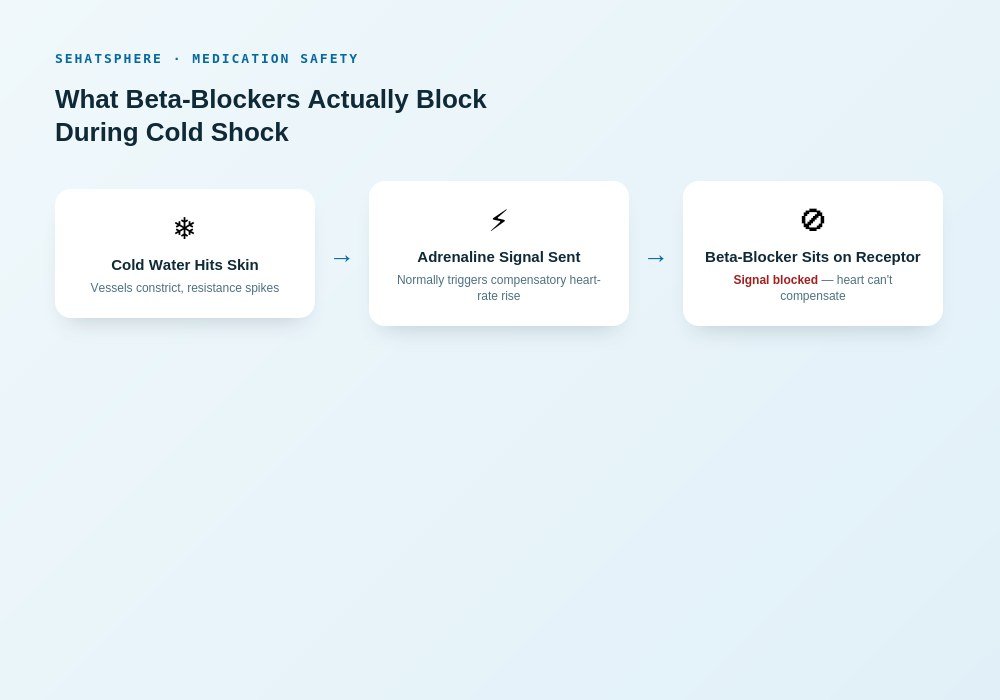
With the compensatory heart-rate response blunted, your heart can’t pump harder to match the sudden spike in resistance from constricted blood vessels. The result is a mismatch your cardiovascular system isn’t built to handle gracefully — consistent with broader research on how beta-blockade alters autonomic responses to acute physical stress.
Sudden cold immersion triggers an involuntary gasp reflex, along with a sharp, fast spike in both heart rate and blood pressure — normal in healthy people, but also the specific window where risk concentrates. In people with uncontrolled high blood pressure, cold shock can push systolic pressure above 200 mmHg, a range associated with real stroke risk through vessel rupture. The American Heart Association has explicitly warned that this combination — cold shock plus a heart already managed by medication — is a real and under-discussed risk for anyone with a cardiac history.
Medications and Conditions Worth a Conversation First
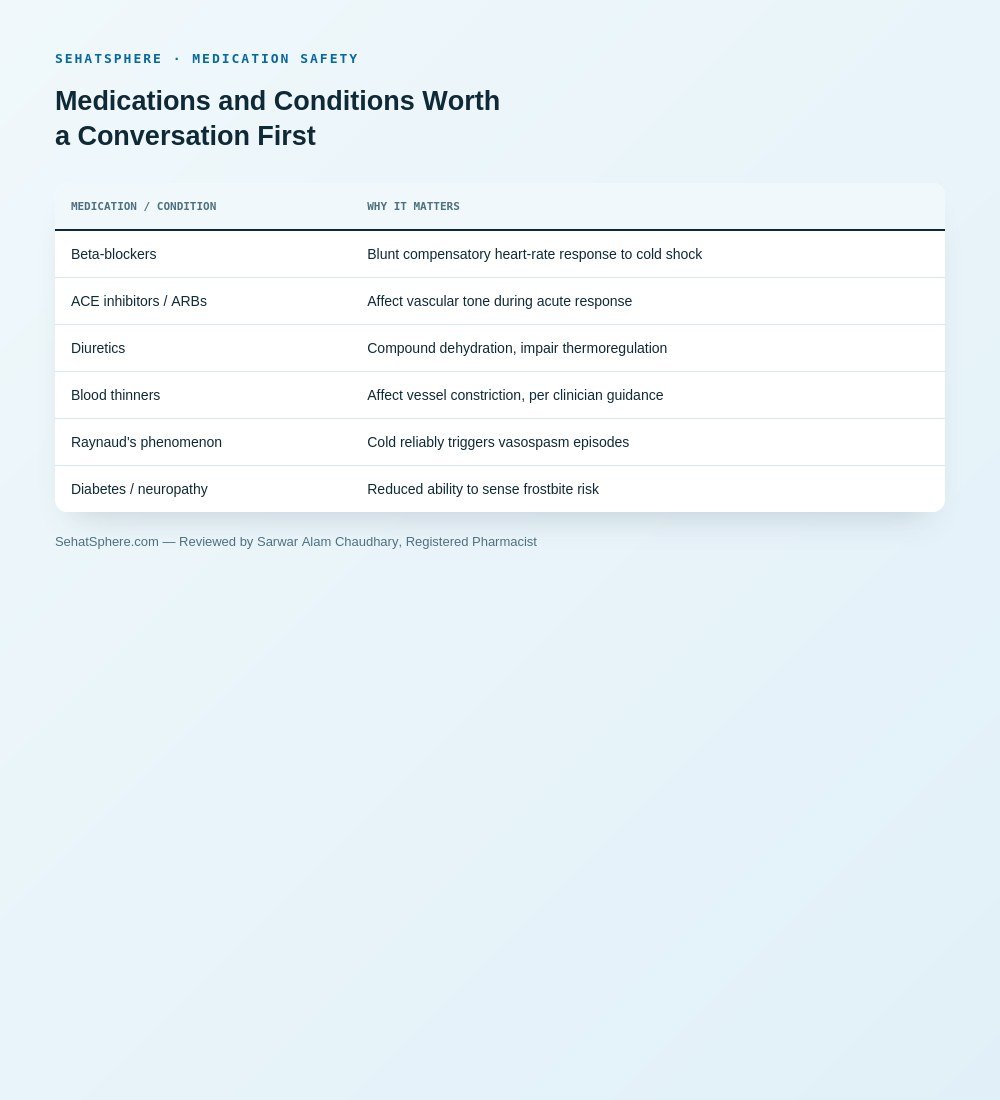
| Medication / Condition | Why It Matters |
|---|---|
| Beta-blockers | Blunt the compensatory heart-rate response to cold shock |
| ACE inhibitors / ARBs | Can increase risk of blood pressure drops when moving from cold to warm |
| Diuretics | Compound dehydration and impair thermoregulation |
| Blood thinners | Affect how vessels constrict; discuss timing with your prescriber |
| Antidepressants | Some affect temperature regulation, increasing hypothermia risk |
| Anti-anxiety medications | May reduce awareness of cold-related warning signs |
| Stimulants | Can amplify the cardiovascular stress response to cold exposure |
| Thyroid medications | Can impact your body’s temperature regulation abilities |
| Raynaud’s phenomenon | Cold reliably triggers painful vasospasm episodes |
| Diabetes / neuropathy | Reduced ability to sense frostbite risk on numb skin |
This is the same category of caution as the beta-blocker warning in our guide on why blood pressure fluctuates — the same drug class, a different acute trigger.
What To Read Next
- Sauna and Your Medications: The heat side of contrast therapy, same medication cautions.
- Why Does Blood Pressure Fluctuate? Our pillar guide on BP swings and what’s normal.
- HRV and Medication: How your medications show up in heart rate variability data.
The Troponin Question Almost Nobody Raises
Here’s a genuinely under-discussed angle, and the honest answer is more nuanced than a clean warning. Troponin is the blood marker doctors use to detect heart muscle damage — one of the first tests run when someone comes to an ER with chest pain. A study of competitive winter swimmers found troponin levels measurably rose within two hours after a cold-water swim, peaking during that window. Separately, the American Heart Association has noted this same pattern in some winter-swimming research, while cautioning that whether it reflects genuine cardiac strain or a more benign, transient response remains actively debated.
Interestingly, a different study looking at brief cold water immersion for athletic recovery — shorter exposure, different context — found lower troponin afterward, not higher. The honest takeaway: intensity, duration, and context all matter, and the science isn’t settled either direction. The practical point for you: if you do longer or more intense sessions and happen to get a troponin test for an unrelated reason, mentioning your cold-plunge habit gives your doctor useful context.
Other Conditions Worth Knowing
Raynaud’s phenomenon causes blood vessels in fingers and toes to spasm shut in response to cold — a cold plunge is close to a worst-case trigger, and most clinical sources simply advise against it for this group. Diabetes with peripheral neuropathy reduces sensation in the hands and feet, meaning the normal pain signal that would tell you to get out before frostbite sets in may not arrive on time. Cold-induced asthma or reactive airways can make the gasp reflex itself genuinely dangerous, independent of any cardiac concern.
Safe Duration & Temperature: What The Guidance Actually Says
This is one of the most-searched practical questions, and the honest answer is that there’s no single universal number — but general safety guidance from clinical sources tends to agree on a few points:
- Beginners typically start with 30–90 seconds in water around 10–15°C, not the 2–10°C extremes experienced practitioners use.
- Building up gradually over weeks matters more than reaching any specific duration quickly.
- Longer isn’t automatically better — most benefit-focused guidance tops out around 2–4 minutes even for experienced plungers.
- If you’re on any of the medications in the table above, get clearance for a specific duration and temperature from your doctor rather than following a generic influencer protocol.
Pregnancy & Children
Pregnancy: Pregnancy already involves significant cardiovascular and circulatory changes, and most clinical sources advise checking with your OB-GYN before trying cold water immersion rather than assuming it’s automatically fine or automatically off-limits. This isn’t a settled area with strong dedicated research on cold plunging specifically during pregnancy — which is exactly why individual clearance matters more than general guidance here.
Children: Kids regulate body temperature differently than adults and can’t always communicate early warning signs clearly. Cold plunging with children should only be done with pediatric guidance and close supervision, not as a family wellness trend copied from adult protocols.
What To Do If Something Goes Wrong
If someone shows confusion, slurred speech, blue lips, or loss of coordination during or after cold exposure, treat it as an emergency:
- Get them out of the water immediately.
- Remove wet clothing and warm them gradually — rapid rewarming (like a hot shower) can actually add cardiac strain during recovery.
- Use dry blankets and warm (not hot) drinks if they’re alert and able to swallow.
- Call emergency services if symptoms are severe, don’t improve quickly, or the person loses consciousness.
This is exactly why the “never plunge alone” rule matters — someone needs to be able to act in that first critical window.
Real vs Rare Risk
It’s worth being honest about scale here. Cold plunging has real, documented safety incidents — including reported lawsuits and deaths associated with unsupervised cold water exposure and extreme cold-therapy programs. Most of these incidents share a common thread: solo sessions, no supervision, and underlying conditions the person either didn’t know about or didn’t disclose. This isn’t a reason to avoid cold plunging — millions of people do it safely every week — but it’s a reason to treat “never alone” as a genuine rule, not a suggestion.
Cold Shower vs Cold Plunge: Does the Difference Matter Medically?
Most of the medication cautions in this guide scale with the intensity of the cold shock, not the specific format. A full-body ice bath at 2–10°C produces a much sharper cold shock response than a cold shower, which only covers part of the body and is rarely as cold. For someone easing back into activity after a cardiac event, or just starting to understand how their beta-blocker affects this response, a cold shower is a genuinely gentler way to test the waters — literally — before committing to a full plunge.
What Cold Acclimatization Actually Changes
Regular practitioners often report the shock response feels less intense over time, and there’s real physiology behind that — repeated cold exposure can blunt the size of the initial gasp and heart-rate spike somewhat, a genuine adaptation. What acclimatization does not do is remove the underlying pharmacological effect of a beta-blocker. An experienced cold-plunger on a beta-blocker still has a blunted compensatory response compared to an experienced cold-plunger who isn’t — acclimatization and medication effects are two separate variables, not substitutes for each other.
A Note on Newly Started Medications
Timing matters here in a way that’s easy to overlook. If you’ve been cold plunging safely for months and then start a new beta-blocker, ACE inhibitor, or diuretic, your established routine is no longer the same test — the medication changes the underlying physiology, even though the water temperature and your habits haven’t changed at all. The safest moment to reassess isn’t after your first plunge on a new medication, it’s before it.
What I Actually Tell Patients
- On a beta-blocker, ACE inhibitor, ARB, diuretic, thyroid medication, or antidepressant? Get medical clearance before starting, not after your first session.
- Never plunge alone — the highest-risk window is the first 30–60 seconds, exactly when help matters most.
- Start with shorter, warmer exposures and build up gradually rather than jumping straight to ice-water extremes.
- Raynaud’s, uncontrolled hypertension, or a cardiac history are reasons to get clearance first, not automatic exclusions.
- If you do intense or prolonged sessions and get bloodwork done, mention your cold-plunge habit — it’s useful context, not a confession.
Frequently Asked Questions
Can I cold plunge if I take beta-blockers?
Talk to your doctor first. Beta-blockers blunt the compensatory heart-rate increase your body normally uses to handle cold shock.
Does cold plunging really damage your heart?
The evidence is genuinely mixed. Some winter-swimming studies show a temporary troponin rise; other research shows no change or even a decrease, depending on intensity and context.
Is cold plunging safe with high blood pressure?
Uncontrolled hypertension combined with cold shock can push systolic pressure into a dangerous range. Get clearance from a doctor before starting.
Can people with Raynaud’s do cold plunges?
Most clinical sources advise against it — cold water immersion is close to a worst-case trigger for Raynaud’s vasospasm episodes.
Who should avoid ice baths entirely?
People with uncontrolled heart disease, Raynaud’s phenomenon, cold-induced asthma, or diabetes with significant neuropathy should get medical clearance first, or avoid it depending on severity.
Is a 3-minute cold plunge safe?
For an acclimatized, cleared adult, yes for most. For beginners, most guidance suggests starting at 30–90 seconds and building up gradually rather than starting at 3 minutes.
Is cold plunging safe during pregnancy?
Check with your OB-GYN first. Pregnancy involves significant cardiovascular changes, and this isn’t a well-studied area specific to cold plunging.
Can I cold plunge if I’m on blood thinners?
Discuss timing with your prescriber. Blood thinners affect how your vessels constrict during the cold shock response, which is worth a specific conversation.
What should I do if someone shows signs of trouble during a plunge?
Get them out immediately, warm them gradually (not with a hot shower), and call emergency services if symptoms are severe or don’t improve quickly.
Why do people combine sauna and cold plunge?
It’s often called contrast therapy or the “Nordic cycle.” The same medication cautions apply to each half separately.
The Bottom Line
Cold plunging isn’t automatically dangerous for people on medication — millions do it safely. What matters is knowing which specific mechanism applies to your specific drug: beta-blockers blunt your heart’s compensatory response, diuretics compound dehydration, and several other medication classes each interact differently. Get clearance before your first session, never plunge alone, and treat a new prescription as a reason to reassess your routine.
- You’re Not a Polar Bear: The Plunge Into Cold Water Comes With Risks. American Heart Association. heart.org
- Impact of Cold-Water Immersion on Cardiac Troponin in Winter Swimmers. discoveryjournals.org
View All References (7) ▾
- Effect of Cold Water Immersion on Cardiac Troponin T and Myoglobin. PubMed. pubmed.ncbi.nlm.nih.gov
- UPMC HealthBeat — Health Risks of Ice Baths. share.upmc.com
- Beta-Blockers and Autonomic Response to Acute Stress. NCBI. ncbi.nlm.nih.gov
- Healthline — Wim Hof Method Safety Concerns and Reported Incidents. healthline.com
- Cold Plunge Side Effects: What You Need to Know. PLUNJ. plunj.co
Why Trust This Guide?