 SehatSphere.com
Generic Medicines and the Price Truth: Why This Pharmacist’s Family Only Takes Generics
- Generic medicines must prove bioequivalence to the original branded drug before approval — this is a regulatory requirement, not a marketing claim.
- A 2026
citizen-funded study of 131 samples across 22 drug types , led by clinician-scientist Dr. Cyriac Abby Philips in Kerala, found every single sample met pharmacopeial quality standards regardless of brand or price — while generics ran 48.6% cheaper on average, and up to 13.9× cheaper for the widest gaps. - Price gaps for common chronic-disease medicines can run into the several hundred percent range for the exact same molecule — this article shows real, cited comparisons rather than vague claims.
- In a survey of prescribing physicians, 80.9% did not believe switching a patient from branded to generic would change their treatment outcome.
- India’s Jan Aushadhi (PMBJP) scheme now runs nearly 18,000 government stores nationwide, covering 2,100+ WHO-GMP certified generic medicines.
- One real exception exists: a small category of narrow-therapeutic-index drugs (certain thyroid, epilepsy, anticoagulant medications) where staying with one manufacturer matters more than the price gap.
- 1. Why I’m Actually Writing This
- 2. The Numbers Nobody Shows You Side by Side
- 3. Estimate Your Own Yearly Savings
- 4. What the Actual Research Found
- 5. Why We Don’t Trust the Cheaper Pill
- 6. What Doctors Themselves Believe
- 7. Even America Runs on Generics
- 8. Where I’ll Push Back on Myself
- 9. What I Actually Do
- 10. How to Switch to Generics, Safely
- 11. Find Your Nearest Jan Aushadhi Kendra
- 12. Show This to Your Pharmacist
- 13. FAQs
- 14. References
1. Why I’m Actually Writing This
Last month, a patient stood at my counter holding a box of Amlodipine, the same 5 mg tablet he’d taken every morning for four years, staring at a price tag that had quietly crept up again. When I mentioned the generic version sitting two shelves away — same salt, same strength, roughly a tenth of the price — he looked at me like I’d suggested something faintly illegal. That reaction is the entire reason I’m writing this.
I’m not anti-brand out of some ideological stance. I’m writing this because I watch this exact scene play out at pharmacy counters constantly, and the pattern is always the same: patients on fixed incomes, often managing chronic conditions like hypertension or diabetes for decades, quietly paying multiples more than they need to — not because a doctor told them to, but because nobody ever told them they didn’t have to.
This isn’t a fringe opinion. It’s the position of India’s own drug regulatory framework, reflected in a government scheme that’s now running nearly 18,000 stores nationwide — grown from roughly 3,200 in 2018, though access still varies sharply by state [5]. The controversy isn’t scientific. It’s cultural.
2. The Numbers Nobody Shows You Side by Side
These aren’t marketing claims from a generic drug company. These are documented price comparisons between Jan Aushadhi generics and their branded equivalents, for medicines millions of Indians take every single day for conditions like hypertension and high cholesterol — the same conditions covered in our Blood Pressure Fluctuation and Early Signs of a Weak Heart guides [1][2].
| Medicine | Branded price | Generic (JAS) price | Gap |
|---|---|---|---|
| Atorvastatin 10mg (10 tabs) | ₹118–152 | ₹4.76 | ~2,389% |
| Amlodipine 5mg (10 tabs) | varies widely | lowest available | ~900%+ |
| Pantoprazole (15 tabs) | ₹80–150 | ₹15–25 | ~5–6× |
| Calcium + Vitamin D3 (15 tabs) | ₹80–120 | ₹20–40 | ~3× |
| Asthma inhalers | ₹200–600 | ₹80–150 | ~2–4× |
Prices approximate, compiled from published cost-comparison research and current Jan Aushadhi listings [1][2][3].
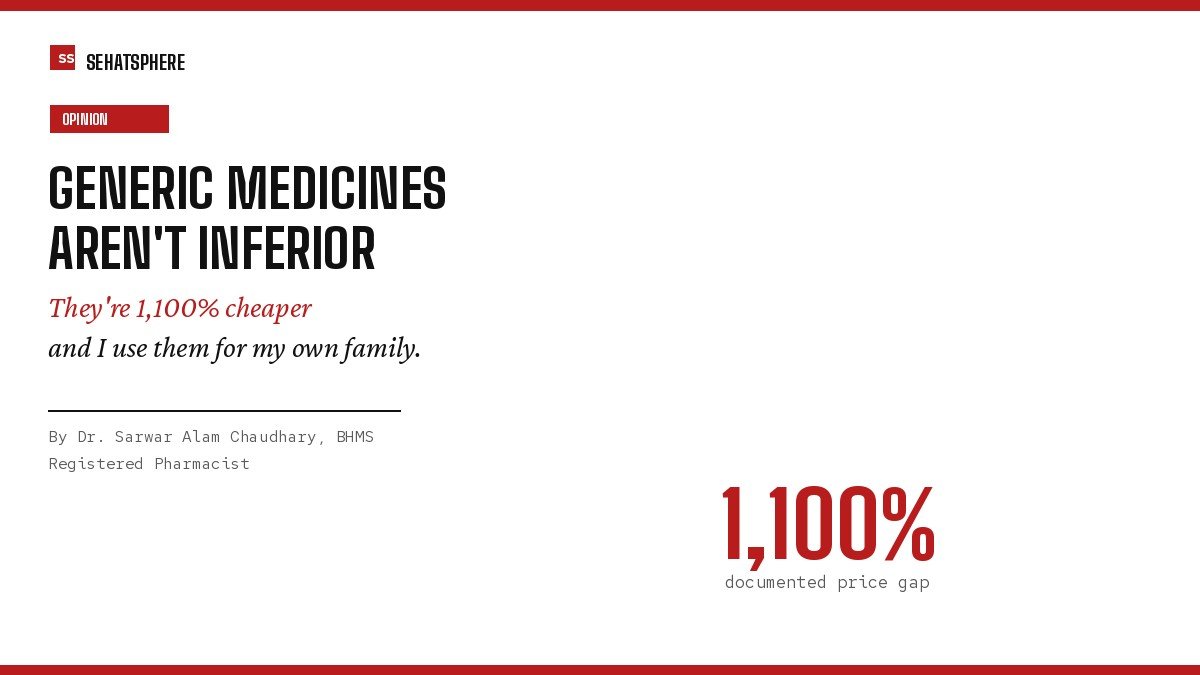
Two boxes, one molecule, one price tag that makes no clinical sense.
3. Estimate Your Own Yearly Savings
Tick what you take regularly for a rough estimate, based on the real price gaps above.
Not sure which of these you’re actually low on? The free Which Nutrient Deficiency Do You Have? tool is a better starting point than guessing.
4. What the Actual Research Found
This is the part most brand-loyalty arguments never engage with: independent, peer-reviewed lab testing of both branded and generic medicines, not just a price comparison.
“A tablet priced at ₹1 performed just as well in lab tests as one costing ₹10.” Dr. Cyriac Abby Philips, clinician-scientist, on independent testing of 131 samples across 22 widely used medicines [3]
That’s a real, published 2026 study — a citizen-funded comparative analysis of branded versus generic medicines across 22 drug types and 8 therapeutic categories, tested at regulated retail outlets in Kerala. Every single one of the 131 samples met all pharmacopeial quality standards, regardless of whether it was generic, branded, or priced differently — while the generics averaged 48.6% cheaper, with the widest gaps running up to 13.9×.
5. Why We Don’t Trust the Cheaper Pill
None of this is an accident. Branded pharmaceutical marketing in India is enormous, sustained, and specifically built around the idea that price signals quality — a logic that works for electronics and clothing and completely breaks down for a molecule that has to prove bioequivalence to get approved at all.
There’s also a documented, if uncomfortable, layer around prescribing incentives — a factor Indian healthcare policy discussions return to repeatedly, alongside plain habit and patient expectation. None of this requires a conspiracy. It just requires nobody actively correcting the assumption, and most people never get the chance to ask.
6. What Doctors Themselves Believe
In a survey of prescribing physicians published in the International Journal of Research in Medical Sciences, 80.9% did not believe switching a patient from a branded to a generic drug would change the outcome of their treatment [4]. That’s not a fringe pharmacist opinion — that’s the majority position among the people writing the prescriptions in the first place.
7. Even America Runs on Generics
If brand-name really were the safer bet, the world’s most profit-driven, marketing-heavy pharmaceutical market would be the last place to prove otherwise. Instead, generic drugs account for 90% of all prescriptions dispensed in the United States — while representing only around 12% of total prescription drug spending. The remaining 10% of branded prescriptions consume nearly 88% of the money spent [6]. That imbalance exists in a market with far tighter regulatory scrutiny than India’s, and it still runs almost entirely on the “cheaper copy.”
8. Where I’ll Actually Push Back on Myself
I won’t pretend this is universal. A small category of narrow-therapeutic-index drugs — certain thyroid medications, epilepsy drugs, and anticoagulants — carries genuine clinical reasoning for staying consistent with one manufacturer rather than switching brand-to-brand repeatedly, since tiny absorption differences matter more when the safety margin is thin. This isn’t the same as “branded is better.” It’s “don’t randomly switch manufacturers on a drug where consistency itself is the safety feature.”
If any of the interaction guides on this site apply to you — Sea Moss, Glutathione, Proffee, or Taurine — that same “check before switching anything” logic applies.
9. What I Actually Do
My own family takes generic medicines. Not as a cost-cutting compromise I feel bad about — as the default, informed choice, the same one 80% of the doctors surveyed above would make for their own prescriptions if patient expectation weren’t in the way. When a new medication comes up in my own household, the first question isn’t which brand to buy. It’s whether a Jan Aushadhi or equivalent generic exists for that molecule, and only then whether there’s a real clinical reason to deviate from it.
If you’re managing several medications and want to check what else deserves this same scrutiny, the Complete Guide to Medicine Safety, the Integrative Interaction Checker, and the Medication + Lifestyle Checker are good starting points — and if timing or brand-switching mistakes are a pattern for you, our Medicine Mistakes guide covers the ones I see most often.
10. How to Switch to Generic Medicines, Safely
- Check if your medicine falls into the narrow-therapeutic-index category above — if so, talk to your doctor before switching anything.
- Ask for the generic (salt) name, not just the brand name, so you can actually compare.
- Search the official Janaushadhi Kendra locator, or simply ask your regular chemist if they stock the generic equivalent.
- Once you find a generic that works, stick with that manufacturer for chronic conditions rather than switching brand-to-brand every refill.
- If something genuinely feels different after switching, tell your doctor — don’t just assume the cheaper pill failed.
11. Find Your Nearest Jan Aushadhi Kendra
Nearly 18,000 government-run stores, 2,100+ medicines, prices typically 50–90% below MRP.
Open Official PMBJP Locator →Or call the PMBJP helpline: 1800-180-8080
12. Show This to Your Pharmacist
✂️ Print This Card
Print this or screenshot it — take it to the counter.
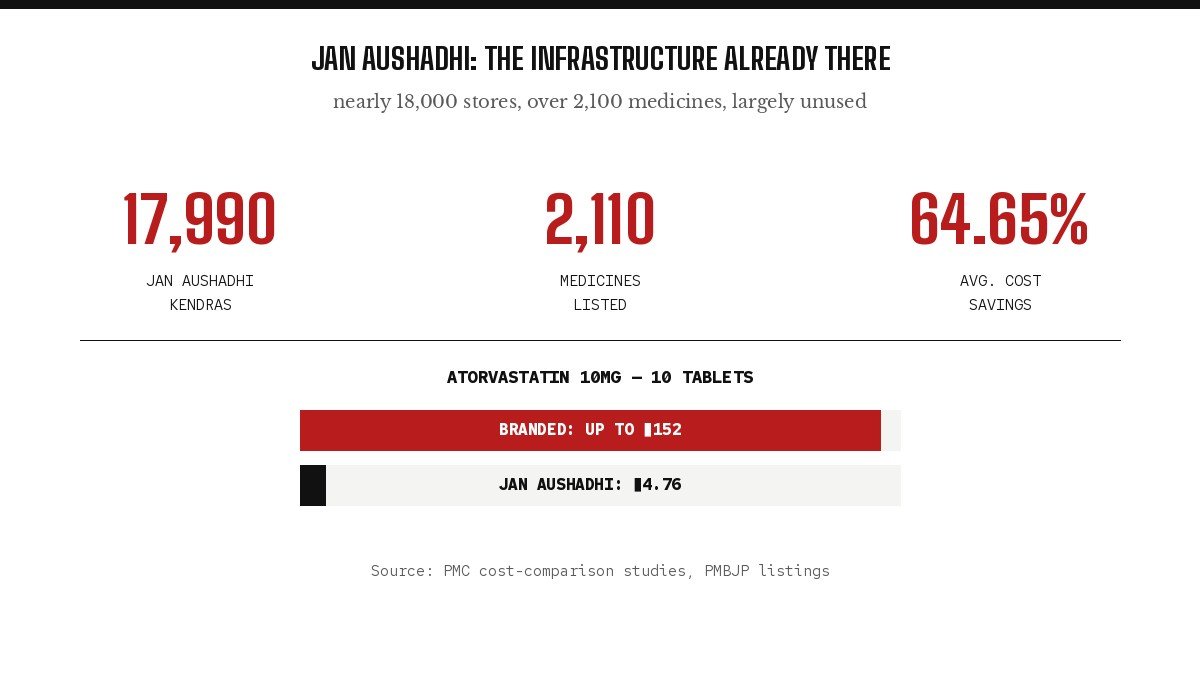
Nearly 18,000 stores. Over 2,100 medicines. A quiet infrastructure most patients have never been told to use.
13. Questions I Get Asked About Generic Medicines
Are generic medicines really as effective as branded ones?
Yes, for the vast majority of medicines. Generic manufacturers must prove bioequivalence to the original branded drug before approval, and independent lab testing on Jan Aushadhi generics has confirmed this in practice.
Why are branded medicines so much more expensive in India?
Primarily marketing costs, brand-building, and margins passed to distributors and retailers — not superior manufacturing. Research shows more branded competitors in a category is linked to higher price spread, not lower prices.
What is the Jan Aushadhi scheme?
A Government of India initiative running nearly 18,000 stores nationwide, selling WHO-GMP certified generic medicines at a fraction of branded prices, covering over 2,100 medicines.
Is there any situation where branded medicine matters more?
Yes, for a small category of narrow-therapeutic-index drugs like certain thyroid, epilepsy, and anticoagulant medications, where doctors sometimes prefer consistency in manufacturer rather than switching frequently.
How do I find a Jan Aushadhi store near me?
You can search the official Janaushadhi Kendra locator online or ask your local chemist whether they stock PMBJP generic alternatives.
Do doctors get incentives to prescribe branded medicines?
This is a documented concern in Indian healthcare policy discussions, though it varies widely by individual doctor and institution. It is one of several factors, alongside habit and patient expectation, that sustains brand-name prescribing.
Can I ask my pharmacist to substitute a generic for what’s written on my prescription?
In most cases yes, for the same active ingredient, strength, and dosage form — it’s worth asking directly rather than assuming you must buy the exact brand written.
The Question I’ll Leave You With
If your doctor’s own colleagues largely agree the outcome doesn’t change, and the price difference is enough to fund another month of the same medicine — what exactly is the brand name buying you? I’d genuinely like to know if you disagree, and why.
Why Trust This Guide
For more on how SehatSphere researches and fact-checks pieces like this one, visit About Us, and if you already have recent lab work to interpret alongside a medication change, the Blood Report Decoder and full Free Health Tools Library are there for exactly that. If cardiovascular medication is what brought you here, our Heart Attack in Young Adults guide is a natural next read, and if you’re managing weight alongside diabetes medication, our Mounjaro & Ozempic diet guide covers what else to check.
- Mukherjee K. A Cost Analysis of the Jan Aushadhi Scheme in India. Int J Health Policy Manag. 2017.
- “Jan Aushadhi Medicine List 2026 | Complete Guide with Prices.” Get Jan Meds. getjanmeds.in
- Philips CA, et al. Pharmaceutical quality and cost-effectiveness of branded versus generic medicines across 22 drug types and 8 therapeutic categories: a citizen-funded comparative study from regulated retail outlets in Kerala, India. Frontiers in Pharmacology. 2026.
- “A study on assessment of awareness on generic drugs among doctors in a tertiary care teaching hospital in north India.” Int J Res Med Sci. msjonline.org
- Behera DK, Rahut DB, et al. Medicine affordability and access in India: lessons from generic–branded price variation under the Jan Aushadhi Scheme. Front Public Health. 2025.
- “2025 U.S. Generic & Biosimilar Medicines Savings Report.” Association for Accessible Medicines. accessiblemeds.org