 SehatSphere.com
Smartwatch Blood Pressure Accuracy: Your Watch’s Reading Is Wrong Exactly When It Matters Most
Smartwatch blood pressure accuracy has a specific, well-documented weakness: a 2022 clinical validation study found devices systematically overestimate low readings and underestimate high readings — meaning the watch is least reliable exactly when a genuinely high blood pressure reading would matter most. The good news: newer research suggests this is genuinely improving, and the fix isn’t complicated once you understand what these devices actually do.
Key takeaways:
- Smartwatch blood pressure accuracy was found “insufficient for clinical usage” in a 2022 study, with only 41% specificity for detecting hypertension.
- A newer January 2026 study found meaningfully improved accuracy, meeting ISO/IEEE standards in nearly every measure — the technology is genuinely getting better.
- Samsung and Apple take completely different approaches: Samsung gives an actual mmHg reading but requires cuff-calibration every 28 days; Apple only detects hypertension trends over 30 days, without ever giving you a number.
- No current wearable provides true, continuous, clinically-accurate cuffless blood pressure monitoring — understanding this limitation is the actual key to using these devices well.
- What the 2022 study actually found
- The evidence has genuinely changed
- The wider device landscape
- Why this actually matters
- Samsung vs Apple: two different approaches
- How these devices actually work
- Why calibration is the hidden catch
- Wrist position matters more than you think
- The technology behind the numbers
- What’s coming next: the newest FDA milestone
- The broader cardiovascular picture
- Checking too often can backfire
- How to use a smartwatch BP feature well
- When to trust an actual cuff instead
- Quick self-check
- FAQs
What the 2022 Study Actually Found
A clinical validation study published in Frontiers in Cardiovascular Medicine tested the Samsung Galaxy Watch Active 2 against 24-hour ambulatory blood pressure monitoring — the real clinical gold standard — in both normotensive and hypertensive patients. The finding was specific and genuinely concerning: smartwatch blood pressure accuracy showed a systematic bias toward the calibration point, meaning low readings got pushed higher and high readings got pushed lower than they actually were.
In practical terms: sensitivity for detecting hypertension was 83%, but specificity was only 41% — meaning the device correctly flagged genuinely high blood pressure a majority of the time, but also frequently gave false reassurance. The study’s own conclusion was direct: smartwatch-based BP measurement was “not yet ready for clinical usage.”
The Evidence Has Genuinely Changed
This is worth stating honestly, since most content treats “smartwatches are inaccurate” as a fixed, permanent verdict. It isn’t.
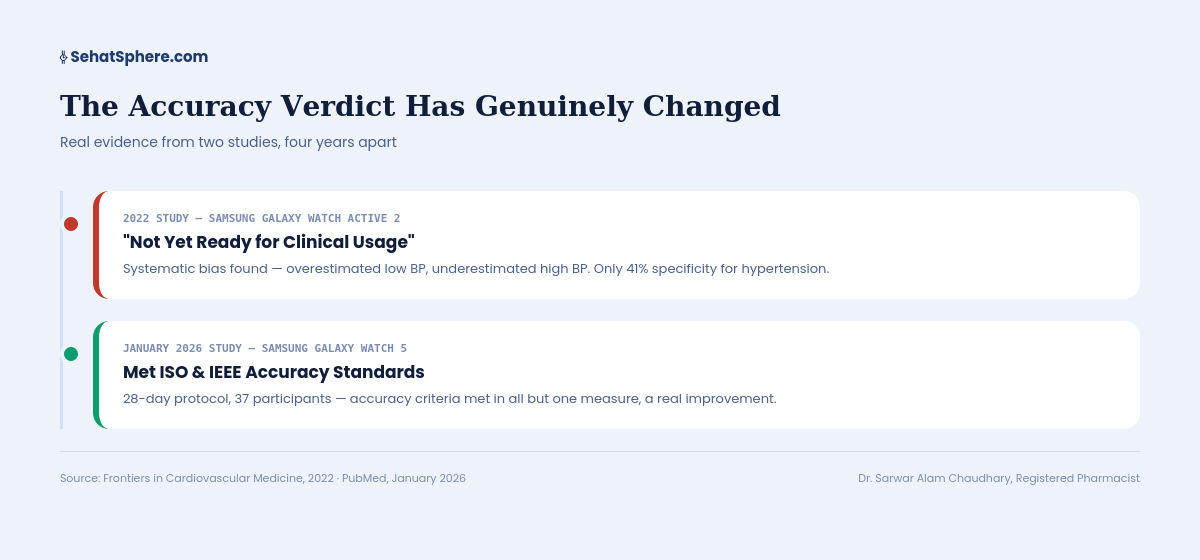
A newer study, published in January 2026 and using the more recent Samsung Galaxy Watch 5, followed 37 participants through a 28-day protocol of paired measurements against a validated reference sphygmomanometer. The result was meaningfully different: the smartwatch met accuracy criteria based on ISO and IEEE standards in all but one measure. This is a genuine, documented improvement over four years — not a marketing claim, an actual peer-reviewed finding.
The American Heart Association weighed in too, and its language was notably blunt for a professional body. A scientific statement published online in December 2025, formally appearing in the journal Hypertension in 2026 and chaired by Dr. Jordana Cohen of the University of Pennsylvania, made a specific, important distinction most consumers never hear: FDA clearance does not mean a cuffless device has undergone the kind of clinical validation needed to establish real-world accuracy. A formal validation protocol isn’t actually required to get FDA clearance in the first place — many devices are tested against far less rigorous standards than people assume when they see a “cleared” label on a box.
The Wider Device Landscape You Haven’t Heard About
Apple and Samsung dominate the conversation, but the field has genuinely expanded. Oura, Whoop, and a growing set of finger-worn rings now market some form of blood pressure tracking, and it’s worth knowing how they differ before assuming they all work the same way.
| Device | What It Actually Does |
|---|---|
| Omron HeartGuide | Genuine inflatable wrist cuff — the only watch that measures BP the same way a clinic does |
| Whoop Blood Pressure Insights | Survived a year-long FDA dispute, formally resolved June 2026 |
| Aktiia G0 / Hilo Band | FDA-cleared July 2025; requires cuff recalibration every 24 hours — more frequent than Samsung’s 28 days |
| Vital Signals Signal Ring | Finger-worn, launched July 2026, claims cuffless measurement without calibration |
Notice the pattern: apart from Omron’s genuine inflatable cuff, every other device on this list — including Samsung’s — estimates pressure optically and leans on periodic real-cuff calibration to stay accurate. None of them measure pressure directly the way a doctor’s office does. If accuracy and clinical decision-making are genuinely the priority, an upper-arm cuff (or Omron’s cuffed watch specifically) remains the more medically defensible default, not a cuffless optical device, however recent its release date.
What To Read Next
- Why Does Blood Pressure Fluctuate? 12 real causes, and a proper 7-day tracking plan.
- Morning Blood Pressure Spikes: Exactly when your readings are naturally highest.
- Complete Guide to Blood Pressure: Proper cuff measurement technique, covered fully.
Why This Actually Matters
High blood pressure isn’t a minor inconvenience being tracked out of curiosity — it’s a leading contributor to roughly 9.4 million deaths worldwide each year, and it’s genuinely the kind of condition that stays silent until a stroke or heart attack makes it visible. This is exactly why the appeal of continuous, wrist-based monitoring is real, and why getting the accuracy question right actually matters, rather than being a minor technical footnote. A separate 2025 Northumbria University validation study, evaluating the Huawei D2 watch against combined AAMI, ESH, and ISO international standards, reflects just how much clinical attention this exact technology category is now receiving — it’s a genuinely active, fast-moving area of medical device research, not a settled question either direction.
Samsung vs Apple: Two Different Approaches
These two major brands solve this problem in genuinely different ways, and confusing them leads to real misunderstanding about what your specific device can and can’t tell you.
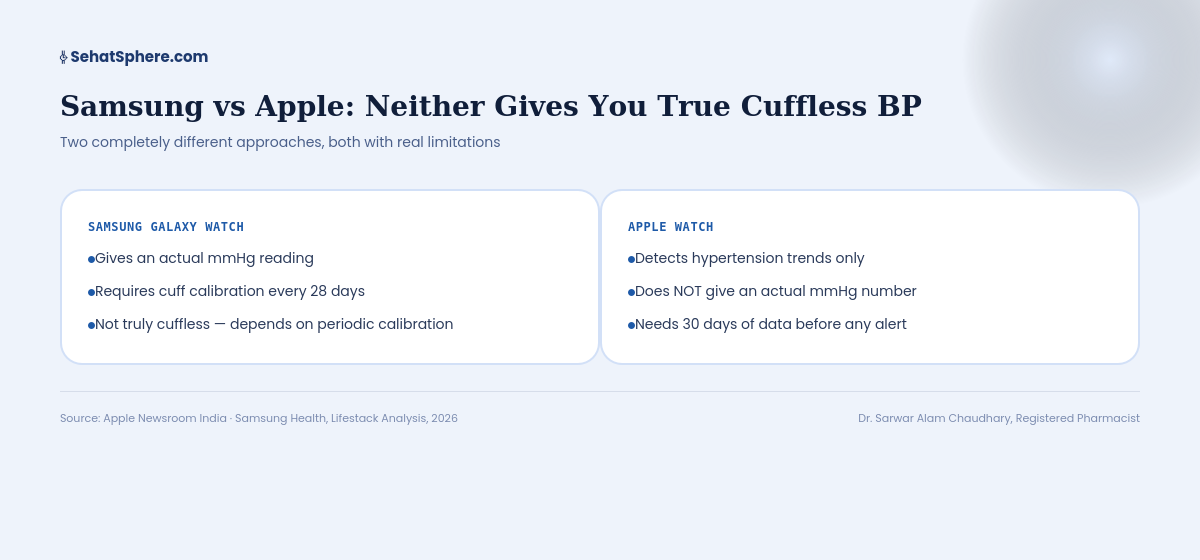
| Feature | Samsung Galaxy Watch | Apple Watch |
|---|---|---|
| Gives actual mmHg reading | Yes | No |
| Requires cuff calibration | Every 28 days | Not applicable |
| Detection window | On-demand | 30-day trend |
| India availability | Available | Confirmed launched |
Apple’s hypertension notification feature, FDA-cleared in September 2025 and launched in India, works entirely differently — it uses the optical heart sensor to analyze how blood vessels respond to each heartbeat over a full 30-day window, and simply alerts you if a consistent hypertension pattern emerges. It never gives you a number at all. The underlying algorithm was trained using machine learning on data from over 100,000 participants across multiple studies, then specifically tested in a roughly 2,000-participant clinical trial before FDA clearance — a genuinely substantial validation effort for a feature that still, by design, stops short of giving an actual reading. Apple itself estimates this feature could help identify a million previously undiagnosed hypertension cases within a year — a genuinely significant public health contribution, precisely because it’s designed as an early-warning trend detector, not a replacement for actual measurement. Our normal blood pressure by age guide is worth reading alongside this one, since knowing your actual target range matters more than any single device’s reading.
How These Devices Actually Work
Neither approach uses a true cuff mechanism. Both rely on photoplethysmography (PPG) — optical sensors using light to detect blood volume changes with each heartbeat — combined with algorithms that estimate blood pressure indirectly from that signal pattern, rather than measuring pressure directly the way an inflatable cuff does. This is precisely why calibration against a real cuff matters so much for devices like Samsung’s: the algorithm needs a genuine reference point to translate optical signal patterns into an actual pressure estimate.
Why Calibration Is the Hidden Catch
This is the single most important, most overlooked detail in the entire smartwatch blood pressure accuracy conversation: no current wearable provides truly independent, cuffless, continuously-accurate blood pressure monitoring. Samsung’s device requires an actual arm cuff for calibration every 28 days; between those calibrations, accuracy genuinely depends on how much your physiology has changed since the last reference reading. Skip the recalibration, and accuracy drifts — a genuine, documented limitation, not user error.
Our Complete Guide to Blood Pressure covers proper cuff-based measurement technique in full, which remains the actual gold standard these wearables are still working to approximate, not replace.
Wrist Position Matters More Than Most People Realize
Even leaving the underlying technology aside, physical positioning genuinely affects every wrist-based reading. Consumer Reports’ own test engineers note that wrist devices must be correctly placed directly over the radial artery and held precisely at heart level during measurement, with minimal wrist movement — get the angle or height wrong, and the reading shifts meaningfully regardless of how good the sensor itself is.
Here’s a genuinely surprising finding worth knowing: the Omron HeartGuide, a wrist-worn device with an actual inflatable cuff built in — not optical estimation, a real mechanical cuff — was rated the lowest-scoring blood pressure monitor Consumer Reports tested, despite carrying the highest price tag of any model in their review at roughly $499. Even genuine cuff technology struggles once you move it from the upper arm to the wrist, since wrist anatomy and positioning consistency are simply harder to standardize than an upper-arm cuff at a fixed, predictable height.
The Technology Behind the Numbers
Cuffless blood pressure estimation isn’t actually new — it traces back to 1993, when Casio released the BP-100, a wristwatch combining a PPG optical sensor with an ECG sensor. Modern devices build on the same underlying family of approaches, typically falling into one of a few technical categories worth knowing by name if you want to understand what your specific device claims to do:
- PAT (Pulse Arrival Time) — measures the delay between a heartbeat (via ECG) and the pulse arriving at the wrist (via PPG); shorter delay generally correlates with higher pressure.
- PTT (Pulse Transit Time) — a related approach measuring how long a pulse wave takes to travel between two points on the body, using two separate optical sensors.
- Bioimpedance — some newer prototype designs pass a small electrical current through wrist tissue and infer pressure-related changes from the resulting signal.
None of these methods measure pressure directly the way an inflating cuff physically does — they’re all indirect estimations requiring an initial reference point, which circles back to exactly why calibration against a real cuff remains unavoidable for the foreseeable future.
What’s Coming Next: The Newest FDA Milestone
This is worth knowing about specifically because it’s the most significant recent development in this exact space. In July 2025, Swiss medtech company Aktiia received the first-ever FDA clearance for an over-the-counter, fully cuffless blood pressure monitor — the Hilo Band (officially the G0 Blood Pressure Monitoring System). Unlike Samsung’s approach, which still requires periodic cuff recalibration to continue functioning, and unlike Apple’s approach, which never gives a number at all, Hilo’s device is designed to provide continuous, ongoing readings across a full 24-hour cycle after an initial one-time calibration.
The device already carries a CE mark and has over 130,000 users in Europe; its FDA clearance was supported by clinical validation against reference standards including double-auscultation measurement in 140 patients. A U.S. consumer launch is expected sometime in 2026. It’s a genuinely significant regulatory milestone — the first time the FDA has authorized any cuffless BP device for OTC use without requiring a prescription — though it’s also worth noting realistically that even this newest, most validated device still requires an initial cuff-based calibration to begin working, reinforcing just how central that step remains across every approach on the market right now.
The Broader Cardiovascular Picture Worth Tracking
Blood pressure monitoring rarely exists in isolation from the rest of your cardiovascular health. If you’re already managing risk factors, our heart attack in young adults guide and anger and blood pressure guide are both worth reading alongside this one. If cholesterol management is part of your routine, our statins guide is relevant too, since these conditions are frequently monitored together. Chronic stress genuinely affects both the accuracy of a single reading and your actual baseline — our mental stress guide covers this overlap. If you’re managing diabetes alongside blood pressure, our diabetes medicine safety guide and diabetic foot care guide both cover genuinely overlapping territory. The free Blood Report Decoder and Biological Longevity Audit are both worth using for a broader sense of where things stand.
An Interesting Side Effect: Checking Too Often Can Backfire
Here’s a genuinely underdiscussed angle worth mentioning directly: constant, anxious re-checking of a smartwatch BP feature can itself raise your reading. This isn’t a data quirk — it’s a real physiological response. The anticipatory stress of repeatedly checking a number you’re worried about triggers its own acute rise in blood pressure, similar in mechanism to the white-coat effect covered in our fluctuating blood pressure guide. Someone who checks a wrist-worn BP feature every few minutes, hunting for reassurance, can genuinely create a self-reinforcing loop where the checking behavior itself becomes a measurable stressor. A sensible middle ground — checking on a set schedule rather than compulsively, and treating any single alarming number as a prompt to breathe and recheck later rather than react immediately — tends to produce both calmer users and more representative readings.
How to Use a Smartwatch BP Feature Well
Given everything covered above, a smartwatch BP feature is still genuinely worth using — just with realistic expectations about what it can and can’t tell you. Our morning blood pressure spikes guide is worth reading alongside this one, since the time of day you happen to check your watch genuinely affects what number you’ll see, independent of any device accuracy question entirely.
- Calibrate on schedule — don’t skip the periodic cuff-based recalibration if your device requires it.
- Treat readings as trend data, not diagnostic numbers — a pattern over weeks tells you more than any single reading.
- Confirm any alert with a real cuff — exactly as Apple’s own guidance recommends: log with an actual cuff for 7 days before assuming a trend alert reflects true hypertension.
- Measure consistently — same arm, seated, rested, similar to proper cuff technique, for whatever comparison value the smartwatch data still offers.
When to Trust an Actual Cuff Instead
Any reading suggesting a hypertensive crisis (180/120 or higher) — confirm immediately with a real cuff or seek medical attention. Medication dosing decisions of any kind. Formal diagnosis of hypertension — this still requires proper clinical measurement or ambulatory monitoring. If you’re managing blood pressure medication already, our BP medicine timing guide is worth reading, since dose decisions should never rest on smartwatch data alone.
Quick Self-Check
Tick anything that applies to you, and see what it suggests.
Frequently Asked Questions
How accurate is smartwatch blood pressure measurement?
A 2022 study found significant limitations, with only 41% specificity for detecting hypertension. A more recent January 2026 study found meaningfully improved accuracy meeting ISO/IEEE standards, suggesting genuine technological progress.
Does Apple Watch actually measure blood pressure?
No. Apple Watch’s hypertension notification feature detects trends over 30 days using the optical heart sensor, but never provides an actual mmHg reading.
Why does my Samsung Galaxy Watch need calibration for blood pressure?
Samsung’s smartwatch BP feature uses optical sensor data combined with an algorithm that requires a genuine cuff-based reference point, recalibrated every 28 days, to accurately estimate pressure.
Can I trust my smartwatch instead of a blood pressure cuff?
Not for diagnosis or medication decisions. No current wearable provides true, continuous, clinically-accurate cuffless blood pressure monitoring; a real cuff remains the gold standard.
What should I do if my smartwatch shows a high blood pressure reading?
Confirm with an actual arm cuff, ideally logging readings for about 7 days, and share the results with your doctor, consistent with current medical guidance.
Is smartwatch blood pressure monitoring available in India?
Yes, both Samsung’s calibrated BP feature and Apple’s hypertension notification feature are available in India.
Which smartwatch is the most accurate for blood pressure?
Omron HeartGuide is generally considered the most accurate among wearables, since it’s the only watch with a genuine inflatable cuff built into the band rather than an optical estimate.
Does FDA clearance mean a smartwatch is clinically validated for blood pressure?
Not necessarily. A 2025-2026 American Heart Association statement specifically noted that FDA clearance does not require the same rigorous validation protocol needed to establish real-world accuracy.
Why do I need to hold my wrist at heart level for an accurate reading?
Positioning affects the pressure reading itself, not just sensor contact. Testing engineers note the device must sit directly over the radial artery and stay at heart level with minimal movement, since height differences relative to the heart genuinely change the pressure measured.
Are wrist blood pressure monitors less accurate than upper-arm cuffs?
Generally yes, even for devices using a real inflatable cuff. Consumer Reports testing found wrist-cuff monitors, including the Omron HeartGuide with a genuine mechanical cuff, scored lower for accuracy than comparable upper-arm cuff monitors.
What does PPG mean in smartwatch blood pressure sensors?
Photoplethysmography, an optical technique using light to detect blood volume changes with each heartbeat at the wrist, forming the basis for most cuffless BP estimation methods.
Can smartwatch blood pressure readings be used to diagnose hypertension?
No. Current guidance is to treat any concerning trend or reading as a prompt to confirm with an actual cuff over several days and share results with a doctor, rather than as a standalone diagnosis.
The Bottom Line
Smartwatch blood pressure accuracy is a genuinely evolving story, not a fixed verdict — older devices earned real skepticism, and newer ones are measurably closing the gap. The practical fix isn’t complicated: understand which type of feature your specific device offers, keep it properly calibrated if it requires that, and always confirm anything concerning with an actual cuff before treating it as diagnostic. These devices are genuinely useful for spotting patterns worth investigating — they’re not yet a replacement for the real measurement your doctor relies on. Our high creatinine levels guide and thyroid medicine guide are both worth reading too, since blood pressure rarely tells the whole story on its own. And if cost has ever been a factor in getting a proper upper-arm cuff monitor at home, our generic medicine pricing guide covers a related principle worth knowing about medical device and medication costs more broadly — a validated $30-40 upper-arm cuff monitor genuinely outperforms every wrist-based device covered in this guide, wearable or not, and remains the single best investment for anyone genuinely serious about tracking their numbers at home.
- Frontiers in Cardiovascular Medicine. Smartwatch-Based Blood Pressure Measurement Demonstrates Insufficient Accuracy, 2022.
- PubMed. Long-term Accuracy and Stability of Blood Pressure Measurements From a Smartwatch, January 2026.
- Apple Newsroom India. Hypertension Notifications Available Today on Apple Watch.
View All References (5) ▾
- Samsung Newsroom. Samsung’s Blood Pressure Monitoring Feature Now Available in Samsung Health.
- Lifestack. Apple Watch Blood Pressure: The Complete Guide.
- FierceBiotech. FDA Clears Its First Over-the-Counter, Cuffless Blood Pressure Wearable.
- Consumer Reports. Measuring Your Blood Pressure With a Wearable Device Isn’t a Great Idea Yet.
- MedTech Dive. How Aktiia Built the First Over-the-Counter Cuffless Blood Pressure Monitor.