
 SehatSphere
THE COMPLETE PILLAR GUIDE · BIOMARKER SCIENCE
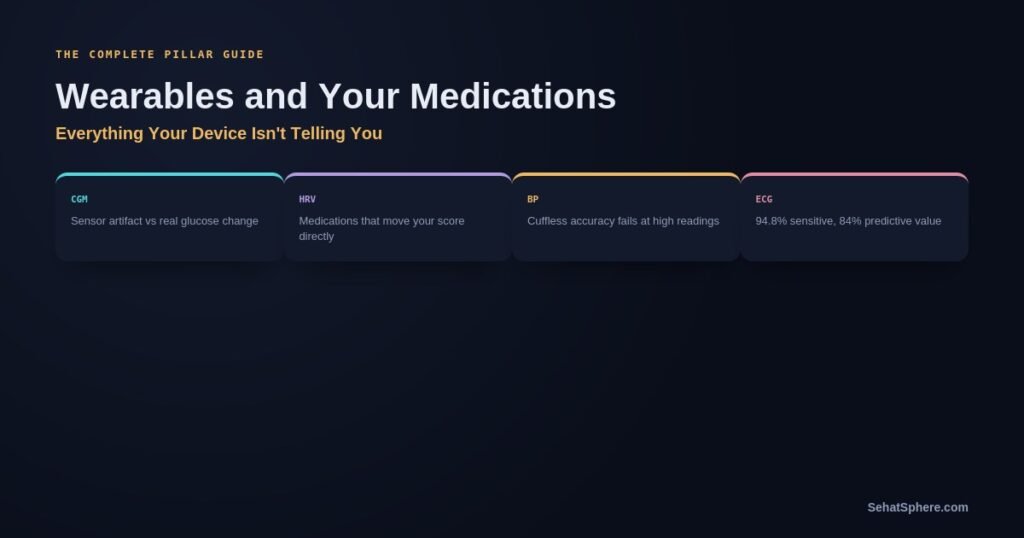
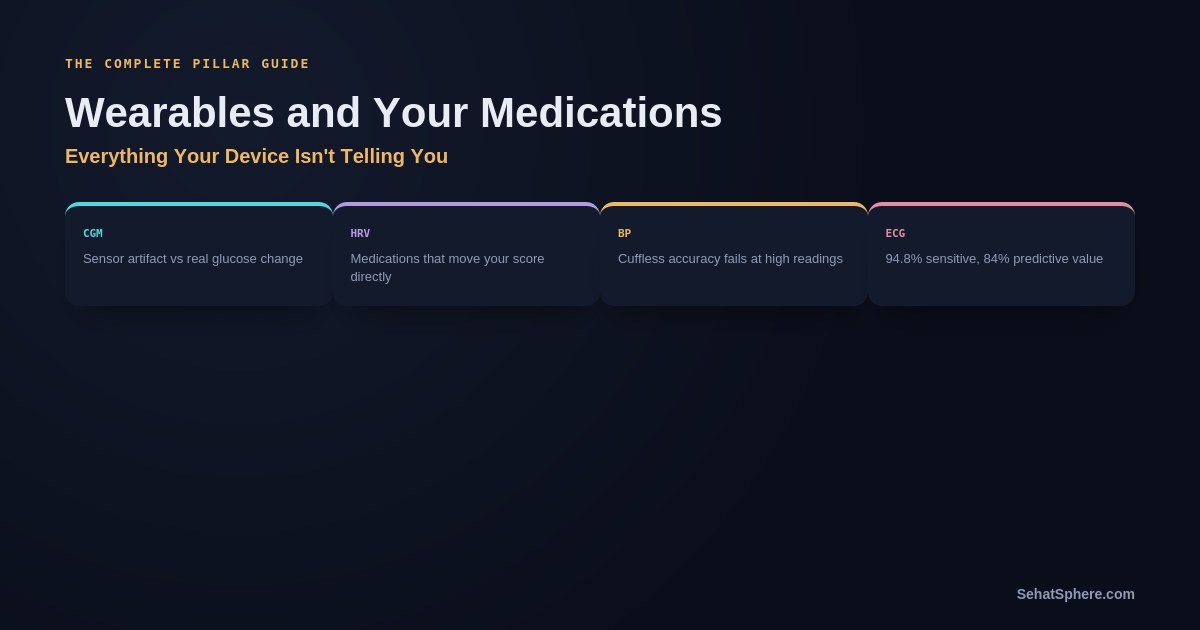
Wearables and Your Medications
Everything Your Device Isn’t Telling You
CGMs, heart rate variability rings, blood pressure watches, and ECG smartwatches now generate more health data than most doctors see in a year. Almost none of it accounts for the medications you’re already taking. This guide covers all four — in one place, for the first time.
Wearables and Your Medications: Why This Guide Exists
Four wearable categories have gone mainstream in the same eighteen-month window: continuous glucose monitors, HRV-tracking rings and bands, blood-pressure smartwatches, and ECG-capable watches for arrhythmia detection. Each has its own dedicated marketing, its own community, its own “biohacking” following. What none of them share is a warning label — because a consumer wearable isn’t required to account for the specific prescription in your medicine cabinet. This guide pulls together everything SehatSphere has independently verified about each category, plus new material on ECG watches and blood thinners that hasn’t been covered anywhere on this site before.
Continuous Glucose Monitors
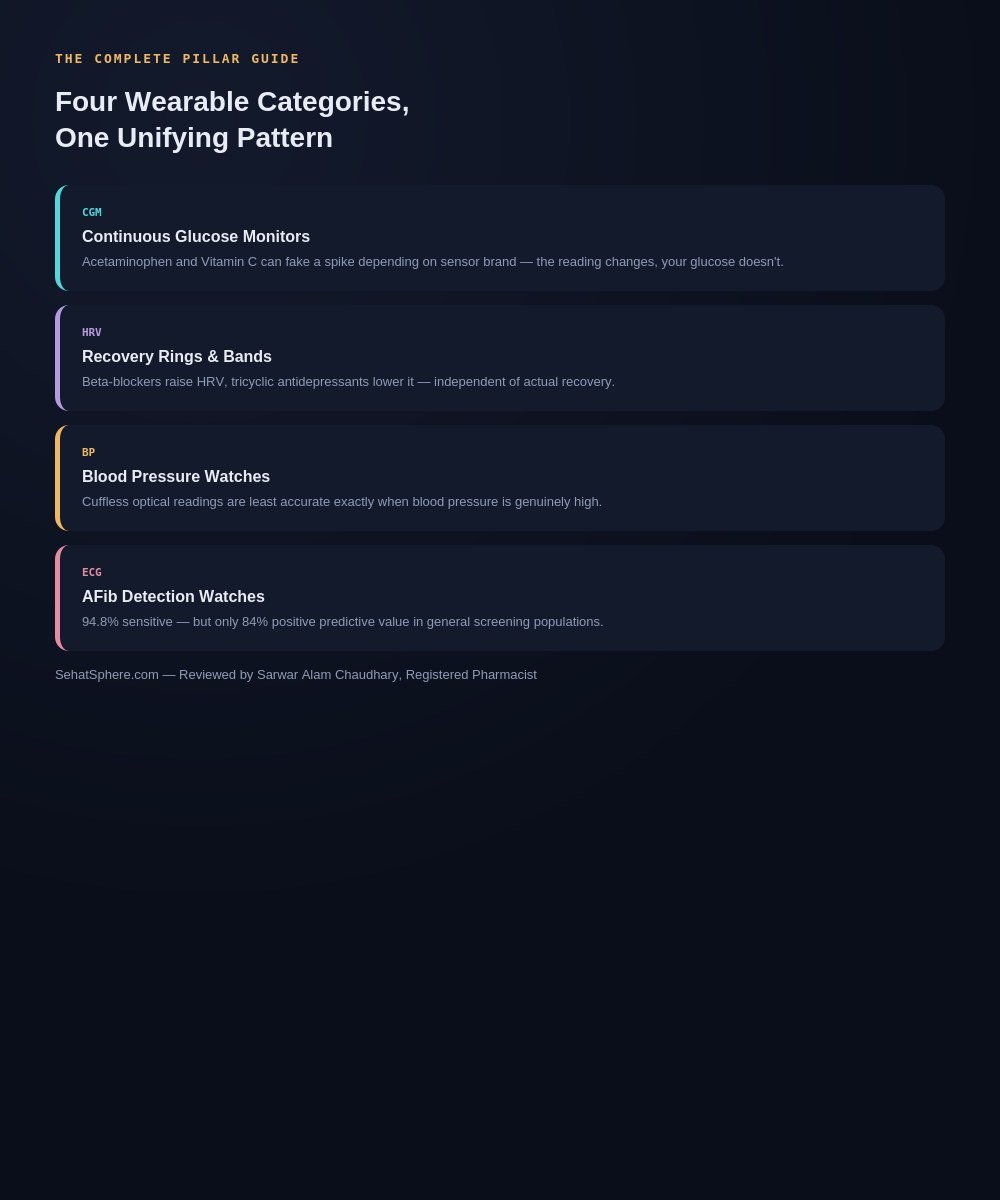
Dexcom Stelo and Abbott Lingo turned glucose monitoring into a mainstream biohacking category in 2025–2026. The gap: some medications don’t raise your glucose at all — they just fool the sensor’s chemistry into reading wrong. Acetaminophen falsely spikes Dexcom sensors specifically; Vitamin C does the same to Abbott sensors. Real physiological effects (steroids, decongestants) are a separate category entirely, and beta-blockers create a distinct danger by masking the warning symptoms of a real low.
New here: Stelo received FDA clearance on March 5, 2024 — the first over-the-counter CGM in FDA history, opening this category to anyone 18+ without a prescription.
Read the full CGM and medication guide →HRV Rings and Recovery Bands
Whoop, Oura, and Garmin all surface a daily “recovery” score built on heart rate variability. The gap: common medications move this number directly. Beta-blockers measurably increase HRV; tricyclic antidepressants measurably decrease it — independent of how rested you actually are. A rising score after starting a blood pressure medication is expected pharmacology, not proof your sleep hygiene improved.
New here: Oura is now pursuing FDA clearance for a blood-pressure feature built into the ring itself — the line between “HRV wearable” and “BP wearable” is actively dissolving as of late 2025.
Read the full HRV and medication guide →Blood Pressure Watches
Cuffless optical BP watches lack established clinical validation, and a 2026 study found their error is worst exactly when blood pressure is genuinely high — the one moment accuracy matters most. Cuff-based options (a real miniature inflatable mechanism, like the Omron HeartGuide) are the closer-to-clinical alternative.
New here: The formal benchmark for cuff-based accuracy is the AAMI/ESH/ISO 81060-2 validation protocol — asking whether a specific device passed this standard is a more useful question than asking whether it is “clinically accurate” in general.
Read the full smartwatch BP accuracy guide →ECG Watches and AFib Detection — New
Apple Watch and similar single-lead ECG watches are genuinely more rigorously studied than the other three categories: meta-analyses show roughly 94.8% sensitivity and 95% specificity for detecting atrial fibrillation against a real 12-lead ECG. That’s a strong number — but the Apple Heart Study also found a positive predictive value of only 0.84, meaning a meaningful share of “irregular rhythm” notifications in a general screening population turn out not to be true AFib on follow-up testing.
This matters directly for medication decisions. An AFib diagnosis commonly leads to a blood thinner (warfarin or a newer DOAC) to prevent stroke — a real medication with real bleeding risk. A watch notification is a reasonable prompt to get checked; it is not, on its own, sufficient grounds to start or stop an anticoagulant. If you’re already on a blood thinner, a watch-detected “normal” rhythm reading also shouldn’t be read as permission to skip a dose — the algorithms are validated for detecting AFib episodes, not for ruling out anticoagulation need.
Wearables and Your Medications: Where This Is Heading
These four categories are no longer staying in their lanes. Oura’s pursuit of a ring-based blood pressure feature is one signal; Dexcom’s $75 million investment in Oura specifically to merge glucose and ring data is another. The practical implication for the next few years: a single device on your body may soon report glucose, HRV, blood pressure, and rhythm data simultaneously — which means the medication-interaction questions in this guide won’t stay neatly separated by category for much longer. Understanding the pattern behind all four now is preparation for a wearable landscape that’s actively merging.
Wearables and Your Medications: The Scale We’re Talking About
None of these categories are niche anymore. Dexcom’s Stelo alone represents the first time in FDA history a continuous glucose monitor was cleared for purchase without a prescription — a regulatory first that opened the entire CGM category to a non-diabetic, non-insulin-using general population overnight. Multiply that shift across HRV rings, BP watches, and ECG-capable devices, and the honest picture is millions of people generating clinically-adjacent data with no clinician in the loop by default. That gap — not the technology itself — is what this guide is really about.
WEARABLES AND YOUR MEDICATIONS: THE PATTERN BEHIND ALL FOUR
Every category above splits into the same two failure modes, and recognizing which one you’re looking at changes what you should actually do about it:
Sensor Artifact
The device itself is fooled — the number is wrong, but your body never changed. CGM + acetaminophen. HRV shifts that just reflect medication pharmacology. Optical BP readings during motion.
Real Physiological Signal
The device is reporting something genuinely happening — steroid-induced glucose rise, a real AFib episode, a real blood pressure spike — that still needs correct interpretation and correct action.
Confusing the two in either direction — dismissing a real signal as “probably the device,” or panicking over an artifact as if it were real — is where most wearable-related medication mistakes actually happen.
Wearables and Your Medications: Master Checklist
- Tell your doctor and pharmacist which wearables you use and what medications you’re on — this single disclosure prevents most of the confusion covered in this guide.
- Never adjust a medication dose — glucose, blood pressure, or anticoagulant — based purely on a wearable reading.
- Confirm unexpected readings with a validated device: a fingerstick for glucose, a cuff for blood pressure, a clinical ECG for rhythm concerns.
- Know which of your specific devices are cuffless/optical (estimate-based) versus cuff or electrode-based (measurement-based) — the distinction predicts how much to trust a single reading.
- A wearable’s real value is trend awareness over weeks, not a single number treated as a lab result.
Frequently Asked Questions
Which wearable category is most clinically validated?
ECG watches for AFib detection have the strongest published accuracy data of the four (94.8% sensitivity, 95% specificity), though even here the positive predictive value in general screening is imperfect at 0.84.
My watch flagged an irregular rhythm — should I stop my blood thinner?
No. Never stop an anticoagulant based on a watch notification. A watch flag is a reason to get a clinical ECG, not a reason to change medication on your own.
Can medications affect more than one of these wearables at once?
Yes — beta-blockers, for example, appear in both the HRV and blood-pressure sections of this guide, affecting different sensors through different mechanisms.
Is any of this a reason to stop using wearables?
No. Every category here has genuine value for trend awareness. The guidance throughout is about not treating a single wearable reading as equivalent to a clinical measurement when a real decision is on the line.
Should I tell my doctor about all my wearables?
Yes — a short list of what you wear and track takes seconds to mention and can prevent misinterpreted lab results or unnecessary follow-up testing.
Which wearable is best if I’m on multiple medications?
There’s no single “best” across categories — the right choice depends on which medications you take. This guide’s four sections each flag the specific interactions relevant to that device type.
Do health wearables replace regular doctor visits?
No. Every device covered here is validated for trend awareness at best, not as a replacement for clinical measurement, lab work, or a doctor’s evaluation.
Are cheaper wearables less accurate than premium ones?
Not necessarily in a straight line — accuracy depends more on whether a device uses validated measurement technology (a real cuff, a real ECG electrode) than on price alone. A cheaper oscillometric device can outperform an expensive optical one for the specific metric it measures.
Sources
- JACC: Advances — Diagnostic Accuracy of Apple Watch ECG for AFib (Meta-Analysis)
- Accuracy of the Apple Watch for Detection of AF — Multicenter Study
- Hypertension Research — Wearable Blood Pressure Monitor Accuracy
- Dexcom — Official CGM Interfering Substances List
- FDA Clears Dexcom Stelo — First OTC Glucose Sensor in Agency History
- MedTech Dive — Oura to Pursue FDA Clearance of Blood Pressure Feature
- Circulation — Accuracy of Apple Watch for Detection of Atrial Fibrillation
Medical disclaimer: This guide is for general education only, not medical advice. Never adjust a medication based on a wearable device reading — confirm with a validated clinical measurement and your doctor.