 SehatSphere.com
Is a PPI Addictive? Pan-D & Omez Rebound Acid Risk Explained
Is a PPI addictive? If you’ve wondered whether Pan-D or Omez are secretly hooking you, you are not imagining it. Stop a proton pump inhibitor (PPI) like Pan-D (pantoprazole), Omez (omeprazole), or esomeprazole after a few weeks of regular use, and a genuine physiological phenomenon called rebound acid hypersecretion (RAHS) can push your stomach’s acid output past where it started — not because your original problem came back, but because the drug itself trained your stomach to make more acid while it was suppressing it. In one placebo-controlled trial of people with completely healthy stomachs and no history of reflux, 44% developed new heartburn, acid regurgitation, or dyspepsia within a week of stopping a 4-week course of pantoprazole, versus just 9% on placebo. That is not a coincidence and it is not “your GERD relapsing” — it is a measurable, mechanistic rebound, and understanding exactly how it happens at the cellular level is the only way to actually get off a PPI without being pulled back on by fear alone.
Key takeaways:
- Stopping a PPI after just 4-8 weeks can trigger rebound acid hypersecretion (RAHS) in a large minority of even healthy people with no prior reflux — one trial found 44% developed new dyspeptic symptoms within a week of stopping, versus 9% on placebo.
- The mechanism is measurable, not psychological: suppressing acid removes a natural brake on the hormone gastrin, gastrin drives growth of acid-making cells, and stopping abruptly unmasks that enlarged secretory capacity.
- A 2024 scientific review concluded PPIs are not “addictive” in the pharmacological sense of opioids or nicotine, but the stop-worsen-restart cycle functionally traps many users in a loop that feels identical to dependence.
- Long-term PPI use carries real, FDA-flagged risks — magnesium deficiency after a year or more, a possible fracture-risk signal at high doses, B12 malabsorption, and a large cohort study linking chronic use to roughly 35-50% higher chronic kidney disease risk (an association, not proven causation).
- Some feared risks are weaker than headlines suggest: recent trial-level evidence found no significant increase in C. difficile infection risk, contradicting older, more alarming observational data.
- Gastroenterology’s own 2022 clinical guidance says most people without a definitive indication (severe esophagitis, Barrett’s esophagus, or high bleeding risk) are reasonable candidates for a supervised taper — never an abrupt, unsupervised stop.
- Over-the-counter PPIs are legally capped at three 14-day courses a year for a specific reason — needing it more often than that is itself a signal to see a doctor, not a reason to simply buy another box.
- Why stopping feels impossible: the restart cycle
- What rebound acid hypersecretion actually is
- The cellular mechanism: gastrin, ECL cells & the proton pump
- The evidence: what the trials actually found
- Are PPIs “addictive”? What the word should mean here
- Who should NOT try to stop (the red flags)
- How to actually taper off a PPI
- The clopidogrel problem & other interactions
- The long-term risk list: what’s real, what’s overblown
- The OTC 14-day rule (and why it exists)
- Alarm symptoms: when this isn’t a tapering problem
- Self-check: should you talk to your doctor about stopping?
- FAQs
Why Stopping Feels Impossible: The Restart Cycle
The pattern I hear at the pharmacy counter is almost always the same. Someone takes omeprazole or pantoprazole for a few weeks, feels completely fine, decides they’re “cured,” and stops. Within days — sometimes within 48 hours — the heartburn comes back, and it often comes back worse than before they ever started the medicine. The natural conclusion is “I guess I need this forever,” and the pill goes back into the daily routine, often without ever asking a doctor whether it was still needed in the first place. This is the exact pattern that has made PPIs one of the most chronically over-continued drug classes in medicine — not because doctors keep prescribing them indefinitely on purpose, but because the drug itself makes stopping feel like proof that you can’t live without it.
What’s actually happening in that gap between stopping and the symptoms returning is a real, published, mechanistic phenomenon called rebound acid hypersecretion — and it happens to people with completely normal, healthy stomachs, not just to people with real reflux disease. That distinction is the single most important thing in this entire guide: if a drug makes healthy volunteers with no history of heartburn develop new heartburn simply by giving them the drug and then taking it away, the symptom cannot be “your original disease relapsing.” It has to be something the drug itself did.
This isn’t a call to panic about a medicine millions of people genuinely need. It’s the opposite — understanding the real mechanism is what lets you tell the difference between a temporary, expected rebound window and a genuine reason to stay on the drug long-term, instead of guessing based on how bad the first few days feel.
What Rebound Acid Hypersecretion Actually Is
Rebound acid hypersecretion (RAHS) is a documented, temporary increase in gastric acid output above pre-treatment baseline, occurring after a course of acid-suppressing therapy is stopped. It is distinct from your original condition simply returning in two specific ways that matter clinically: it happens fast (within days, not the weeks-to-months it typically takes GERD symptoms to gradually resurface), and it can occur in people who had no acid-related symptoms whatsoever before starting the drug.1,2
A 2024 scientific review in the International Journal of Molecular Sciences, titled bluntly “Rebound Acid Hypersecretion after Withdrawal of Long-Term Proton Pump Inhibitor Treatment — Are PPIs Addictive?”, laid out the physiological timeline: measurable gastric hyperacidity can persist for more than 8 weeks but less than 26 weeks after extended PPI treatment is stopped, even though most people’s actual symptoms settle down considerably faster than that.3 The gap between “the physiological rebound is still measurable” and “the symptoms have mostly faded” is exactly why so many people restart the drug during a window when their body was already most of the way through recovering.
The Cellular Mechanism: Gastrin, ECL Cells & the Proton Pump
To understand why stopping a PPI can genuinely make your stomach produce more acid than before you started, you need to follow one hormone through a feedback loop that the drug quietly breaks.
Step 1: The proton pump itself
PPIs work by irreversibly binding the H+/K+-ATPase enzyme — the “proton pump” — sitting on the surface of gastric parietal cells. This pump is the final common step of acid secretion: no matter whether the stimulus was histamine, gastrin, or the vagus nerve, every signal to make acid ultimately has to pass through this one pump. Because the binding is irreversible, a single dose doesn’t wear off the way most drugs do — acid secretion only recovers as the parietal cell manufactures brand-new, un-blocked pump molecules, which is part of why once-daily dosing still gives roughly 24 hours of acid control despite the drug itself clearing from the blood in just 1-2 hours.
Step 2: Gastrin loses its brake
Under normal conditions, stomach acid itself acts as a brake on a hormone called gastrin, which is released by G-cells in the stomach lining specifically to stimulate more acid production. It’s a classic negative-feedback loop: acid rises, gastrin release is suppressed, acid production levels off. A PPI breaks this loop from the other end — by suppressing acid so effectively, it removes gastrin’s normal brake entirely, and serum gastrin levels climb well above normal. This state is called hypergastrinemia, and it is a well-documented, expected consequence of PPI therapy, not a rare side effect.
Step 3: ECL cells and parietal cells grow
Chronically elevated gastrin doesn’t just sit in the blood — it actively signals. Gastrin binds CCK2 receptors on enterochromaffin-like (ECL) cells, triggering histamine release (histamine being another major acid-stimulating signal) and, over weeks to months, a genuine trophic (growth-promoting) effect that increases both ECL cell numbers and parietal cell mass. In effect, your stomach quietly builds a larger, more capable acid-producing workforce while the PPI keeps that workforce’s output blocked at the final step.
Step 4: The rebound, when the blockade lifts
Stop the PPI, and the pump blockade disappears within days as new pump molecules are synthesized — but the enlarged, hypergastrinemia-driven acid-secreting capacity built up during treatment doesn’t disappear nearly as fast. For a window that can run from several weeks up to roughly six months in people who were on long-term therapy, the stomach has more acid-making machinery than it started with and nothing left blocking it — hence rebound acid hypersecretion exceeding the original baseline.3
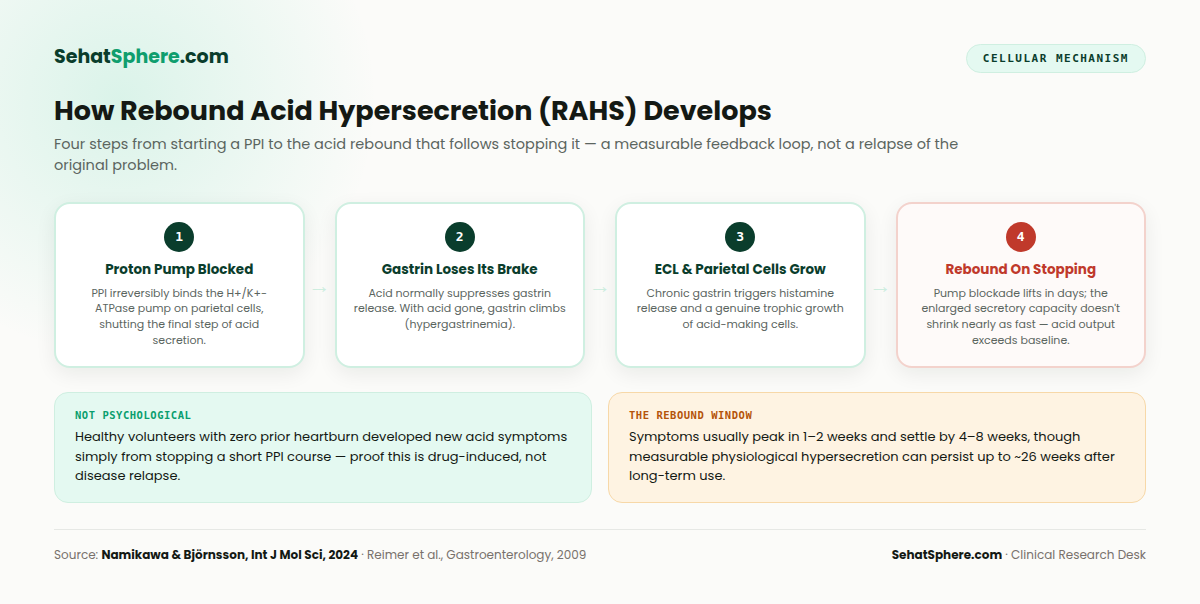
A PPI doesn’t just turn acid production “off” — it forces the stomach to try harder to make acid, building extra acid-making capacity behind the blockade. Stopping suddenly is like releasing a compressed spring: the compensation was real, and so is the release.
The Evidence: What the Trials Actually Found
The strongest evidence for RAHS doesn’t come from patients who already had GERD — it comes from healthy volunteers with no acid-related symptoms at all, given a PPI purely as a research intervention and then switched to placebo. Two separate placebo-controlled trials found essentially the same thing.
| Study | Participants | Protocol | Result After Stopping |
|---|---|---|---|
| Reimer et al., Gastroenterology, 20091 | 120 | Esomeprazole 40mg/day × 8 weeks, then 4 weeks placebo, vs. 12 weeks placebo throughout | 22% / 22% / 21% reported dyspepsia, heartburn, or regurgitation at weeks 10-12, vs. 7% / 5% / 2% on placebo |
| Niklasson et al., Am J Gastroenterol, 20102 | 48 | Pantoprazole 40mg/day × 4 weeks (H. pylori-negative volunteers), then 6 weeks observation | 44% developed dyspeptic symptoms in week 1 post-treatment, vs. 9% on placebo |
Both trials share the detail that makes them so persuasive: every participant was healthy and asymptomatic before enrollment. There was no pre-existing GERD to “relapse.” The symptoms that appeared after stopping were, by elimination, caused by the treatment-and-withdrawal cycle itself — which is precisely why the review discussed above uses the word “induces” rather than “unmasks” in its own title: Proton-Pump Inhibitor Therapy Induces Acid-Related Symptoms in Healthy Volunteers After Withdrawal of Therapy.1
Is a PPI Addictive? What “Addictive” Should Actually Mean Here
The word “addictive” is doing a lot of loose work online, so it’s worth being precise. Pharmacological addiction — the kind associated with opioids, nicotine, or benzodiazepines — involves a reward pathway in the brain, tolerance that requires escalating doses for the same effect, and often drug-seeking behavior driven by craving. PPIs do none of this. There is no reward-pathway activation, no euphoria, and no need to keep raising the dose to get the same acid control.3
What PPIs do cause is something more specific and, in a way, more interesting: a genuine physiological rebound that creates a behavioral loop indistinguishable from dependence from the patient’s side of the counter. You stop, you feel worse than before you started, you restart, you feel better, and the pattern repeats — not because your brain craves the drug, but because your stomach’s acid-making machinery temporarily overshot. The 2024 review that posed this exact question in its title concluded that “addictive” isn’t the pharmacologically correct term, but acknowledged the functional trap is real enough that patients and prescribers alike consistently mistake it for one.3
Calling PPIs “addictive” like opioids overstates the pharmacology. Calling the rebound-restart cycle “nothing to worry about” understates the lived experience. Both are real — the mechanism is physiological rebound, not addiction, but the practical result for someone trying to stop without guidance can feel exactly the same.
Who Should NOT Try to Stop (The Red Flags)
Before anything else in this guide: rebound acid hypersecretion is a reason to taper thoughtfully, not a reason to assume everyone should get off PPIs. Some people have a genuine, ongoing indication where stopping — even carefully — carries real risk, and the 2022 American Gastroenterological Association (AGA) Clinical Practice Update on De-Prescribing PPIs is explicit that these groups should generally continue therapy under their doctor’s guidance rather than attempt a taper on their own initiative:4
- Severe erosive esophagitis, esophageal ulcers, or peptic strictures — “complicated” GERD that needs sustained acid suppression to heal and stay healed.
- Barrett’s esophagus — a precancerous change in the esophageal lining where ongoing acid control is part of standard management.
- Eosinophilic esophagitis — PPIs are a recognized first-line treatment in a meaningful subset of these patients.
- Idiopathic pulmonary fibrosis — some guidance continues PPI therapy in this population for reasons distinct from reflux itself.
- High upper GI bleeding risk — long-term aspirin, NSAID, or multiple-anticoagulant use with a prior GI bleed history.
The AGA’s core principle is worth repeating exactly as written: the decision to de-prescribe should be based solely on the absence of a valid ongoing indication — never on fear of side effects alone, and never in a patient who still has one of the reasons above. If you fall into any of these categories, this guide’s tapering advice does not apply to you without your prescribing doctor’s direct involvement.
How to Actually Taper Off a PPI
For everyone else — people taking a PPI without one of the red-flag indications above, often started years ago for a mild or self-limited issue and never formally reassessed — the AGA’s guidance and the trial data above point to a specific, sensible approach rather than an abrupt stop-and-hope strategy.4
1. Confirm there’s no ongoing reason to stay on it
This is step zero, and it belongs in a conversation with your doctor, not a Google search — the AGA’s first recommendation is a “regular review and documentation of the ongoing indication,” which most long-term users have simply never had.
2. Step down dose before stepping off entirely
If you’re on twice-daily dosing, most guidance supports moving to once-daily first. From once-daily, options include gradually spacing doses (e.g., every other day) or switching to “on-demand” dosing — taking it only on days symptoms actually occur — before stopping completely. The AGA update notes both gradual tapering and abrupt discontinuation “can be considered,” but explicitly recommends counseling patients about the possibility of transient rebound symptoms either way, so the expectation is set before the attempt, not after.4
3. Consider an H2-blocker “bridge”
H2-receptor antagonists (like famotidine) work through a different mechanism — blocking histamine’s H2 receptor on the parietal cell rather than the proton pump itself — and don’t drive the same gastrin-hyperplasia cycle. Using a short course of an H2 blocker specifically during the rebound window can blunt symptoms enough to get through the physiological adjustment period without simply restarting the PPI. This is a strategy to discuss with your doctor or pharmacist rather than self-select, since dosing and duration depend on your specific history.
4. Expect and plan for the window, not the day
Based on the trial data above, expect the worst of any rebound symptoms in roughly the first one to two weeks, with most people’s symptoms settling within four to eight weeks — while keeping in mind the physiological hypersecretion itself can measurably persist for up to six months in people who were on long-term therapy.3 Knowing this in advance is often the single biggest factor in whether someone pushes through a taper or panics and restarts on day four.
Adding an antacid, H2 blocker, or herbal remedy during a taper? Cross-check it against everything else you’re taking before you combine anything.
Check Interactions Free →The Clopidogrel Problem & Other Interactions
Beyond the rebound-acid story, PPIs create acid conditions that some other drugs actually depend on — and one interaction is important enough that the FDA placed a boxed warning about it directly on the clopidogrel (Plavix) label.
Clopidogrel (Plavix)
Clopidogrel is a prodrug — it has to be activated by a liver enzyme called CYP2C19 before it can do its job of preventing platelet clots, which matters enormously in people with cardiac stents or a recent heart attack. Omeprazole and, to a lesser extent, esomeprazole are meaningful inhibitors of that same CYP2C19 enzyme, competing for the same metabolic pathway clopidogrel needs to become active. The practical concern is reduced clopidogrel effectiveness in exactly the patients who can least afford it — those relying on it to keep a coronary stent clot-free. If you are on clopidogrel after a stent or heart attack, this combination needs your cardiologist’s direct input; pantoprazole is generally considered to interact with CYP2C19 less than omeprazole, but the decision should never be made by simply swapping brands on your own.
Drugs that need stomach acid to absorb
Several other medicines depend on an acidic stomach environment for proper absorption, and PPI-induced hypochlorhydria (low acid) can blunt how much of the drug actually gets into your bloodstream. This includes certain antifungals (like ketoconazole and itraconazole), some HIV medications, and — as covered in more detail below — dietary iron. If you’re taking a PPI alongside any prescription that specifically says “take on an empty stomach” or notes acid-dependent absorption on its label, flag the combination with your pharmacist rather than assuming it’s automatically fine.
The Long-Term Risk List: What’s Real, What’s Overblown
Long-term PPI use has accumulated a long list of associated risks in the medical literature over the past 15 years. Some are strong enough that the FDA has issued formal safety communications; others are weaker than headlines suggest once you look at how the underlying studies were actually designed. Being honest about both is the only way this list is actually useful to you. If you’re on a long-term PPI and want to check whether your symptoms line up with any of the deficiencies below, our nutrient deficiency finder tool is a useful starting point before your next lab test.
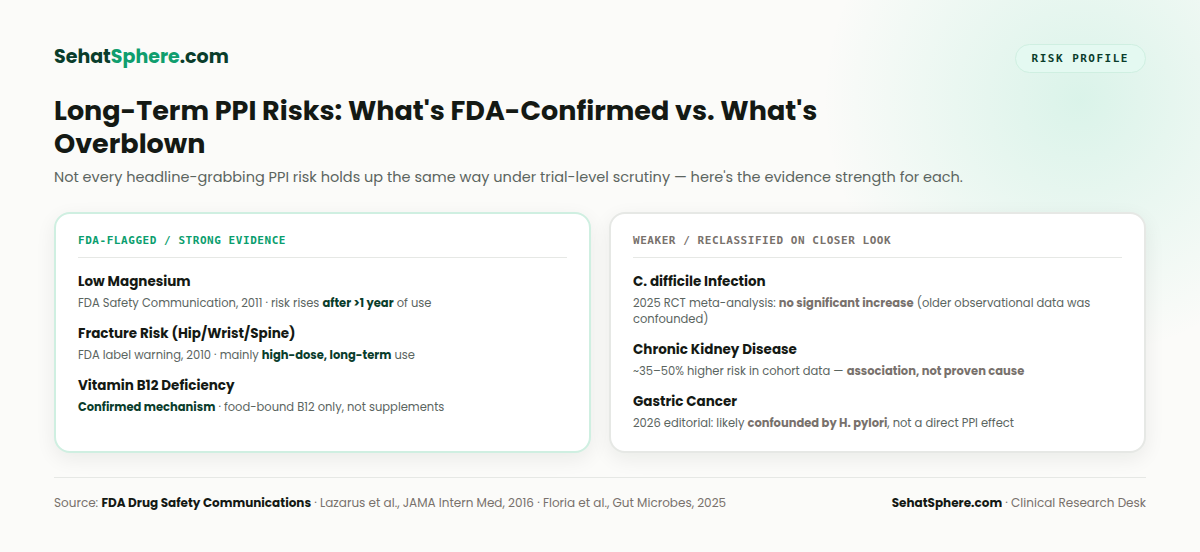
Magnesium deficiency (hypomagnesemia) — FDA-confirmed, dose-dependent on duration
In March 2011, the FDA issued a formal Drug Safety Communication after reviewing cases of low serum magnesium associated with PPI use lasting longer than one year.5 Notably, in roughly one-quarter of the cases reviewed, magnesium supplementation alone did not correct the deficiency — the PPI itself had to be discontinued before magnesium levels normalized, which is a meaningfully strong signal for causation rather than coincidence. Symptoms can include muscle spasms, irregular heartbeat, and seizures, though many people remain asymptomatic until levels are checked — our magnesium deficiency symptoms guide covers what to watch for in more detail.
Vitamin B12 deficiency — real mechanism, food-bound B12 only
Vitamin B12 naturally present in food arrives bound to dietary protein, and it takes stomach acid and pepsin (itself activated by acid) to cleave B12 free before it can be absorbed further down the gut. PPI-suppressed acid impairs exactly this step. Importantly, this mechanism only affects protein-bound, food-source B12 — synthetic B12 in supplements and fortified foods is already free-form and absorbs normally regardless of stomach acid, which is why a B12 supplement remains an effective fix for someone who cannot come off a PPI. If you want the full picture of how this deficiency actually develops, see our guide to vitamin B12 deficiency.
Fracture risk — FDA-flagged, mainly at high dose and long duration
The FDA revised PPI labeling in 2010 to warn of a possible increased risk of hip, wrist, and spine fractures, based on several observational studies, with the concern concentrated in high-dose and long-term (generally over one year) use.6 The proposed mechanism includes reduced calcium absorption in a lower-acid stomach environment, though the exact contribution of PPIs versus the underlying health status of long-term users remains debated.
Chronic kidney disease — a real association, not proven causation
A widely cited 2016 study in JAMA Internal Medicine, following over 10,000 participants in the Atherosclerosis Risk in Communities cohort (and replicated in a separate 250,000-patient health-system dataset), found PPI users had roughly 50% higher adjusted risk of incident chronic kidney disease compared to non-users, and about 39% higher risk compared to H2-blocker users.7 The authors were careful to frame this as an association from observational data, not proof that PPIs directly cause kidney damage — but it’s a large, well-adjusted cohort study, and it’s a meaningful part of why “does this person still need a PPI” is now a standard question in kidney-risk assessment.
C. difficile infection — weaker than older data suggested
Older observational studies suggested PPI users were up to twice as likely to develop Clostridioides difficile infection, largely attributed to reduced acid’s role in killing ingested spores. However, a 2025 systematic review and meta-analysis restricted specifically to randomized controlled trials found that PPIs did not significantly increase C. difficile risk compared to placebo or other acid-suppressing drugs.8 The authors attribute the gap to confounding in the observational data — PPI users in those studies tended to be older, hospitalized, and more heavily exposed to antibiotics, all of which independently raise C. difficile risk regardless of the PPI itself. This is a good example of why trial-level evidence sometimes overturns a scarier-sounding association.
Gastric cancer signal — likely confounded, not established
Some population studies have linked long-term PPI use to a modestly higher rate of gastric cancer, with proposed mechanisms including hypergastrinemia’s trophic effects, accelerated atrophic gastritis, and bacterial changes that can promote carcinogenic nitroso compounds. A 2026 editorial in Gut and Liver examining this evidence concluded the excess is more likely explained by residual undetected H. pylori infection and the fact that PPI use itself is often a marker of pre-existing upper GI symptoms, rather than PPIs directly causing cancer.9 This remains an active area of research, and it’s a legitimate part of the case for periodic reassessment — not a reason for panic in someone using a PPI appropriately.
Iron deficiency — same acid-dependent absorption problem as B12
Non-heme dietary iron arrives in the oxidized ferric (Fe³⁺) state and must be reduced to the absorbable ferrous (Fe²⁺) state, a conversion that gastric acid substantially assists. In the more alkaline stomach environment a PPI creates, more of that iron can re-oxidize back to the poorly absorbed ferric form before it ever reaches the point of absorption in the duodenum, which is a recognized contributor to iron deficiency in some long-term PPI users. For a full breakdown of how iron deficiency actually develops and progresses in stages, see our complete guide to iron deficiency anemia.
None of this means “get off your PPI immediately.” It means a PPI, like any long-term medicine, deserves a periodic real conversation about whether the original reason for taking it is still there — which is exactly the AGA’s own core recommendation above.
The OTC 14-Day Rule (And Why It Exists)
Over-the-counter PPIs like Prilosec OTC (omeprazole) and its equivalents carry a specific label instruction that most people skim past: do not use for more than 14 days, and do not repeat a 14-day course more often than every 4 months — in practice, a cap of roughly three 14-day courses per year.10 This isn’t an arbitrary marketing restriction. It reflects exactly the mechanism covered throughout this guide: the OTC formulation is intended for short, self-limited episodes of frequent heartburn, and both the rebound-hypersecretion risk on stopping and the long-term risk list above scale with how long and how continuously the drug is used.
The label’s own guidance is direct: if you find yourself needing to repeat the 14-day course sooner than every four months, or more than roughly twice a year, that itself is a signal to see a doctor rather than simply purchasing another box. Ongoing, near-continuous “OTC PPI use” without ever being formally evaluated is one of the most common ways people end up on an indefinite PPI with no one having actually confirmed they need one.
Alarm Symptoms: When This Isn’t a Tapering Problem
Everything in this guide assumes ordinary, garden-variety acid reflux or dyspepsia. Certain symptoms alongside reflux are considered “alarm features” in gastroenterology precisely because they can signal something that needs direct medical evaluation — an endoscopy, blood work, or imaging — rather than either a PPI taper or another round of self-treatment:
- Unintentional weight loss
- Difficulty or pain swallowing (dysphagia or odynophagia)
- Signs of GI bleeding — black, tarry stools, or vomiting blood or material resembling coffee grounds
- Persistent vomiting
- New reflux symptoms after age 60
- Iron-deficiency anemia found on blood work with no other obvious cause
- A family history of upper GI cancer
If any of these apply to you, the priority is a proper diagnostic workup — not deciding whether to taper a PPI or reach for an antacid. These symptoms exist on medical alarm-feature lists specifically because self-management can delay a diagnosis that genuinely benefits from being caught early.
Self-Check: Should You Talk to Your Doctor About Stopping?
This isn’t a diagnostic tool, and it doesn’t replace your doctor’s judgment — but if several of these describe your situation, it’s a genuinely good reason to raise the specific question of de-prescribing at your next visit, rather than continuing indefinitely by default or stopping cold turkey on your own:
Related Reading
- Chronic Antacid Use & Mineral Malabsorption — the same acid-suppression mineral story, from the antacid side.
- Pantoprazole Side Effects: The Complete Guide — a full breakdown of one specific PPI.
- The Complete Guide to Medicine Safety — the WHO’s 5 Moments framework for every medicine you take, not just this one.
- Iron Deficiency Anemia: Signs, Stages & Fixes — how the same acid-dependent absorption story plays out with iron.
The Bottom Line
Rebound acid hypersecretion is real, measurable, and mechanistic — not a sign of weakness, and not proof you need a PPI for life. If you don’t have one of the genuine long-term indications covered above, a supervised, expectation-set taper (not an abrupt unsupervised stop, and not indefinite continuation by default) is the evidence-backed path most people in that position should be discussing with their doctor.
Frequently Asked Questions
Is a PPI addictive, like Pan-D or Omez?
Not in the pharmacological sense of opioids or nicotine — there’s no reward pathway or craving involved. What they cause is rebound acid hypersecretion after stopping, which creates a stop-worsen-restart cycle that feels like dependence even though the mechanism is physiological rebound, not addiction.
What is rebound acid hypersecretion?
A documented increase in stomach acid production above your original baseline after stopping a PPI, caused by elevated gastrin and enlarged acid-producing cell populations that built up while the drug was suppressing acid output.
How long does rebound acid last after stopping a PPI?
Symptoms typically peak in the first one to two weeks and settle within four to eight weeks for most people, though the underlying physiological hypersecretion can measurably persist for up to roughly six months after long-term therapy.
Can I just stop taking my PPI cold turkey?
For most people without a red-flag indication (like Barrett’s esophagus or severe esophagitis), abrupt stopping is an option guidance considers acceptable, but a gradual step-down with your doctor’s input and clear expectations about rebound symptoms generally leads to a more successful, less panic-driven outcome.
What can I take instead of a PPI during rebound?
An H2-blocker such as famotidine works through a different mechanism and doesn’t drive the same rebound cycle, making it a common “bridge” option during a taper — discuss the specific choice and duration with your doctor or pharmacist.
How long is it safe to take a PPI?
There’s no universal cutoff — it depends entirely on your specific indication. People with a genuine chronic indication (Barrett’s esophagus, severe esophagitis) may need indefinite therapy, while many others are on it far longer than their original reason ever required and are reasonable candidates for reassessment.
Does long-term PPI use cause kidney disease?
A large cohort study found PPI users had roughly 35-50% higher adjusted risk of chronic kidney disease compared to non-users, but this is an association from observational data, not confirmed proof of direct causation.
Do PPIs cause vitamin B12 or magnesium deficiency?
Magnesium deficiency is FDA-confirmed with use beyond one year. B12 deficiency has a real, understood mechanism (impaired release of B12 from dietary protein) but only affects food-bound B12 — supplement-form B12 still absorbs normally.
Can I take a 14-day OTC PPI course back-to-back?
No — the label instructs a maximum 14-day course, not repeated more often than every 4 months. Needing it sooner or more than about twice a year is a signal to see a doctor rather than repeat the OTC course.
Do PPIs cause C. difficile infection?
Older observational studies suggested up to double the risk, but a 2025 systematic review of randomized controlled trials found no significant increase — the earlier signal appears largely explained by confounding factors like age, hospitalization, and antibiotic exposure in PPI users.
What are the warning signs I shouldn’t just manage reflux myself?
Unintentional weight loss, difficulty swallowing, signs of GI bleeding (black stools or vomiting blood), persistent vomiting, new symptoms after age 60, unexplained iron-deficiency anemia, or a family history of upper GI cancer all warrant prompt medical evaluation rather than self-treatment.
Is it safe to take a PPI during pregnancy?
A large Danish cohort study (Pasternak & Hviid, New England Journal of Medicine, 2010) and subsequent reviews found no increased risk of birth defects, miscarriage, or preterm delivery with omeprazole or esomeprazole use in pregnancy, though any medication decision during pregnancy should still be made together with your obstetric provider.
One Last Thing
If you take one thing from this guide, let it be this: the fact that stopping your PPI made you feel worse is not proof you’ll need it forever. It’s evidence of a well-documented, time-limited rebound — one your body can genuinely recover from with the right plan and, where appropriate, your doctor’s involvement.
- Reimer C, Sondergaard B, Hilsted L, Bytzer P. Proton-pump inhibitor therapy induces acid-related symptoms in healthy volunteers after withdrawal of therapy. Gastroenterology. 2009;137(1):80-87.
- Niklasson A, Lindström L, Simrén M, Lindberg G, Björnsson E. Dyspeptic symptom development after discontinuation of a proton pump inhibitor: a double-blind placebo-controlled trial. American Journal of Gastroenterology. 2010;105(7):1531-1537.
- Namikawa K, Björnsson ES. Rebound Acid Hypersecretion after Withdrawal of Long-Term Proton Pump Inhibitor (PPI) Treatment — Are PPIs Addictive? International Journal of Molecular Sciences. 2024;25(10):5459.
- Targownik LE, Fisher DA, Saini SD. AGA Clinical Practice Update on De-Prescribing of Proton Pump Inhibitors: Expert Review. Gastroenterology. 2022.
- U.S. Food and Drug Administration. FDA Drug Safety Communication: Low magnesium levels can be associated with long-term use of Proton Pump Inhibitor drugs (PPIs). March 2, 2011.
View All References (10)
- U.S. Food and Drug Administration. FDA Drug Safety Communication: Possible increased risk of fractures of the hip, wrist, and spine with the use of proton pump inhibitors. 2010 (updated 2011).
- Lazarus B, Chen Y, Wilson FP, et al. Proton Pump Inhibitor Use and the Risk of Chronic Kidney Disease. JAMA Internal Medicine. 2016;176(2):238-246.
- Floria DE, et al. Proton pump inhibitors are not associated with an increased risk of Clostridioides difficile infection: a systematic review and meta-analysis of randomized controlled trials. Gut Microbes. 2025;17(1):2562341.
- Yoo HW. Long-Term Proton Pump Inhibitor Use and Gastric Cancer Risk: Interpreting Population-Based Evidence. Gut and Liver. 2026;20(4):497-498.
- Pasternak B, Hviid A. Use of proton-pump inhibitors in early pregnancy and the risk of birth defects. New England Journal of Medicine. 2010;363(22):2114-2123; U.S. Food and Drug Administration, Prilosec OTC drug facts label (14-day course dosing instructions).