 SehatSphere.com
Chronic Antacid Use and Mineral Malabsorption: Why It Quietly Causes Fatigue
- Chronic antacids and daily PPIs do more than quiet heartburn — they convert magnesium, iron, and vitamin B12 into forms your intestine can actually absorb, and suppressing acid for months quietly shuts that conversion step down, mineral by mineral.
- The FDA has issued two separate, specific warnings on this: a 2011 communication on low magnesium (risk climbs after roughly one year of continuous use) and a 2010 communication on fracture risk tied to high-dose, long-term use.
- A
2026 study of 255 long-term PPI users found vitamin B12 deficiency in 38.6% to 59.0% of patients depending on which PPI they took, magnesium deficiency up to 39.3%, and calcium deficiency up to 31.0%. - Two real, published 2024 case reports show how far this can go: PPI-induced magnesium crashes severe enough to cause seizures and reversible cognitive decline — both patients fully recovered after stopping the drug.
- Four minerals fail for four genuinely different chemical reasons — this isn’t one blanket “acid is good” story, and knowing which mechanism applies to your medication changes what actually helps.
- Stopping a long-term PPI abruptly triggers rebound acid hypersecretion. The real fix is a supervised taper, not cold turkey — this article covers the actual protocol.
- 1. Chronic Antacids: The Habit Nobody Questions
- 2. Why Stomach Acid Controls Absorption
- 3. The Fatigue Loop: Four Minerals, Four Mechanisms
- 4. What the FDA Actually Warned About
- 5. Two Real Published Cases
- 6. Clinical Impact Matrix
- 7. Who’s Most at Risk
- 8. How Long Have You Been Taking One?
- 9. The Safe Tapering Protocol
- 10. Fatigue & Malabsorption Self-Check
- 11. Quick Knowledge Check
- 12. FAQs
- 13. References
1. Chronic Antacids: The Habit Nobody Questions
At the pharmacy counter, this is one of the most routine conversations I have. Someone buys a strip of omeprazole or pantoprazole the way they’d buy a painkiller — take one, feel better in twenty minutes, forget about it. Nobody asks what a proton pump inhibitor (PPI) actually does inside the stomach, because nobody needs to. It works. That’s the entire evaluation.
The problem isn’t the occasional tablet after a heavy meal. It’s when that tablet turns into chronic antacids use — a strip that becomes a monthly refill, then a permanent fixture in the bag, taken without a prescription review for years. PPIs are among the most-used drug classes worldwide, and a large share of that use is unsupervised, over-the-counter, and open-ended — nobody set an end date because nobody thought there needed to be one.
That open-endedness is exactly what turns a genuinely useful, short-term drug class into a long-term absorption problem. If your own reflux keeps resurfacing, it’s worth reading why in our GERD and silent reflux management guide before reaching for another refill — treating the actual cause sometimes removes the need for daily acid suppression altogether.
2. Why Stomach Acid Controls Absorption
Most people think of stomach acid (hydrochloric acid, HCl) as the thing that causes heartburn and digests food — full stop. Clinically, that’s only half its job. The other half is chemistry most patients never hear explained: HCl is what converts several key minerals from a form your food carries them in into a form your intestine can actually pull into the bloodstream.
Neutralize that acid for months at a time — which is exactly what a PPI or a daily antacid is designed to do — and the conversion step stalls before absorption ever gets a chance to happen. The mineral is still in your food. It just never gets unlocked.
The scale of that pH shift is bigger than most patients assume. A healthy fasting stomach normally sits around pH 1.5 to 2.5 — aggressively acidic, by design. A standard once-daily PPI dose reliably pushes that above pH 4 for most of the day, and twice-daily dosing can push it past pH 6 for extended stretches — closer to the pH of saliva than of digestive acid. That’s not a minor adjustment; it’s a near-complete shutdown of the exact chemical environment magnesium, iron, and B12 depend on to become absorbable.
This isn’t one single failure. Magnesium, iron, vitamin B12, and calcium each depend on stomach acid through a different chemical step — which is why the next section breaks each one out separately instead of lumping them into one vague “acid is important” statement.
3. The Fatigue Loop: Four Minerals, Four Mechanisms
“Fatigue” is a frustratingly non-specific symptom, which is exactly why it gets dismissed so often — including by patients themselves. But when magnesium, iron, and B12 are all quietly running low at the same time, the fatigue isn’t vague at all. It has a direct cellular explanation: all three are required inputs for mitochondrial ATP production, the actual energy-generating machinery inside every cell in your body.
Magnesium: the pH-gated channel problem
Magnesium is absorbed in the small intestine and colon through two routes: a passive route that just follows concentration, and an active route through specific channels called TRPM6 and TRPM7. Those channels are pH-sensitive — they work properly in a mildly acidic environment. Raise intestinal pH with a PPI, and TRPM6/TRPM7 activity drops, magnesium solubility drops with it, and less magnesium crosses into your bloodstream even if your diet is otherwise fine. Long-term PPI use also appears to shift gut microbiota composition in ways that further reduce the acidity these channels need.
Iron: stuck in the wrong oxidation state
Dietary non-heme iron (the kind in plant foods, eggs, and dairy) arrives in your gut as ferric iron (Fe³♠). It has to be reduced to ferrous iron (Fe²♠) before an intestinal transporter can pick it up — and that reduction reaction needs an acidic environment to run efficiently. A high-pH stomach from PPI use leaves a meaningful share of dietary iron stuck in the ferric form, unabsorbed, and headed straight to the toilet instead of your bloodstream.
Vitamin B12: never cut loose from its carrier
B12 doesn’t arrive in food as a free molecule — it’s bound to dietary protein. Normally, stomach acid plus the enzyme pepsin (which acid itself activates) cleaves B12 off that protein so it can bind first to R-proteins in saliva and gastric juice, then to intrinsic factor for absorption in the ileum. Suppress acid and pepsin activation, and B12 simply never gets liberated from its food source in the first place — it’s not that intrinsic factor stops working, it’s that B12 never reaches the point where intrinsic factor would even matter. (This is a genuinely common mix-up in patient explainers online — intrinsic factor isn’t the broken step here.)
Calcium: a solubility problem, not an absorption problem
This one is nuanced enough that it’s worth being precise: calcium carbonate — the cheapest, most common calcium supplement — needs stomach acid to dissolve into an absorbable ionized form. Calcium citrate does not; it’s acid-independent and absorbs normally even on a PPI. So a PPI doesn’t block “calcium” broadly — it specifically undermines carbonate-based supplements and the calcium naturally bound in some foods, which is a meaningfully different, more fixable problem than a blanket “PPIs steal your calcium” claim would suggest.
Low magnesium and low iron both blunt mitochondrial ATP output — the actual cellular energy currency. That shows up as fatigue. Fatigue gets treated with more caffeine, more sugar, sometimes more antacids for a stress-related stomach — which does nothing for the underlying deficiency and can extend the very PPI course that caused it. The loop isn’t metaphorical; it’s a real feedback cycle between a biochemical deficit and a behavioral response that doesn’t address it.
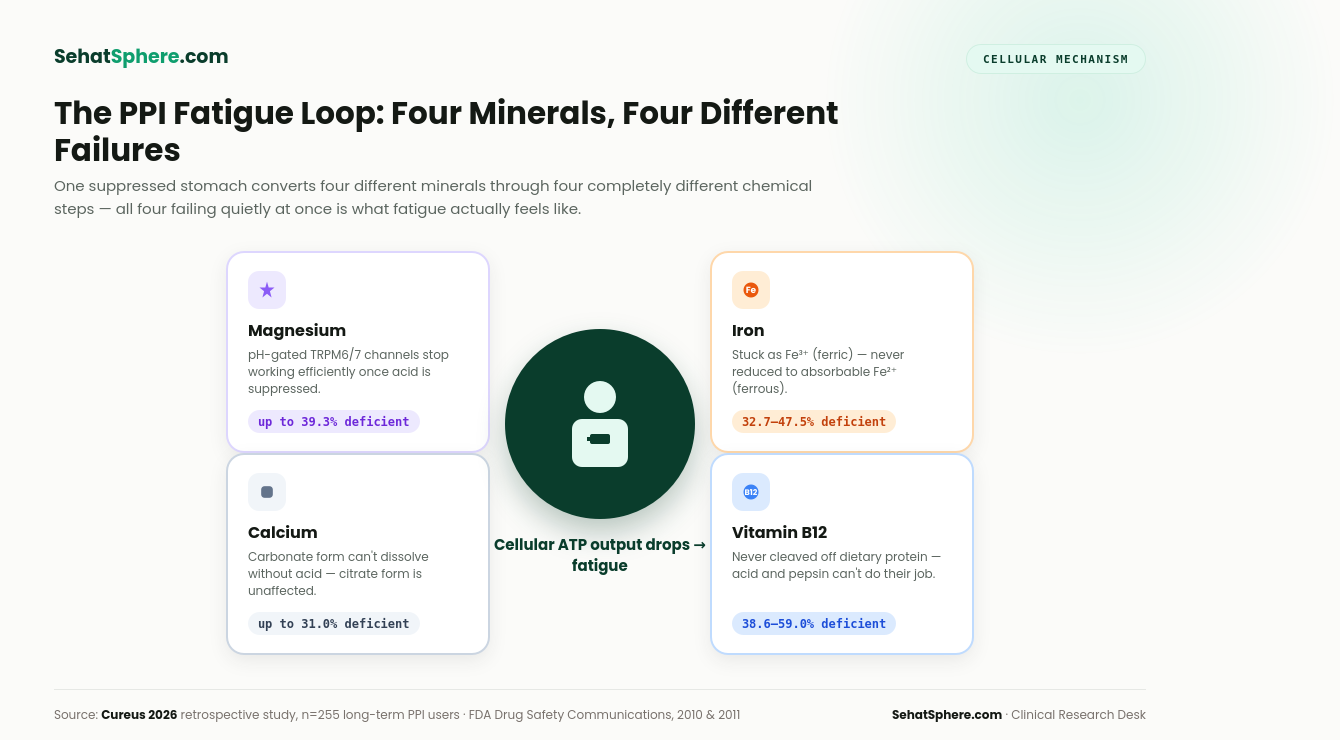
Four completely different chemical failures, one shared symptom — which is exactly why “just take a multivitamin” rarely fixes PPI-related fatigue on its own.
4. What the FDA Actually Warned About
These aren’t blog-derived concerns — both of the following are specific, dated FDA Drug Safety Communications, the same regulatory mechanism used for other well-known drug warnings.
“Low Magnesium Levels Can Be Associated With Long-Term Use of Proton Pump Inhibitor Drugs (PPIs).” The FDA specifically flagged risk rising after longer than one year of continuous use, and noted that in about a quarter of reported cases, magnesium supplementation alone wasn’t enough — the PPI itself had to be stopped before levels normalized. Reported complications included muscle spasm, abnormal heart rhythm, and seizures.
“Possible Increased Risk of Fractures of the Hip, Wrist, and Spine With the Use of Proton Pump Inhibitors.” This warning was specifically tied to high-dose or long-term use — the FDA explicitly noted the association was not established for short-term, low-dose, over-the-counter use, which is an important distinction most alarmist coverage of this warning leaves out.
Notice what both warnings have in common: duration and dose. Neither is a case against short-term, appropriately-indicated PPI use for an active ulcer or confirmed reflux disease. Both are specifically about the drift from “short course to treat a flare” into “indefinite daily habit,” which is the actual pattern this article is written for.
5. Two Real Published Cases
Illustrative stories are easy to write and hard to verify. So instead of inventing a patient, here are two real ones — published in Clinical Nephrology: Case Studies in January 2024, by Souza et al., specifically documenting PPI-induced hypomagnesemia and its downstream effects.
35-year-old male, 5 years on omeprazole
Presented with chest pain, facial tingling (paresthesia), muscle stiffness, limb cramps, and a positive Trousseau sign (carpal spasm on blood pressure cuff inflation — a classic bedside sign of low calcium/magnesium). Labs showed magnesium of 0.8 mg/dL (normal: 1.7–2.2), with accompanying low potassium and low calcium.
65-year-old female, 5 years on omeprazole
Presented with progressive muscle weakness, tremor, nausea, severe headache, and two generalized tonic-clonic seizures, alongside measurable cognitive decline. Magnesium was 0.6 mg/dL — severely low.
Neither patient had an exotic risk factor — both were on a single, common PPI, for the same five-year duration, taken exactly as prescribed. That’s precisely why the FDA’s one-year threshold matters: this isn’t a rare-drug-interaction problem, it’s a duration problem that can affect an entirely ordinary long-term PPI course.
6. Comprehensive Clinical Impact Matrix
A 2026 retrospective study of 255 long-term PPI users (defined as continuous use of six months or more) measured exactly how common these deficiencies actually are — broken down by which specific PPI the patient was taking, since not all PPIs carry identical risk.
| Nutrient | Real mechanism | Documented prevalence (2026 study, n=255) | Clinical symptoms |
|---|---|---|---|
| Vitamin B12 | Acid/pepsin can’t cleave B12 from dietary protein | 38.6% (omeprazole) to 59.0% (esomeprazole) | Tingling in fingers/toes, brain fog, chronic low energy, pallor |
| Magnesium | pH-dependent TRPM6/TRPM7 channels underperform | 11.9% (omeprazole) to 39.3% (esomeprazole) | Muscle cramps, eye twitching, anxiety-like symptoms, fatigue |
| Calcium | Carbonate form needs acid to dissolve; citrate form doesn’t | 7.9% (omeprazole) to 31.0% (lansoprazole) | Long-term bone density loss, fracture risk with high-dose/long-term use |
| Iron (ferritin) | Ferric-to-ferrous reduction impaired at high gastric pH | 32.7% to 47.5% (no significant difference by PPI type) | Paleness, breathlessness on exertion, brain fog |
Two things stand out. First, this isn’t rare — for B12 specifically, deficiency was the majority outcome, not the exception, in this cohort. Second, the specific PPI matters: esomeprazole carried the highest magnesium and B12 risk in this dataset, while lansoprazole carried the highest calcium risk. If you’re on one PPI and it’s not working well for you long-term, that’s a real conversation to have with a prescriber rather than simply switching to a different one from the same class without checking labs.
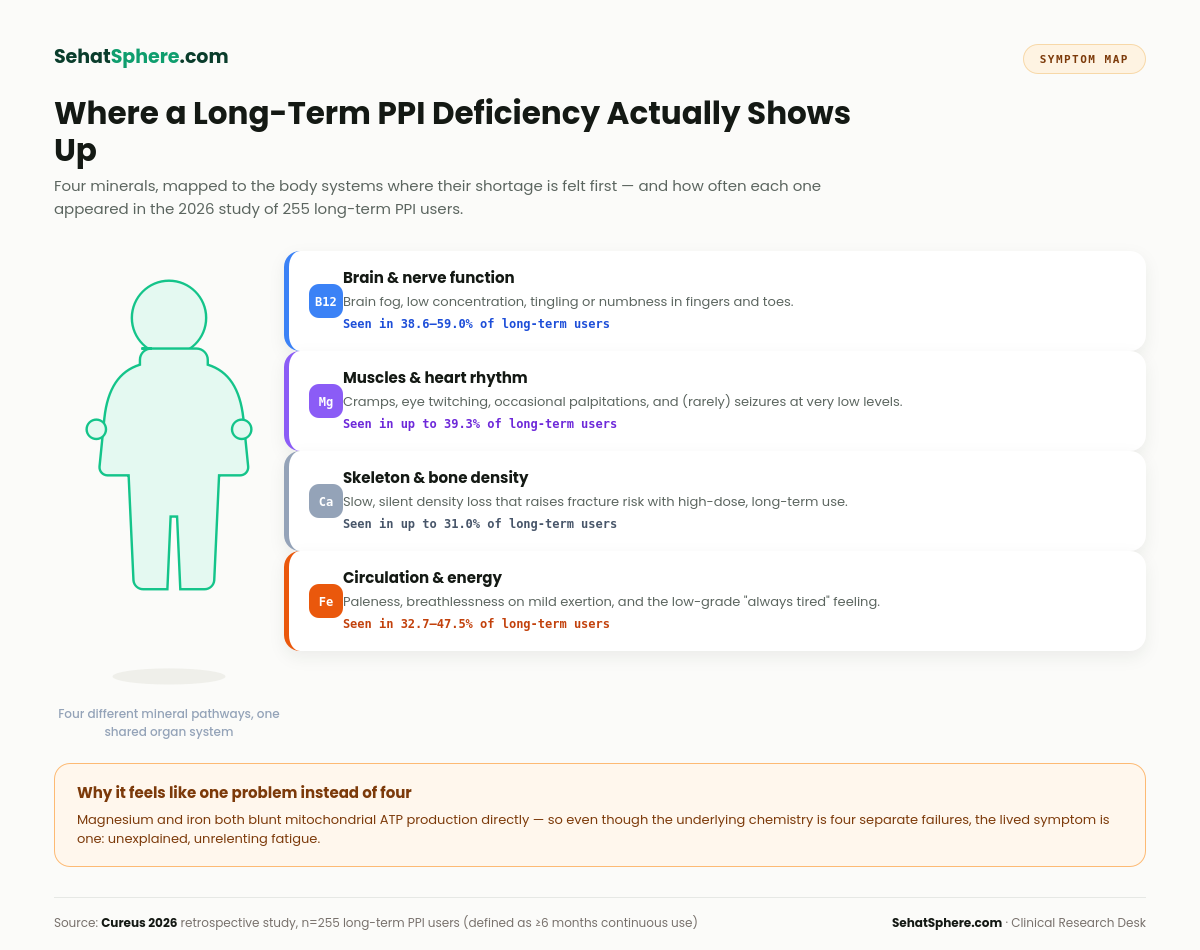
Same four minerals, mapped to where you’d actually feel each one failing — useful context before you fill out the self-check below.
7. Who’s Most at Risk (Beyond Just Duration)
Duration is the biggest lever, but it’s not the only one. A few factors stack on top of it and push some people into deficiency faster than the general timelines above would suggest.
- Adults 65 and older. Aging on its own reduces gastric acid output and intrinsic factor production (a pattern called atrophic gastritis). A PPI doesn’t start that decline — it accelerates a process that’s often already underway, which is part of why older adults show up disproportionately in PPI-deficiency case series, including both cases in the real reports above.
- Vegetarians and vegans. Dietary B12 comes almost entirely from animal sources, so a vegetarian starts from a lower baseline intake before a PPI even reduces absorption further — two independent risk factors stacking on the same nutrient. Our vitamin B12 deficiency in vegetarians guide covers the dietary side of this in more depth.
- Anyone also taking metformin. This is a genuinely underappreciated combination: metformin independently reduces B12 absorption through a separate, calcium-dependent mechanism at the ileal receptor site. A controlled trial found that increasing calcium intake partially reversed metformin-induced B12 malabsorption — which tells you the mechanism is real, not incidental. A patient on both metformin and a long-term PPI is stacking two independent causes of B12 deficiency, not one.
- Anyone also on a diuretic. Loop and thiazide diuretics affect magnesium and calcium handling at the kidney, independent of what a PPI does at the stomach. Combining the two doesn’t just add the risks — it removes two of the body’s separate buffers against the same deficiency at once. Our magnesium and your medications guide covers this pairing specifically.
- Post-menopausal women. Bone density is already declining independent of any medication. Layering a PPI’s calcium-carbonate-absorption problem on top of that baseline is exactly the population the FDA’s 2010 fracture warning was most concerned about.
None of this means any of these groups should avoid a PPI when one is genuinely needed. It means the one-year mental checkpoint from the FDA’s own warning should arguably come sooner — and with a lower threshold for asking for labs — if more than one of these factors applies to you.
8. How Long Have You Been Taking One?
Both FDA warnings above are explicitly duration-based. This isn’t a guessing exercise — plug in roughly how long you’ve been taking a PPI or a daily antacid and see where you land against the FDA’s own published thresholds.
9. The Safe Tapering Protocol
Here is the single most important safety point in this entire article: if you’ve been on a PPI for months or years, do not stop it abruptly on your own. Long-term acid suppression triggers compensatory gastrin release, and stopping suddenly causes rebound acid hypersecretion — often worse heartburn than you started with, which then convinces people to simply resume the PPI indefinitely. That rebound is the single biggest reason long-term PPI use is so hard to escape once it starts.
- Gradual, supervised tapering. Work with a physician to step the dose down over weeks, not days, giving the stomach’s own acid-producing cells time to recalibrate.
- Bridge with an H2-blocker. Switching temporarily to a histamine-2 receptor antagonist (like famotidine) during the taper softens the rebound without the same long-term mineral-absorption profile as a PPI.
- Fix the actual trigger. Late meals, lying down within three hours of eating, and excess caffeine all worsen lower esophageal sphincter (LES) function — treating these directly can be what actually lets the taper succeed.
- Recheck labs before and after. A baseline magnesium, B12, and ferritin panel before tapering — and again a few months after — is the only way to know whether the deficiency has actually corrected, rather than assuming it has.
Several PPI users are also on antihypertensives, and dehydration or electrolyte shifts from either condition can compound each other. Our guide to fluctuating blood pressure is worth reading alongside this one if you’re managing both.
10. Fatigue & Malabsorption Self-Check
This isn’t a diagnosis — it’s a structured way to decide whether your symptoms and your medication history are worth a real lab-based conversation with your doctor or pharmacist.
11. Quick Knowledge Check
Four questions to confirm the mechanisms above actually stuck — not a graded exam, just a gut check.
12. Frequently Asked Questions
Can long-term antacid or PPI use cause permanent fatigue?
Not permanently on its own — but the fatigue persists for as long as the underlying magnesium, iron, or B12 deficiency stays uncorrected. Both published case reports above showed full recovery once magnesium normalized after stopping the drug.
How long can I safely take a PPI without checking my minerals?
The FDA’s own magnesium warning is specifically about use longer than one year. If you’re approaching or past that mark, a baseline magnesium, B12, and ferritin panel is a reasonable ask at your next visit — not an overreaction.
Is it safe to stop a PPI abruptly?
No. Sudden cessation after long-term use commonly triggers rebound acid hypersecretion — often worse than the original symptoms — which is exactly what pulls most people back onto the drug indefinitely. A supervised taper avoids this.
Do all PPIs carry the same mineral-deficiency risk?
No. In the 2026 study of 255 long-term users cited above, esomeprazole carried the highest magnesium and B12 deficiency rates, while lansoprazole carried the highest calcium deficiency rate. Omeprazole generally ran lower across most measures in this particular dataset.
Which calcium supplement should I take if I’m on a long-term PPI?
Calcium citrate over calcium carbonate. Carbonate needs stomach acid to dissolve into an absorbable form; citrate is acid-independent, so it absorbs normally regardless of how suppressed your stomach acid is.
Do H2-blockers like famotidine cause the same mineral problems?
The evidence is much weaker for H2-blockers than for PPIs — they suppress acid less completely, which is exactly why they’re used as a bridging option during a PPI taper rather than being flagged with their own FDA magnesium warning.
Can I just take a magnesium supplement instead of stopping the PPI?
Sometimes — but not reliably. In the real case reports cited above, oral magnesium supplementation alone failed in roughly a quarter of documented cases; the PPI itself had to be stopped before levels normalized. Supplementing without addressing the cause is a partial fix at best.
Why do young adults get acid reflux so often in the first place?
Irregular meal timing, high stress, late-night eating, and diets heavy in processed and fried food all weaken lower esophageal sphincter function. Treating these directly, alongside our GERD and silent reflux management guide, often reduces how much acid suppression is actually needed.
Is there a kidney connection to long-term PPI use?
A 2016 JAMA Internal Medicine study by Lazarus et al. found an association between PPI use and chronic kidney disease risk, independent of the mineral-deficiency mechanisms in this article. It’s a separate concern worth knowing about — our high creatinine levels guide and eGFR & CrCl calculator are useful starting points if you’re on a long-term PPI and haven’t had kidney function checked recently.
What’s the difference between an antacid, an H2-blocker, and a PPI?
An antacid (like calcium carbonate or magnesium hydroxide tablets) neutralizes acid that’s already present, for minutes at a time. An H2-blocker reduces acid production for several hours. A PPI shuts down the stomach’s acid-producing pumps for up to 24-72 hours per dose — which is exactly why it carries the strongest long-term mineral-absorption effect of the three.
The Bottom Line
An occasional antacid or a short PPI course for a confirmed ulcer isn’t the concern here — it’s the drift into chronic antacids use, years of unsupervised daily dosing, which is exactly what both FDA warnings and the 2026 deficiency data are about. If you’re past the one-year mark, the right move isn’t panic or quitting cold turkey — it’s a magnesium/B12/ferritin panel and an honest conversation about whether you still need the dose you’re on, tapered properly if you don’t.
Why Trust This Guide
- U.S. Food and Drug Administration. FDA Drug Safety Communication: Low magnesium levels can be associated with long-term use of Proton Pump Inhibitor drugs (PPIs). March 2, 2011.
- U.S. Food and Drug Administration. FDA Drug Safety Communication: Possible increased risk of fractures of the hip, wrist, and spine with the use of proton pump inhibitors. May 2010.
- Souza CC, Rigueto LG, Santiago HC, Seguro AC, Girardi ACC, Luchi WM. Multiple electrolyte disorders triggered by proton pump inhibitor-induced hypomagnesemia: Case reports with a mini-review of the literature. Clinical Nephrology: Case Studies. 2024;12:6-11.
- Atoum BI. Association of Long-Term Proton Pump Inhibitor Use With Nutrient Deficiencies: A Retrospective Cross-Sectional Study. Cureus. 2026.
- Heidelbaugh JJ. Proton pump inhibitors and risk of vitamin and mineral deficiency: evidence and clinical implications. Ther Adv Drug Saf. 2013;4(3):125-133.
- Lazarus B, Chen Y, Wilson FP, et al. Proton Pump Inhibitor Use and the Risk of Chronic Kidney Disease. JAMA Intern Med. 2016;176(2):238-246.
- Lam JR, Schneider JL, Zhao W, Corley DA. Proton Pump Inhibitor and Histamine 2 Receptor Antagonist Use and Vitamin B12 Deficiency. JAMA. 2013;310(22):2435-2442.
- Puckett D, Gharzai LA. Mechanisms of proton pump inhibitor-induced hypomagnesemia. Review, PMC.
- Bauman WA, Shaw S, Jayatilleke E, Spungen AM, Herbert V. Increased Intake of Calcium Reverses Vitamin B12 Malabsorption Induced by Metformin. Diabetes Care. 2000;23(9):1227-1231.