
 SehatSphere
BP SERIES · CLINICAL REVIEW
Your Smartwatch’s BP Reading
Wrong Exactly When It Matters Most
Smartwatch blood pressure monitors are booming in 2026. A published clinical study found their biggest measurement error happens exactly when your blood pressure is genuinely high — the one moment accuracy matters most.
Why Everyone’s Suddenly Wearing a BP Watch
Blood pressure smartwatches went from a niche gadget to a mainstream category in 2025-2026, with models from Samsung, Omron, and several newer brands all competing for the “hypertension management made easy” pitch. For anyone who’s read SehatSphere’s guide on why home BP monitors give false highs, this next generation of wrist-worn devices raises the same question with new technology: is the number on your wrist actually trustworthy?
Two Completely Different Technologies, One Marketing Category
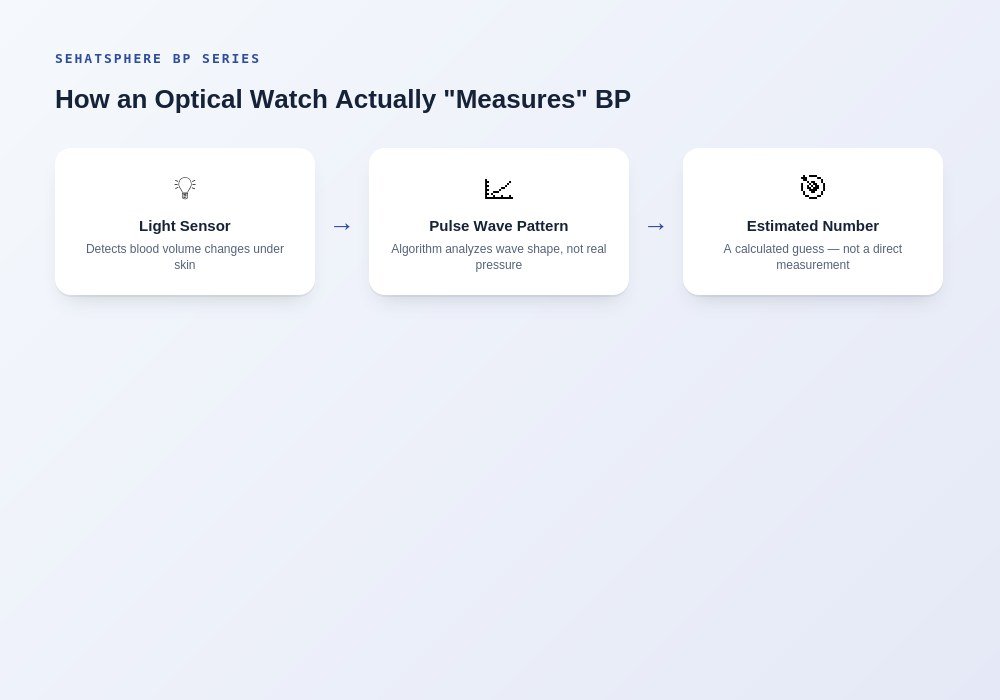
“Smartwatch blood pressure” actually covers two very different approaches, and the distinction matters enormously. Cuffless optical watches use light sensors (PPG, the same tech behind heart-rate tracking) and an algorithm to estimate blood pressure from your pulse wave — no physical pressure measurement happens at all. Cuff-based watches, like the Omron HeartGuide, use a genuine miniature inflatable cuff built into the strap, applying real oscillometric pressure the same way a standard arm monitor does.
Only one of these is measuring blood pressure directly. The other is estimating it.
03 The Bias No Product Review Mentions
A 2026 study in Hypertension Research reviewing cuffless wearable BP technology concluded there is “no convincing evidence that any cuffless BP technology has adequate accuracy as required for clinical use” — and that scientific societies do not recommend them for monitoring people already being treated for hypertension. A separate method-comparison study found something even more specific: cuffless smartwatch readings showed a proportional bias where low systolic readings were overestimated and high readings were underestimated. In plain terms — the device is least accurate exactly when your blood pressure is genuinely elevated, which is the one moment accuracy actually matters.
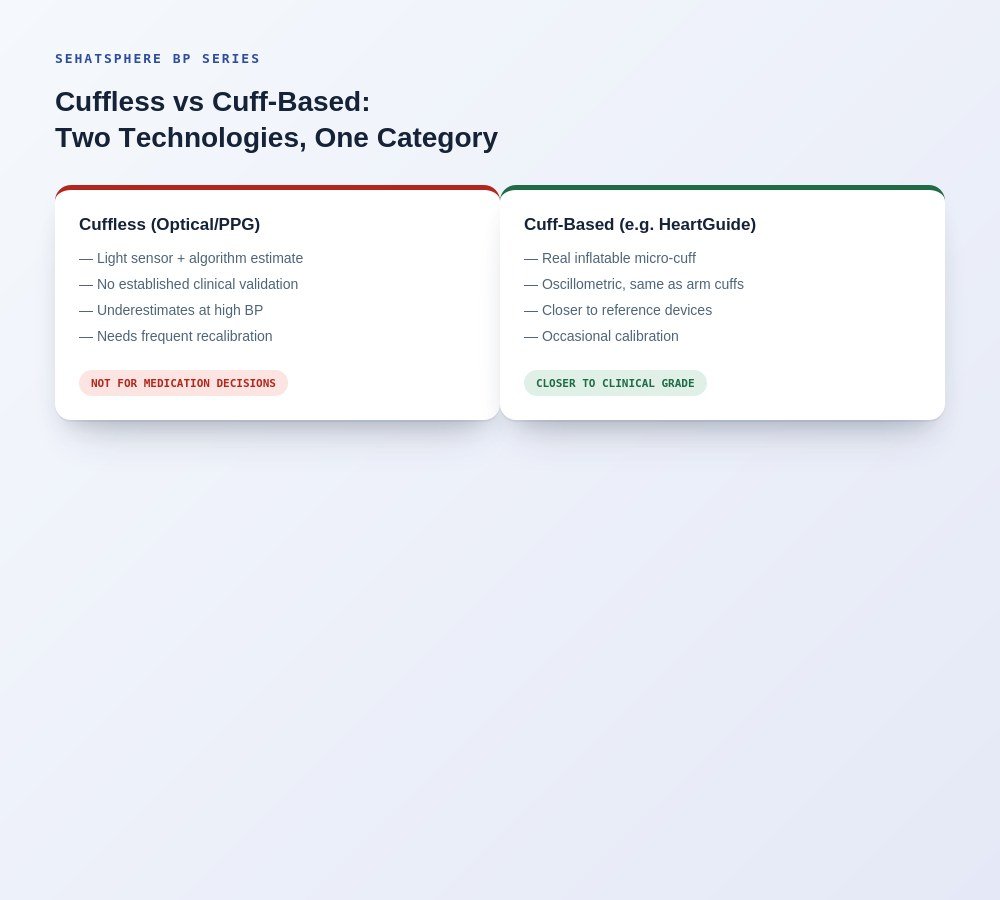
Cuffless vs Cuff-Based Smartwatch Blood Pressure, Side by Side
| Cuffless (Optical/PPG) | Cuff-Based (e.g. HeartGuide) | |
|---|---|---|
| How it works | Light sensor + algorithm estimate | Real inflatable micro-cuff |
| Clinical validation | Not established for treated hypertension | Oscillometric, same principle as arm cuffs |
| Accuracy at high BP | Tends to underestimate | Closer to reference devices |
| Calibration needed | Frequent, against a real cuff | Occasional |
This isn’t a reason to distrust wearables broadly — it’s a reason to know which type is on your wrist before trusting a number that could change a real decision.
If You’re Adjusting Medication Based on Watch Readings
This is where the bias becomes more than a technical footnote. If a cuffless watch is reassuring you with a “normal” reading during exactly the periods your blood pressure is actually running high, you or your doctor could be making dosing decisions on incomplete information — feeling falsely reassured that a medication is working when a validated cuff reading might tell a different story. For anyone tracking how their treatment is working over time, SehatSphere’s guide on normal blood pressure ranges is worth pairing with a validated measurement method, not a wrist estimate alone.
What “FDA Cleared” Actually Means Here
Device marketing often leans on regulatory language that sounds more reassuring than it is. An FDA clearance for a wearable typically confirms the device is substantially equivalent to an existing cleared device and safe to use — it does not automatically mean the blood pressure number it produces meets the same clinical accuracy standard as a validated arm cuff. The relevant distinction for you as a patient isn’t “is it cleared,” it’s “is it cleared specifically for the claim I’m relying on” — in this case, accurate BP measurement for treatment decisions, not general wellness tracking.
By Device: What’s Actually Inside
Samsung Galaxy Watch (BP tracking feature): Optical/PPG-based, requires calibration against a manual cuff reading periodically, positioned by Samsung itself as a wellness feature rather than a diagnostic one in most markets. Omron HeartGuide: A genuine miniature oscillometric cuff built into the watch band — the same underlying principle as a standard home BP monitor, just smaller. Newer wrist devices (Wellue, Jakoblife and similar): Also oscillometric micro-cuff designs, generally following the same validated principle as HeartGuide rather than optical estimation.
Quick Glossary
PPG (photoplethysmography) — the light-based sensor technology used for optical heart-rate and BP estimation.
Oscillometric — the standard cuff-based method that measures actual pressure oscillations in the artery, used in essentially all validated home and hospital BP monitors.
Clinical validation — formal testing against a reference standard (typically auscultatory or intra-arterial measurement) in a defined patient population.
Proportional bias — a measurement error that isn’t constant, but changes direction or size depending on how high or low the true value is.
Movement, Wrist Position, and Other Real-World Factors
Even a well-designed optical sensor faces practical accuracy challenges a lab test doesn’t always capture. Wrist position relative to heart height changes the reading meaningfully — the same principle that applies to a manual cuff. Movement, ambient light, tattoos, and skin tone have all been documented in the literature as factors that can affect PPG signal quality. None of this is unique to blood pressure sensing — it’s the same set of variables that affects optical heart-rate tracking — but it compounds an already-unvalidated estimate rather than a validated one.
Who Should Be Most Cautious
Beyond anyone actively titrating blood pressure medication, a few groups deserve extra caution with cuffless estimates specifically: people with irregular heart rhythms (atrial fibrillation and similar arrhythmias can distort the pulse wave patterns these algorithms depend on), older adults with stiffer arteries (which changes pulse wave velocity in ways some algorithms weren’t trained on), and anyone with a diagnosed white-coat or masked hypertension pattern, where trend accuracy matters more than a single point-in-time estimate.
How to Check Your Own Device’s Validation Status
Independent validation bodies — the STRIDE BP initiative and similar academic consortia — publish lists of blood pressure devices that have passed formal accuracy protocols against a reference standard. Before trusting any wearable’s BP number for a real decision, it’s worth checking whether your specific model and firmware version appears on an independent validation list, rather than relying on the manufacturer’s own marketing claims alone.
What To Actually Do
- If you’re on blood pressure medication, use a validated arm-cuff monitor for any reading that will inform a treatment decision.
- Cuffless smartwatches are reasonable for general trend awareness, not for confirming your medication is working.
- If you specifically want a wearable, cuff-based options (genuine inflatable mechanism) are closer to clinical measurement than optical ones.
- A single “normal” watch reading during a period you feel unwell is not a reason to dismiss symptoms — check with a validated cuff.
Frequently Asked Questions
Are smartwatch blood pressure monitors accurate?
It depends on the type. Cuffless optical watches lack established clinical validation for treated hypertension. Cuff-based watches with a real inflatable mechanism are closer to clinical accuracy.
Can I rely on my Samsung Galaxy Watch for blood pressure?
Samsung’s BP feature uses optical estimation and requires calibration against a real cuff monitor. Treat it as a trend indicator, not a replacement for a validated device.
Which smartwatch is most accurate for blood pressure?
Cuff-based devices like the Omron HeartGuide use genuine oscillometric measurement and are generally closer to clinical accuracy than optical-only watches.
Should I stop using my BP watch?
Not necessarily — it’s still useful for general awareness. Just don’t use it alone to confirm your medication is working or to make dosing decisions.
What does FDA clearance actually guarantee?
It confirms the device is safe and substantially equivalent to an existing cleared device — not that its specific BP reading matches clinical accuracy standards for treatment decisions.
How often should I calibrate an optical BP watch?
Manufacturers typically recommend calibration against a validated arm cuff every few weeks, and after any significant change in blood pressure medication or dose.
Can a smartwatch detect a hypertensive emergency?
No consumer smartwatch, cuffless or cuff-based, should be relied on to detect a hypertensive emergency. Severe symptoms warrant a validated cuff reading and immediate medical attention regardless of watch data.
Sources
Medical disclaimer: This article is for general education only, not medical advice. Use a validated blood pressure device and consult your doctor for any treatment decisions.