 SehatSphere.com
Protein Deficiency in India: Why Your “Balanced” Thali Falls Short
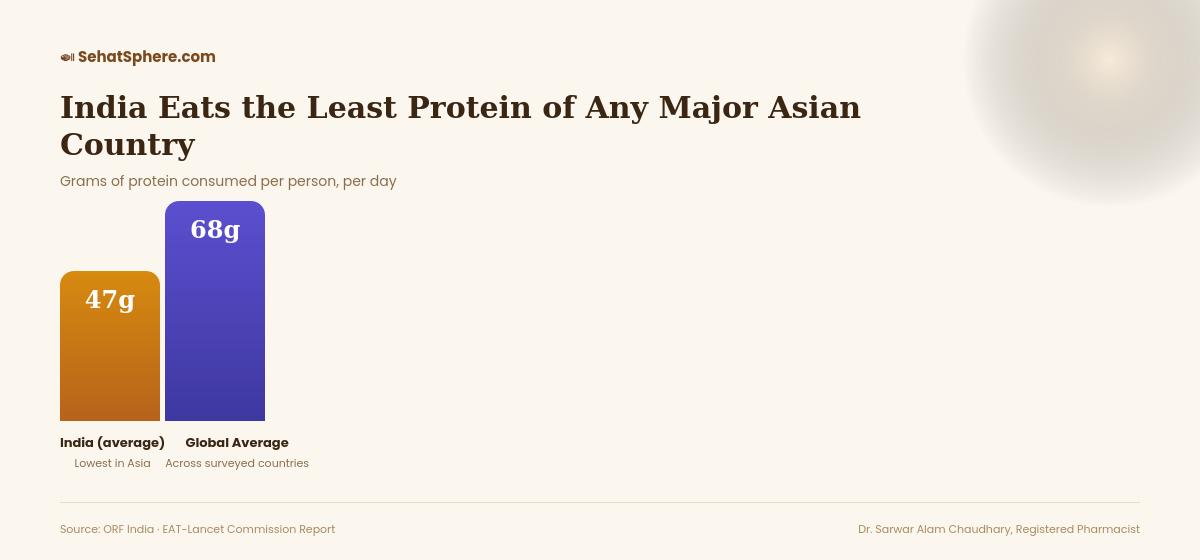
Protein deficiency in India is a genuinely documented, national-scale problem, not a fitness-blog exaggeration. India eats less protein per person than almost any other major country in the world — 47 grams a day on average, against a global average of 68 grams. And per NFHS-5 and National Institute of Nutrition data, 73% of Indians fall short of even the recommended minimum. This isn’t about extreme diets or bodybuilder-level targets. It’s about ordinary thalis quietly providing far less protein than most people assume.
Key takeaways:
- A typical serving of 3 chapatis and rice provides only about 12g of protein — and a katori of dal shared among a family can drop to 2g per person.
- The ICMR actually lowered India’s official protein RDA in 2020 (to 0.83g/kg/day), and most Indians still don’t meet even that reduced target.
- “High protein damages your kidneys” doesn’t hold up for healthy adults, per a 25-study McMaster University meta-analysis — though the caution is genuinely valid for people who already have kidney disease.
- 85% of Indians believe protein causes weight gain — a myth that directly discourages the exact intake most people are already falling short on.
- How bad is protein deficiency in India
- Why your thali has less protein than you think
- How much protein you actually need
- Signs of protein deficiency
- The kidney myth, honestly explained
- The “protein causes weight gain” myth
- Not all protein is equal
- Real food sources, by the gram
- If you’re managing medications
- Quick self-check
- FAQs
How Bad Is Protein Deficiency in India, Really?
This isn’t a niche nutrition-blog concern — it’s a well-documented, national-scale gap. A 2017 survey found 73% of Indians are protein deficient, while over 90% don’t actually know what their daily requirement is. India’s average per-capita protein intake sits at just 47 grams per day — the lowest among major Asian countries, well behind the global average of 68 grams.
India also carries what researchers call a double burden of malnutrition: 38% of children under five are undernourished (roughly 46.6 million children), while simultaneously 15% of the population is overweight or obese — two seemingly opposite problems that both trace back, in part, to diets heavy in refined carbohydrates and light on quality protein. This same pattern shows up in our fatty liver treatment guide and insulin resistance guide, since carbohydrate-heavy, protein-light eating is a shared root cause across several of India’s fastest-growing metabolic conditions.
Why Your Thali Has Less Protein Than You Think
85% of people surveyed across 16 Indian cities don’t track their protein intake at all — and when the actual numbers get measured, the gap is often larger than expected.
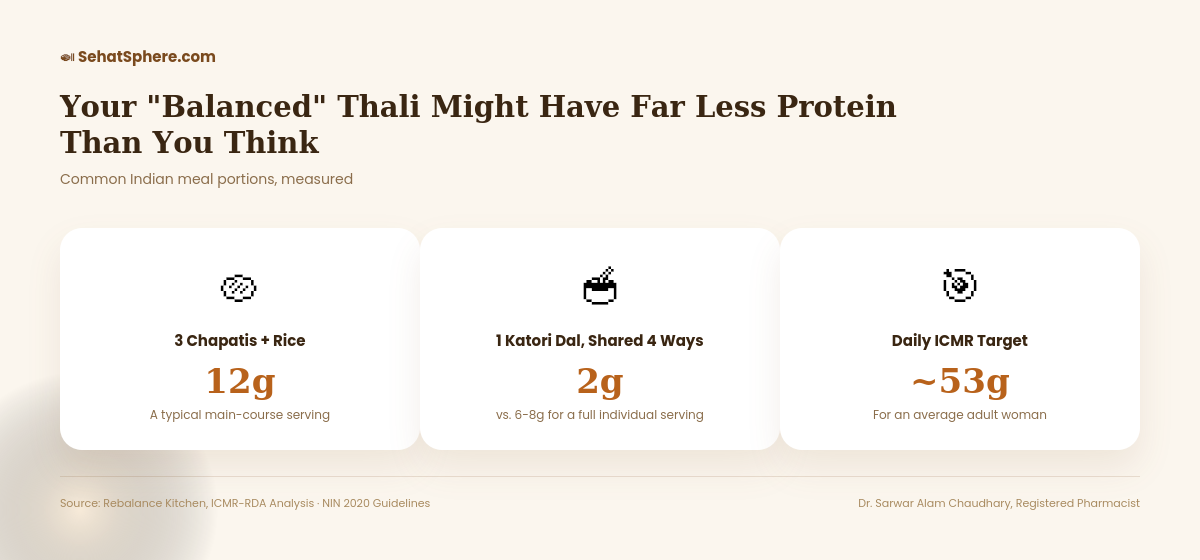
A single katori of dal shared among four or more family members — a genuinely common practice — means each person gets roughly 2 grams of protein, compared to the 6–8 grams a full individual serving would provide. This isn’t a failure of willpower; it’s simply that traditional serving sizes and habits were never calibrated against actual gram targets.
How Much Protein You Actually Need
Solving protein deficiency in India starts with knowing your own real number, not a vague sense of “eating enough.” The ICMR-NIN 2020 RDA book lays out exactly what that number is by group.
| Group | Recommended Intake |
|---|---|
| Sedentary adult (ICMR RDA, 2020) | 0.83 g/kg/day |
| Cereal-heavy, lower-quality-protein diet | ~1.0 g/kg/day |
| Adults 60+ (sarcopenia prevention) | 1.0–1.2 g/kg/day |
| Strength training / active individuals | 1.2–1.6 g/kg/day |
For a 60kg adult woman, the ICMR RDA works out to roughly 50 grams a day — a number that sounds modest until you actually count it out across a full day’s meals, as the thali breakdown above shows. The 2020 revision actually lowered the RDA from a previous 1 g/kg/day standard, yet a large share of Indians still fall short of even this reduced number. If you’re also managing PCOS, our PCOS symptoms guide is worth reading, since adequate protein genuinely helps manage the insulin-resistance side of that condition. Older adults specifically should read this alongside our normal blood pressure by age guide, since muscle preservation and cardiovascular health are closely linked in this age group.
Signs of Protein Deficiency
Nearly half of urban Indians don’t associate common, everyday symptoms with insufficient protein, largely because these symptoms overlap heavily with other conditions:
| System | Common Signs |
|---|---|
| Muscle & Strength | Muscle loss, weakness, slow recovery after exertion |
| Immunity | Frequent infections, slow wound healing |
| Hair & Skin | Hair thinning, brittle nails, dull skin |
| Energy & Cognition | Chronic fatigue, difficulty concentrating |
These overlap heavily with other nutrient gaps too — our hair fall and vitamin deficiency guide and vitamin D deficiency guide cover genuinely adjacent territory, since fatigue and hair changes rarely have just one single cause. The free Nutrient Deficiency Symptom Finder tool (card below) is worth using to help narrow down which gap is actually driving your specific symptoms.
What To Read Next
- Hair Fall & Vitamin Deficiency: Protein is one of the most overlooked nutrients here too.
- High Creatinine Levels, Explained: Why higher protein intake can temporarily raise this number.
- How to Reverse Insulin Resistance: Protein quality directly affects this metabolic picture.
The Kidney Myth, Honestly Explained
This fear has kept countless healthy people from eating adequate protein for decades. A McMaster University meta-analysis, examining more than two dozen studies and hundreds of participants, found no evidence linking high-protein diets to kidney disease in healthy individuals — including those with obesity, hypertension, or type 2 diabetes.
One genuinely useful, related fact: eating more protein can cause a temporary, harmless rise in serum creatinine — the same lab marker covered in our high creatinine levels guide. Doctors already account for this when interpreting kidney panels, and it doesn’t reflect real kidney damage in someone with otherwise healthy kidneys.
This reassurance is specifically for healthy adults. Current 2024 international guidelines (KDIGO) do recommend caution — roughly 0.8 g/kg/day, avoiding intakes above 1.3 g/kg/day — for people who already have diagnosed chronic kidney disease, where the calculation genuinely changes.
Protein source also matters for long-term kidney health, independent of total amount: research suggests plant proteins, fish, eggs, and poultry carry meaningfully lower long-term kidney stress than the same total protein built primarily from red and processed meat. If you’re also tracking any lab values related to this, our high creatinine levels guide and creatine and blood test guide both cover this same “context before panic” principle in more depth, and the free Blood Report Decoder tool (card below) can help you interpret your own results.
The “Protein Causes Weight Gain” Myth
85% of people in one Indian survey believed protein leads to weight gain — a belief that runs directly counter to the actual evidence. Protein is, if anything, the macronutrient most associated with satiety and preserved lean mass during weight management. This myth appears to be a major, underappreciated reason so many Indians remain protein-deficient despite growing general nutrition awareness — the exact food category people should be eating more of is the one they’re actively avoiding. This mirrors a similar pattern our Mounjaro and Ozempic diet guide covers, where adequate protein is specifically emphasized to preserve muscle during medically-supervised weight loss, not avoided.
Not All Protein Is Equal
Roughly 60% of protein intake in a typical Indian diet comes from cereals — wheat, rice — which are considered lower-quality protein sources. They’re measured lower on the DIAAS (Digestible Indispensable Amino Acid Score), largely because they’re missing or low in specific essential amino acids like lysine. This is exactly why the “cereal-legume-milk” combination principle exists in Indian nutrition guidelines — combining sources with complementary amino acid profiles gets you genuinely closer to complete protein than any single source alone, especially for vegetarian diets.
Real Food Sources, By the Gram
| Food (typical serving) | Approx. Protein |
|---|---|
| Paneer, 100g | 18g |
| Egg, 1 large | 6g |
| Dal, 1 full katori | 6–8g |
| Greek yogurt/curd, 1 cup | 10–11g |
| Chicken breast, 100g | 27g |
| Sattu, 1 serving | 20g |
Practically closing this gap doesn’t require dramatic changes — it means treating protein-rich foods as a deliberate, measured part of each meal rather than an afterthought. Reviving traditionally protein-dense, now-declining staples like sattu and fermented foods is one genuinely accessible, culturally-rooted option many households have quietly moved away from. If cost is a genuine barrier — cited as the single biggest obstacle in Indian surveys — dal, eggs, and curd remain among the most affordable protein sources available, gram for rupee. If cost has ever affected your consistency with prescribed medication too, our generic medicine pricing guide covers a related principle worth knowing.
If You’re Also Managing Medications
Protein intake genuinely intersects with several common medication situations worth knowing about. If you’re on thyroid medication, high-protein meals close to your dose can affect absorption timing, similar to the calcium and coffee interactions covered in that guide. If you’re managing acid reflux with pantoprazole (card below) or dealing with GERD, reduced stomach acid can genuinely impair protein digestion over the long term, on top of the B12 and magnesium concerns already covered in those guides. And if you’re on statins (card below) or managing antibiotics regularly, adequate protein supports the muscle recovery these conditions can otherwise quietly undermine. The free Integrative Interaction Checker is worth running your full medication and supplement list through.
Quick Self-Check
Tick anything that applies to you, and see what it suggests.
Frequently Asked Questions
How much protein do Indians actually need per day?
The ICMR 2020 RDA is 0.83g per kilogram of body weight for sedentary adults, working out to roughly 50g/day for a 60kg woman. Those following cereal-heavy diets, older adults, and active individuals need more.
Why is protein deficiency so common in India?
Protein deficiency in India is driven by India’s average per-capita protein intake (47g/day), the lowest among major Asian countries, cereal-heavy diets, low awareness of actual gram requirements, cost barriers, and a persistent myth that protein causes weight gain.
Does eating too much protein damage your kidneys?
Not in healthy adults, per a large McMaster University meta-analysis. The genuine caution applies specifically to people who already have diagnosed chronic kidney disease.
Does protein cause weight gain?
No, this is a widespread but unsupported myth. Protein is generally associated with increased satiety and preserved lean muscle mass, not fat gain.
How much protein is in a typical Indian meal?
A serving of 3 chapatis with rice provides only about 12g of protein, and a shared katori of dal can drop to just 2g per person – both well short of a single meal’s fair share of daily needs.
What are the signs of protein deficiency?
Muscle loss, weakness, frequent infections, hair thinning, brittle nails, and chronic fatigue are common signs, though they overlap with other nutrient deficiencies too.
Can vegetarians get enough protein in India?
Yes, with deliberate planning. Combining cereals, legumes, and dairy (the traditional cereal-legume-milk pattern) provides more complete amino acid coverage than any single source alone.
Does high protein intake raise creatinine levels?
Yes, temporarily and harmlessly in people with healthy kidneys. Doctors account for this when interpreting kidney function tests, and it doesn’t indicate real kidney damage on its own.
The Bottom Line
Protein deficiency in India isn’t a fringe concern or a fitness-influencer talking point — it’s a documented, national-scale gap affecting the majority of the population, hiding behind meals that look complete but measure out far short of actual targets. The fixes are genuinely unglamorous: know your real gram target, count what a typical serving actually provides, and stop avoiding protein-rich foods over an unfounded weight-gain fear. For most healthy people, more protein is not a risk to manage — it’s a gap worth closing.
- Protein Deficiency in Urban India: A Growing Nutritional Crisis. The Indian Practitioner, 2026.
- India’s Protein Deficiency and the Need to Address the Problem. Observer Research Foundation, 2024.
- National Institute of Nutrition. Nutrient Requirements for Indians, 2020.
View All References (5) ▾
- McMaster University. Researchers Show High-Protein Diet Does Not Affect Kidney Function. EurekAlert, 2018.
- KDIGO 2024 Clinical Practice Guideline for Chronic Kidney Disease Management.