 SehatSphere.com
PCOS Symptoms: 7 Warning Signs You Shouldn’t Ignore
A national Indian study of nearly 10,000 women found up to 19.6% meet diagnostic criteria for PCOS — yet globally, an estimated 70% of cases go undiagnosed. The reason isn’t that PCOS is rare or hard to spot. It’s that its signs show up as separate, seemingly unrelated complaints: irregular periods here, stubborn acne there, hair thinning blamed on stress.
Key takeaways:
- PCOS is increasingly called PMOS (Polyendocrine Metabolic Ovarian Syndrome) by major clinics, since most patients don’t actually have true ovarian cysts.
- You only need 2 of 3 Rotterdam criteria to be diagnosed — not every symptom on this list.
- Nearly 1 in 3 Indian women with PCOS also has fatty liver disease — the same insulin-resistance pathway drives both.
- Insulin resistance, weight, and hair changes form a genuine feedback triangle — treating one in isolation often disappoints because the other two keep feeding it.
- Why symptoms get missed
- Why some clinics now call it PMOS
- The PCOS triangle
- How common is this in India
- The 7 warning signs
- What to say at a doctor’s visit
- How it’s actually diagnosed
- The long-term health connection
- Nutrient gaps that get missed
- Managing it — including inositol
- Quick self-check
- FAQs
Why PCOS Symptoms Get Missed So Often
PCOS is caused by a hormonal imbalance — higher-than-typical androgens combined, in most cases, with insulin resistance. These two factors ripple outward into effects on periods, skin, hair, and weight that look, on the surface, like completely unconnected problems.
Someone might see a dermatologist for acne, a hairstylist about thinning hair, and simply accept irregular periods as “how their body is” — without any single doctor ever seeing the full picture at once. A teenager gets treated for acne, a woman in her twenties for irregular cycles, someone in her thirties for difficulty conceiving — three different doctors, three specialties, and often no one connecting the dots across years. There’s also no single blood test that confirms PCOS on its own, which is part of why this fragmentation happens so easily.
This lack of one clean diagnostic answer also means PCOS often gets reduced to whichever symptom bothers a woman most at any given moment, rather than being understood as one connected condition running underneath all of them. It’s genuinely common to hear “I wish someone had told me these were all related” from women years into managing individual symptoms separately.
Why Some Clinics Now Call It PMOS
Cleveland Clinic and other major centers have begun using PMOS (Polyendocrine Metabolic Ovarian Syndrome) instead of PCOS in patient materials — a genuinely current shift most people haven’t heard about yet. The reason: most women with this condition don’t actually have true cysts. What shows up on ultrasound is a cluster of small, immature follicles that never fully matured — a different thing entirely. The rename is meant to reflect what the condition actually is: a metabolic and endocrine disorder, not primarily an ovarian one.
This naming shift matters beyond semantics. Patients who understand PCOS as fundamentally metabolic, rather than as an ovarian problem, are more likely to engage with the insulin-resistance-focused treatment that actually moves the needle, rather than fixating narrowly on reproductive symptoms alone.
The PCOS Triangle: Insulin, Hair, and Weight
One of the most underexplained parts of PCOS is how tightly three seemingly separate issues feed into each other.
| Point | What Happens | Feeds Into |
|---|---|---|
| Insulin resistance | Present in over 70% of PCOS cases, even in women who aren’t overweight | Pushes ovaries to produce more androgens |
| Weight gain | Concentrates around the abdomen, resists typical diet/exercise effort | Abdominal fat itself worsens insulin resistance further |
| Hair changes | Excess growth in some areas, thinning at the scalp | Same androgens driving weight gain also drive this |
Each point can worsen the other two, which is exactly why treating just one in isolation — only the acne, or only trying to lose weight — so often feels disappointing. Our insulin resistance guide covers the metabolic driver at the center of this triangle in more depth, and our hair fall guide covers the hair side specifically.
How Common Is This in India?
A large national study of 9,824 Indian women aged 18–40 found weighted prevalence of 7.2% using NIH criteria and 19.6% using the broader Rotterdam criteria — the gap itself shows how much diagnosis depends on which standard is applied. Phenotype C (high androgens + polycystic ovaries, but relatively regular cycles) was the most common presentation, at 40.8% of cases.
| Comorbidity Among Indian Women With PCOS | Rate |
|---|---|
| Dyslipidemia (abnormal cholesterol) | 91.9% |
| Obesity | 43.2% |
| Non-alcoholic fatty liver disease | 32.9% |
| Metabolic syndrome | 24.9% |
| Hypertension | 8.3% |
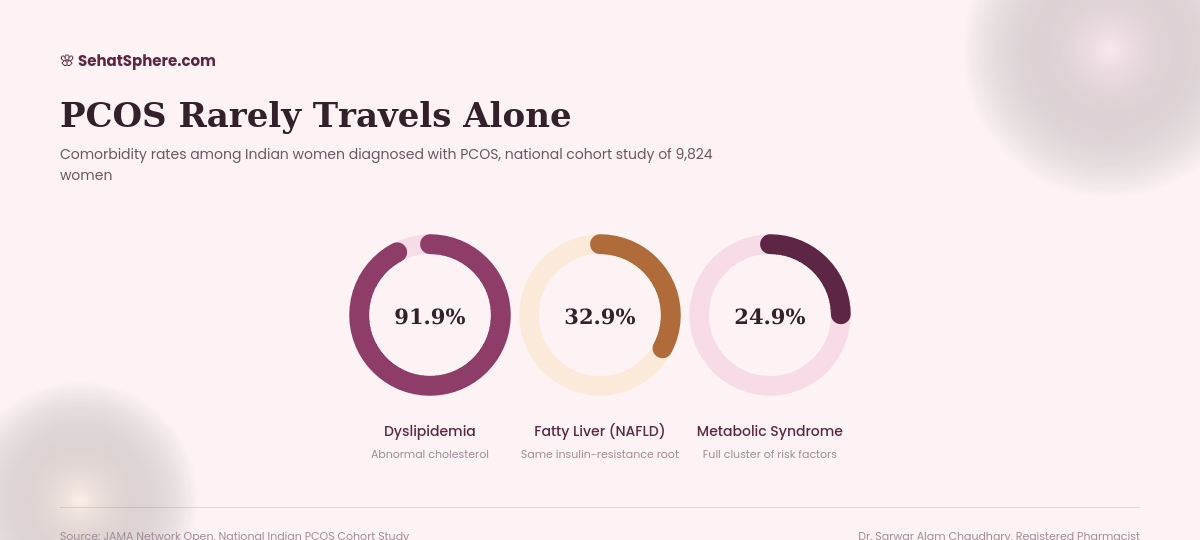
That 32.9% fatty-liver figure is genuinely important — PCOS and NAFLD share the same insulin-resistance root, and our fatty liver treatment guide is worth reading alongside this one if you have PCOS, not as a separate concern. South Asian women also show what researchers call the “Asian Indian phenotype” — meaningful insulin resistance and central fat accumulation at BMI levels considered normal by global standards, which is part of why being thin doesn’t rule PCOS out. If a routine lab panel ever comes back with an unexpectedly high creatinine or unusual value, our high creatinine levels guide and the free Blood Report Decoder can help you make sense of it before assuming the worst.
What To Read Next
- How to Reverse Insulin Resistance: The metabolic driver at the center of the PCOS triangle.
- Fatty Liver Treatment: Nearly a third of Indian women with PCOS also have this.
- Hair Fall Vitamin Deficiency: Hair changes are part of the same hormonal pattern.
The 7 Warning Signs
Most women have some combination of these, not all seven.
1. Irregular or missed periods
Cycles consistently longer than 35 days, or fewer than eight periods a year, are generally considered irregular enough to warrant evaluation rather than waiting it out. This is often the earliest sign and the one dismissed longest.
2. Excess hair growth (hirsutism)
Coarse, dark hair in a male-pattern distribution — upper lip, chin, chest, back — affects roughly 70% of women with PCOS. It responds to treatment, though gradually, since existing follicles have already been affected by months or years of hormonal influence.
3. Persistent acne
Adult-onset acne concentrated along the jawline and chin, responding poorly to standard skincare, is specific enough that dermatologists often ask about menstrual regularity when they see this exact pattern.
4. Weight gain that’s hard to lose
Somewhere between 40–80% of women with PCOS struggle with weight, concentrated around the abdomen. Standard calorie-counting sometimes underperforms here specifically, since insulin resistance changes how the body partitions those same calories.
5. Hair thinning on the scalp
The flip side of hirsutism — the same androgens causing excess hair growth elsewhere cause thinning at the crown and part line, following a pattern similar to male-pattern baldness.
6. Dark, velvety skin patches
Called acanthosis nigricans, this dark, thickened skin at the neck, underarms, or groin is a specific, well-documented marker of insulin resistance — and one of the most overlooked signs, since it’s rarely mentioned to a doctor unprompted.
7. Mood changes
Women with PCOS face roughly 3 times higher rates of anxiety and depression, from a combination of hormonal effects and the emotional toll of visible symptoms.
Myth: “PCOS just means having cysts on your ovaries.” Fact: The “cysts” seen on ultrasound are actually small, immature follicles, not true cysts — and polycystic ovary appearance is just one of three diagnostic criteria, not the whole condition.
What to Actually Say at a Doctor’s Visit
Given how easily PCOS gets fragmented across specialists, walking in with a clear, connected summary genuinely helps. Rather than mentioning symptoms one at a time across different visits, consider writing down everything at once: your cycle pattern over the last 6-12 months, any hair or skin changes, weight trends, and family history of PCOS or diabetes. Bringing this as a single list, rather than waiting to be asked about each symptom individually, is one of the most practical things you can do to shorten the path to an actual diagnosis.
It’s also worth explicitly asking whether your evaluation will include an androgen panel and a discussion of insulin resistance, not just a pelvic ultrasound alone — since ultrasound findings are only one of three criteria, and a normal-looking ultrasound doesn’t rule PCOS out on its own.
How PCOS Is Actually Diagnosed
Diagnosis follows the Rotterdam criteria — at least 2 of 3 features, after ruling out conditions that mimic PCOS, such as thyroid disorders.
| Criterion | What It Means |
|---|---|
| Irregular or absent ovulation | Infrequent, unpredictable, or missing periods |
| Clinical or biochemical hyperandrogenism | Visible signs (hirsutism, acne) or elevated androgens on a blood test |
| Polycystic ovary morphology | A specific appearance of the ovaries on ultrasound |
You don’t need all three — two is sufficient, which is exactly why two women with PCOS can look quite different from each other. Because PCOS is a diagnosis of exclusion, ruling out thyroid disorders is a standard part of proper workup — our thyroid guide covers this overlapping condition in depth. Beyond diagnosis, PCOS is further classified into four phenotypes (A through D) based on exactly which criteria are met — Phenotype A (all three) tends to carry the most pronounced metabolic features, while Phenotype D (mildest) shows fewer androgen-related symptoms.
The Long-Term Health Connection
PCOS isn’t just reproductive or cosmetic — it carries meaningfully higher long-term risk for type 2 diabetes and cardiovascular disease, through the same insulin-resistance pathway covered above. Regular monitoring of blood sugar and cholesterol is generally recommended, precisely because these risks develop quietly, often years before any symptom would prompt testing on its own. If you’re also managing blood pressure, our normal blood pressure by age guide and morning BP spikes guide are worth reading, since the same metabolic pattern touches both conditions. Chronic stress genuinely compounds this picture too — our anger and blood pressure guide and BP fluctuation guide cover the cortisol side of this overlap.
The Nutrient Gaps That Get Missed Alongside PCOS
Fatigue, hair changes, and mood symptoms in PCOS can genuinely overlap with separate nutrient deficiencies, and it’s worth ruling these out rather than attributing everything to hormones by default. Vitamin D deficiency is extremely common in India despite abundant sunlight, and low vitamin D has its own documented association with worsened insulin resistance — our vitamin D deficiency guide covers why this happens even in a sunny country. B12 deficiency can independently cause fatigue and mood changes that mimic PCOS symptoms — our B12 deficiency guide is worth a read, and the free Nutrient Deficiency Symptom Finder is a genuinely useful starting point to organize your symptoms before a doctor’s visit.
Elevated uric acid also travels alongside the same metabolic syndrome cluster common in PCOS — our high uric acid diet guide shares much of the same evidence-based dietary approach covered here. And if digestive symptoms are part of your picture, our GERD guide and pantoprazole guide are worth knowing, since acid-reducing medication can independently affect the same B12 and magnesium levels PCOS management already needs to track.
Managing PCOS: What Actually Helps
Because insulin resistance sits at the center of the triangle, lifestyle approaches that improve insulin sensitivity — regular activity, reducing refined carbs and sugar, gradual weight management where relevant — tend to improve multiple symptoms at once. Symptom improvement operates on different timelines: metabolic markers can shift within weeks, while hormonal symptoms like hirsutism often take several months, which is worth knowing to avoid early discouragement.
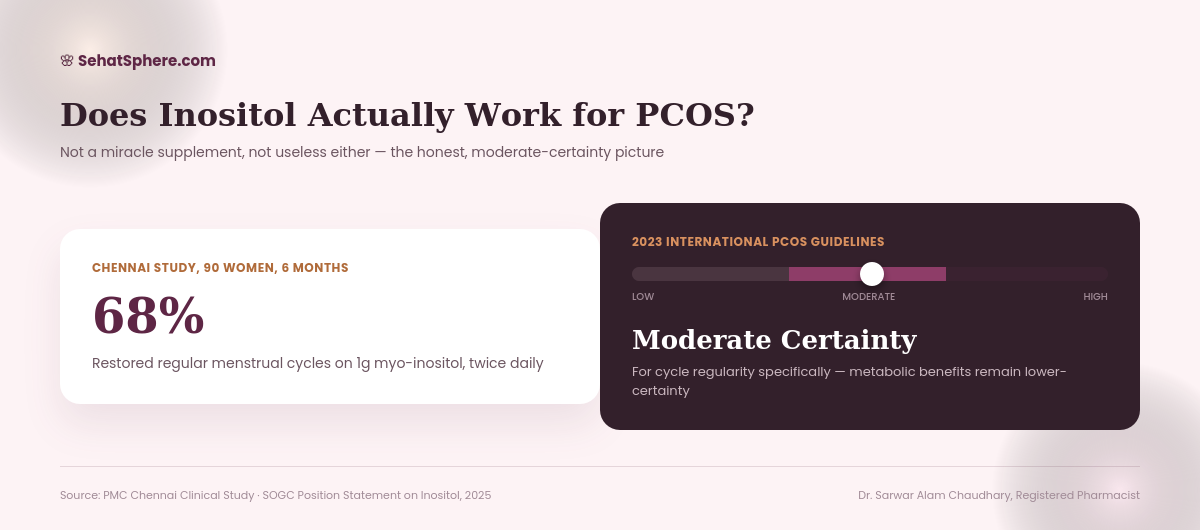
One supplement genuinely worth understanding: myo-inositol. A Chennai study of 90 women taking 1g twice daily for 6 months found 68% restored menstrual cycle regularity. The 2023 international PCOS guidelines rate this as moderate-certainty evidence for cycle regularity specifically, with lower-certainty evidence for metabolic and hormonal benefits — a genuinely honest, non-overhyped picture rather than a miracle-supplement claim. One practical note: a 600mg soft-gel capsule form showed better bioavailability than an equivalent 2g powder dose in a small trial, at a substantially lower dose.
Sleep quality and stress management play a meaningful, less-discussed role too — both independently worsen insulin resistance. Our mental stress guide covers this same cortisol pathway. If magnesium or other supplements are part of your routine, our magnesium interactions guide and the free Integrative Interaction Checker are worth checking before adding anything new. If you’re on any long-term medications for other conditions, our statins guide and antibiotic mistakes guide are worth being aware of, and if cost has ever affected your consistency with prescribed treatment, our generic medicine pricing guide is worth a look. For a broader sense of how these daily habits add up, the Biological Longevity Audit is a reasonable starting point too.
Quick Self-Check
Tick anything that applies to you, and see what it suggests.
Frequently Asked Questions
What is the most common early sign of PCOS?
Irregular or missed periods are usually the earliest and most noticeable sign, though it’s often the one dismissed longest as normal cycle variation.
Can you have PCOS without irregular periods?
Yes, though less common. Diagnosis requires 2 of 3 Rotterdam criteria, and some women have hyperandrogenism and polycystic ovaries with relatively regular cycles (Phenotype C, the most common type in India).
Is PCOS the same as having ovarian cysts?
Not exactly. The “cysts” are actually small, immature follicles, not true cysts. This is part of why some clinics now use the term PMOS instead.
How is PCOS actually diagnosed?
Under the Rotterdam criteria, diagnosis requires at least 2 of 3 features: irregular ovulation, signs of high androgens, and polycystic ovary appearance on ultrasound, after ruling out mimicking conditions like thyroid disorders.
Why does PCOS cause weight gain that’s hard to lose?
Insulin resistance, present in over 70% of PCOS cases, makes it easier to store fat and harder to burn it, particularly around the abdomen, independent of calorie intake alone.
Does PCOS increase the risk of fatty liver disease?
Yes, significantly. A large Indian study found 32.9% of women with PCOS also had non-alcoholic fatty liver disease, sharing the same insulin-resistance root cause.
Does inositol actually help with PCOS?
Evidence is honestly mixed but genuinely promising for menstrual regularity specifically – a Chennai study found 68% of women restored regular cycles after 6 months. Metabolic and hormonal benefits have weaker, lower-certainty evidence.
Does PCOS affect mental health?
Yes, research links PCOS to roughly 3 times higher risk of anxiety and depression, from hormonal effects combined with the emotional impact of visible symptoms.
Is PCOS common in India specifically?
Yes, a national study of nearly 10,000 women found prevalence up to 19.6% using Rotterdam criteria, among the highest reported globally.
Does losing weight cure PCOS?
Weight loss can meaningfully improve symptoms and insulin sensitivity, but PCOS isn’t cured by weight alone, since it occurs in women of every body size, including at a healthy weight.
The Bottom Line
PCOS rarely announces itself as one clear problem — it shows up as several separate-seeming complaints that never get connected until someone looks at the whole picture at once. You don’t need every symptom on this list to have it, and you don’t need to be overweight to have it either. The genuinely actionable part: insulin resistance sits at the center of nearly everything else, which is exactly why addressing it tends to move multiple symptoms at once, rather than chasing acne, hair, and weight as three separate battles. If you recognize several of these signs in yourself, the single most useful thing you can do is bring the whole pattern to one doctor at once, rather than letting it stay split across a dermatologist, a hairstylist, and a gynecologist who never compare notes.
- Joham AE, et al. Prevalence, Phenotypes, and Comorbidities of PCOS Among Indian Women. JAMA Network, 2024.
- Cleveland Clinic. PMOS (Polyendocrine Metabolic Ovarian Syndrome). clevelandclinic.org
- HHS Office on Women’s Health. Polycystic Ovary Syndrome. womenshealth.gov
View All References (6) ▾
- The Effectiveness of Myo-Inositol in Women With PCOS: A Prospective Clinical Study, Chennai. PMC
- SOGC Position Statement on Inositol for PCOS, 2025.
- Epidemiology, Pathogenesis, Genetics and Management of PCOS in India. Indian Journal of Medical Research.