 SehatSphere.com
Common Antibiotic Mistakes: What’s Fueling India’s Resistance Crisis
Multidrug-resistant infections claim an estimated 58,000 infant lives every year in India, and a South-Central India study found 78% of pharmacies dispensing antibiotics with no prescription at all. The advice you’ve followed your whole life — “always finish the full course” — is also, quietly, now being questioned by the same science that once demanded it.
Key takeaways:
- India has one of the world’s highest antibiotic resistance rates — some common bacteria now show 80% resistance to standard treatments.
- “Always complete the full course” is a genuinely more complicated recommendation than it used to be — newer research shows unnecessarily long exposure itself drives resistance.
- Dairy and calcium can cut absorption of certain antibiotic classes by 50–80%, but this only applies to specific drugs, not all antibiotics equally.
- The “antibiotics cancel your birth control” fear is largely outdated for most antibiotics — with one specific, real exception.
- India’s resistance crisis, in numbers
- The WHO’s official “superbug” list
- The “finish the course” controversy
- How antibiotics actually work
- A note on children specifically
- 7 everyday mistakes
- Real food and drink interactions
- Gut health and recovery
- The birth control myth, corrected
- When antibiotics don’t even apply
- What to do with leftovers
- Quick self-check
- FAQs
India’s Resistance Crisis, in Numbers
This isn’t an abstract global health talking point. A global study published in Lancet eClinicalMedicine found India carries one of the highest rates of multidrug-resistant organisms (MDROs) in the world. Some of the numbers behind that: K. pneumoniae and E. coli — bacteria behind common lung and urinary infections — now show roughly 80% resistance to third-generation cephalosporins, a class of antibiotics once considered reliable first-line treatment.
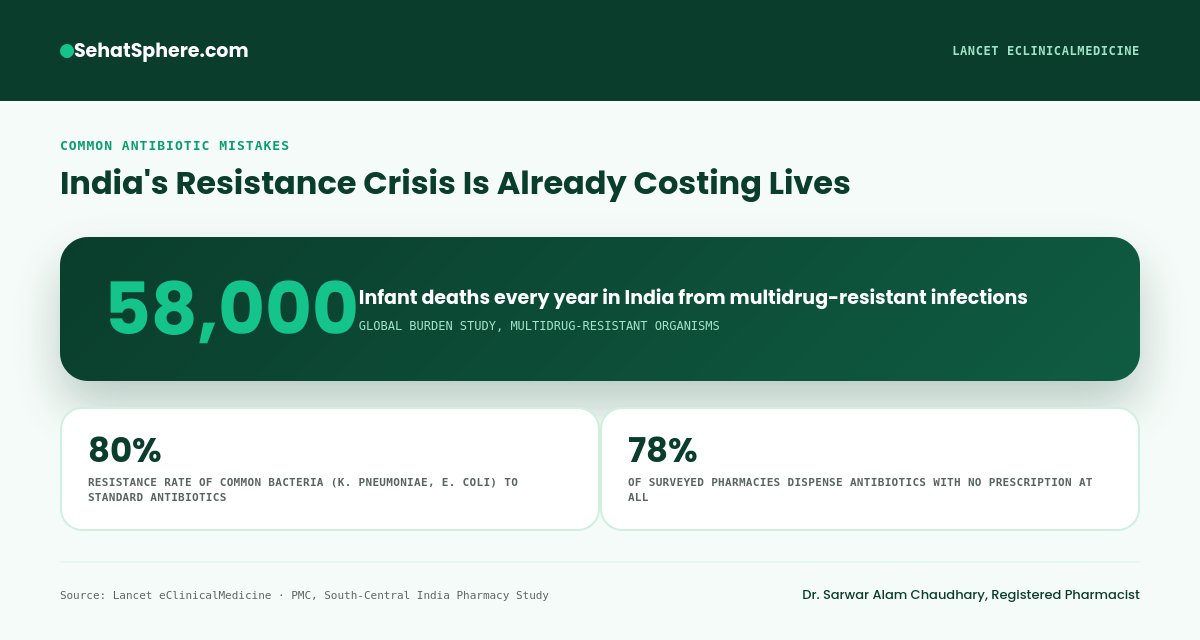
India’s total antibiotic consumption roughly doubled between 2000 and 2015 (3.2 to 6.5 billion defined daily doses), reflecting both genuine medical need and, separately, genuine overuse. A pharmacy-dispensing study in South-Central India found 78% of surveyed pharmacies dispensing antibiotics over the counter, without a prescription, for conditions including the common cold and viral sore throats — conditions antibiotics don’t treat at all. The most commonly dispensed antibiotics this way included azithromycin, amoxicillin, and cefixime — drugs from the WHO’s “Watch” category, meaning they carry a higher resistance risk and are meant to be used more selectively, not as casual first-line options.
This crisis compounds with other chronic health patterns in ways that aren’t always obvious. If you’re managing blood pressure alongside frequent infections, our BP fluctuation guide and normal blood pressure by age guide are worth reading, since illness itself can genuinely destabilize otherwise well-controlled readings.
The WHO’s Official “Superbug” List — and Why Typhoid Is On It
In May 2024, the WHO released an updated Bacterial Priority Pathogens List (BPPL) — 24 specific bacteria, ranked and scored by how urgently the world needs new treatments against them, built from expert surveys and real global burden data.
| Pathogen | Threat Score | Why It Matters in India |
|---|---|---|
| Carbapenem-resistant Klebsiella pneumoniae | 84% (top-ranked) | Common cause of severe hospital-acquired pneumonia and bloodstream infections |
| Fluoroquinolone-resistant Salmonella Typhi | 72% | The bacterium behind typhoid fever — genuinely common across India |
| Drug-resistant Shigella | 70% | Causes severe bacterial dysentery, spread through contaminated food and water |
Seeing typhoid’s own bacterium on a global “most urgent” list should reframe how casually antibiotics get treated for a “simple fever” in India specifically. A drug-resistant typhoid infection isn’t a hypothetical — it’s a well-documented, current reality in exactly the kind of over-the-counter antibiotic culture described above.
The “Finish the Course” Controversy
This is the part almost no patient-facing article addresses honestly. For decades, the WHO’s own guidance was unambiguous: “always complete the full prescription, even if you feel better, because stopping antibiotics early promotes the growth of drug-resistant bacteria.” Over the past decade, accumulating research has complicated this considerably.
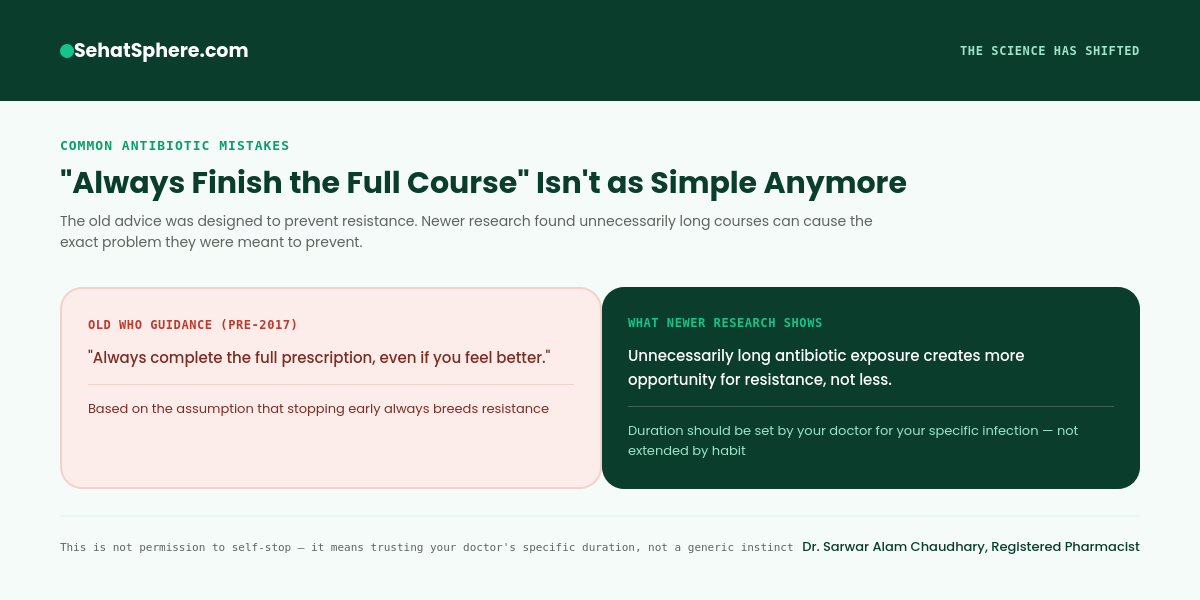
The honest, responsible takeaway is not “decide for yourself when to stop.” It’s that expert bodies are increasingly moving toward shorter, evidence-based prescribed durations determined by your doctor for specific infections, rather than defaulting to long courses “just in case.” The old blanket rule is being revised by the same science that created it — which is exactly why the actual duration your doctor prescribes matters more than a generic instinct to either “push through” or “stop once you feel better.”
This is not permission to stop antibiotics whenever you personally feel better. It means duration should be set by your prescriber based on current evidence for your specific infection — not extended by habit, and not shortened by your own judgment either.
How Antibiotics Actually Work
Not all antibiotics work the same way, which is part of why “just take any antibiotic” is such an unreliable instinct. Bactericidal antibiotics (like penicillins) directly kill bacteria by rupturing their cell walls. Bacteriostatic antibiotics (like tetracyclines and macrolides such as azithromycin) don’t kill bacteria outright — they stop them from multiplying, relying on your own immune system to clear the rest. This is exactly why a healthy immune system matters alongside the drug itself, and why people with weakened immunity sometimes need a bactericidal option specifically rather than whatever’s available at the counter.
This distinction also explains why stopping a bacteriostatic antibiotic too early is particularly risky: the bacteria were only paused, not killed, and a partial course gives them a chance to resume multiplying with some members already having survived exposure to the drug — the exact scenario that breeds resistance.
A Note on Children Specifically
Self-medicating a child with adult antibiotics, or a sibling’s leftover prescription, deserves its own specific caution. Children’s dosing is calculated by weight, not simply “half a tablet,” and giving the wrong dose — too little or too much — carries real risk in a body still developing. Fever, cough, and sore throat in children are overwhelmingly viral, exactly as in adults, and a pediatrician’s assessment before reaching for a leftover strip protects both the individual child and the broader resistance picture, since children are disproportionately represented in India’s antibiotic-resistance mortality data.
7 Everyday Mistakes
1. Buying antibiotics over the counter without a diagnosis
The most common driver of India’s resistance crisis. A cough, cold, or sore throat is very often viral — antibiotics do nothing for viral infections and only expose your body’s bacteria to unnecessary selective pressure.
2. Saving “leftover” antibiotics for next time
A half-finished strip saved from a previous illness is rarely the right drug, right dose, or right duration for a new infection — and using it exposes bacteria to a sub-therapeutic dose, the single most reliable way to breed resistance.
3. Sharing antibiotics with family members
Different infections need different antibiotics. What worked for one family member’s UTI may be completely wrong for another person’s chest infection, even with similar symptoms.
4. Taking it at random times instead of evenly spaced
Most antibiotics work by maintaining a steady blood concentration above the level bacteria can survive. Bunching doses together and skipping stretches lets levels dip, giving surviving bacteria room to adapt.
5. Not mentioning ALL current medications and supplements
Antibiotics interact with far more than people expect — from thyroid medication to blood thinners to cholesterol medications to specific supplements — and your pharmacist can only check for these if they know your full list. The free Integrative Interaction Checker is worth running your complete list through before starting any new antibiotic course.
6. Assuming alcohol is always fine, or always dangerous
The truth sits in between, and depends entirely on which antibiotic — covered in detail below.
7. Stopping because side effects felt “normal” without mentioning them
Mild nausea might be expected. A spreading rash, severe diarrhea, or difficulty breathing are not, and self-managing through a genuine reaction can delay care that’s actually needed.
What To Read Next
- Thyroid Medicine Mistakes: Another everyday medication with real timing consequences.
- Integrative Interaction Checker: Free tool to check your full medication list at once.
- Complete Guide to Medicine Safety: The broader framework this guide sits inside.
- Blood Report Decoder: Free tool to understand any lab value that changes during illness.
- Does Anger Raise Blood Pressure? Being unwell is its own kind of stress on the body.
Real Food and Drink Interactions
| Antibiotic Class | Interaction | What To Do |
|---|---|---|
| Tetracyclines, Fluoroquinolones | Dairy/calcium cuts absorption 50–80% | Separate by 2–4 hours |
| Metronidazole, Tinidazole | Alcohol causes a genuine disulfiram-like reaction | Avoid alcohol entirely during and 48 hours after |
| Penicillins (amoxicillin), Azithromycin | No significant dairy interaction | No special timing needed |
| Most other antibiotics + alcohol | No direct chemical interaction, but worsens GI side effects and healing | Reasonable to avoid while unwell regardless |
The metronidazole-alcohol reaction deserves special attention — it causes genuine, severe flushing, nausea, vomiting, and a racing heart, not a mild inconvenience. This is one of the few antibiotic-alcohol combinations that’s a hard “no,” not a “probably fine in moderation.” If magnesium or iron supplements are part of your routine alongside an antibiotic course, our magnesium interactions guide covers a similar absorption-competition principle, and if a routine lab test looks unexpectedly off during or after a course, our high creatinine levels guide and creatine and blood test guide both cover the same “context before panic” principle worth applying here too.
The Bigger Picture: Gut Health and Recovery
Antibiotics disrupt your gut microbiome alongside killing the bacteria causing your infection, which is part of why digestive upset is so common during a course. If you’re also managing acid reflux, our GERD guide and pantoprazole guide are worth reading alongside any antibiotic course, since acid-suppressing medication and antibiotics both independently affect gut bacteria. Fatigue during recovery is also worth ruling out against a genuine nutrient gap rather than assuming it’s purely the infection — the free Nutrient Deficiency Symptom Finder and our B12 deficiency guide are reasonable starting points. Being unwell itself is also a genuine stressor on the body — our mental stress guide covers why recovery can feel harder than the infection alone would suggest. If you’re tempted to reach for “immune-boosting” adaptogens instead of finishing a prescribed course, our ashwagandha guide and ACV guide cover why these aren’t substitutes for a confirmed bacterial infection, and the Biological Longevity Audit is a better starting point for genuine day-to-day immune support.
The Birth Control Myth, Corrected
This fear has circulated for over 40 years, and current evidence mostly doesn’t support it. Multiple pharmacokinetic studies show estrogen and progestin blood levels remain stable when common antibiotics are taken alongside hormonal birth control. A systematic review of clinical and pharmacokinetic studies concluded there’s no meaningful drug interaction between hormonal contraception and non-rifamycin antibiotics.
| Antibiotic Type | Affects Birth Control? |
|---|---|
| Most common antibiotics (amoxicillin, azithromycin, etc.) | No meaningful effect |
| Rifampin, rifabutin, rifapentine (used for TB) | Genuinely reduces effectiveness |
One honest caveat: a 2020 observational database study found unintended pregnancies were reported roughly 7 times more often alongside antibiotic use than with unrelated drugs — though the study design (retrospective, self-reported) couldn’t rule out other explanations, like illness itself affecting pill absorption through vomiting or diarrhea. The reasonable, non-alarmist takeaway: for most antibiotics, no backup contraception is medically required, but if you’re on rifampin specifically, or the illness itself is causing vomiting or diarrhea, backup protection is a sensible precaution regardless of the antibiotic.
When Antibiotics Don’t Even Apply
The single biggest driver of unnecessary antibiotic use isn’t misusing a correctly-prescribed antibiotic — it’s taking one for an infection it was never going to treat in the first place. The common cold, most sore throats, flu, and most coughs are viral. Antibiotics have zero effect on viruses; taking one anyway offers no benefit while still exposing your body’s bacteria to resistance-building pressure.
A doctor’s assessment — sometimes with a rapid strep test or similar — is the only reliable way to know whether a given sore throat or fever is bacterial. “It got better after I took antibiotics” is not reliable evidence it was bacterial; most viral infections resolve on their own around the same timeline regardless. If fever itself is the recurring pattern in your household, our Complete Health Library covers a broader range of common conditions worth understanding before reaching for a pharmacy strip. And if cost pressure has ever pushed you toward skipping a proper doctor visit in favor of self-treating, our generic medicine pricing guide is worth reading — a proper diagnosis is usually cheaper than a resistant infection later.
What To Actually Do With Leftover Antibiotics
Given everything above, the honest answer to “what do I do with the rest of the strip” is rarely “save it.” Flushing antibiotics down the drain or toilet lets trace amounts enter water systems, where they’ve been documented contributing to environmental antibiotic resistance — a genuinely under-discussed piece of the same puzzle. The better approach: return unused antibiotics to a pharmacy that accepts take-back programs where available, or if none exists locally, mix them with an unpalatable substance (used coffee grounds, for instance) in a sealed bag before regular disposal, specifically to discourage accidental use by children, pets, or anyone rummaging through household waste.
This single habit — properly disposing of a completed or discontinued course rather than tucking it into a drawer “just in case” — closes off one of the most common paths toward the self-medication and sharing mistakes covered earlier in this guide.
Quick Self-Check
Tick anything that applies to you, and see what it suggests.
Frequently Asked Questions
What is the most common antibiotic mistake?
Taking antibiotics without a proper diagnosis, often for viral infections like the common cold, where they have no effect and only contribute to resistance.
Is it true you should always finish the full course of antibiotics?
This is genuinely more complicated than the old blanket advice suggested. Research now shows unnecessarily long antibiotic exposure can itself drive resistance. The safe approach is following the specific duration your doctor prescribes, not personally deciding to extend or shorten it.
Can I drink alcohol while taking antibiotics?
It depends entirely on the antibiotic. Metronidazole and tinidazole cause a genuine, severe reaction with alcohol. Most other antibiotics have no direct chemical interaction, though alcohol can still worsen side effects and slow healing.
Do antibiotics really cancel out birth control?
For most common antibiotics, current evidence says no. The one confirmed exception is rifampin and related drugs used for tuberculosis, which do reduce contraceptive effectiveness.
Can I take antibiotics with milk or dairy?
It depends on the antibiotic. Tetracyclines and fluoroquinolones can have their absorption cut by 50-80% by dairy and need 2-4 hours of separation. Penicillins and azithromycin are generally unaffected.
How bad is antibiotic resistance in India?
Very serious. Some common bacteria show around 80% resistance to standard treatments, and multidrug-resistant infections are estimated to cause 58,000 infant deaths annually in India.
Is it safe to use leftover antibiotics from a previous illness?
No. A different infection needs the right specific drug, dose, and duration. Leftover antibiotics are rarely an exact match and using them can expose bacteria to an inadequate dose, encouraging resistance.
Do antibiotics affect gut health?
Yes, they can disrupt the gut microbiome alongside killing the bacteria causing infection. This effect is usually temporary, and probiotic-rich foods during and after a course are commonly recommended, though the strongest evidence exists for reducing antibiotic-associated diarrhea specifically.
What is the difference between bactericidal and bacteriostatic antibiotics?
Bactericidal antibiotics directly kill bacteria, while bacteriostatic antibiotics stop them from multiplying and rely on your immune system to clear the rest. This is part of why stopping a bacteriostatic antibiotic too early is particularly risky.
Is typhoid becoming drug-resistant in India?
Yes. Fluoroquinolone-resistant Salmonella Typhi, the bacterium causing typhoid fever, ranks among the WHO’s top global priority pathogens as of 2024, reflecting a genuine and growing resistance problem specific to regions including India.
Is it safe to give a child leftover antibiotics from a sibling?
No. Children’s antibiotic dosing is calculated by weight, and using a leftover prescription risks both an incorrect dose and treating the wrong type of infection entirely.
The Bottom Line
Antibiotics remain genuinely life-saving medications, and India’s resistance crisis isn’t a reason to fear them — it’s a reason to use them precisely. That means only when a doctor confirms a bacterial infection, exactly as long as prescribed (no more, no less), without sharing or saving leftovers, and with an honest conversation about your full medication list and drinking habits. The old instinct to either “push through the full pack no matter what” or “stop as soon as I feel fine” are both outdated in different ways — the science has moved toward precision, and so should the way we actually take these drugs. Every strip finished properly and every leftover disposed of correctly is a genuinely small act with an outsized effect on whether the next generation’s infections still respond to treatment at all.
- Lancet eClinicalMedicine. Global burden of multidrug-resistant organisms, India country data.
- Antibiotic-Dispensing Patterns and Awareness of Antimicrobial Resistance Among Community Pharmacists in South-Central India. PMC
- Drug interactions between non-rifamycin antibiotics and hormonal contraception: a systematic review. PubMed
View All References (5) ▾
- The Swaddle. Why Are Patients Still Told to Complete Their Antibiotic Course? theswaddle.com
- Social determinants of antibiotic misuse: a qualitative study from Haryana, India. PMC