 SehatSphere.com
Vitamin D Deficiency in India: Why Sunlight Isn’t Enough
India sits at a latitude that should make vitamin D deficiency rare. Instead, national data consistently shows the opposite: 70–90% of Indians tested for vitamin D come back deficient, across every age, region, and income group. The paradox isn’t a myth — it’s a real, well-documented gap between abundant sunlight and what your skin actually converts from it.

Key takeaways:
- Only about 15% of the compound in your skin that sunlight hits actually converts to usable vitamin D — the rest becomes inert byproducts, which is why “more sun” has diminishing returns.
- A 2025 India-specific consensus (41 endocrinologists) now recommends a higher target — 40–60 ng/mL — than older global cutoffs.
- Vitamin D isn’t really a vitamin — it behaves like a hormone, requiring activation in your liver and kidneys before your body can use it.
- Testing and supplementing “just in case” isn’t the current best-practice advice; it’s meant for specific symptoms and risk groups, not routine screening of every healthy adult.
- The sunlight paradox, explained
- How common is this in India
- Why sunlight alone isn’t enough
- Symptoms worth paying attention to
- What the numbers actually mean
- Who actually needs testing
- Real treatment doses
- Food sources that actually help
- How this connects to metabolic health
- Getting tested without overpaying
- Quick self-check
- FAQs
The Sunlight Paradox, Explained
Vitamin D isn’t absorbed from food the way most nutrients are — it’s manufactured in your skin when UVB radiation hits a compound called 7-dehydrocholesterol. Here’s the part almost nobody knows: only about 15% of that compound actually converts into usable previtamin D3. The rest photo-isomerizes into lumisterol and tachysterol — inert byproducts with no role in calcium metabolism at all.
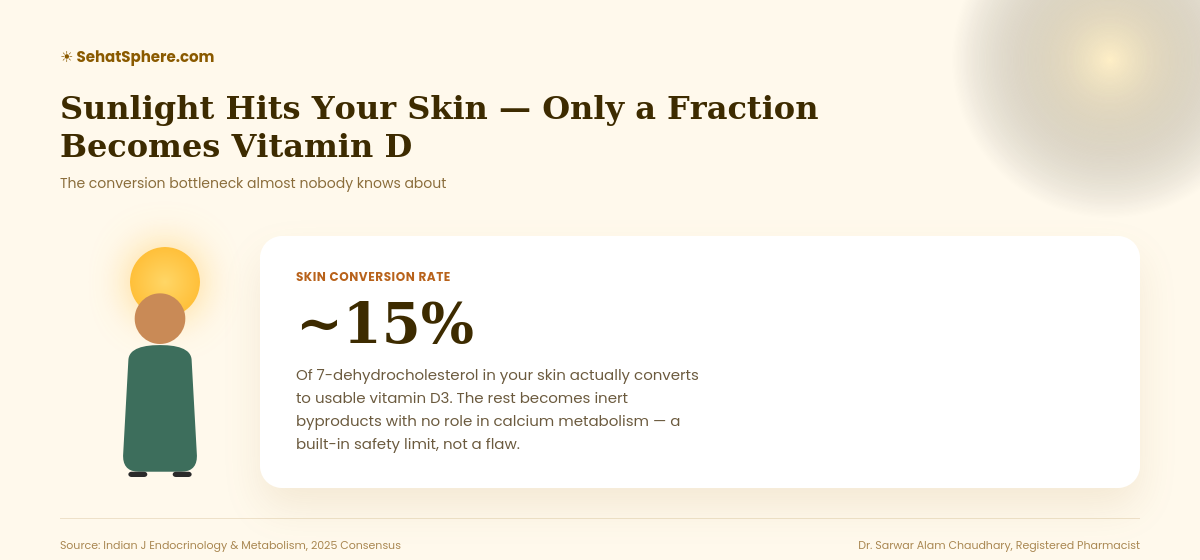
This isn’t a flaw; it’s a built-in safety mechanism. Once enough previtamin D3 accumulates, further sun exposure just degrades excess vitamin D3 into inactive compounds instead of building up to toxic levels — which is exactly why vitamin D toxicity from sun exposure alone essentially never happens, no matter how long you sit outside. It’s also why “just get more sun” is well-meaning but incomplete advice: your skin was never designed to convert unlimited sunlight into unlimited vitamin D.
Once made in the skin, vitamin D still isn’t ready to use. It travels to the liver, where it’s converted to calcidiol (the form measured on a standard blood test), then to the kidneys, where it becomes calcitriol — the biologically active hormone your body actually uses. This two-step activation is exactly why vitamin D behaves more like a hormone than a typical dietary vitamin, and why liver or kidney conditions can independently affect your levels regardless of how much sun or supplementation you get.
How Common Is This in India?
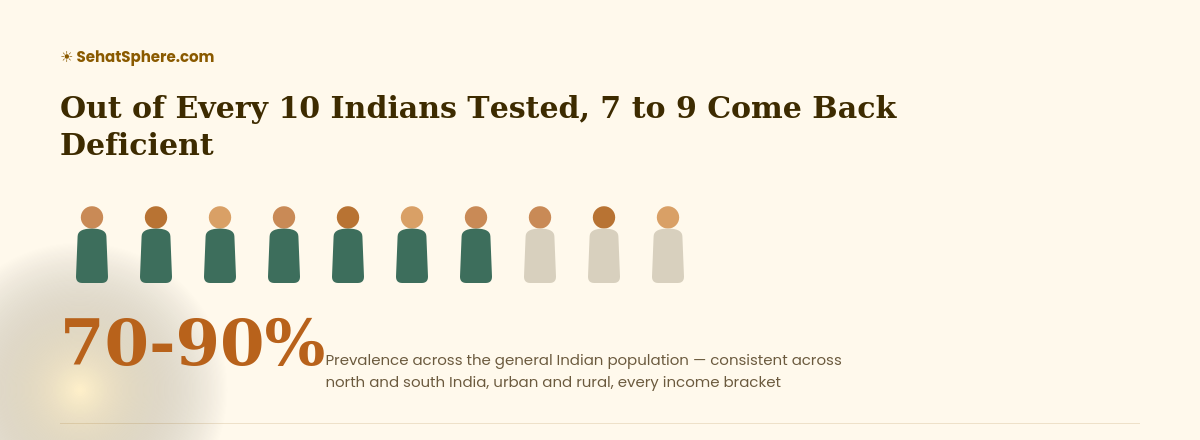
Multiple independent studies converge on the same uncomfortable range: 70–90% prevalence of vitamin D deficiency across the general Indian population, cutting across north and south India, urban and rural settings, and every socioeconomic bracket. This isn’t a new finding either — it’s been documented consistently for over a decade.
| Population Studied | Deficiency Rate |
|---|---|
| General adult population (pooled) | 70–90% |
| Healthy children/adolescents (23-study pooled review, 38,762 subjects) | Majority affected |
| Infants, Meerut tertiary center study | 42.9% |
| Children aged 1–4, nationwide survey | 13.7% |
Urban adolescents and girls specifically show higher deficiency rates than rural or male counterparts in multi-state Indian studies — a pattern that tracks closely with indoor lifestyles, clothing coverage, and sunscreen use rather than latitude or season alone. Pregnant women represent another consistently high-risk group across Indian data, since maternal vitamin D status directly affects fetal bone development, making this a genuine priority-testing group rather than a routine add-on. If blood pressure is also part of your health picture during or after pregnancy, our normal blood pressure by age guide is worth reading alongside this one.
Why Sunlight Alone Isn’t Enough
Several genuinely Indian-specific factors compound the paradox beyond the biological conversion limit above:
Higher skin melanin
More pigmentation blocks a larger share of incoming UVB before it can even reach the 7-dehydrocholesterol layer — a real, well-documented physiological trade-off.
Indoor-first urban lifestyles
Office hours, air-conditioned commutes, and screen-based work mean many working adults get minimal direct midday sun exposure most days of the week.
Clothing and cultural practices
Extensive skin coverage, common across many Indian communities for cultural or religious reasons, directly reduces the skin surface area available for UVB conversion.
Urban air pollution
Particulate matter in city air scatters and absorbs UVB radiation before it reaches street level, measurably reducing effective sun exposure even on visibly sunny days.
Almost no dietary fortification
Unlike several Western countries, staple foods like milk in India are rarely fortified with vitamin D by default, removing a backup source most people don’t realize they’re missing.
The ideal window for UVB conversion is specifically 10am to 3pm, when the sun’s angle is steep enough to deliver UVB efficiently — exactly the hours most working adults spend indoors.
What To Read Next
- Vitamin B12 Deficiency: Another nutrient gap that overlaps with the same fatigue symptoms.
- Nutrient Deficiency Symptom Finder: Free 2-minute tool to check what’s actually behind your symptoms.
- Hair Fall & Vitamin Deficiency: Low vitamin D is a documented, under-discussed contributor.
Symptoms Worth Paying Attention To
Mild deficiency is often silent, which is part of why it goes undiagnosed for years. When symptoms do appear, they’re frequently misattributed to stress, aging, or simply “being busy”:
| Severity | Symptoms |
|---|---|
| Mild–Moderate | Persistent fatigue, low mood, frequent infections, bone or muscle aches |
| Significant | Muscle weakness, worsening bone density, increased fall/fracture risk |
| Severe (rare, untreated) | Rickets in children (soft, deformable bones); osteomalacia in adults |
Fatigue overlapping this heavily with other common deficiencies is exactly why testing the right specific marker matters more than guessing — our B12 deficiency guide and the free Nutrient Deficiency Symptom Finder are worth using alongside this one, since B12 and vitamin D deficiency can look nearly identical day to day.
What the Numbers Actually Mean
India-specific cutoffs, per Indian Academy of Pediatrics and the 2025 endocrinology consensus, differ meaningfully from older global standards:
| Category | 25(OH)D Level |
|---|---|
| Deficiency | <12 ng/mL |
| Insufficiency | 12–20 ng/mL |
| Sufficiency (older standard) | >20 ng/mL |
| Target range (2025 India consensus) | 40–60 ng/mL |
| Toxicity threshold | >100 ng/mL (with high calcium) |
The gap between the older “>20” sufficiency marker and the newer India-specific 40–60 target reflects genuinely evolving science, not inconsistent advice — the 2025 consensus was built by 41 endocrinologists specifically because global guidelines weren’t accounting for India’s unique deficiency burden and genetic/lifestyle context.
Who Actually Needs Testing
Treating a blood test result rather than a patient is a clinical error, regardless of how the numbers look. Testing and supplementation are meant for people with genuine symptoms or in specific risk groups — not as routine screening for every healthy adult with no complaints.
Groups where testing is genuinely worth pursuing: persistent, unexplained fatigue; bone or muscle pain; pregnant or breastfeeding women; older adults with limited sun exposure; anyone with very limited skin exposure due to clothing or indoor lifestyle; and people with malabsorption conditions affecting fat-soluble vitamin uptake.
Real Treatment Doses
Per current Indian pediatric and endocrine guidelines, treatment is weight/age-specific, not a flat one-size-fits-all number:
| Group | Typical Dose |
|---|---|
| Infants (maintenance) | 400 IU/day |
| Older children/adolescents (maintenance, via diet+sun) | 400–600 IU/day |
| Deficiency treatment, under 1 year | 2,000 IU/day, 12 weeks |
| Deficiency treatment, older children | 3,000 IU/day, 12 weeks |
Adult treatment doses vary more widely based on how deficient someone is and individual factors, which is exactly why self-dosing high-strength supplements without a confirmed blood level is genuinely risky — toxicity, while rare, is real and specifically tied to supplement over-dosing, never to sun exposure.
Food Sources That Actually Help
Since Indian staples are rarely fortified by default, deliberate food choices matter more here than in countries with fortified dairy as standard:
- Fatty fish (salmon, mackerel, sardines) — among the few naturally rich sources
- Egg yolks — a modest but genuinely useful contributor
- Fortified milk or plant-based milk — check labels specifically, since fortification isn’t universal in India
- Mushrooms exposed to UV light — one of the only meaningful plant-based sources
Realistically, food alone rarely closes a significant deficiency — it’s a maintenance strategy alongside sensible sun exposure and, where a doctor confirms it’s needed, supplementation. If magnesium is also part of your supplement routine, it’s worth knowing the two nutrients work together — magnesium is required to activate vitamin D in the body, and our magnesium deficiency guide and magnesium interactions guide cover this connection in depth.
How This Connects to Your Broader Metabolic Health
Vitamin D deficiency rarely exists in isolation. Low levels are independently associated with worsened insulin resistance, which is part of why our insulin resistance guide and fatty liver treatment guide are worth reading if vitamin D is part of your picture. Women with PCOS specifically show higher rates of vitamin D deficiency in Indian studies, adding one more layer to an already interconnected metabolic picture. If thyroid symptoms are also part of your history, our thyroid guide is worth reading too, since fatigue overlaps heavily across all three conditions.
Chronic stress independently worsens vitamin D metabolism as well — our mental stress guide covers this same cortisol pathway. If you’re on long-term medication for other conditions, it’s worth knowing some can affect vitamin D metabolism too — our pantoprazole guide and statins guide touch on this overlap, and the free Integrative Interaction Checker is worth running your full medication list through before adding any new supplement.
Getting Tested Without Overpaying
A 25(OH)D blood test is widely available at most diagnostic labs in India, and doesn’t require special preparation like fasting. If cost is a concern, our generic medicine pricing guide covers a broader principle worth knowing — branded versions of the same supplement often cost significantly more for an identical active ingredient. Once you have a result, the free Blood Report Decoder can help you understand exactly where your number sits relative to the ranges in this guide, and the Biological Longevity Audit is worth trying for a broader sense of how this fits into your overall health picture.
Quick Self-Check
Tick anything that applies to you, and see what it suggests.
Frequently Asked Questions
Why is vitamin D deficiency so common in India despite abundant sunlight?
Only about 15% of the compound sunlight interacts with in your skin actually converts to usable vitamin D. This, combined with higher skin melanin, indoor lifestyles, clothing coverage, pollution, and lack of dietary fortification, creates a genuine gap despite plentiful sun.
What is the normal vitamin D level for Indians?
Current India-specific consensus recommends a target of 40-60 ng/mL, higher than the older global “>20 ng/mL” sufficiency marker, reflecting India’s unique deficiency burden.
Can you get vitamin D toxicity from sunlight?
No. Your skin has a built-in mechanism that degrades excess previtamin D3 into inactive compounds once enough has accumulated, making toxicity from sun exposure alone essentially impossible.
Does everyone need a vitamin D test?
No. Current guidance favors testing for people with genuine symptoms or specific risk factors, not routine screening of every healthy adult without complaints.
What are the early symptoms of vitamin D deficiency?
Persistent fatigue, low mood, frequent infections, and bone or muscle aches are common early signs, though many people have no symptoms at all in mild deficiency.
What is the best time to get sunlight for vitamin D?
Between 10am and 3pm, when the sun’s angle is steep enough for efficient UVB conversion in the skin.
Can vitamin D deficiency cause hair fall?
Yes, it’s a documented, often under-discussed contributor to hair thinning, alongside other more commonly suspected causes.
How much vitamin D supplement is safe to take without a doctor?
Self-dosing high-strength supplements without a confirmed blood test is genuinely risky. Treatment doses are specific to age and deficiency severity, and toxicity, while rare, is tied specifically to supplement over-use, not sunlight.
The Bottom Line
India’s vitamin D paradox is real, well-documented, and explained by genuine biology, not bad luck — your skin was never built to convert unlimited sunlight into unlimited vitamin D, and modern indoor life closes the gap even further. The fix isn’t panic-testing or high-dose self-supplementation; it’s recognizing genuine symptoms, understanding who actually needs testing, and treating a confirmed deficiency with the right dose for the right amount of time. Fifteen minutes of midday sun on exposed arms and legs, a few days a week, remains a genuinely useful, free habit worth building — just not a complete solution on its own for most people living and working the way modern urban India does.
- Ritu G, Gupta A. Vitamin D Deficiency in India: Prevalence, Causalities and Interventions. Nutrients, 2014;6(2):729-775.
- Prevention and Treatment of Vitamin D Deficiency in India: 2025 Consensus Statement. Indian Journal of Endocrinology and Metabolism.
- Indian Academy of Pediatrics Revised (2021) Guidelines on Prevention and Treatment of Vitamin D Deficiency and Rickets.