 SehatSphere.com
Why Does Heart Rate Fluctuate? 12 Hidden Causes, Smartwatch Errors & a 7-Day Control Plan
Many people notice their pulse jump from 65 to 110 bpm within an hour on a smartwatch, with no obvious explanation — and reach for their phone half-convinced something is wrong. Most of the time, nothing is. Heart rate is designed to move, controlled by a tug-of-war between two nerve branches that respond to everything from caffeine to a stressful email. This guide covers the real, verified causes, when a fluctuation actually matters, and — since so many people first notice this on a wearable — exactly how accurate that reading on your wrist actually is.
Key takeaways:
- Heart rate is controlled by a constant tug-of-war between your sympathetic (“speed up”) and parasympathetic (“slow down”) nervous systems.
- 12 everyday factors — from caffeine and dehydration to fever, hormones, and medications — can shift your pulse without any underlying disease.
- Wrist-worn wearables can be off by roughly 9-14 bpm on average, and the error gets worse during activity, not because of skin tone.
- A racing heart specifically when you stand up may be POTS (postural orthostatic tachycardia syndrome), a real, diagnosable condition that predominantly affects women.
- A resting heart rate consistently above 100 bpm or below 60 bpm (with symptoms) is the threshold worth discussing with a doctor.
What Is Heart Rate?
Heart rate is the number of times your heart beats per minute (bpm). Every beat pumps oxygen-rich blood throughout your body to keep your organs and muscles working properly. It’s generally described in two ways: your resting heart rate (beats per minute while calm, seated, and not recently active) and your target or exercise heart rate (the range your heart should reach during moderate to vigorous activity to safely benefit your cardiovascular system).
For example, a resting heart rate of 72 bpm simply means your heart beats 72 times every minute while you’re at rest. According to the Cleveland Clinic, several everyday factors can make your heart rate fluctuate, including emotions, weight, fitness level, and sleep quality.
Your Body’s Natural Pacemaker: How Heart Rate Is Actually Controlled
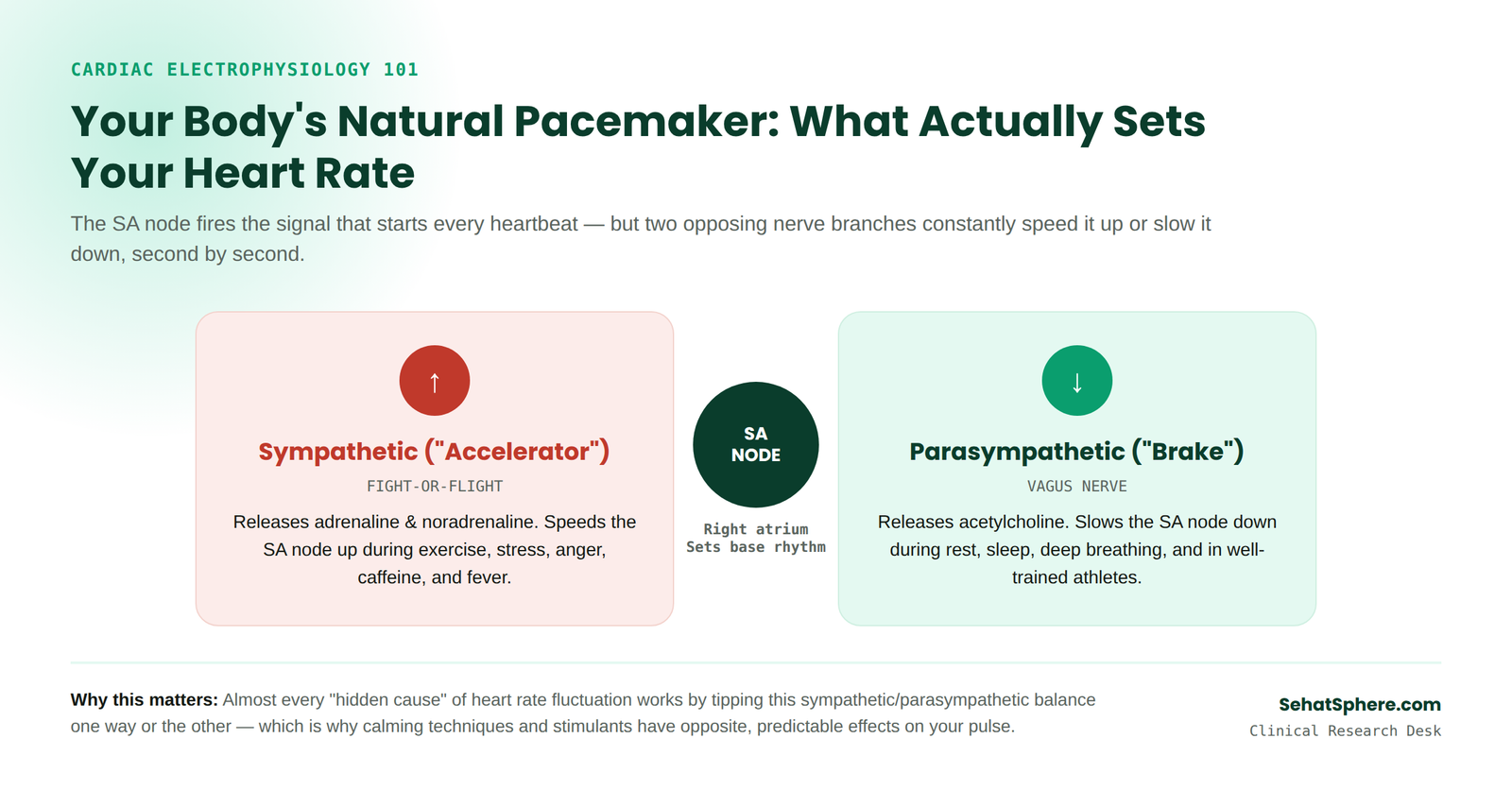
Every heartbeat starts with an electrical signal from a small cluster of specialized cells in the right atrium called the sinoatrial (SA) node — your heart’s own natural pacemaker. Left completely alone, the SA node would fire at a steady 90-100 beats per minute. The reason your resting heart rate usually sits lower than that, and the reason it moves around at all, is two opposing branches of your autonomic nervous system constantly pulling on it in real time.
- The sympathetic nervous system (“accelerator”): releases adrenaline and noradrenaline, speeding the SA node up during exercise, stress, anger, caffeine, or fever
- The parasympathetic nervous system (“brake”), via the vagus nerve: releases acetylcholine, slowing the SA node down during rest, sleep, and deep breathing
This balance is sometimes summarized as heart rate variability (HRV) — the tiny beat-to-beat variation in timing between heartbeats. Counter-intuitively, more variability generally reflects a healthier, more responsive autonomic nervous system, while a rigidly fixed heart rate can actually be a sign of reduced cardiac flexibility. Almost every cause covered in this guide works by tipping this sympathetic/parasympathetic balance one way or the other, which is why the fixes that actually work (calming the nervous system) and the triggers that make things worse (stimulants) sit on exact opposite sides of the same mechanism.
Normal Heart Rate Chart
| Category | Resting Heart Rate |
|---|---|
| Bradycardia (slow) | Below 60 bpm |
| Normal | 60–100 bpm |
| Tachycardia (fast) | Above 100 bpm |
| Emergency range | Above 150 bpm or below 40 bpm (with symptoms) |
A resting heart rate below 60 bpm is not automatically a problem — it’s common and often healthy in trained athletes and very fit individuals, whose more efficient hearts need fewer beats to circulate the same amount of blood. What matters most is whether the number is normal for you and whether it comes with symptoms like dizziness, fainting, or chest discomfort.
How Heart Rate Changes Throughout the Day
Heart rate naturally follows your body’s internal biological clock and reacts instantly to what you’re doing and feeling:
- Lowest during deep sleep
- Rises gradually after waking up
- Increases sharply during physical activity
- Temporarily rises during stress, anxiety, or excitement — see our guide on whether anger specifically raises blood pressure for a deeper look at this exact mechanism
- Can spike briefly when standing up suddenly
Small heart rate changes throughout the day are completely normal. The concern begins when your resting rate stays unusually high or low for you, or changes suddenly along with symptoms such as chest pain, severe dizziness, fainting, or shortness of breath.
12 Hidden Causes of Heart Rate Fluctuation
Many people assume a changing heart rate always points to a heart problem. In reality, heart rate can shift because of several normal body functions as well as certain medical conditions.
Temporary fluctuations are usually harmless. However, a consistently very fast, very slow, or irregular pulse — especially with symptoms — should always be evaluated by a healthcare professional.
1. Physical activity
Your heart naturally beats faster during movement or exercise to supply your muscles with more oxygen, then gradually returns to baseline once you rest.
2. Stress & anxiety
Strong emotions activate the sympathetic “accelerator” described above, releasing adrenaline that temporarily speeds up your heartbeat. Our guide on managing mental stress naturally covers evidence-based ways to dial this down.
3. Caffeine & nicotine
Coffee, energy drinks, and smoking stimulate the sympathetic nervous system and cause a temporary rise in heart rate.
4. Dehydration
When fluid levels drop, blood volume decreases and the heart may beat faster to keep blood circulating properly.
5. Fever or infection
Your body’s metabolism speeds up during illness, which commonly raises heart rate along with body temperature.
6. Poor or irregular sleep
Heart rate normally drops during sleep. Insomnia, poor sleep quality, or untreated sleep apnea can disturb this natural pattern.
7. Certain medicines
Decongestants and stimulant-based medicines may raise heart rate, while beta-blockers and certain heart medicines can lower it. If you’re on regular medication and notice a pattern, check it against the Integrative Interaction Checker or the Medication + Lifestyle Checker, or ask your doctor.
8. Hormonal changes
Thyroid disorders, pregnancy, and hormonal imbalances can significantly influence how fast or slow your heart beats. Some adaptogenic herbs like ashwagandha can also interact with thyroid function and heart rate — worth checking if you take it regularly.
9. Body position changes
Standing up quickly can cause a brief spike in heart rate. In some people this reaction is exaggerated and persistent — a pattern covered in its own section below.
10. Body weight
A higher body mass index can be linked to a higher resting heart rate, as the heart works harder to circulate blood. If you’re managing weight with newer medicines, our guide on the Mounjaro & Ozempic diet in India covers what to eat alongside them.
11. Fitness level
Well-trained athletes often have a naturally lower resting heart rate because their heart pumps blood more efficiently with each beat.
12. Underlying heart rhythm issues
Conditions such as arrhythmia (including atrial fibrillation and supraventricular tachycardia) can cause the heart to beat too fast, too slow, or irregularly, independent of activity or emotion. If you’re also managing high blood pressure, our Complete Guide to Blood Pressure covers how the two systems interact.
Seek immediate medical attention if your heart rate is above 150 bpm or below 40 bpm and you experience severe chest pain, difficulty breathing, sudden weakness or numbness, confusion, fainting or near-fainting, severe dizziness, cold sweat, or an irregular or fluttering heartbeat.
Is Your Smartwatch Lying to You?
Since so many people first notice a “fluctuating” heart rate on a wrist-worn device, it’s worth answering directly: how accurate are these readings? A widely cited 2020 study in npj Digital Medicine tested six popular wearable devices against a medical-grade ECG reference and found average errors of roughly 9.5 bpm at rest, rising to about 13.5 bpm during activity — meaningful enough to make a perfectly normal heart rate look like a concerning spike.
The biggest driver wasn’t skin tone, which the researchers specifically tested and found had no statistically significant effect on accuracy. The real culprit was something called signal crossover: these devices use optical sensors (photoplethysmography, or PPG) that shine light through your skin and measure blood-flow changes, and rhythmic wrist motion — walking, and even typing — can get mistaken for a pulse beat, throwing the reading off. Consumer devices from major brands also generally outperformed cheaper alternatives in the same study.
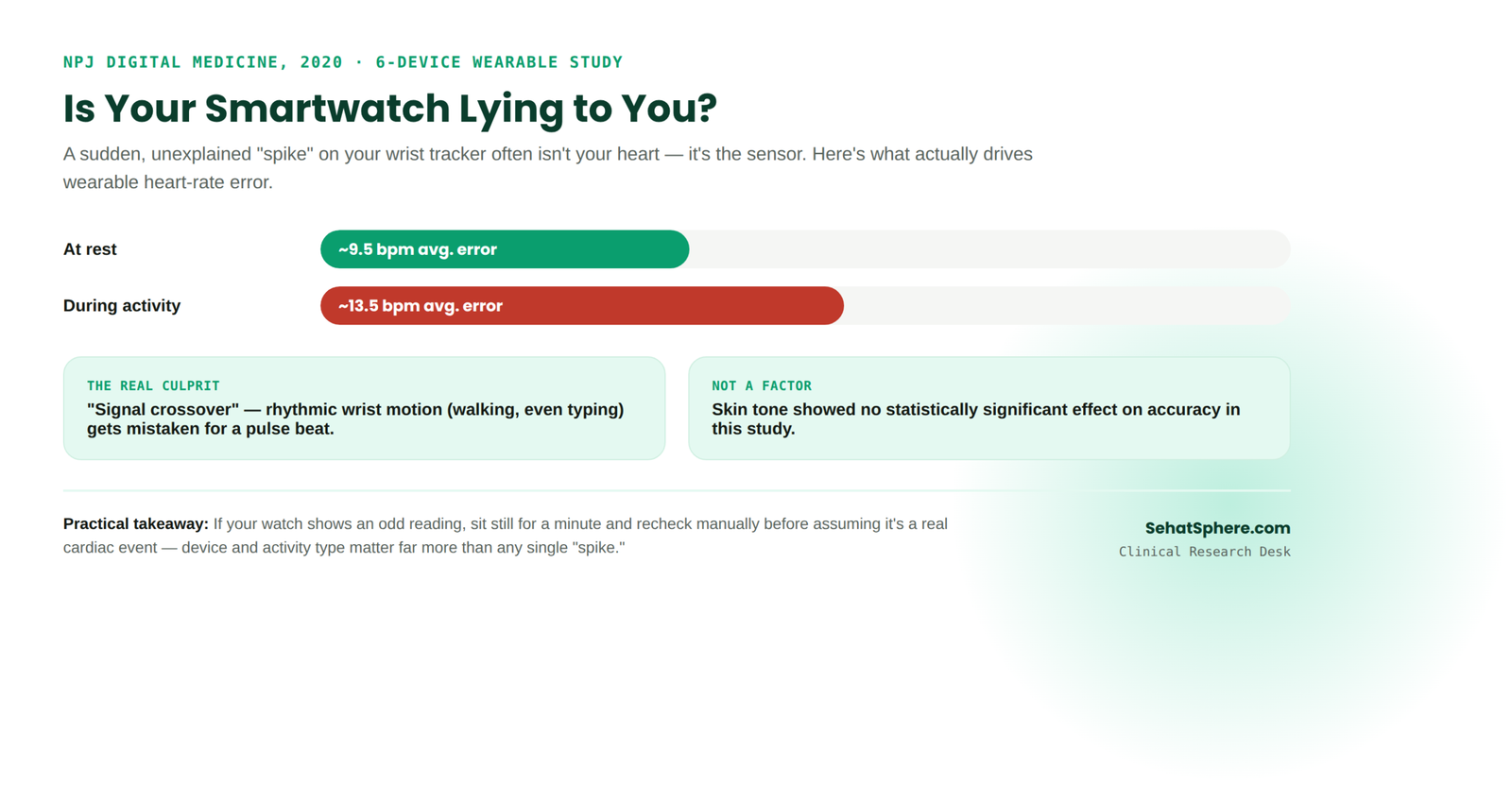
If your watch shows an unusual reading, sit still for a minute and recheck manually before assuming it’s a real cardiac event. See our guide on wearable blood pressure accuracy for the same issue applied to wrist-worn BP monitors, which face an even steeper accuracy challenge.
What To Read Next
- Does Anger Raise Blood Pressure? The 2024 science on how a hot temper actually damages your arteries.
- Normal Blood Pressure by Age: See what a healthy range should look like across the decades.
- Is Your Home BP Machine Lying to You? The same accuracy question, applied to your cuff monitor.
- Complete Guide to Medicine Safety: Our master guide to using every medication correctly and safely.
When Standing Up Triggers a Racing Heart: POTS
One specific pattern deserves its own section, because it’s genuinely common yet rarely discussed by name: postural orthostatic tachycardia syndrome (POTS). This is a real, diagnosable condition — not just ordinary lightheadedness from standing up fast.
The clinical diagnostic criteria, per Johns Hopkins Medicine, are specific: a heart rate increase of at least 30 bpm in adults (or at least 40 bpm in adolescents) within the first 10 minutes of standing, without a significant drop in blood pressure (which would instead point to orthostatic hypotension) and without an obvious cause like acute dehydration or blood loss. POTS predominantly affects women, and most often develops in adolescence or young adulthood, sometimes following a viral illness, surgery, or pregnancy. Researchers don’t fully understand the exact cause in every case, but contributing mechanisms include lower circulating blood volume, blood pooling in the legs when upright, elevated stress hormones, and blood vessels that don’t constrict efficiently in response to nervous system signals.
An occasional brief head-rush when you stand up too fast is normal. POTS is different: a persistent, measurable, repeatable heart rate jump every time you stand, often alongside fatigue, brain fog, or fainting, that meaningfully affects daily life. If this pattern sounds familiar, it’s worth raising by name with your doctor — a tilt-table test can confirm it.
Signs, Symptoms & Who’s at Greater Risk
Many people notice no symptoms even when their heart rate changes. However, when fluctuations become significant or occur suddenly, the body may produce noticeable warning signs.
| Common Symptom | Possible Meaning |
|---|---|
| Palpitations | A racing, pounding, or fluttering heartbeat — sometimes linked to anxiety or arrhythmia |
| Dizziness | May occur when heart rate is too fast or too slow to pump blood efficiently |
| Fatigue | Can occur when the heart isn’t pumping blood as effectively as it should |
| Chest pain | Medical emergency — seek urgent medical care |
| Shortness of breath | May indicate a serious heart or lung condition |
| Fainting | Can happen when the brain briefly receives less blood flow due to an abnormal heart rate |
An irregular heartbeat can sometimes be silent, producing no symptoms at all until it’s picked up during a routine check-up. Regular pulse checks are genuinely useful for this reason.
Certain factors raise the odds of a heart rate problem worth investigating: age above 40, a family history of heart disease, obesity, thyroid disorders, smoking, high caffeine or alcohol intake, a sedentary lifestyle, and chronic stress all compound the risk. If several apply to you, our guide on early warning signs of a weak heart is worth reading alongside this one.
How doctors diagnose heart rate problems
Doctors usually don’t diagnose heart rate problems from a single reading alone — monitoring over time provides a far more accurate picture, typically through some combination of a manual pulse check, home or wearable monitoring, an ECG, a 24-48 hour Holter monitor, a physical exam, thyroid and blood tests, and (when needed) echocardiography or a stress test. The British Heart Foundation notes that home monitors are useful for tracking trends but can’t diagnose a condition on their own. Already have a thyroid or CBC report in hand? Run it through the free Blood Report Decoder to understand it in plain language.
See a doctor if your resting heart rate is repeatedly above 100 bpm without a clear cause, repeatedly below 60 bpm with symptoms (and you’re not an athlete), you experience frequent palpitations, recurrent dizziness or fainting, chest pain, breathing difficulty, or a sudden unexplained change from your normal baseline. If medicines are part of the picture, our Complete Guide to Medicine Safety is a good place to start.
7-Day Heart Rate Control Plan
If your heart rate fluctuates frequently, healthy lifestyle changes can help support better long-term control. This plan builds simple daily habits — it does not replace medical advice or prescribed treatment.
| Day | Main Goal | Action Plan |
|---|---|---|
| Day 1 | Know your numbers | Check your resting pulse each morning before getting up. Record it daily. |
| Day 2 | Cut back stimulants | Reduce caffeine and energy drinks; avoid nicotine. |
| Day 3 | Stay hydrated | Drink adequate water throughout the day unless your doctor has advised fluid restriction. |
| Day 4 | Cardio exercise | Walk briskly for 30 minutes or perform another doctor-approved aerobic activity. |
| Day 5 | Stress control | Practice deep breathing, meditation, or yoga for 10-15 minutes. |
| Day 6 | Healthy sleep | Aim for 7-9 hours of quality sleep and avoid late-night screen time. |
| Day 7 | Review progress | Compare your daily pulse readings and continue the habits that helped most. |
Foods that may support a healthy heart rate
Potassium-rich bananas, magnesium-rich leafy greens, fiber-rich oats, omega-3-rich fatty fish, walnuts, and berries are all reasonable additions to a heart-supportive diet. Not sure if you’re actually getting enough magnesium and potassium from your diet? Try the free Nutrient Deficiency Symptom Finder to check. Superfoods like moringa are another natural source of these minerals — just check it against your medicines first. On the flip side, excess caffeine, energy drinks, excess alcohol, high-sodium processed foods, and sugary drinks are all worth limiting — our guide on ultra-processed foods covers exactly how these ingredients quietly add up.
Taking a dose at the wrong time or with the wrong food is one of the most common medicine mistakes people make without realizing it, and it can directly affect heart rate readings.
See the Full List of Medicine Mistakes →Target Heart Rate Calculator
Enter your age to estimate your maximum heart rate and safe exercise heart rate zones, using the widely used 220-minus-age formula. This is an estimate only.
Daily Heart Rate Checklist
Tick off what you’ve done today — small, consistent habits matter more than occasional big efforts.
Frequently Asked Questions
Is a fluctuating heart rate normal?
Yes. It’s normal for heart rate to fluctuate throughout the day because of activity, stress, sleep, and body temperature. Persistent or extreme fluctuations should be evaluated by a healthcare professional.
Can anxiety suddenly increase heart rate?
Yes. Anxiety activates the sympathetic “accelerator” branch of your nervous system, releasing stress hormones that temporarily raise heart rate.
What is the best time to check my resting heart rate?
Usually in the morning before getting out of bed, before coffee or activity, for the most accurate resting reading.
Can dehydration affect heart rate?
Yes. Dehydration reduces blood volume, which can make the heart beat faster to compensate.
How accurate are smartwatch heart rate readings?
A 2020 study of six wearable devices found average errors of about 9.5 bpm at rest and 13.5 bpm during activity, mainly caused by rhythmic wrist motion being mistaken for a pulse beat, not skin tone.
What is POTS, and how is it different from normal dizziness on standing?
POTS (postural orthostatic tachycardia syndrome) is a diagnosable condition defined by a heart rate increase of at least 30 bpm in adults within 10 minutes of standing, without a significant blood pressure drop. It predominantly affects women and is a persistent, repeatable pattern, unlike an occasional brief head-rush.
Which foods help support a healthy heart rate?
Bananas, leafy vegetables, oats, walnuts, fatty fish, and berries can be part of a heart-healthy diet, largely through their potassium, magnesium, and omega-3 content.
Can poor sleep increase heart rate?
Yes. Poor sleep quality or sleep apnea may disturb the natural nighttime drop in heart rate.
When should I go to the hospital for heart rate?
Seek emergency care immediately if your heart rate is above 150 bpm or below 40 bpm with symptoms such as chest pain, fainting, confusion, or difficulty breathing.
Can exercise lower resting heart rate?
Regular cardiovascular exercise can help make the heart more efficient over time, which may lower resting heart rate. Follow your healthcare provider’s advice about the right exercise for you.
Should I worry if my heart rate is naturally below 60 bpm?
Not necessarily. A resting heart rate below 60 bpm is common in fit individuals and athletes. It becomes a concern mainly when it comes with symptoms like dizziness or fainting.
Can medications affect my heart rate?
Yes. Decongestants and stimulant-based medicines may raise heart rate, while beta-blockers and certain heart medicines can lower it. Check any regular medication against a reliable interaction checker or ask your doctor if you notice a pattern.
The Bottom Line
Heart rate is meant to move — it’s controlled by a real-time tug-of-war between your sympathetic and parasympathetic nervous systems, and 12 everyday factors can tip that balance without any underlying disease. Before assuming a wearable reading means something is wrong, remember that these devices carry a genuine, well-documented error margin, especially during activity. What does deserve attention: a resting rate consistently above 100 or below 60 bpm with symptoms, a heart rate that spikes specifically and repeatedly when you stand (possibly POTS), or any of the emergency warning signs above. For everything else, the same simple habits — hydration, sleep, moderate caffeine, stress management, and consistent movement — do most of the real work.
- Cleveland Clinic. Heart Rate. my.clevelandclinic.org
- British Heart Foundation. How a Healthy Heart Works: Your Heart Rate. bhf.org.uk
- Johns Hopkins Medicine. Postural Orthostatic Tachycardia Syndrome (POTS). hopkinsmedicine.org
- Bent B, Goldstein BA, Kibbe WA, Dunn JP. Investigating sources of inaccuracy in wearable optical heart rate sensors. npj Digital Medicine, 2020;3:18.