
 SehatSphere
Medication Safety
Moringa and Your Medications
The antiretroviral interaction almost nobody mentions
Moringa and your medications is a combination most viral coverage narrows down to the same two or three cautions, repeated across dozens of nearly identical wellness-blog posts. Moringa has moved from niche Ayurvedic and African traditional use into mainstream TikTok wellness alongside ashwagandha and other adaptogens. Nearly every safety article repeats the same thyroid and diabetes warnings without adding anything new. Here’s the angle that’s almost entirely missing: a real human pharmacokinetic study on moringa and a specific class of HIV medication, buried in clinical literature rather than consumer content.
Jump to: The antiretroviral study · Thyroid and diabetes, briefly · The enzyme mechanism · Test yourself · FAQ
Quick answer: Moringa and your medications interact through moringa’s effect on liver enzymes that process a large share of prescription drugs. A human pharmacokinetic crossover study specifically examined moringa alongside nevirapine, an antiretroviral used in HIV treatment — a documented, clinically studied interaction that gets almost no coverage compared to the thyroid and diabetes warnings dominating search results.[1]
Moringa oleifera has centuries of traditional use across South Asia and Africa, and its recent TikTok visibility has ridden the same adaptogen wave that made ashwagandha mainstream — Spate’s trend data groups moringa alongside ashwagandha as ingredients that “are no longer niche.”[2] Given SehatSphere’s dual pharmacist and BHMS grounding, moringa is a genuinely interesting case: a plant with real traditional-medicine standing that also happens to have one of the more specifically studied — and specifically overlooked — modern drug interactions of any current supplement trend.
Moringa and your medications: the antiretroviral study
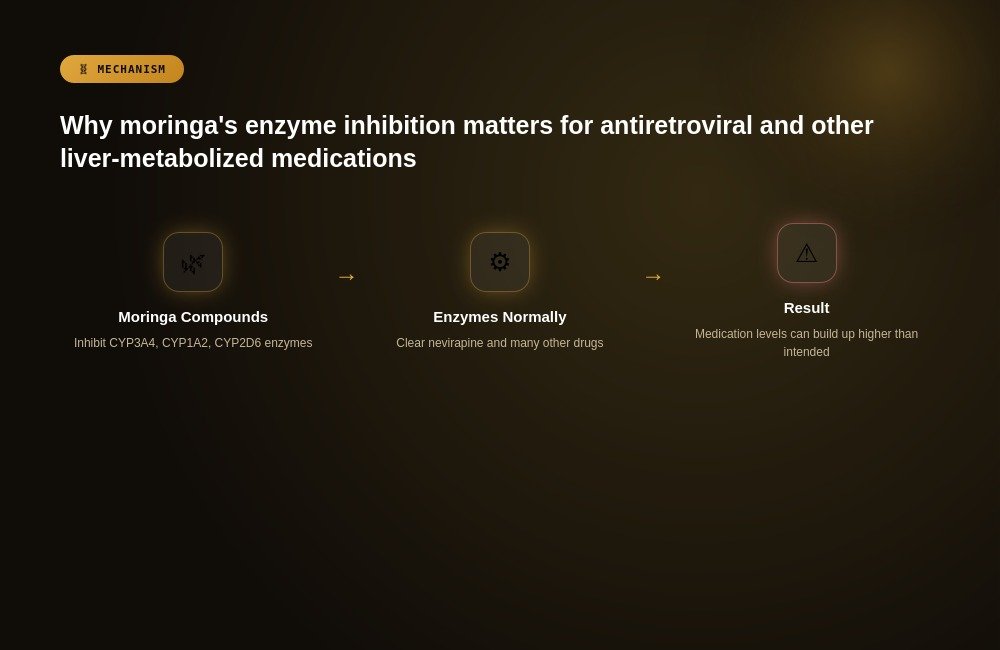
Here’s the interaction almost no mainstream coverage leads with. A human pharmacokinetic crossover study looked specifically at nevirapine — a non-nucleoside reverse transcriptase inhibitor used in HIV treatment — in people taking moringa alongside it.[1] The concern stems from moringa’s documented inhibition of CYP3A4, CYP1A2, and CYP2D6 enzymes in laboratory studies — the same enzyme family responsible for metabolizing nevirapine and many other antiretrovirals.[3] This isn’t a theoretical extrapolation from animal data; it’s a specific human study built around a specific medication class that’s easy to miss entirely if you’re only reading general “moringa side effects” content.
In regions where moringa has deep traditional roots, it also frequently overlaps with populations managing HIV through long-term antiretroviral therapy — making this a genuinely practical safety gap, not an obscure academic footnote. Someone managing HIV who adds moringa as a “natural immune support” has no obvious reason to connect the two, since moringa’s marketing almost never references antiretroviral therapy specifically.
Moringa and your medications: thyroid and diabetes, briefly
To be fair to existing coverage, the thyroid and diabetes cautions are genuinely well documented and worth repeating rather than skipping. Moringa may reduce the conversion of thyroxine to its active form and can decrease levothyroxine’s effectiveness, with multiple drug-reference sources flagging the combination.[4] It also has a real, measurable blood-sugar-lowering effect, which is genuinely useful for some people but carries a documented hypoglycemia risk when combined with insulin or oral diabetes medications.[5] These parts of the story are already well covered elsewhere — it’s the antiretroviral angle above that tends to be left out entirely.
Moringa and your medications: what’s documented
| Medication / Class | Documented Concern |
|---|---|
| Nevirapine (antiretroviral) | Human PK study — enzyme inhibition |
| Levothyroxine (thyroid) | Reduced effectiveness — well documented |
| Insulin / oral diabetes meds | Hypoglycemia risk — additive effect |
| Statins (lovastatin specifically) | CYP3A4 substrate — levels may rise |
| Antihypertensives | Additive blood-pressure-lowering effect |
Moringa and your medications: the enzyme mechanism, explained properly
Most consumer content says moringa “can interact with liver-processed medications” without explaining what that actually means, which makes the caution easy to underestimate. The specific mechanism is CYP3A4, CYP1A2, and CYP2D6 enzyme inhibition — these three enzymes together are responsible for metabolizing a genuinely large share of prescription medications, from certain statins (lovastatin specifically) to some antifungals, antihistamines, and sedatives, in addition to the antiretroviral interaction discussed above.[3] When moringa inhibits these enzymes, medications that rely on them for clearance can build up to higher-than-intended levels in the body — a mechanism-specific reason “ask your pharmacist” is more than a generic caution here.
Moringa and your medications: a note on quality and part-of-plant confusion
Moringa products vary considerably depending on which part of the plant they’re made from — leaf, root, bark, or flower — and this distinction genuinely matters beyond just potency. Root, bark, and flower preparations carry documented uterine-stimulating effects and are specifically contraindicated in pregnancy, while leaf powder, the form used in most quality wellness supplements, carries a different and generally milder safety profile.[5] A recent multistate contamination concern involving moringa leaf powder also underscores that supply-chain quality is a real, separate safety dimension from the pharmacological interactions discussed throughout this guide — sourcing from a tested, reputable brand matters independent of which medications you take.
A wider view: enzyme inhibition versus enzyme induction
It’s worth understanding why enzyme inhibition specifically creates risk, rather than just accepting it as a warning. When a supplement inhibits CYP3A4, medications that rely on that enzyme for clearance don’t get broken down as quickly, so they can accumulate to higher-than-intended concentrations — the opposite problem from an enzyme inducer, which speeds up clearance and can make a medication less effective. Moringa’s documented effect is inhibition, meaning the practical risk leans toward medication levels building up rather than dropping too low — a distinction that matters for understanding why the antiretroviral and statin interactions discussed in this guide specifically raise a toxicity concern rather than an efficacy concern.
Two scenarios worth reading
Scenario one: someone managing HIV through stable, long-term antiretroviral therapy starts moringa leaf powder as a daily “immune support” habit picked up from social media, never mentioning it at a routine viral-load check because it doesn’t register as a medication conversation. Scenario two: someone on levothyroxine and metformin adds moringa to a morning smoothie for its nutrient density, and over several weeks develops mild but persistent hypoglycemic episodes alongside a thyroid panel that doesn’t match their usual pattern — two separate, real mechanisms compounding at once, neither one obvious on its own.
Three myths worth retiring
Myth: “Moringa is just a nutrient-dense leaf, not a drug.” Its documented enzyme-inhibiting and blood-sugar-lowering effects are pharmacologically real, regardless of how it’s marketed. Myth: “If it’s used traditionally for centuries, modern medications wouldn’t have existed to interact with it.” Traditional use predates today’s prescription drug landscape entirely — a long history of safe traditional use doesn’t say anything about a medication class that didn’t exist when that tradition developed. Myth: “Enzyme interactions are only a concern for exotic or rare medications.” CYP3A4 alone metabolizes a substantial share of all prescription drugs on the market — this is one of the most common metabolic pathways in medicine, not a rare one.
What I actually tell patients
- On antiretroviral therapy for HIV? Mention moringa use specifically at your next visit — this interaction is documented in human pharmacokinetic data, not just theory.
- On levothyroxine? Space moringa doses several hours apart and get thyroid levels checked after starting it regularly.
- On insulin, metformin, or another diabetes medication? Watch for hypoglycemia symptoms and monitor blood sugar more closely when starting moringa.
- On any medication metabolized by liver enzymes (many statins, antifungals, sedatives)? Ask your pharmacist specifically about CYP3A4 interactions before adding moringa regularly.
- None of this means avoiding moringa — it means treating a genuinely bioactive plant with the same seriousness as any other substance capable of measurably shifting how your body processes medication.
Test yourself
1. What specific medication was studied alongside moringa in a human pharmacokinetic study?
2. Which enzymes does moringa inhibit that matter for drug metabolism?
3. What should you do if you’re on levothyroxine and want to try moringa?
Who this guide matters most for
Not everyone reading about moringa needs to weigh every caution in this guide equally. The antiretroviral interaction matters specifically for anyone on HIV treatment, a genuinely serious and specific population. The thyroid and diabetes cautions matter for a much larger group already managing those conditions with medication. And the broader enzyme-inhibition point — that moringa can affect how your body clears a wide range of liver-metabolized drugs — is worth a brief mention to your pharmacist regardless of which specific medication you take, simply because CYP3A4 substrates are common enough that it’s easier to ask once than to guess whether your particular prescription is affected.
Moringa and your medications: the bottom line
The pattern here matches what shows up across nearly every viral supplement trend this guide series has covered: the safety conversation concentrates around whichever caution surfaced first and got repeated across enough wellness blogs to dominate search results, while a real, specifically studied risk for a different population gets comparatively little attention. The antiretroviral interaction discussed at the top of this guide is under-covered because it affects a specific population, not because the underlying evidence is weak — a human pharmacokinetic study is a stronger evidence category than most of the theoretical cautions repeated elsewhere. None of this means avoiding moringa. It means giving the same weight to a documented interaction with a smaller audience as to the more commonly repeated thyroid and diabetes warnings, and mentioning moringa specifically at your next medication review regardless of which category applies to you.
Moringa and your medications: FAQ
Does moringa interact with HIV medication?
Yes — a human pharmacokinetic study specifically examined moringa alongside nevirapine, an antiretroviral, due to moringa’s enzyme-inhibiting effects.
Is moringa safe with thyroid medication?
Use caution. Moringa may reduce levothyroxine effectiveness — space doses apart and monitor thyroid levels after starting it.
Does moringa actually lower blood sugar?
Yes, with a real, documented effect that can compound with insulin or diabetes medications to cause hypoglycemia.
What is moringa used for?
Moringa oleifera is a nutrient-dense leaf used traditionally across South Asia and Africa, now popular as a wellness supplement for its vitamin, mineral, and antioxidant content.
What does CYP3A4 have to do with moringa?
CYP3A4 is a liver enzyme that metabolizes a large share of prescription drugs. Moringa inhibits this enzyme, which can raise levels of medications that rely on it.
Is moringa safe just because it’s natural and traditional?
No. Traditional use doesn’t account for modern medications that didn’t exist when that tradition developed — moringa is pharmacologically active with real interaction potential.
Is moringa safe during pregnancy?
Leaf powder in moderate amounts is generally considered lower-risk, but root, bark, and flower preparations carry documented uterine-stimulating effects and should be avoided.
Does enzyme inhibition mean my medication becomes stronger or weaker?
Generally stronger — inhibition slows clearance, so medication levels can build up higher than intended.
What part of the moringa plant is safest for supplements?
Leaf powder is the form used in most quality wellness supplements and generally carries a milder safety profile.