 SehatSphere.com
Zinc Deficiency Symptoms: 7 Warning Signs Your Body Is Sending
- Zinc deficiency symptoms are easy to dismiss individually — hair thinning, a lingering cold, a slow-healing cut, dry skin, and a smaller appetite all have dozens of other explanations, which is exactly why the pattern across several of them together is what actually matters.
- Zinc is a required cofactor for
over 200 enzymes and for thymulin, the thymus hormone that matures your T-cells — one reason a single mineral shortfall shows up across skin, hair, gut, taste, and immune function all at once. - The standard blood test (serum zinc) has real, underappreciated pitfalls: fasting status, time of day, and even a recent cold can shift the number enough to mislead — a “normal” result taken at the wrong moment isn’t always reassuring.
- Vegetarians/vegans, people with IBD or celiac disease, pregnant or breastfeeding women, and people with alcohol use disorder carry the highest documented real-world risk — NIH data puts low zinc status at 30–50% prevalence in the last group alone.
- In its most severe form, zinc deficiency produces a specific, named triad — a distinctive skin rash, diarrhea, and hair loss — called acrodermatitis enteropathica.
- Zinc lozenges for the common cold: the best current evidence (a 2024 Cochrane review) found they may shave roughly 2 days off a cold’s duration but did little to prevent one in the first place — a more modest claim than most product marketing implies.
Zinc deficiency is one of the more common, and more consistently missed, nutrient gaps — not because it’s rare, but because almost every symptom it causes has a dozen other equally plausible explanations. A cold that lingers longer than usual, hair that’s shedding more than it should, a cut that’s slow to close, dry patches of skin, a smaller appetite than usual — each one gets its own separate excuse. What actually points to zinc is the pattern: several of these showing up together, in someone who also happens to fit one of the well-documented risk groups. This guide covers the 7 real warning signs, why the standard blood test is trickier to interpret than most people realize, who’s genuinely at risk, what happens in the rare but real severe form, and the dosing mistake — more zinc is not automatically better — that most zinc articles gloss over entirely.
1. Why Zinc Deficiency Symptoms Get Missed So Often
Zinc doesn’t have one signature symptom the way, say, a broken bone has an X-ray finding. Instead, it’s a required cofactor for more than 200 different enzymes throughout the body, plus a handful of specific structural and hormonal roles that don’t overlap much with each other on the surface — taste-bud renewal, T-cell maturation, keratin synthesis in hair, and skin-barrier repair are genuinely different biological jobs, and zinc sits underneath all of them.
That breadth is exactly the problem for recognition. When one system is affected, the symptom looks like a skin issue, a hair issue, a gut issue, or an immune issue — never a “zinc issue” on its own. It’s the co-occurrence of several signs, not any single one, that’s the real signal — which is also why the self-check further down this page scores a pattern rather than any one box.
The other reason zinc deficiency is underdiagnosed: unlike iron or B12, most doctors don’t order a zinc test as part of a routine panel unless something specific — a risk factor, a stubborn rash, unexplained hair loss — prompts them to ask for it specifically.
2. The 7 Warning Signs of Zinc Deficiency
These seven are the signs most consistently documented in clinical literature, ranging from the National Institutes of Health’s own deficiency criteria to specific mechanistic research on each one. None of them is exclusive to zinc — that’s the whole point of this article — but seeing several together is worth taking seriously.
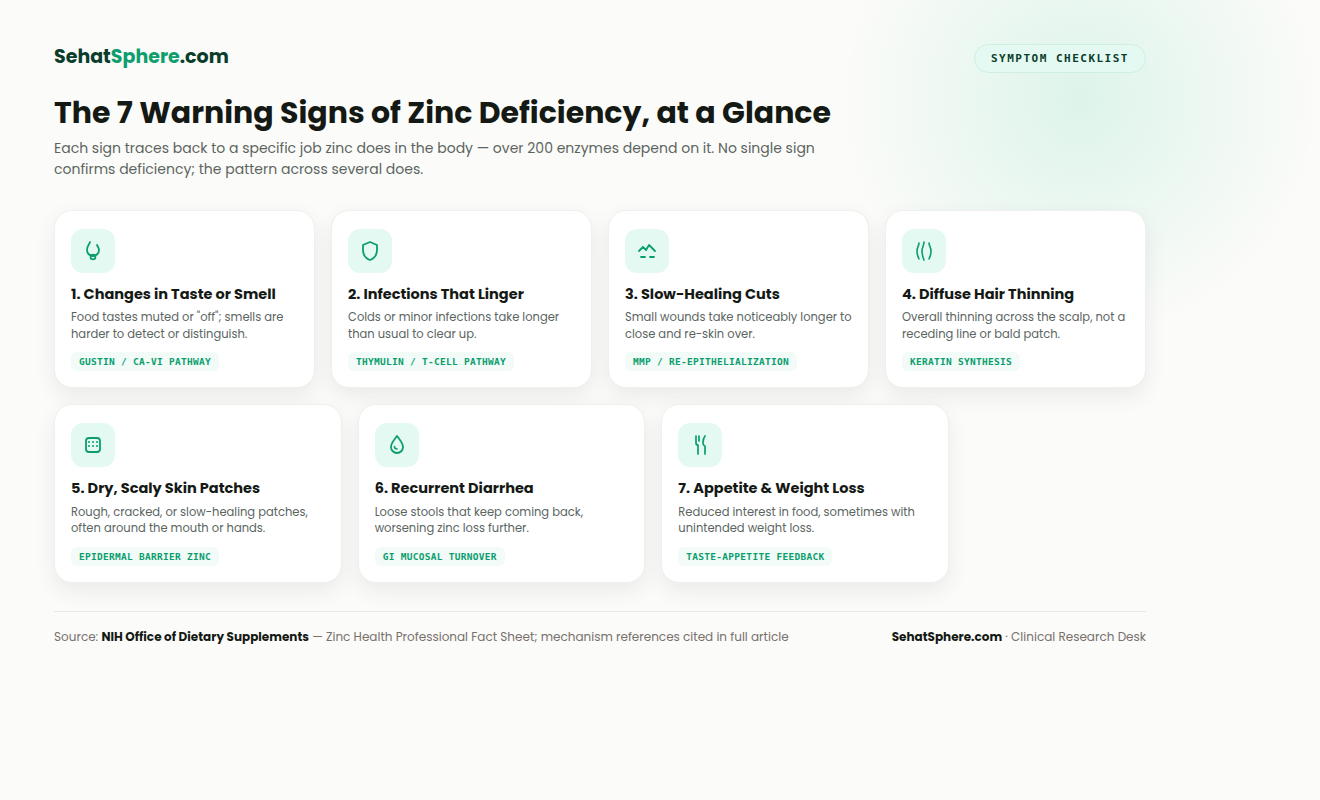
1. Changes in Taste or Smell
Zinc is essential for a specific salivary protein called gustin (also known as carbonic anhydrase VI), which taste buds need for normal renewal and maturation. Without enough zinc, gustin activity drops, taste buds don’t regenerate properly, and food can start tasting muted, metallic, or simply “off.” If this specific symptom appeared suddenly while you’re on a long-term stomach-acid medication (a PPI, or an over-the-counter antacid used daily), that combination deserves its own deeper look — our Zinc Deficiency and Your Medications guide covers that specific medication-driven angle, including a real FDA warning history, in full detail.
2. Frequent Infections That Seem to Linger
Zinc is required to activate thymulin, a thymus-produced hormone that matures T-cells — the immune cells responsible for coordinating your body’s response to infection. Without adequate zinc, thymulin can’t do its job properly, T-cell function weakens, and the practical result is colds, sinus infections, or minor illnesses that come more often and take longer than usual to clear.
3. Cuts and Wounds That Heal Slower Than They Should
Wound healing is a multi-step process, and zinc turns out to be load-bearing at nearly every step of it. It’s needed for the initial immune-cell response to an injury, for matrix metalloproteinases (zinc-dependent enzymes that remodel damaged tissue), for keratinocyte migration during re-epithelialization (the skin literally closing itself back over), and as a cofactor in the signaling pathway that drives collagen production. A deficiency doesn’t stop healing outright — it slows every stage of it, which shows up as a scrape or cut that takes noticeably longer to close than it used to.
4. Diffuse Hair Thinning
Hair follicle cells rely on zinc-dependent enzymes to synthesize keratin, the structural protein that makes up the hair shaft. When zinc runs low, follicles can be pushed prematurely into telogen — their resting, non-growing phase — resulting in diffuse shedding across the scalp rather than distinct bald patches (that pattern, patchy hair loss, points toward a different condition, alopecia areata, not zinc). Published research has shown that correcting a confirmed zinc deficiency with oral zinc improves this specific pattern of hair loss.
5. Dry, Scaly, or Slow-Healing Skin Patches
Because zinc is central to keratinocyte function and skin-barrier repair, low zinc status commonly shows up as dry, rough, or scaly skin, sometimes with patches that are slow to heal or prone to minor infection. In its most extreme form — covered in its own section further down — this becomes a specific, recognizable rash pattern rather than just “dry skin.”
6. Chronic or Recurrent Diarrhea
Zinc plays a direct role in maintaining the intestinal lining, and deficiency is associated with looser, more frequent stools, particularly once deficiency becomes more pronounced. This relationship also runs in the opposite direction — diarrhea itself causes zinc loss through the gut, which is part of why zinc supplementation is used therapeutically, in an entirely separate public-health context, to help manage diarrheal illness in young children in some countries.
7. Loss of Appetite or Unintended Weight Loss
A reduced sense of taste (sign #1) naturally makes food less appealing, but zinc also has a more direct effect on appetite regulation itself. The NIH lists loss of appetite as one of the recognized signs of mild zinc deficiency, and in children specifically, ongoing deficiency is also associated with impaired growth — a related but distinct concern from adult appetite changes.
Per the NIH’s own clinical summary, more severe zinc deficiency has also been linked to altered cognitive and psychological function specifically in older adults — a less commonly discussed sign that’s worth mentioning to a doctor if it appears alongside any of the seven above, rather than assumed to be an unrelated, separate issue.
“Zinc deficiency is basically just about catching more colds.”
Immunity is one of at least seven distinct systems zinc supports — hair, skin, taste, gut, appetite, and (in children) growth are all affected too, since zinc is a cofactor for over 200 different enzymes.
3. Check Your Zinc Deficiency Risk
Tick any that apply to you right now. This is a rough pattern-check, not a diagnosis — the point is to see whether several signs are clustering together.
This tool is for general awareness only and can’t replace a blood test or a doctor’s evaluation.
4. Who’s Most Likely to Have Zinc Deficiency
Per the NIH’s Office of Dietary Supplements, certain groups carry meaningfully higher documented risk than the general population. Pick the one closest to your situation to see the specific mechanism behind it.
Two groups deserve a specific mention beyond the dropdown above: infants who are exclusively breastfed past 6 months without zinc-containing complementary foods, since breast milk’s zinc content naturally declines over time; and people with sickle cell disease, who have a well-documented higher prevalence of zinc deficiency, likely from a combination of increased urinary losses and reduced intake.
5. The Diagnosis Problem: Why the Blood Test Is Trickier Than It Looks
A serum or plasma zinc test is the standard way to check zinc status, and the cutoffs are specific: below about 70 mcg/dL (10.7 µmol/L) in women and 74 mcg/dL (11.3 µmol/L) in men on a fasting morning sample generally indicates inadequate status, with more overt clinical signs typically appearing below roughly 50 mcg/dL (7.6 µmol/L). That precision is exactly what makes the test easy to misread if it isn’t drawn and interpreted carefully.
What can throw the number off
- Time of day and fasting status: zinc levels run higher in the morning and decline for several hours after eating, so an afternoon or non-fasting sample can read roughly 9% lower than a true baseline — enough to blur the line around a borderline result.
- Recent or active infection: the body redistributes zinc into the liver during an acute-phase inflammatory response, which can push a blood test result down even when your actual zinc stores are fine. This is exactly why interpretation should ideally be paired with an inflammation marker like CRP.
- Low albumin: roughly 60–70% of the zinc circulating in blood is bound to albumin. If albumin itself is low — from liver disease, malnutrition, or a recent illness — the total zinc reading drops with it, independent of your true zinc status.
- Hemolysis (a rough blood draw): red blood cells contain 10–20 times more zinc than the surrounding serum. If red cells rupture during or after the draw, they can spuriously inflate the result, which is why a visibly hemolyzed sample should be redrawn rather than trusted.
A single zinc test result taken during a cold, right after a meal, or in the afternoon isn’t necessarily wrong — but it’s worth re-checking with a proper fasting morning sample, ideally alongside a CRP and albumin, before ruling deficiency in or out based on one number.
🩸 Already Have Your Numbers?
Our Blood Report Decoder reads zinc alongside 20 other common markers together, flagging patterns automatically instead of making you interpret each result in isolation.
6. Zinc Deficiency vs Other Common Nutrient Gaps
Fatigue, appetite loss, and hair changes overlap heavily with two other deficiencies this site covers in depth: iron and B12. Telling them apart matters, because the fix for one won’t correct the other two.
| Sign | Zinc | Iron | B12 |
|---|---|---|---|
| Taste/smell changes | Classic sign | Uncommon | Uncommon |
| Hair loss pattern | Diffuse thinning | Diffuse thinning | Less typical |
| Fatigue | Indirect (via appetite/immunity) | Classic, direct sign | Classic, direct sign |
| Skin/rash | Classic sign | Uncommon | Uncommon |
| Confirmatory test | Serum/plasma zinc | Ferritin, hemoglobin | Serum B12, MMA |
All three deficiencies can genuinely coexist in the same person, especially in vegetarians and vegans, which is exactly the kind of overlapping pattern our nutrient deficiency finder tool is built to score across ten commonly-missed nutrients at once, rather than checking each one in isolation. If fatigue and pale skin are your dominant signs rather than taste changes or a rash, our iron deficiency anemia guide covers that overlapping picture — including its own 3 hidden stages — in full depth.
7. When It Gets Severe: Acrodermatitis Enteropathica
Most zinc deficiency is mild-to-moderate and manageable, but it’s worth knowing what the far end of the spectrum actually looks like, because it’s a genuinely distinctive, named clinical picture — not just “worse skin.”
Acrodermatitis enteropathica presents as a classic triad: a specific periorificial and acral dermatitis (a rash in a horseshoe or U-shaped pattern around the mouth, plus the fingers, toes, elbows, and knees), diarrhea, and alopecia affecting the scalp, eyebrows, and eyelashes together — essentially signs #4, #5, and #6 from this article’s list, but severe and combined.
It has two distinct causes. The genetic form comes from mutations in the SLC39A4 gene, which encodes a zinc-transporter protein needed to absorb zinc across the intestinal lining — a rare, inherited, autosomal recessive condition. The acquired form comes from severe dietary or malabsorptive zinc deficiency in someone without the genetic defect — for example, from a severe underlying GI condition or an extremely restricted diet. Both converge on the same underlying problem: systemic zinc levels too low to support the roughly 200 metalloenzymes zinc participates in, with skin, gut, and hair follicles — all high-turnover tissues — showing the damage first and most visibly.
This condition responds well to zinc repletion once correctly identified, which is exactly why recognizing the pattern (rather than treating the rash, the diarrhea, and the hair loss as three separate, unrelated problems) matters clinically.
8. Zinc and Your Medications, Briefly
Certain medications can meaningfully lower zinc status over time, and it’s worth a brief mention here even though it’s not this article’s main focus. Long-term use of proton pump inhibitors (PPIs) and other stomach-acid-reducing medications can reduce zinc absorption, since stomach acid helps release zinc from food into an absorbable form — the same underlying mechanism covered for iron and magnesium in our chronic antacids and mineral malabsorption guide.
If sign #1 above — a new change in taste or smell — appeared specifically while you’re on a long-term acid-reducing medication, that combination is common enough, and specific enough, to deserve its own dedicated guide rather than a paragraph here: our Zinc Deficiency and Your Medications guide covers the real FDA warning history behind intranasal zinc products, the PPI-zinc absorption mechanism in full cellular detail, and the copper-deficiency risk from over-supplementing zinc to compensate.
Zinc can also chelate with (bind to and block the absorption of) certain antibiotics, including some fluoroquinolones and tetracyclines, if taken too close together — the same spacing logic covered for iron elsewhere on this site. Checking any supplement against your current prescriptions before combining them is exactly what our Integrative Interaction Checker is built for.
9. Zinc Food Sources and Absorption
Zinc’s best dietary sources are dramatically uneven — a handful of oysters can outperform an entire day’s worth of most other foods combined.
| Food | Approx. Zinc | Serving |
|---|---|---|
| Oysters | 28–32 mg | 3 oz (~6 medium) |
| Beef | ~3.8 mg | 3 oz cooked |
| Fortified breakfast cereal | ~2.8 mg | 1 serving |
| Pumpkin seeds | ~2.2 mg | 1 oz |
| Chickpeas / lentils | ~1.3–2.5 mg | 1 cup cooked |
| Yogurt / dairy | ~1–1.5 mg | 1 cup |
Plant-based zinc comes with a genuine catch: phytates — natural compounds in whole grains, legumes, and nuts — bind zinc in the gut and meaningfully reduce how much of it actually gets absorbed, compared to the zinc in meat and shellfish. This is precisely why the NIH lists vegetarians and vegans as a documented at-risk group even when their total dietary zinc intake looks adequate on paper. Soaking, sprouting, or fermenting legumes and grains before cooking measurably reduces their phytate content and helps close some of that gap.
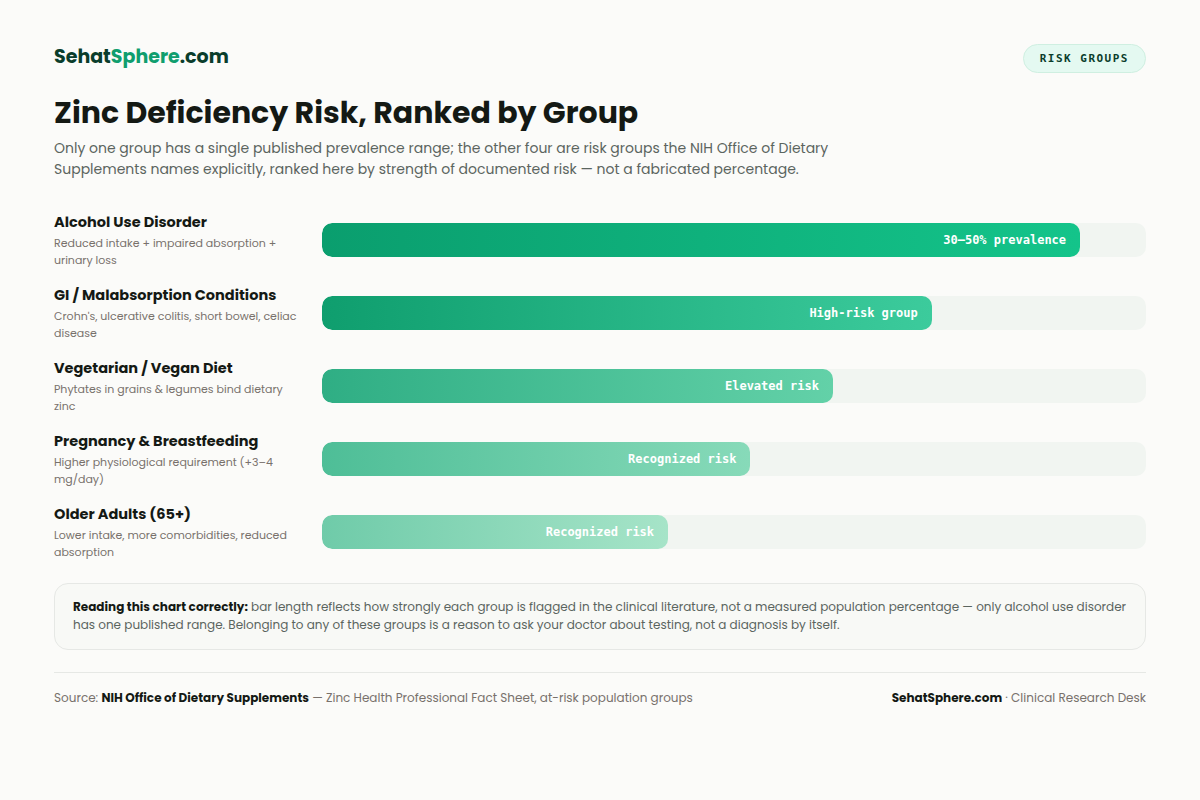
Alcohol use disorder carries the single highest documented prevalence of low zinc status among the groups the NIH names specifically.
10. Before You Start Supplementing
A confirmed, or strongly suspected, deficiency is a reasonable reason to supplement. “Zinc is good for immunity, so more must be better” is not — and this is the section most zinc articles either skip or bury, even though it’s genuinely important.
The NIH sets the adult RDA at 11 mg/day for men and 8 mg/day for women, rising to 11 mg/day during pregnancy and 12 mg/day while breastfeeding. The Tolerable Upper Intake Level (UL) is 40 mg/day from supplements and food combined — and this ceiling exists for a specific, well-documented reason, not as an arbitrary caution.
Sustained zinc intake above the 40 mg/day upper limit is a documented cause of copper deficiency. Excess zinc triggers a gut protein called metallothionein that binds copper more strongly than zinc, blocking copper absorption and depleting the body’s copper stores over time. In case reports, this has led to serious blood disorders — including sideroblastic anemia, neutropenia, and even agranulocytosis. Our Zinc Deficiency and Your Medications guide covers this specific mechanism, and the exact intake thresholds involved, in full clinical detail.
What about zinc lozenges for a cold?
This is worth its own honest answer, since it’s one of the most common reasons people reach for zinc in the first place. A comprehensive 2024 Cochrane review found that zinc offered little to no benefit for preventing a cold in the first place (a modest risk reduction that didn’t clear the threshold for confidence across 9 studies), but may reduce the duration of an existing cold by roughly 2 days, based on 8 studies. The same review noted an increased risk of non-serious side effects — mainly taste disturbances and stomach upset — when zinc is used this way, particularly at the higher lozenge doses studied (up to 276 mg/day for several days).
“Taking extra zinc whenever I feel a cold coming on can’t hurt, and more is safer than less.”
The best current evidence shows a modest benefit at best for an active cold, little benefit for prevention, and a real ceiling (40 mg/day) above which copper deficiency becomes a genuine risk if sustained.
11. Quick Glossary
- Hypogeusia
- A reduced or altered sense of taste — one of the classic early signs of zinc deficiency, linked to zinc’s role in the gustin/carbonic anhydrase VI protein.
- Metallothionein
- A zinc-induced gut protein that also binds copper. In excess, it’s the mechanism behind zinc-induced copper deficiency.
- Acrodermatitis enteropathica
- A specific, severe zinc-deficiency condition presenting as a triad of periorificial/acral dermatitis, diarrhea, and hair loss — either genetic or acquired.
- Bioavailability
- How much of a nutrient’s total content in food actually gets absorbed. Plant-based zinc has lower bioavailability than zinc from meat or shellfish, due to phytates.
- Acute-phase reactant
- A substance whose blood level shifts predictably during inflammation or infection. Zinc’s serum level can drop as part of this response, independent of true zinc status.
12. Quick Knowledge Check
Five questions to confirm the mechanisms above actually stuck — not a graded exam, just a gut check.
13. Frequently Asked Questions
What are the first signs of zinc deficiency?
Early, mild signs tend to be nonspecific — reduced appetite, mild taste changes, and more frequent minor infections. The NIH also lists growth issues in children and reproductive changes in adults as mild-deficiency signs, with diarrhea, hair loss, and cognitive changes appearing as deficiency becomes more severe.
How is zinc deficiency actually diagnosed?
Through a serum or plasma zinc blood test, ideally a fasting morning sample. Women below roughly 70 mcg/dL (10.7 µmol/L) and men below roughly 74 mcg/dL (11.3 µmol/L) are considered deficient — though results should be read alongside inflammation markers, since infection can push readings down artificially.
Can zinc deficiency really cause hair loss?
Yes. Zinc-dependent enzymes are needed for keratin synthesis in hair follicles, and deficiency can push follicles into a resting (telogen) phase early, causing diffuse — not patchy — shedding. Published research has shown oral zinc repletion improves this specific pattern in people with a confirmed deficiency.
What foods are highest in zinc?
Oysters are dramatically higher than anything else — 28 to 32 mg per 3 oz serving, versus under 4 mg for beef. Fortified cereal, pumpkin seeds, legumes, and dairy follow well behind.
Who is most at risk of zinc deficiency?
Vegetarians and vegans, people with IBD or celiac disease, pregnant or breastfeeding women, people with alcohol use disorder, people with sickle cell disease, and infants exclusively breastfed past 6 months, per the NIH’s Office of Dietary Supplements.
Can vegetarians get enough zinc from food alone?
It’s possible but takes some planning. Phytates in grains and legumes bind zinc and reduce its absorption compared to zinc from meat or shellfish, so vegetarians often need higher intake targets, and food prep methods like soaking or sprouting legumes genuinely help.
How much zinc do adults need per day?
11 mg/day for men and 8 mg/day for women, rising to 11 mg/day during pregnancy and 12 mg/day while breastfeeding, per the NIH.
Can too much zinc be harmful?
Yes. Sustained intake above the 40 mg/day adult upper limit is a documented cause of copper deficiency — zinc induces a gut protein, metallothionein, that binds copper instead — which in case reports has caused serious blood disorders. Full mechanism covered in our zinc-and-medications guide.
Does zinc deficiency cause skin problems?
Yes. Dry, scaly patches and slow-healing skin lesions are common signs, and in its most severe or genetic form, zinc deficiency causes a specific, named condition — acrodermatitis enteropathica.
What is acrodermatitis enteropathica?
A distinctive condition — genetic (from a zinc-transporter gene mutation) or acquired (from severe dietary or malabsorptive deficiency) — presenting as a classic triad of periorificial/acral skin rash, diarrhea, and hair loss.
Do zinc lozenges actually help with a cold?
Modestly, at best. A 2024 Cochrane review found they may shorten a cold by roughly 2 days but showed little to no benefit for preventing one, and can cause taste disturbances or stomach upset as side effects.
Can zinc deficiency cause diarrhea?
Yes, especially as deficiency becomes more pronounced — it’s part of the acrodermatitis enteropathica triad. Zinc is also used therapeutically, in a completely separate public-health context, to help manage diarrheal illness in young children.
How long does it take to correct zinc deficiency?
Mild, diet-related gaps can improve within weeks of consistent intake. Deficiency tied to an ongoing GI condition or long-term medication use may need longer-term monitoring, since it won’t fully resolve until the underlying cause is also addressed.
Is it safe to take a zinc supplement without medical guidance?
For short-term, moderate use it’s generally low-risk, but sustained high-dose supplementation without a confirmed deficiency risks copper deficiency and offers no proven extra benefit over meeting the RDA — testing first, especially if several of the 7 warning signs apply, is the safer approach.
The Short Version
Zinc deficiency rarely announces itself with one obvious symptom — it’s a required cofactor for over 200 enzymes, so it shows up as a cluster of unrelated-looking signs instead: taste changes, lingering infections, slow-healing wounds, diffuse hair thinning, skin issues, diarrhea, and appetite loss. The standard blood test has real interpretation pitfalls (timing, inflammation, albumin), vegetarians/vegans and people with GI conditions, pregnancy, or alcohol use disorder carry the highest documented risk, and the severe end of the spectrum — acrodermatitis enteropathica — is a specific, recognizable, treatable condition rather than just “bad skin.” The dosing mistake worth avoiding either way: more zinc isn’t automatically better, and sustained intake above 40 mg/day carries a real, documented copper-deficiency risk.
Why Trust This Guide
More From the Deficiency Series
- National Institutes of Health, Office of Dietary Supplements. Zinc: Fact Sheet for Health Professionals. RDA, upper limit (40 mg/day), deficiency signs, and at-risk groups.
- National Institutes of Health, Office of Dietary Supplements. Zinc: Fact Sheet for Consumers.
- Komai M, Goto T, Suzuki H, et al. Zinc deficiency and taste dysfunction; contribution of carbonic anhydrase, a zinc-metalloenzyme, to normal taste sensation. BioFactors. 2000.
- Lin PH, Sermersheim M, Li H, et al. Zinc in Wound Healing Modulation. Nutrients. 2018 — mechanisms covering PMN chemotaxis, keratinocyte migration, matrix metalloproteinases, and collagen synthesis.
- Karashima T, Tsuruta D, Hamada T, et al. Oral zinc therapy for zinc deficiency-related telogen effluvium. Dermatologic Therapy. 2012.
- DermNet. Acrodermatitis Enteropathica — genetic (SLC39A4) and acquired forms, classic symptom triad.
- Cochrane. Zinc for the Prevention and Treatment of the Common Cold. 2024 review — prevention, duration, and adverse-effect findings.
- Gibson RS, et al. Principles of Nutritional Assessment — Serum Zinc. Diagnostic caveats: fasting, time of day, inflammation, hemolysis, and albumin binding.