 SehatSphere.com
Apple Cider Vinegar and Your Medications: 7 Real Interactions a Pharmacist Actually Checked
Every second wellness reel this year has featured the same shot: a cloudy glass of apple cider vinegar, downed first thing in the morning, promising fat loss and “detox.” Patients walk into the pharmacy holding the bottle, genuinely proud of the new habit — and when I pull up their profile and see a diuretic, digoxin, or insulin on the list, that pride usually turns into a question I get asked constantly: is there a real interaction between apple cider vinegar and your medications? So I checked, properly, against real interaction-checker databases and published case reports, drug class by drug class — not against what a supplement blog assumes should be dangerous.
Key takeaways:
- Two of the interactions most commonly warned about online — statins and warfarin — show up as no known interaction when checked directly against interaction databases. That’s genuinely reassuring, not a claim to be nervous about.
- The real, documented risk runs through one shared mechanism: chronic acid loading can quietly lower potassium, and low potassium is exactly what makes diuretics, digoxin, and insulin more dangerous than they’d otherwise be.
- A published case report followed a woman who drank 250ml of cider vinegar daily for six years before her potassium crashed to 2.8–3.2 mval/l, alongside early osteoporosis.
- A 2025 meta-analysis of 7 controlled trials (463 people) found ACV lowered fasting blood sugar by roughly 22 mg/dL on average — real enough to matter for anyone on glucose-lowering medication too.
All 8 Medication Classes, At a Glance
| Medication Class | Rating |
|---|---|
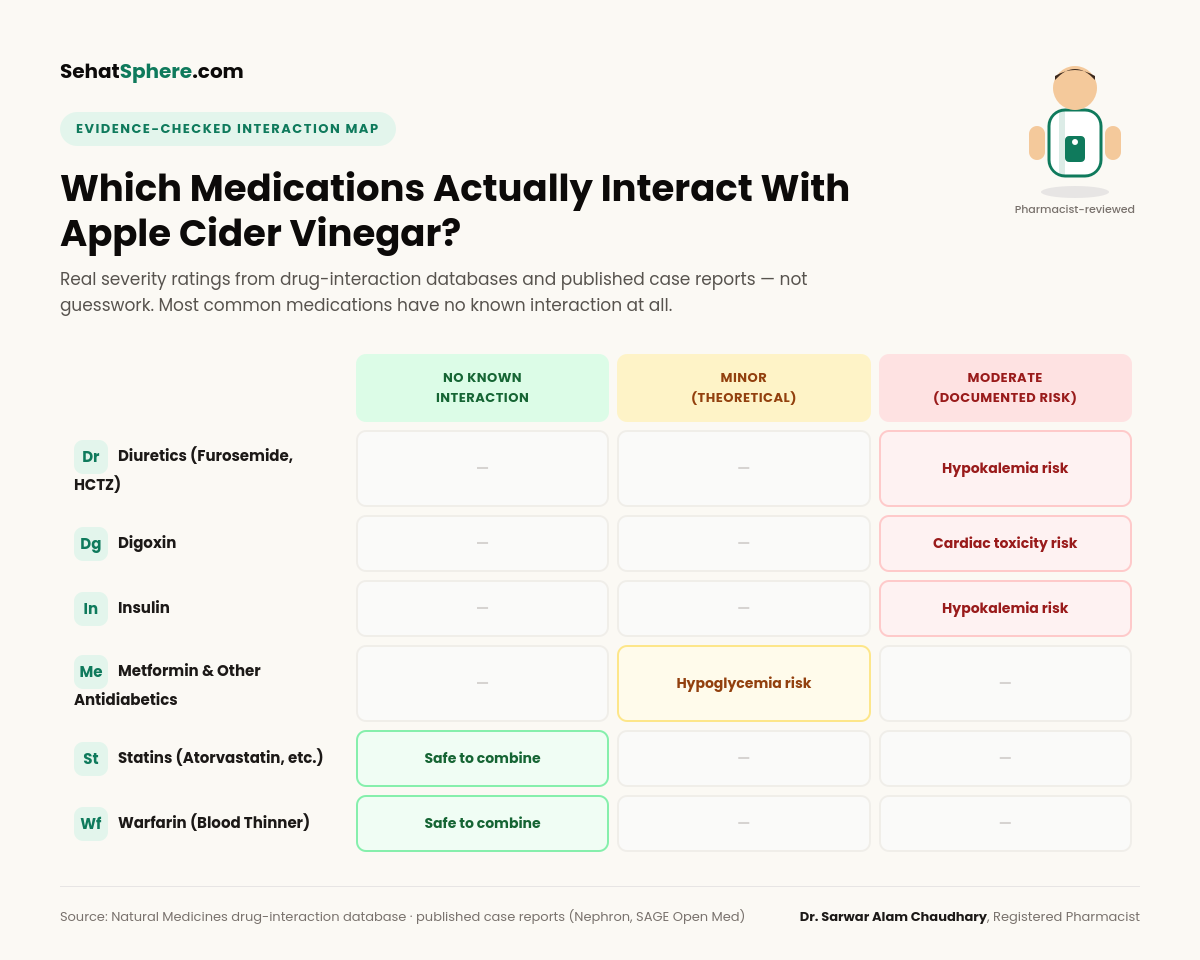
| Diuretics (furosemide, HCTZ) | Moderate — documented |
| Digoxin | Moderate — documented |
| Insulin | Moderate — documented |
| Metformin & other oral diabetes drugs | Minor — theoretical |
| Levothyroxine (thyroid) | Minor — theoretical, timing-sensitive |
| PPIs (omeprazole, pantoprazole) | Minor — symptom-level, not a true interaction |
| Statins (atorvastatin, etc.) | No known interaction |
| Warfarin | No known interaction (direct) |
- What ACV actually does once you swallow it
- The one real mechanism behind every risk here
- ACV and diuretics / blood pressure pills
- ACV and digoxin
- ACV, insulin, metformin & the real glucose data
- Statins & warfarin: the two “interactions” that aren’t
- ACV and acid reflux medication (PPIs)
- ACV and thyroid medication
- Interactive interaction checker
- The 3-hour timing protocol
- Liquid, gummies, or capsules: does the form matter
- Teeth, bones & who should avoid ACV entirely
- Test your knowledge
- Quick self-check
- FAQs
What ACV Actually Does Once You Swallow It
Before any interaction makes sense, the mechanism has to be clear, because “vinegar is acidic, medications are chemicals, therefore danger” is not actually an explanation — it’s a guess dressed up as science. Apple cider vinegar is roughly 5–6% acetic acid by volume, with a pH typically between 2 and 3. That’s a genuinely low pH, but acetic acid is a weak acid — it doesn’t fully dissociate in water the way a strong acid like hydrochloric acid does, which is exactly why you can drink diluted vinegar at all without it burning through tissue on contact. Your own stomach, for comparison, runs at a similar or lower pH all day as part of normal digestion.
Swallowed on an empty stomach, ACV’s acid load does two measurable things: it can transiently slow gastric emptying — the rate at which your stomach releases its contents into the small intestine — and, more importantly for the interactions covered in this guide, sustained high-volume intake forces your kidneys to do extra buffering work to keep your blood’s acid-base balance steady. Interestingly, this doesn’t match how vinegar has traditionally been used in Indian kitchens at all — a splash in a pickle or a kanji ferment is a world away, in both volume and frequency, from a daily neat shot marketed as a “morning detox,” which is a distinctly recent, largely social-media-driven habit rather than a traditional one.

That second effect is the one worth paying attention to. Your kidneys manage acid-base balance largely through the distal nephron, where cells trade hydrogen ions for potassium and sodium to keep blood pH in its narrow normal range. Hand that system a large, repeated acid load — day after day, year after year — and the potassium side of that trade can start running a genuine deficit. This single pathway, not any dramatic “drug-blocking” effect, is the foundation for almost every real answer about apple cider vinegar and your medications covered in this guide.
The One Real Mechanism Behind Every Risk Here
Once you understand that ACV’s main systemic effect is a slow potassium drain under chronic, high-volume use, three drug classes fall into place immediately — not because ACV does anything unique to each of them, but because each of them already depends on potassium staying in a normal range to work safely.
Chronic acid load → kidneys excrete more potassium to compensate → serum potassium drifts down → hypokalemia → anything that already depends on normal potassium (a diuretic, a heart-rhythm drug, an insulin regimen) now has a smaller safety margin than before.
This is the actual clinical logic pharmacists use when checking ACV against a patient’s medication list — and it’s a considerably more precise, more honest story than the internet’s usual “acid neutralizes your pills” explanation, which barely applies to any of the drugs discussed below.
What To Read Next
- Complete Guide to Blood Pressure: Where diuretics fit into your overall BP management plan.
- Thyroid Medicine Mistakes: The other everyday timing errors that quietly ruin levothyroxine absorption.
- Blood Report Decoder: Free tool to check where your potassium and glucose actually stand.
ACV and Diuretics / Blood Pressure Pills
This is the best-documented interaction on this entire page, and it deserves to be treated as such. Potassium-wasting diuretics — loop diuretics like furosemide, and thiazides like hydrochlorothiazide (HCTZ) — already push potassium out through the kidneys as part of how they lower blood pressure. Layer a chronic, high-volume acid load from ACV on top of that same renal pathway, and interaction-checker databases built on the Natural Medicines database flag this combination specifically for an increased hypokalemia risk. Our complete guide to blood pressure covers how these medications work more broadly if you’re on one.
A published case report in the journal Nephron is worth knowing about specifically because it shows what this looks like taken to an extreme: a 28-year-old woman had been drinking roughly 250ml of cider vinegar daily — diluted in water and used as salad dressing — for six years. She presented with hypokalemia (potassium 2.8–3.2 mval/l, well below the normal 3.5–5.0 range), elevated renin, and bone mineral density already in the osteoporotic range. She wasn’t even on a diuretic; the acid load alone did this over six years. Add a diuretic to that same picture and the timeline to a dangerous potassium level shortens considerably — which is exactly the scenario interaction checkers are warning about.
This isn’t a reason to panic over an occasional tablespoon of ACV in a salad dressing. It’s a reason to avoid daily, undiluted, high-volume intake if you’re on a diuretic — and to mention it at your next check-up so a routine potassium test can confirm you’re not drifting low. Our high creatinine levels guide is worth reading too, since kidney function and potassium handling are directly connected.
ACV and Digoxin
This is the interaction almost nobody writes about, and it’s arguably the most clinically important one in this entire guide. Digoxin works by inhibiting the Na²+/K²+-ATPase pump in heart muscle cells — and that same pump is exquisitely sensitive to how much potassium is circulating in your blood. When potassium runs low, digoxin binds more readily to that pump, and the drug’s effective toxicity threshold drops without the dose itself changing at all. This is precisely why hypokalemia is one of the most common triggers for digoxin toxicity in real clinical practice, independent of anything to do with ACV specifically.
Put the two facts together and the interaction becomes obvious: anything that can chronically lower your potassium — including sustained heavy ACV use — narrows digoxin’s already-narrow safety margin. Interaction-checker databases list this combination explicitly, flagging an increased risk of cardiac toxicity through exactly this potassium pathway, not through any direct chemical interaction between digoxin and acetic acid.
ACV, Insulin, Metformin & the Real Glucose Data
ACV’s blood-sugar effect is one of the few claims in vinegar folklore that actually holds up under real study. A 2025 dose-response meta-analysis pooling 7 controlled trials and 463 participants found that ACV significantly reduced fasting blood sugar by an average of 21.9 mg/dL and HbA1c by roughly 1.53 percentage points, with the effect growing stronger at doses above 10ml/day. An earlier, frequently cited 2004 trial in Diabetes Care found vinegar meaningfully improved insulin sensitivity to a high-carbohydrate meal specifically in people with insulin resistance or type 2 diabetes. Our insulin resistance guide covers the deeper mechanism behind why that sensitivity shift matters.
That real glucose-lowering effect is exactly why combining ACV with glucose-lowering medication needs genuine attention, not dismissal. Interaction databases split this by drug class in a way that’s worth knowing precisely:
| Drug Class | Interaction Rating | Why |
|---|---|---|
| Insulin | Moderate | Flagged specifically for added hypokalemia risk, on top of the more obvious stacked glucose-lowering effect |
| Sulfonylureas (glimepiride, glyburide) | Minor | Theoretical hypoglycemia risk from stacked glucose-lowering effects |
| Metformin | Minor | Doesn’t independently cause hypoglycemia, but ACV’s own glucose-lowering effect can still stack with it |
| GLP-1 / SGLT2 drugs (semaglutide, empagliflozin, etc.) | Minor | Same theoretical stacking concern, generally lower urgency than insulin or sulfonylureas |
In practice, this means: if you’re on insulin or a sulfonylurea and want to try ACV, do it with more frequent glucose monitoring for the first couple of weeks, especially around meals where you’d normally expect a spike. Our Blood Report Decoder and the berberine and your medications guide are both worth reading alongside this, since berberine shares a similar real-but-stackable glucose effect.
Statins & Warfarin: The Two “Interactions” That Aren’t
This section exists because getting this right matters as much as getting the real risks right. Checked directly against interaction-checker databases built on the Natural Medicines dataset — the same source pharmacists themselves use at the counter — both of these show up clean.
No known interaction. ACV doesn’t share any of the metabolic pathways statins depend on, and no documented case exists connecting the two. Our statins side effects guide covers what actually is worth watching for on this medication.
No known direct drug interaction. There’s a separate, general point worth being honest about: concentrated acetic acid can irritate the GI lining on its own, and any GI irritant theoretically compounds bleeding risk in someone already on a blood thinner. That’s a general caution about acid and mucosa, though — not a documented interaction between the two substances specifically, and it’s an important distinction to keep straight.
Getting this wrong is exactly how misinformation about ACV spreads — either into “it’s totally natural, ignore everything” on one side, or “acid destroys every drug it touches” on the other. Neither is accurate, and both statins and warfarin are proof of that.
ACV and Acid Reflux Medication (PPIs)
Here’s a claim that needs correcting directly, because it’s repeated constantly and it’s pharmacologically overstated: ACV does not “neutralize” or deactivate a proton pump inhibitor like omeprazole or pantoprazole. PPIs work by irreversibly binding to the H+/K+-ATPase pump inside the stomach’s parietal cells, shutting down acid production at the source — a systemic, cellular-level mechanism that a swallowed tablespoon of vinegar simply cannot chemically reverse.
What actually happens is more mundane, and in a way more useful to know: if you’re taking a PPI specifically because you have GERD or an ulcer, drinking something acidic on top of an already-inflamed esophagus can independently aggravate your symptoms — working against the relief the drug is trying to give you, not against the drug itself. That’s a genuine reason to reconsider using ACV as a “digestive aid” alongside PPI therapy, just not for the mechanism most articles claim. Our pantoprazole side effects guide and GERD and silent reflux guide both cover what does genuinely help this condition.
ACV and Thyroid Medication (Levothyroxine)
This one deserves an honest “theoretical but sensible” label rather than being stated as settled fact. Levothyroxine absorption is already unusually sensitive to timing and stomach contents — it’s why the standard instruction is to take it on an empty stomach and wait 30–60 minutes before eating anything at all. ACV’s mild, transient effect on gastric emptying could plausibly add extra variability into that already-narrow window, but this specific pairing hasn’t been directly tested in a clinical trial the way the diuretic-hypokalemia link has.
Given how much thyroid dosing already depends on consistent absorption day to day, treating this as “worth a sensible timing buffer” rather than “proven dangerous” is the honest position — and it costs nothing to simply keep the two several hours apart. Our thyroid medicine mistakes guide and ashwagandha and your medications guide cover other everyday habits that interfere with this same absorption window.
Interactive Interaction Checker
A generic “consult your doctor” placeholder isn’t good enough for a question this specific. Select your medication class below for the exact evidence-graded rating for apple cider vinegar and your medications, explained throughout this guide.
Managing a longer medication list? The free Integrative Interaction Checker and Can I Take This With That tool both cover a much wider set of combinations beyond ACV alone.
The 3-Hour Timing Protocol
For every drug class covered above where timing genuinely matters — thyroid hormone, and any oral medication where you want to avoid overlapping absorption windows entirely — the same simple rule from pharmacy practice applies: keep at least three hours between your ACV and your pills, in either direction.
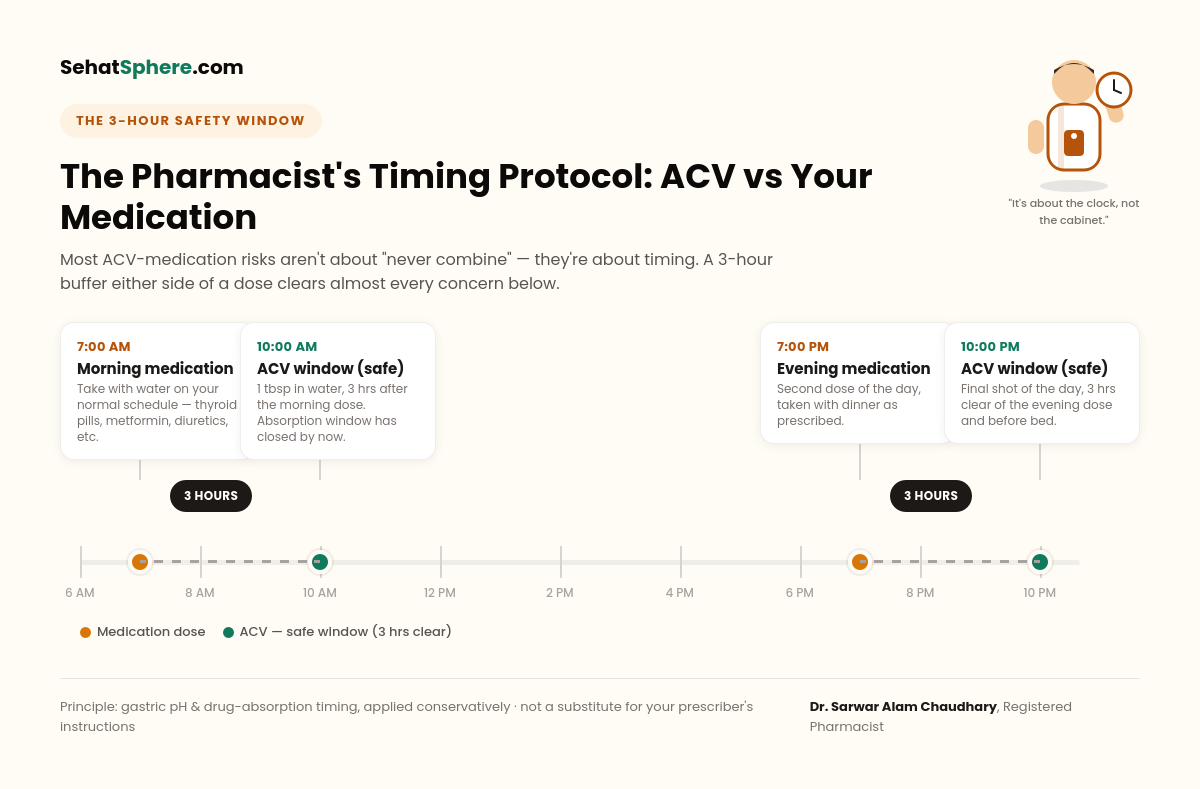
- Take your medication at its normal scheduled time, with a full glass of water.
- Wait a minimum of 3 hours before consuming any apple cider vinegar.
- Dilute no more than 1 tablespoon of raw, unfiltered ACV into at least 10–12 ounces (roughly 300–350ml) of water — never drink it undiluted.
- Drink it through a straw to limit contact with tooth enamel, then rinse your mouth with plain water afterward.
- If you take ACV more than once a day, repeat the same 3-hour buffer around your evening dose too.
Our common antibiotic mistakes guide covers this exact same timing-discipline principle applied to a completely different drug class, if the pattern is a useful one for your routine generally.
Liquid, Gummies, or Capsules: Does the Form Matter?
Everything above assumes the classic liquid shot, and that assumption genuinely matters, because the popular alternatives deliver very different acetic acid doses. ACV gummies are formulated to taste pleasant, which usually means a fraction of the acetic acid content of a real tablespoon of liquid vinegar — our ACV gummies and your medications guide breaks down exactly how much lower, and what that means for the interactions covered here. ACV capsules sit somewhere in between, and dosing is far less standardized across brands than a measured tablespoon of liquid.
The practical takeaway: the hypokalemia-driven risks in this guide scale with cumulative daily acetic acid exposure, not with “have you technically had ACV today.” A gummy or two is a very different exposure than 2 tablespoons of undiluted liquid vinegar daily for years, and the case reports cited above are firmly in the latter category, not the former.
Teeth, Bones & Who Should Avoid ACV Entirely
Two consequences of chronic ACV use are easy to overlook because they’re slow rather than dramatic. Dental enamel is the more immediate one: a lab study cited by dental researchers found prolonged vinegar exposure caused up to a 20% loss of tooth enamel, and that damage is irreversible once it happens. This is precisely why the straw-and-rinse habit in the timing protocol above isn’t optional advice — it’s the single cheapest thing you can do to prevent damage that can’t be undone later.
The second, slower consequence showed up directly in the six-year case report cited earlier: alongside her hypokalemia, that patient’s bone density had already dropped into the osteoporotic range, with low osteocalcin and very low urinary deoxypyridinoline — both markers consistent with reduced bone turnover from years of chronic acid buffering pulling on the body’s mineral reserves. Our vitamin D deficiency guide is worth reading alongside this, since bone health in India already runs on a thin margin for entirely separate reasons.
Chronic kidney disease (CKD), severe gastroparesis, or active peptic ulcer disease — unless you have direct clearance from a nephrologist or gastroenterologist. Each of these conditions independently makes ACV’s acid and potassium effects considerably harder for your body to buffer safely. Our eGFR kidney function calculator is a useful starting point if you’re unsure where your own kidney function stands.
Test Your Knowledge
Five quick questions based directly on what this guide covers.
Quick Self-Check
Tick anything that applies to you, and see what it suggests.
Frequently Asked Questions
Can apple cider vinegar cause low potassium if I’m on blood pressure pills?
Yes, specifically with diuretics like furosemide or HCTZ. Both push potassium out through the same renal pathway, and interaction databases flag this combination for added hypokalemia risk. A published case report documents this happening after years of daily high-volume ACV use.
Does apple cider vinegar interact with digoxin?
Yes, through potassium. Digoxin’s toxicity threshold drops sharply when potassium runs low, so anything that chronically lowers potassium — including heavy ACV use — genuinely deserves your doctor’s attention if you’re on this medication.
Is apple cider vinegar safe with statins?
Checked directly against interaction-checker databases for atorvastatin and the statin class broadly, ACV shows no known interaction. This is one of the most commonly misreported “interactions” online.
Can I take apple cider vinegar with warfarin (blood thinners)?
No documented direct drug interaction exists. A separate, general caution applies: any strong GI irritant can theoretically add to bleeding risk in someone on a blood thinner, but that’s different from a proven interaction between the two substances.
Does apple cider vinegar affect thyroid medication like levothyroxine?
Possibly, through a theoretical mechanism (ACV can slightly delay gastric emptying), though this specific pairing hasn’t been directly tested in trials. Since levothyroxine absorption is already timing-sensitive, keeping the two several hours apart is a sensible, low-cost precaution.
Is it safe to combine apple cider vinegar with insulin or diabetes medication?
With insulin, interaction checkers flag an added hypokalemia risk plus the more obvious stacked glucose-lowering effect. With metformin and most other oral diabetes drugs, the risk is rated minor — mainly worth monitoring for extra glucose-lowering, not hypokalemia specifically.
Does apple cider vinegar interfere with PPIs like omeprazole or pantoprazole?
Not by deactivating the drug itself — PPIs work at the cellular level and vinegar can’t reverse that. The real concern is that ACV’s own acidity can aggravate an already-inflamed esophagus, working against the symptom relief the medication is meant to provide.
How much does apple cider vinegar actually lower blood sugar, according to real studies?
A 2025 meta-analysis of 7 controlled trials (463 people) found an average fasting blood sugar reduction of about 21.9 mg/dL and an HbA1c reduction of roughly 1.53 percentage points, with larger effects at daily doses above 10ml.
Can apple cider vinegar damage my teeth if I take it daily?
Yes. Lab research cited by dental sources found prolonged vinegar exposure caused up to 20% enamel loss, which is irreversible. Always dilute it, drink through a straw, and rinse with plain water afterward.
Who should avoid apple cider vinegar completely?
Anyone with chronic kidney disease, severe gastroparesis, or active peptic ulcer disease, unless specifically cleared by a nephrologist or gastroenterologist — each condition makes ACV’s acid and potassium effects considerably harder to buffer safely.
How long should I wait between apple cider vinegar and my medication?
A minimum of 3 hours in either direction is the standard, sensible buffer covered in this guide’s timing protocol — especially important for thyroid hormone and any other timing-sensitive medication.
Are apple cider vinegar gummies as risky as liquid ACV for these interactions?
Generally no. Gummies typically deliver a fraction of the acetic acid found in a real tablespoon of liquid vinegar, and the documented risks in this guide scale with cumulative daily acid exposure, not simply whether you’ve had “some” ACV that day.
Can pregnant or breastfeeding women combine ACV with prenatal vitamins?
High-dose medicinal vinegar is generally discouraged during pregnancy and lactation, given insufficient safety trials in this population and the same mineral-depletion mechanism covered throughout this guide.
The Bottom Line
Apple cider vinegar and your medications don’t need to be an either-or decision, but they do need honesty on both sides. The real, documented risks all run through one mechanism — chronic acid load quietly lowering potassium — and that mechanism genuinely matters if you’re on a diuretic, digoxin, or insulin. It has essentially nothing to do with statins or warfarin, whatever the internet claims. Diluted, timed with a 3-hour buffer, and kept away from a straight daily shot, ACV is a manageable habit for most people. Undiluted, daily, for years, on top of a diuretic or digoxin, it’s the exact scenario the published case reports describe.
- Lhotta K, et al. Nephron. Hypokalemia, Hyperreninemia and Osteoporosis in a Patient Ingesting Large Amounts of Cider Vinegar.
- HelloPharmacist. Apple Cider Vinegar Drug Interactions, Uses, Side Effects & More.
- Frontiers in Nutrition (2025). Dose-Response Meta-Analysis of Apple Cider Vinegar on Glycemic Parameters.
- American Diabetes Association, Diabetes Care (2004). Vinegar Improves Insulin Sensitivity to a High-Carbohydrate Meal.
View All References (10) ▾
- HelloPharmacist. Apple Cider Vinegar – Warfarin Interaction Details.
- HelloPharmacist. Apple Cider Vinegar – Atorvastatin Interaction Details.
- Türkiye Klinikleri, Case Report. Hypokalemia Induced Cardiac Arrest: An Unknown Complication of Cider Vinegar.
- GoodRx Health. How Bad Is Apple Cider Vinegar for Your Teeth?.
- PubMed. Safety and Side Effects of Apple Vinegar Intake: A Systematic Review.
- PMC. Effect of Apple Cider Vinegar on Lipid Profiles and Glycemic Parameters: Meta-Analysis.