
 SehatSphere
Medication Safety
ACV Gummies and Your Medications
The weight-loss study everyone cites was actually about a diabetic complication
ACV gummies and your medications is a combination that hides a genuinely ironic detail almost nobody points out directly, even across dozens of articles covering the same handful of familiar warnings. Apple cider vinegar gummies are one of TikTok’s most consistently viral wellness purchases, frequently marketed around a single frequently-cited human study. That study wasn’t about weight loss at all — it was measuring apple cider vinegar’s effect on gastroparesis, a diabetic complication involving dangerously delayed stomach emptying. The same mechanism the weight-loss marketing borrows from is exactly why this combination deserves real caution with GLP-1 drugs like Ozempic or Mounjaro.
Jump to: The citation irony · The GLP-1 risk · Digoxin and diuretics · Test yourself · FAQ
Quick answer: ACV gummies and your medications interact through a mechanism most marketing never explains clearly. The pilot study most often cited to justify ACV for blood sugar and weight goals actually measured delayed gastric emptying in type 1 diabetics — and that same delayed-emptying effect is precisely what makes ACV a genuine caution alongside GLP-1 weight-loss drugs, which slow gastric emptying by the same basic mechanism.[1]
ACV gummies and your medications: the citation irony
Here’s the detail almost never spelled out plainly. A frequently-cited 2007 pilot study on apple cider vinegar and gastric emptying was conducted specifically in people with type 1 diabetes and documented gastroparesis — a complication where the stomach empties too slowly, causing nausea, bloating, and unpredictable blood sugar swings.[1] The study found ACV further delayed gastric emptying in this population. Wellness marketing routinely borrows this exact finding to suggest ACV promotes fullness and supports weight loss — technically consistent with the data, but stripped of the context that the original study was investigating a complication, not a benefit.
In my own counseling, this is the kind of detail that changes how a patient thinks about a supplement entirely once it’s pointed out — not because ACV is inherently dangerous, but because understanding what a cited study actually measured changes how seriously to take the mechanism it describes.
ACV gummies and your medications: the GLP-1 risk
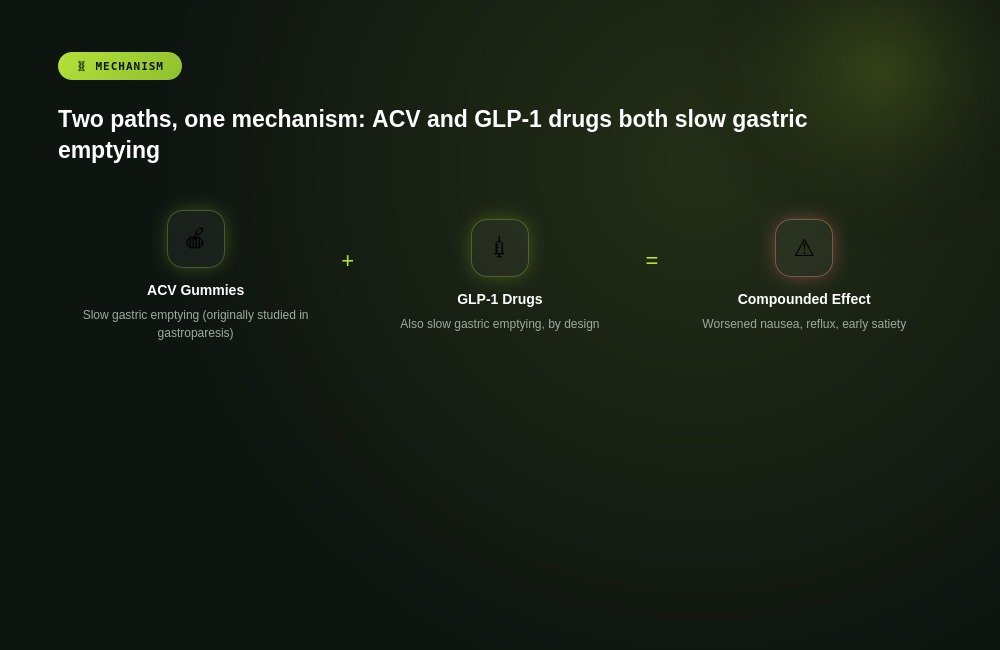
GLP-1 receptor agonists — semaglutide (Ozempic, Wegovy) and tirzepatide (Mounjaro, Zepbound) — work partly by deliberately slowing gastric emptying, which is a core part of how they suppress appetite.[2] Layering ACV’s own gastric-emptying-delaying effect on top of a medication already working through that same mechanism can meaningfully worsen nausea, reflux, and early satiety — particularly during dose escalation, when GI side effects are already at their most common.[3] This isn’t the same category of risk as a dangerous drug interaction in the traditional sense; it’s an additive mechanical effect that can turn manageable GLP-1 side effects into genuinely disruptive ones.
ACV gummies and your medications: digoxin and diuretics
To be fair to existing coverage, the digoxin and diuretic cautions are genuinely well documented and worth repeating rather than skipping. ACV can lower potassium levels, and combined with a diuretic that already depletes potassium, this can compound into clinically significant hypokalemia.[4] For anyone on digoxin specifically, low potassium raises the risk of digoxin toxicity, a serious heart-rhythm concern.[4] These cautions are already well covered elsewhere — it’s the GLP-1 and citation-context angle above that tends to be missing entirely.
ACV gummies and your medications: what the study actually found
It’s worth being precise about what the Hlebowicz study actually measured, rather than just noting its context was misapplied. Researchers gave a small group of type 1 diabetics with documented gastroparesis a diluted vinegar solution before a meal and measured how long food remained in the stomach using scintigraphy — a nuclear medicine imaging technique.[1] The result: vinegar further slowed an already-slowed process, which the researchers noted could worsen glycemic instability in a population already vulnerable to unpredictable blood sugar swings from delayed emptying. This is a legitimate, useful finding for understanding ACV’s mechanism — it simply isn’t a weight-loss finding, and applying it to a general audience without that context changes what the result actually implies about safety.
A wider view: why “natural” doesn’t mean “mechanism-free”
The broader lesson here extends beyond ACV specifically. A supplement’s marketing narrative and its actual pharmacological mechanism are sometimes built from the same data, described in opposite tones — the same gastric-slowing effect framed as “supports fullness and satiety” in one context and “a documented complication mechanism” in another. Neither framing is dishonest exactly, but only one gives you enough information to reason about a real interaction with a GLP-1 medication that works through the identical mechanism. This is precisely the kind of gap this guide series exists to close — not correcting bad science, but restoring context that changes how a real mechanism should be weighed.
Two scenarios worth reading
Scenario one: someone newly started on Mounjaro adds daily ACV gummies for an extra metabolic boost during dose escalation, and within a week is dealing with nausea severe enough to consider stopping the GLP-1 medication entirely — never connecting the timing to the supplement they added the same week. Scenario two: someone on a diuretic for blood pressure starts ACV gummies as a “gentle, natural” daily habit, and months later a routine blood test shows unexpectedly low potassium, with the ACV gummies never mentioned during the medication history because they don’t register as a “real” supplement.
Three myths worth retiring
Myth: “Gummies are gentler than liquid ACV, so the interactions don’t really apply.” The active acetic acid content is what drives these mechanisms, not the delivery format — a gummy still delivers a real, measurable dose. Myth: “If a study is cited on a supplement label or ad, it must have been about that use case.” The gastroparesis study is a clear example of a real study being cited for a use case it wasn’t actually designed to test. Myth: “Natural interactions can’t be as serious as drug-drug interactions.” Potassium depletion severe enough to affect digoxin safety, or GI side effects severe enough to derail GLP-1 treatment, are both genuinely serious outcomes regardless of the mechanism’s “natural” label.
What I actually tell patients
- On a GLP-1 medication (Ozempic, Wegovy, Mounjaro, Zepbound)? Hold off on ACV gummies specifically during dose escalation, when GI side effects are already most likely.
- On a diuretic or digoxin? Mention ACV gummy use at your next check-in — potassium monitoring is a reasonable, specific precaution.
- On insulin or a sulfonylurea? Watch for hypoglycemia symptoms, since ACV’s blood-sugar-lowering effect is real and can compound.
- Have any diagnosed digestive condition involving delayed emptying? This combination is worth avoiding rather than experimenting with.
- None of this means ACV gummies are inherently dangerous — it means understanding what the marketing borrows from, and applying real caution specifically during GLP-1 dose escalation or alongside potassium-affecting medications.
Test yourself
1. What was the frequently-cited ACV study actually measuring?
2. Why does ACV specifically matter for GLP-1 drug users?
3. Why is ACV a concern for people on digoxin?
Who this guide matters most for
Not everyone taking ACV gummies needs to weigh every caution here equally. The GLP-1 interaction matters specifically for the fast-growing group now on semaglutide or tirzepatide — a population large enough, and growing quickly enough, that this specific gap in coverage is genuinely overdue for attention. The digoxin and diuretic cautions matter for a different, longer-established group already managing heart or blood pressure conditions. And the citation-context point — understanding what a cited study actually measured — is worth internalizing regardless of which medication you take, since it’s a pattern that shows up across supplement marketing far beyond ACV specifically.
ACV gummies and your medications: the bottom line
The pattern here matches what shows up across this entire guide series: a viral supplement gets scrutinized for the most visible caution — in ACV’s case, tooth enamel and general digestive discomfort — while a quieter, more mechanism-specific risk sits one layer beneath the marketing, missed because a cited study’s actual context never made it into the wellness-blog retelling. Nothing here requires giving up ACV gummies entirely. It requires reading past the marketing claim to the mechanism underneath it, and treating that mechanism with the same seriousness whether it’s framed as a benefit or backed by a study about a complication.
ACV gummies and your medications: FAQ
Can I take ACV gummies with Ozempic or Mounjaro?
Use caution, especially during dose escalation. Both ACV and GLP-1 drugs slow gastric emptying, and the combined effect can worsen nausea and early satiety.
Do ACV gummies interact with digoxin?
Indirectly, through potassium. ACV can lower potassium levels, which raises the risk of digoxin toxicity.
Is the ACV weight-loss study legitimate?
The frequently-cited study is real, but it measured gastric emptying in diabetics with gastroparesis, not weight loss in a general population – an important context most marketing omits.
Can ACV gummies cause low blood sugar with diabetes medication?
Yes, ACV has a real blood-sugar-lowering effect that can compound with insulin or sulfonylureas, raising hypoglycemia risk.
Are ACV gummies safer than liquid ACV for medication interactions?
No. The active acetic acid content drives these interactions regardless of whether it’s delivered as a liquid or a gummy.
What is gastroparesis?
A condition where the stomach empties too slowly, causing nausea, bloating, and blood sugar instability, commonly linked to diabetes.
Should I stop ACV gummies completely if I’m on a GLP-1 medication?
Not necessarily long-term, but holding off specifically during dose escalation, when GI side effects are most common, is a reasonable precaution.
How was the original ACV and gastric emptying study conducted?
Researchers gave diluted vinegar to type 1 diabetics with gastroparesis and measured stomach emptying time using imaging technology called scintigraphy.
Can ACV gummies affect other oral medications besides GLP-1 drugs?
Potentially – delayed gastric emptying can theoretically slow the absorption timing of other oral medications taken around the same time.