 SehatSphere.com
Metabolic Flexibility vs Rigidity: Why Your Energy Crashes Between Meals
Two people can eat the exact same meal and have completely different afternoons — one stays steady until dinner, the other crashes by 3pm craving sugar. The difference usually isn’t willpower. It’s metabolic flexibility — your body’s ability to efficiently switch between burning carbs and burning fat — and impaired flexibility often shows up years before any blood sugar test would flag a problem. Understanding metabolic flexibility vs rigidity is exactly what separates people who stay steady between meals from those who don’t.
Key takeaways:
- Metabolic flexibility is your mitochondria’s ability to switch fuel sources between fed (carbs) and fasted (fat) states — impaired flexibility is now recognized as a precursor to insulin resistance, often years before diagnosis.
- Researchers call the rigid, stuck-burning-glucose state “mitochondrial gridlock” — a genuinely useful way to picture what’s actually going wrong.
- Metabolic flexibility isn’t just about weight or energy — a 2025 surgical study found patients with better fat-oxidation capacity had significantly fewer post-operative complications.
- Intermittent fasting isn’t universally beneficial here: a 2024 study found it genuinely improved flexibility in healthy subjects, but showed no benefit (and sometimes harm) in those already dealing with obesity or diabetes.
- What metabolic flexibility actually means
- What metabolic rigidity looks like
- “Mitochondrial gridlock,” explained
- What causes rigidity in the first place
- The surprising surgery connection
- Signs your metabolism may be inflexible
- Why fasting isn’t a universal fix
- What genuinely improves flexibility
- Practical eating strategies
- The broader picture worth tracking
- Quick self-check
- FAQs
Metabolic Flexibility vs Rigidity: What Actually Separates the Two
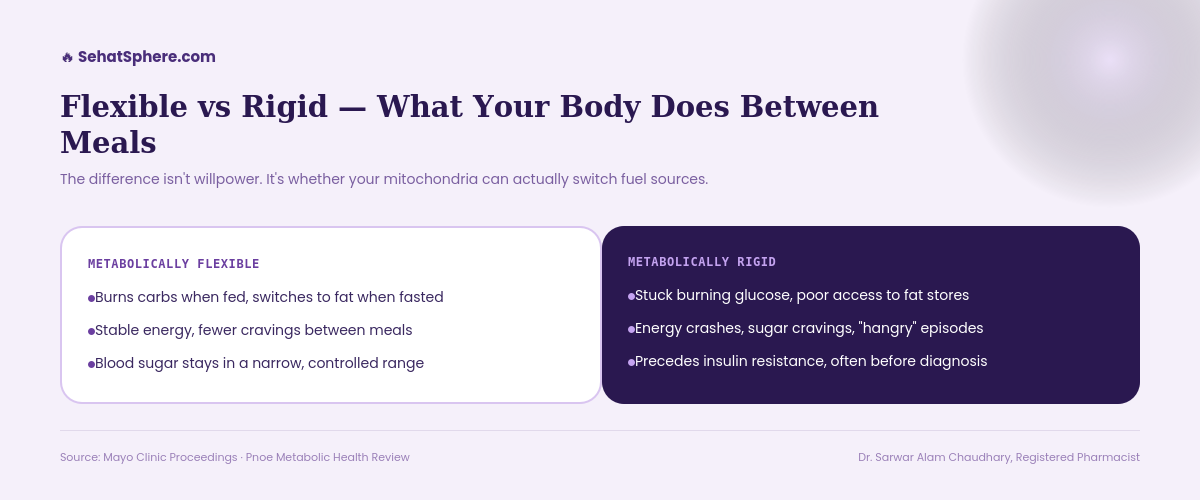
At the cellular level, your mitochondria — the energy-producing structures inside nearly every cell — are constantly choosing which fuel to burn. After a meal, a metabolically flexible body efficiently shifts toward burning the incoming glucose, keeping blood sugar from spiking too high. Between meals or overnight, it smoothly shifts back to burning stored fat, preventing blood sugar from dropping too low. This rapid, efficient switching is what researchers actually mean by “metabolic flexibility” — not a wellness buzzword, but a measurable physiological capacity.
What Metabolic Rigidity Looks Like
Metabolic inflexibility (or rigidity) is the opposite — a body that stays stuck relying on glucose even when it should be shifting to fat, with a diminished ability to upregulate fat-burning during fasting or exercise. In this state, ingested carbohydrates that aren’t immediately used tend to get stored as fat instead, including in places they shouldn’t accumulate, like the liver — directly connecting to the pattern covered in our fatty liver treatment guide.
Impaired metabolic flexibility is associated with meaningfully higher risk of obesity, metabolic syndrome, type 2 diabetes, systemic inflammation, and cardiovascular disease. Central obesity — fat accumulating specifically around the abdomen — is both a cause and consequence of this rigid state, creating a genuinely self-reinforcing cycle that our insulin resistance guide covers from the downstream side. This same rigid state is closely linked to the cardiovascular risk pattern covered in our heart attack in young adults guide, and to the diabetes-medication picture in our diabetes medicine safety guide.
“Mitochondrial Gridlock,” Explained
This is a genuinely useful mental model researchers use: imagine your mitochondria as an intersection designed to let traffic (fuel) flow smoothly in whichever direction is needed. In the modern era of frequent eating and chronic overnutrition, fuel keeps arriving continuously — carbs, fats, and everything else — without the normal “quiet periods” your metabolism evolved to expect. The mitochondria end up overwhelmed by continuous fuel influx while ATP (energy) demand stays comparatively low, creating exactly what researchers term mitochondrial gridlock — a system so busy processing constant incoming fuel that it loses its normal ability to switch flexibly between sources.
What To Read Next
- How to Reverse Insulin Resistance: The clinical endpoint metabolic rigidity often leads toward.
- Fatty Liver Treatment Guide: Where excess, unswitched carbs often end up stored.
- Protein Deficiency in India: Protein timing directly affects fuel-switching efficiency.
What Causes Rigidity in the First Place
Eating too frequently
Constant grazing keeps insulin persistently elevated, which directly blocks your body’s ability to access fat stores — there’s simply never a genuine “quiet period” for the switch to fat-burning to occur.
Refined carbs and added sugar
Diets heavy in refined carbohydrates can overwhelm normal glucose-handling capacity, pushing the system toward chronic carb-reliance by default.
Inactive muscle
Muscle is your body’s largest glucose- and fat-burning tissue. Sedentary muscle simply burns less of both, reducing the total demand that would otherwise drive flexible switching.
Chronic stress and high cortisol
Elevated cortisol interferes directly with insulin sensitivity and fat metabolism — our mental stress guide covers this same cortisol pathway from a broader angle.
Poor sleep
Sleep deprivation disrupts hunger hormones and glucose regulation directly, independent of diet or exercise choices made during waking hours.
Midlife hormone shifts
Perimenopause and post-menopause changes, driven by declining estrogen, measurably reduce metabolic flexibility by affecting both insulin sensitivity and fat metabolism.
The Surprising Surgery Connection
This is a genuinely underdiscussed finding that most metabolic health content never mentions. A 2025 study of 585 patients undergoing major surgery found that those with higher fat-oxidation capacity before their operation — meaning better metabolic flexibility — had significantly fewer post-operative complications, measured by a standardized morbidity score. Patients with the lowest complication rates showed meaningfully higher fat oxidation early in exercise testing, and more effective carbohydrate utilization at peak intensity, compared to those with higher complication burdens.
This suggests metabolic flexibility isn’t just a wellness or weight-loss concept — it’s a measurable marker of how resilient your body is under genuine physiological stress, with real, hospital-relevant consequences.
Signs Your Metabolism May Be Inflexible
| Sign | What’s Actually Happening |
|---|---|
| Energy crashes 2-3 hours after eating | Difficulty smoothly transitioning off the glucose you just consumed |
| Feeling “hangry” or shaky if a meal is delayed | Poor access to fat stores when glucose runs low |
| Strong sugar or carb cravings | Body defaulting to glucose-seeking rather than fat-burning |
| Difficulty losing weight despite consistent effort | Calories being stored rather than efficiently oxidized |
| Waking up hungry despite a late dinner | Overnight fat-burning phase isn’t engaging properly |
None of these symptoms are diagnostic on their own — they overlap with several other conditions our thyroid guide and vitamin D deficiency guide cover, which is exactly why a pattern across several signs, not one isolated symptom, is what’s actually worth paying attention to.
Why Fasting Isn’t a Universal Fix
Intermittent fasting is one of the most commonly recommended tools for improving metabolic flexibility, and the honest evidence is genuinely more nuanced than most content admits.
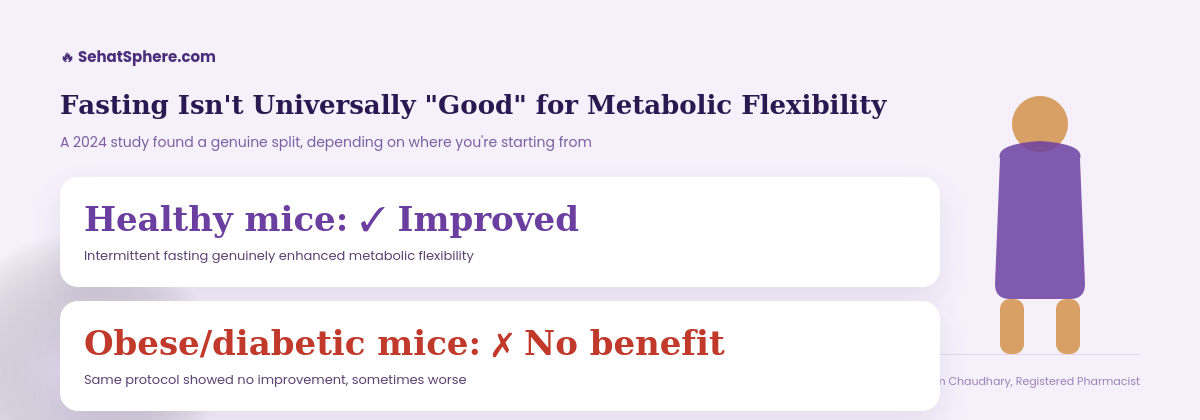
A 2024 study found intermittent fasting genuinely improved metabolic flexibility in healthy subjects — but in those already dealing with obesity or diabetes, it showed no improvement, and in some cases, a worse effect. This is a genuinely important distinction: fasting appears to work best as a preventive or optimization tool for people who are already relatively metabolically healthy, not necessarily as a first-line fix once meaningful insulin resistance has already set in. If you fall into the second group, our insulin resistance guide covers a more foundational starting point before layering on fasting protocols.
Separately, a clinical trial in people with type 2 diabetes and early kidney complications found a 6-month periodic fasting-mimicking diet genuinely improved metabolic flexibility markers and reduced albuminuria (a marker of kidney damage) — showing that with the right protocol and medical supervision, fasting can still help even in more advanced metabolic states, just not casually or without guidance.
What Genuinely Improves Flexibility
A mix of training types
Zone 2 cardio (roughly 60-70% of max heart rate) specifically improves mitochondrial function, while strength training improves insulin sensitivity and glucose handling — the combination outperforms either alone.
Building muscle mass
Muscle burns meaningfully more calories than fat even at rest, directly increasing your body’s total capacity for flexible fuel use throughout the day.
Fasted exercise, occasionally
Training in a fasted state specifically trains the dual-fuel-switching capacity itself, not just general fitness — though this isn’t necessary for every session.
Protecting sleep
Human growth hormone, essential for metabolic repair, is released primarily during deep sleep — making consistent, adequate sleep a genuine metabolic intervention, not just a comfort measure.
Managing stress deliberately
Since cortisol directly interferes with insulin sensitivity, stress management is a legitimate, evidence-based lever here, not a soft add-on.
Practical Eating Strategies
A structured, meta-analysis-backed intervention (11 studies) found intermittent fasting produced an average weight reduction of 3.59kg and a BMI drop of 1.39 kg/m² in people with metabolic syndrome specifically — genuinely meaningful numbers, not marginal effects. Beyond fasting windows specifically, a few practical habits consistently show up across the research:
- Eat protein before carbohydrates at a given meal — this genuinely blunts the resulting glucose spike compared to eating carbs first.
- Front-load carbohydrates earlier in the day rather than late evening, when insulin sensitivity is naturally higher.
- Space meals 3-5 hours apart rather than constant grazing, giving insulin genuine room to fall between meals.
- Balance each plate with protein, fiber-rich carbohydrates, and healthy fats together, rather than isolated carb-heavy meals.
If you’re tracking these changes over time, the free Blood Report Decoder can help you interpret fasting glucose and lipid panel trends, and the Biological Longevity Audit is a reasonable starting point for a broader sense of where your daily habits currently stand.
The Broader Picture Worth Tracking
Metabolic flexibility rarely exists in isolation from the rest of your health. If a routine lab panel shows an unexpected creatinine or kidney-marker change, our high creatinine levels guide covers the same “context before panic” principle worth applying here. If PCOS is part of your picture, our PCOS symptoms guide shares substantial overlap with metabolic rigidity specifically, since insulin resistance sits at the center of both. Nutrient status also genuinely affects this whole picture — our protein deficiency in India guide and zinc deficiency guide both cover nutrients directly involved in insulin signaling and glucose handling. And if blood pressure or cholesterol medication is already part of your routine, our normal blood pressure by age guide and statins guide are worth reading together with this one, since these conditions rarely appear alone in real patients.
Quick Self-Check
Tick anything that applies to you, and see what it suggests.
Frequently Asked Questions
What is metabolic flexibility in simple terms?
Your body’s ability to efficiently switch between burning carbohydrates (after eating) and burning fat (when fasting), without energy crashes or excessive hunger.
What is metabolic rigidity or inflexibility?
A state where the body stays stuck relying on glucose for fuel, with a diminished ability to switch to burning fat, often preceding insulin resistance and weight gain.
What is “mitochondrial gridlock”?
A term researchers use to describe mitochondria overwhelmed by continuous fuel intake without adequate rest periods, losing their normal flexible fuel-switching ability.
Is intermittent fasting good for metabolic flexibility?
It depends on your starting point. A 2024 study found it improved flexibility in healthy subjects but showed no benefit, and sometimes harm, in those with existing obesity or diabetes.
Can metabolic flexibility affect surgery outcomes?
Yes, a 2025 study of 585 surgical patients found those with better fat-oxidation capacity before surgery had significantly fewer post-operative complications.
What are the signs of poor metabolic flexibility?
Energy crashes after eating, feeling shaky or “hangry” if meals are delayed, strong carb cravings, difficulty losing weight, and waking up hungry despite a late dinner.
What exercise improves metabolic flexibility the most?
A combination of Zone 2 cardio (60-70% max heart rate) for mitochondrial function and strength training for insulin sensitivity, rather than either type alone.
Does poor sleep affect metabolic flexibility?
Yes, sleep deprivation disrupts hunger hormones and glucose regulation, and deep sleep is when growth hormone essential for metabolic repair is released.
The Bottom Line
Metabolic flexibility vs rigidity explains something a lot of generic diet advice misses entirely: why two people can eat similarly and feel completely different by mid-afternoon. It’s not about willpower or discipline — it’s a measurable, trainable capacity at the level of your mitochondria, genuinely improvable through a combination of movement, sleep, stress management, and eating pattern, not any single “hack.” The honest caveat worth remembering: fasting protocols that help a metabolically healthy person may do nothing, or even backfire, for someone already dealing with insulin resistance — which is exactly why understanding your own starting point matters more than copying whatever protocol is trending. If cost has ever affected your consistency with follow-up testing, our generic medicine pricing guide is worth reading as you build a sustainable, long-term plan around all of this.
- Storz MA, et al. Metabolic Flexibility and Its Impact on Health Outcomes. Mayo Clinic Proceedings.
- Conn MO, et al. Not So Fast: Intermittent Fasting Fails to Improve Metabolic Flexibility in Mice With Obesity and Type 2 Diabetes. Physiology, 2024-2025.
- Metabolic Flexibility as a Candidate Mechanism for Postoperative Morbidity. PMC.