
Which Nutrient Deficiency Do You Have?
Add your symptoms and risk factors, and this finder matches your pattern against 10 commonly missed deficiencies — with a visual radar chart, confidence score, WhatsApp share, downloadable PDF, and suggested test order.
टूल, FAQ और 10-न्यूट्रिएंट टेबल हिंदी में उपलब्ध हैं। बाकी लंबा लेख और डाउनलोड होने वाली PDF रिपोर्ट अभी अंग्रेज़ी में है।
Find Your Match
Add context, tick symptoms, get a visual pattern match
Any of these apply to you? (optional, improves accuracy)
Energy & Mind
0/5Muscles & Nerves
0/5Skin, Hair & Nails
0/9Immune & Digestive
0/4Bone & Body
0/8Your Symptom Pattern, Visualized
Important
This is a screening tool based on documented symptom patterns and risk factors, not a diagnosis. It points you toward which blood tests are worth requesting — the only way to actually confirm a deficiency.
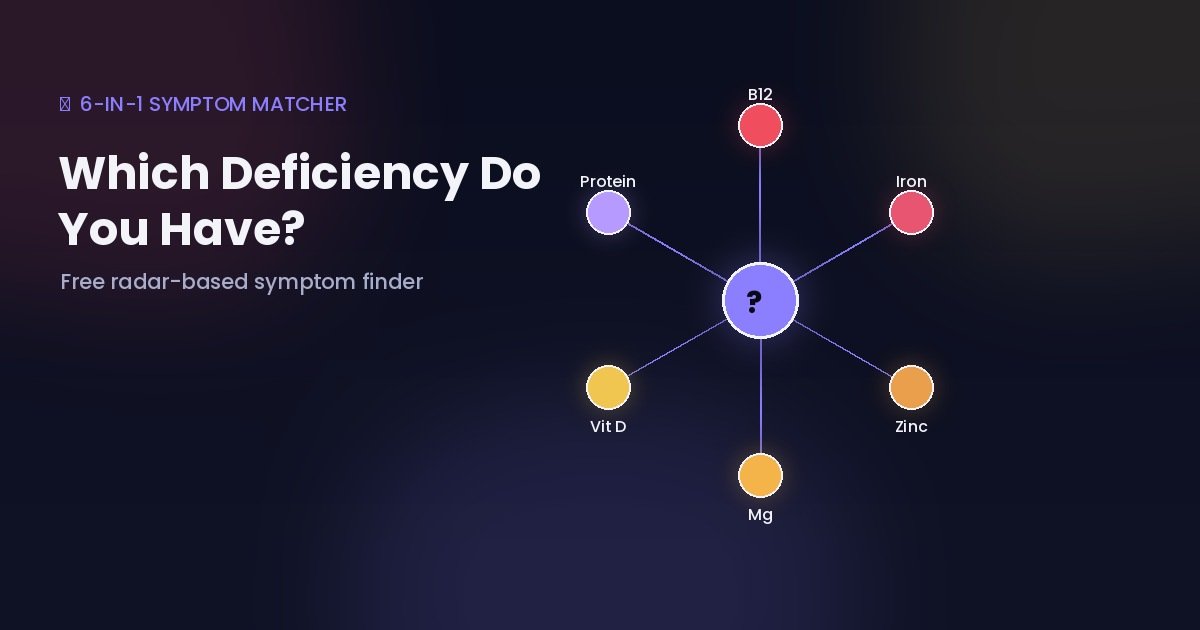
Which nutrient deficiency do you have? Over the past several guides, we’ve covered several of the most commonly missed nutrient deficiencies one at a time — B12, iron, zinc, magnesium, vitamin D, and protein. This finder now scores your actual symptom pattern and risk factors against 10 deficiencies at once — those six, plus folate, vitamin C, iodine, and omega-3 — visualized on a radar chart, the way a doctor mentally cross-references a full history rather than checking one nutrient in isolation.
How This “Which Nutrient Deficiency Do You Have” Finder Works
Each symptom is weighted based on how strongly and specifically it’s associated with each of the 10 deficiencies in published clinical literature and the reference fact sheets from NIH’s Office of Dietary Supplements (ODS). The 9 risk-factor chips add further weight based on well-documented population-level risk — a vegetarian diet, for instance, genuinely raises B12, iron, zinc, and omega-3 risk independent of current symptoms, because all four are more abundant (or, for omega-3, mostly sourced) from animal and marine foods.
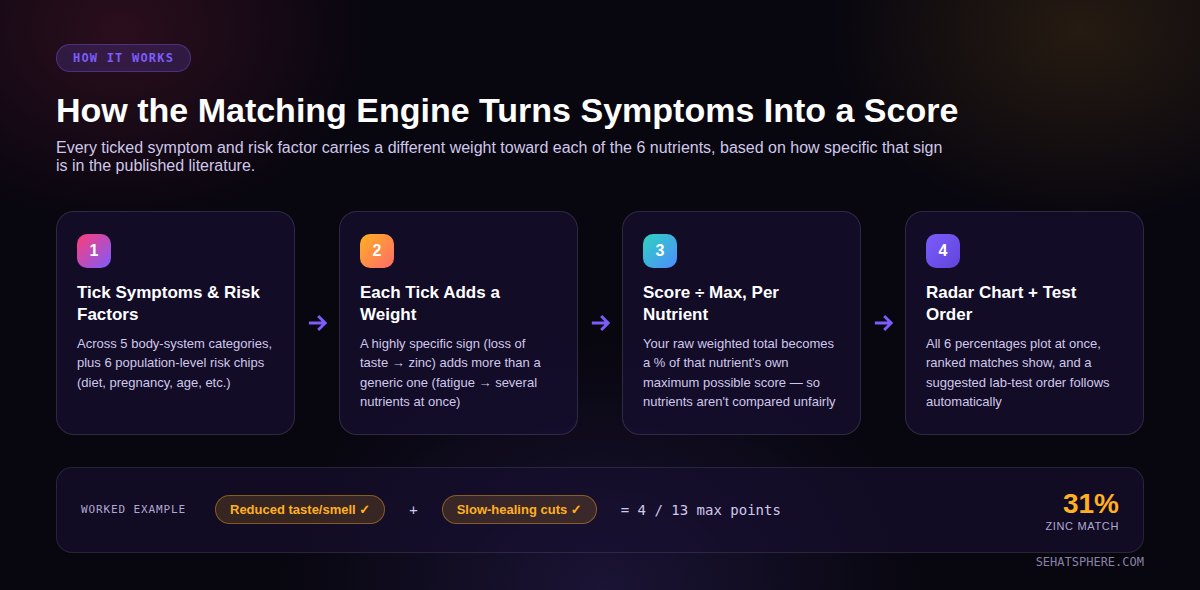
When you click “Find My Match,” the tool totals your weighted score for each nutrient and converts it to a percentage of that nutrient’s maximum possible score, so a deficiency with fewer, more specific symptoms isn’t unfairly outscored by one with more symptoms and risk factors listed. A symptom like reduced taste or smell, for example, carries a heavier weight toward zinc than a generic symptom like fatigue does toward any single nutrient, because taste and smell changes are a comparatively specific, well-documented sign of zinc deficiency rather than something that shows up broadly across many unrelated conditions.
The confidence score reflects how much information you provided — a result based on 2 ticked boxes is inherently less reliable than one based on 12, and the tool says so directly rather than presenting every result with equal false certainty.
The radar chart plots all 10 percentages at once on a single visual, so you can see your overall pattern shape — a sharp single spike suggests one dominant match, while a wide, spread-out shape suggests several overlapping gaps worth testing together. One nutrient, omega-3, is scored a little differently — see the FAQ below on why.
Why Symptoms Overlap So Much
Fatigue alone now shows up in iron, B12, magnesium, and folate deficiency. Hair thinning shows up in four of the ten. This isn’t a flaw in the tool — it’s a genuine feature of how these nutrients work in the body.
Many of these 10 nutrients support overlapping systems: cellular energy production, immune function, and tissue repair all depend on multiple nutrients working together, not any single one in isolation. A shortfall in almost any of them can produce a similar-feeling fatigue or a similar-looking bout of hair thinning. Folate and B12 are the clearest example of true overlap — both cause the exact same type of anemia (megaloblastic anemia) through related but distinct pathways, which is why doctors routinely test them together rather than assuming a low B12 explains everything.

One overlap most people never hear about: magnesium is a required cofactor for the liver and kidney enzymes that convert vitamin D into its active hormonal form. A 2018 review in the Journal of the American Osteopathic Association lays this out directly — without adequate magnesium, supplemental vitamin D can sit around in an inactive form even when a blood test shows an acceptable total level, which is one reason some people feel no better on a vitamin D supplement until their magnesium is also corrected.[1]
It’s also worth knowing that overlapping deficiencies aren’t a coincidence in many cases — a vegetarian diet, for instance, raises risk for B12, iron, and zinc simultaneously, since all three are more abundant and more easily absorbed from animal foods. Someone with several matching nutrients in their results isn’t necessarily wrong about any of them; they may genuinely have more than one gap at once.
The 10 Nutrients at a Glance
| Nutrient | Most Distinctive Sign | Test to Request | Learn More |
|---|---|---|---|
| Vitamin B12 | Tingling/numbness, brain fog | Serum B12 | Full guide → · NIH fact sheet |
| Iron | Pica (ice/dirt cravings), spoon nails | Ferritin + Hemoglobin | Full guide → · NIH fact sheet |
| Zinc | Loss of taste or smell | Serum Zinc | Full guide → · NIH fact sheet |
| Magnesium | Muscle cramps, twitching | Serum Magnesium | Full guide → · NIH fact sheet |
| Vitamin D | Bone/joint pain, low mood | 25-OH Vitamin D | Full guide → · NIH fact sheet |
| Protein | Muscle loss, swelling | Serum Albumin | Full guide → · MedlinePlus |
| Folate (B9) | Mouth ulcers, megaloblastic anemia | Serum/RBC Folate | NIH fact sheet ↗ (SehatSphere guide coming soon) |
| Vitamin C | Bleeding gums, easy bruising | Plasma Vitamin C | NIH fact sheet ↗ (SehatSphere guide coming soon) |
| Iodine | Neck swelling (goiter), feeling cold | Urinary Iodine / TSH | NIH fact sheet ↗ (SehatSphere guide coming soon) |
| Omega-3 | Rough, dry skin (true deficiency is rare) | Omega-3 Index (RBC) | NIH fact sheet ↗ (SehatSphere guide coming soon) |
For a broader clinical reference on vitamins and minerals in general, the National Institutes of Health’s MedlinePlus overview is a solid, freely available resource.
Before You Start Supplementing
A high match percentage here is a reason to test, not a reason to start swallowing capsules the same afternoon. Three of these ten nutrients carry real, documented harm when megadosed without a confirmed deficiency: excess iron accumulates in the liver and heart over time in people who didn’t actually need it; high-dose vitamin D taken for months without monitoring can push blood calcium high enough to affect the kidneys; and chronically excessive iodine intake can inflame the thyroid gland, trigger a goiter, and has been linked to a higher risk of thyroid cancer. All three are avoidable simply by testing first.
The other seven are gentler on the body, but two of them cause harm by hiding a different problem rather than by toxicity: high-dose folate (folic acid) supplements can correct the anemia caused by a B12 deficiency while the nerve damage that same B12 deficiency also causes keeps progressing unnoticed — testing B12 before starting folate is what prevents this. B12 supplementation carries the mirror-image risk, masking a separate, more serious B12-independent cause of anemia if it’s started before proper testing. On top of that, magnesium and zinc can each blunt the absorption of certain antibiotics and thyroid medication if taken too close together, and high-dose omega-3/fish oil can raise bleeding risk when combined with blood-thinners like warfarin. Vitamin C is the gentlest of the ten in ordinary doses — mostly stomach upset if overdone — except in hemochromatosis (an iron-overload condition), where high doses can make the iron overload worse. This is exactly the kind of interaction our Integrative Interaction Checker exists to screen for — worth a quick check with your current medication list before you buy anything, even a supplement that seems harmless.
Once you do have real lab numbers back, our Blood Report Decoder reads them together with 19 other common markers and flags combination patterns a single deficiency test alone wouldn’t show — the natural next stop after this finder.
What This Tool Can’t Do
It can’t account for medications, other health conditions, or lab-specific reference ranges, all of which can shift how a real result should be interpreted.
It also can’t diagnose anything — its entire purpose is to help you walk into a blood test with a clearer, more specific idea of what’s worth requesting, rather than guessing or requesting every test available.
Your Privacy
Working out which nutrient deficiency do you have shouldn’t require handing over personal data. Every calculation happens directly in your browser. Nothing you select is sent to, logged, or stored on any server by Sehatsphere. The optional Save Profile feature stores your answers only on your own device’s browser storage.
The Short Version: Which Nutrient Deficiency Do You Have?
- Add your sex, age, and any relevant risk factors for a more accurate match.
- Tick whatever symptoms apply across all five categories.
- Results show a radar chart, confidence score, ranked matches, and a suggested test order.
- Overlapping symptoms across nutrients are normal — several deficiencies can genuinely coexist, and magnesium status can even affect how well your vitamin D works.
- Test before you supplement — iron and high-dose vitamin D can cause real harm without a confirmed deficiency, and it’s worth screening any new supplement against your current medications first.
- This is a screening tool, not a diagnosis — use it to decide what to test, not to skip testing.
Frequently Asked Questions
It’s a screening tool based on documented symptom patterns and known risk factors, not a diagnosis. It’s designed to point you toward which blood tests are worth requesting, not to replace them.
Many nutrients support overlapping body systems, especially cellular energy production and immune function, so fatigue or frequent infections can show up across several different deficiencies rather than pointing to just one.
Yes, and it’s common — iron and B12 deficiency often overlap in vegetarians, for example, and magnesium deficiency can blunt your body’s ability to activate vitamin D even when your D level looks borderline-adequate on paper. This is exactly why the finder shows your top matches rather than a single answer.
No. All matching happens directly in your browser. The optional Save Profile feature stores your answers only on your own device.
It reflects how many symptoms and risk factors you provided. More input generally produces a more reliable pattern match, so a low confidence score means the result should be treated as a rougher estimate.
It visualizes your match percentage across all 10 nutrients at once, so you can see your overall pattern shape rather than just a ranked list — a wide, spread-out shape suggests multiple overlapping gaps, while a sharp single point suggests one dominant match.
Follow the suggested test order for your top matches, read the full guide for each, and take actual test results to a doctor rather than starting supplements based on symptoms alone.
Yes, simply answer based on their symptoms and risk factors instead of your own — the tool doesn’t collect any identifying information either way.
No. This finder tells you what’s worth testing, not what to start taking. Supplementing blindly can mask the real cause of a symptom, and some nutrients (iron and vitamin D especially) cause genuine harm in excess when taken without a confirmed deficiency.
Yes, and it’s worth doing before you start anything, prescription or over-the-counter. Our Integrative Interaction Checker screens common supplements against prescription medications so you know about a spacing or dosing conflict before it becomes a problem.
Yes — iron, B12, vitamin D, zinc, folate, and iodine requirements all rise in pregnancy and lactation, which is why the pregnancy/breastfeeding risk chip adds weight to all six of those nutrients. Folate is the single most well-known example, since folic acid before and during early pregnancy is what prevents neural tube defects, and both iodine and iron needs also rise by roughly a third to a half. Deficiency screening for several of these is routinely built into antenatal care for exactly this reason.
A general symptom checker tries to cover every possible condition from a symptom list, which spreads its accuracy thin. This finder is deliberately narrow — it only scores your pattern against 10 well-documented, commonly missed nutrient deficiencies, using published symptom-association data for those ten specifically.
Because it genuinely is different. NIH’s Office of Dietary Supplements notes that a true omega-3 deficiency (rough, scaly skin and a red, itchy rash) is very rare in a normal diet, unlike B12 or iron deficiency, which are common. So instead of leaning on vague, poorly-documented symptoms like most omega-3 marketing does, this finder scores omega-3 mostly on real dietary risk — how rarely you eat fatty fish, flaxseed, or walnuts, and whether you eat a fully plant-based diet — which is the honestly-supported way to flag low intake.
Not yet as standalone SehatSphere articles — those are in progress. Until they’re published, this finder links you directly to the NIH Office of Dietary Supplements’ own consumer fact sheet for each of these four, which is the same authoritative source the tool’s scoring is built from.