
Iron Deficiency Anemia: 7 Warning Signs You’re Ignoring
It’s easily India’s most common nutrient deficiency, yet almost every one of its 7 signs gets blamed on stress, poor sleep, or “just being tired.” Here’s how to actually recognize it.
Iron deficiency anemia is India’s single most common nutrient deficiency, and yet it’s routinely mistaken for ordinary tiredness, a busy schedule, or “just needing more sleep.” The reason is simple: every one of its warning signs has a dozen more mundane explanations, so the actual cause rarely gets suspected until a blood test forces the issue. This guide covers the seven real signs worth knowing, how hemoglobin and ferritin actually differ as tests, how to tell iron deficiency apart from B12-related anemia, and what an evidence-based fix looks like.
Why Iron Deficiency Anemia Gets Missed So Often
Iron deficiency develops gradually, in stages. Your body first draws down stored iron reserves before hemoglobin — the oxygen-carrying protein in blood — actually starts to drop. This means someone can be meaningfully iron-depleted for months before a standard checkup, which usually only measures hemoglobin, would catch anything unusual.
Fatigue is the single most common sign, and also the least specific one — nearly everyone attributes tiredness to stress, poor sleep, or a demanding week long before considering a nutrient deficiency. It usually takes several signs appearing together, not just one, before iron deficiency becomes a reasonable thing to actually test for.
This gradual onset also means the person experiencing it often adapts without realizing it — quietly avoiding stairs, sitting down more often, or simply accepting a lower baseline energy level as normal, which delays recognition even further.
🩸 Already Have Your Hemoglobin or Ferritin Numbers?
Our Blood Report Decoder reads hemoglobin, ferritin, MCV, and 17 other common markers together, automatically flagging patterns like the iron-deficiency signal covered in this guide — a genuinely faster way to see the full picture than checking one number at a time.
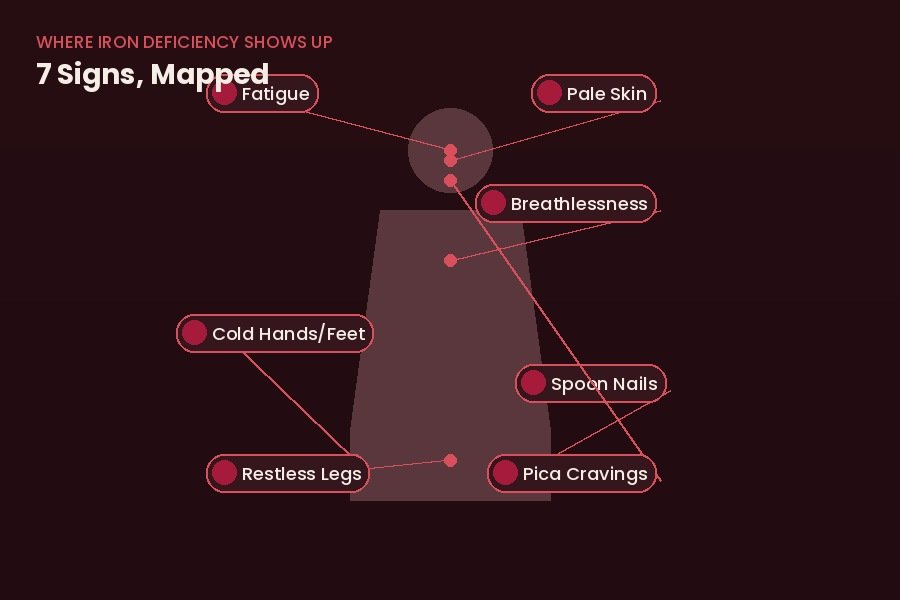
The 7 Warning Signs of Iron Deficiency Anemia
These seven signs are the ones most consistently documented in clinical literature. Most people notice a few of these long before ever connecting them to iron.
1. Persistent Fatigue
Without enough iron, your body can’t make enough hemoglobin to carry oxygen efficiently to your tissues, leaving you feeling drained regardless of how much you sleep. This fatigue tends to feel heavier and more constant than ordinary tiredness, though it’s rarely recognized as different until it’s pointed out directly.
A useful distinction: ordinary tiredness usually improves noticeably after a good night’s sleep or a restful weekend, while iron-deficiency fatigue tends to persist regardless of how much rest you get.
2. Pale Skin
Hemoglobin is what gives blood, and by extension skin, its healthy color. A noticeably pale complexion, pale inner eyelids, or pale nail beds are classic, visible signs of anemia — and often something family members notice before the person experiencing it does.
Checking the inner lower eyelid specifically is a simple, commonly taught trick — a healthy pink-red color versus a pale, washed-out appearance can be a useful visual clue even before any blood test.
3. Shortness of Breath
When less oxygen reaches your muscles and tissues, ordinary activities — climbing stairs, brisk walking, light exercise — can leave you noticeably more breathless than they used to. This is frequently mistaken for being out of shape rather than a blood-oxygen issue.
The detail worth noticing is a genuine change from your own baseline — if stairs that used to be easy suddenly feel difficult over a period of weeks, that shift itself is more meaningful than the absolute level of fitness.
4. Cold Hands and Feet
Reduced oxygen delivery affects circulation to your extremities first, which is why persistently cold hands and feet, even in warm conditions, is a recognized sign worth paying attention to alongside the others on this list.
This is a genuinely easy sign to dismiss, especially in people who already run cold naturally, which is part of why it works better as supporting evidence alongside other signs rather than a standalone red flag.
5. Brittle or Spoon-Shaped Nails
This is one of the more distinctive signs on this list. Nails that become unusually brittle, thin, or develop a concave, spoon-like shape — a condition called koilonychia — are specifically associated with more significant, longer-standing iron deficiency rather than a mild, recent one.
Because this sign typically appears later than fatigue or paleness, its presence generally suggests the deficiency has been present for a meaningful stretch of time rather than a few recent weeks.
6. Restless Legs
An uncomfortable urge to move your legs, particularly at night, has a well-documented link to low iron stores. This connection is specific enough that iron levels are one of the first things checked when restless legs syndrome is being evaluated.
This symptom also tends to disrupt sleep quality directly, which can compound the fatigue already caused by low iron — creating a frustrating cycle where poor sleep and low energy reinforce each other.
7. Unusual Cravings (Pica)
Craving and sometimes eating non-food substances — ice, dirt, chalk, or raw starch — is a distinctive, well-documented sign specifically linked to iron deficiency. We’ve covered this specific phenomenon in more depth further down this guide, since it’s genuinely one of the more surprising and lesser-known connections in this entire list.
Unlike most cravings, this one has a clear physiological explanation rather than being purely psychological, which is part of why it’s taken seriously as a genuine clinical sign rather than dismissed as an odd personal habit.
Myth vs Fact
Myth: “If my hemoglobin is normal, I don’t have an iron problem.” Fact: Ferritin, your iron storage marker, often drops well before hemoglobin does — meaning a normal hemoglobin doesn’t rule out an underlying iron deficiency that hasn’t progressed to full anemia yet.
Check Your Iron Deficiency Risk
Tick any symptoms that apply to you right now. This is a rough self-check, not a diagnosis.
Tick the boxes above to see your result.
This tool is for general awareness only and can’t replace a blood test or a doctor’s evaluation.
Who’s Most Likely to Have Iron Deficiency Anemia
Women of reproductive age carry the highest risk of any group, since menstrual blood loss removes meaningful iron every single month — heavier periods mean proportionally higher risk.
Pregnant women have substantially increased iron needs to support both their own increased blood volume and fetal development, making this one of the most consistently monitored groups for iron status.
Vegetarians and vegans absorb non-heme iron, the form found in plant foods, considerably less efficiently than the heme iron found in meat, making dietary planning more important for this group specifically.
Frequent blood donors and endurance athletes both lose iron through mechanisms unrelated to diet — donation directly, and endurance training through a combination of increased red blood cell turnover and mild gastrointestinal blood loss.
People with digestive conditions such as celiac disease, Crohn’s disease, or anyone who has had gastric bypass surgery often absorb iron poorly regardless of intake, making this group worth monitoring even with an otherwise iron-rich diet.
Children and adolescents, particularly during rapid growth spurts, have proportionally higher iron requirements relative to their size, and teenage girls specifically combine this growth demand with the onset of menstrual blood loss — a combination worth being aware of for parents.
Hemoglobin vs Ferritin: Why Both Tests Matter
These two tests measure genuinely different things, and confusing them is one of the most common reasons iron deficiency gets missed on a routine checkup.
Hemoglobin measures the oxygen-carrying protein currently circulating in your blood right now. It’s part of nearly every standard blood test, but it only drops once iron deficiency has progressed to full anemia.
Ferritin measures your body’s stored iron reserves — essentially your iron savings account. Ferritin typically falls well before hemoglobin does, making it a meaningfully earlier and more sensitive indicator of an iron problem developing.
This is exactly why asking for ferritin specifically, rather than assuming a normal hemoglobin rules out an iron issue, makes a genuine difference in catching a deficiency before it progresses to full-blown anemia with all seven signs in play.
It’s also worth knowing that ferritin can be temporarily elevated by inflammation or infection, independent of actual iron status, which is why testing during or right after being sick can occasionally give a misleadingly reassuring result. Testing during a period of normal health gives a clearer picture.
For a broader clinical reference on iron’s role and deficiency, the National Institutes of Health’s consumer fact sheet on iron is a solid, freely available resource.
Iron Deficiency vs B12 Deficiency Anemia: Telling Them Apart
Both iron and B12 deficiency can cause anemia, but they work through entirely different mechanisms — and mixing them up leads to the wrong fix entirely. MCV, a measure of average red blood cell size, is the key differentiator.
Iron deficiency typically produces smaller-than-normal red blood cells, since there isn’t enough iron to properly build each cell’s oxygen-carrying capacity. B12 deficiency, covered in depth in our vitamin B12 guide, produces the opposite pattern — larger, less efficient cells, since B12 is needed for normal cell division.
| Marker | Iron Deficiency | B12 Deficiency |
|---|---|---|
| MCV (cell size) | Low (small cells) | High (large cells) |
| Ferritin | Low | Usually normal |
| Common trigger | Blood loss, poor absorption | Vegetarian diet, absorption issues |
Both deficiencies can technically coexist in the same person, particularly in vegetarians, which is exactly the kind of combined pattern our Blood Report Decoder is built to flag automatically rather than requiring you to cross-reference each marker manually.
This distinction matters clinically because the fix is completely different for each — iron supplementation won’t correct a B12 deficiency, and B12 supplementation won’t correct an iron one, regardless of how similar the fatigue and paleness might feel from the outside.
Iron Food Sources That Actually Help
Iron comes in two dietary forms: heme iron, found in meat, poultry, and fish, which your body absorbs efficiently, and non-heme iron, found in plant foods, which absorbs considerably less efficiently on its own.
Pairing non-heme iron sources with vitamin C — a squeeze of lemon over leafy greens, or fruit alongside an iron-rich meal — measurably improves how much of that plant-based iron your body actually absorbs.
Cooking in cast-iron cookware is a small, genuinely effective habit worth knowing — food cooked this way, particularly acidic dishes like tomato-based curries, picks up a meaningful amount of additional iron during cooking itself.
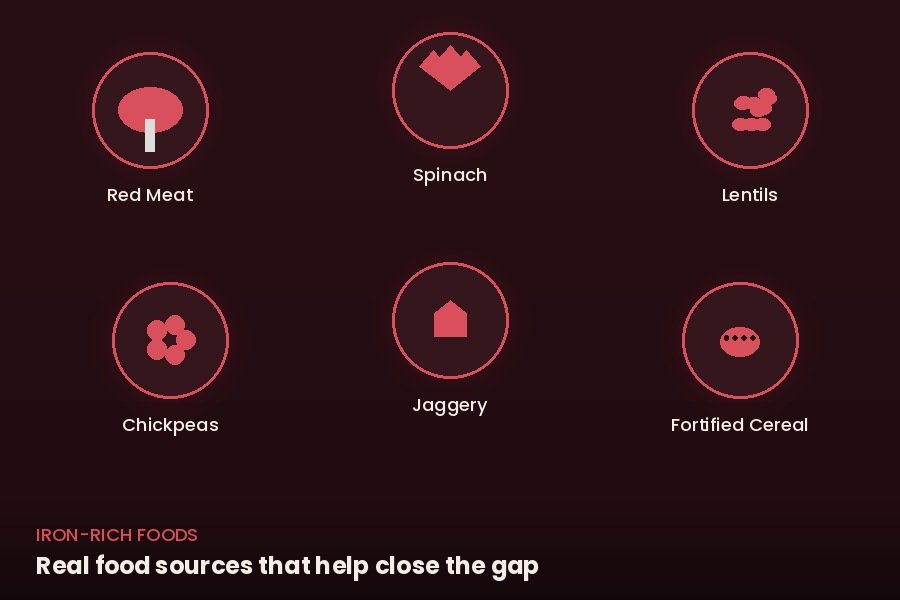
Iron Content by Food
| Food | Approx. Iron | Serving |
|---|---|---|
| Red meat | ~2.5–3 mg | 100g cooked |
| Spinach (cooked) | ~3.5 mg | 1 cup |
| Lentils | ~3.3 mg | 1 cup cooked |
| Chickpeas | ~2.5 mg | 1 cup cooked |
| Jaggery | ~0.5–1 mg | 1 tbsp |
| Fortified cereals | Varies, often 4–8 mg | 1 serving |
Worth knowing: tea and coffee contain compounds that bind to iron and significantly reduce absorption — spacing them at least an hour or two away from iron-rich meals makes a genuine difference.
Fixing Iron Deficiency Anemia
Diet is a reasonable starting point for mild cases: iron-rich foods paired with vitamin C, and avoiding tea or coffee around mealtimes.
For a confirmed deficiency, supplements are commonly prescribed as ferrous sulfate, ferrous gluconate, or ferric citrate. Taking iron on an empty stomach improves absorption but can cause stomach upset for some people, which is a common reason people stop taking it before finishing a course.
Constipation and darkened stools are common, generally harmless side effects of oral iron — worth knowing in advance so they don’t cause unnecessary alarm partway through treatment.
Supplementing without a confirmed deficiency isn’t advisable, since excess iron can’t be easily excreted by the body and accumulates in organs over time, making unsupervised long-term use genuinely risky rather than simply unnecessary.
Retesting after a few months of treatment, rather than stopping as soon as symptoms feel better, confirms whether ferritin has actually been rebuilt to a healthy reserve level — since feeling better and having fully corrected iron stores aren’t quite the same thing.
The Pica Phenomenon: Iron’s Strangest Symptom
Of all seven signs covered in this guide, pica is the one people are least likely to connect to iron on their own. Pica is a craving for and sometimes consumption of non-food substances — ice is the most common, though dirt, chalk, paper, and raw starch have all been documented.
The exact biological mechanism behind pica isn’t fully understood, but its connection to iron deficiency is well-documented and repeatedly observed clinically. Cravings for ice specifically, sometimes called pagophagia, are common enough to be considered a genuine clinical clue rather than an unusual quirk.
What makes this symptom particularly useful diagnostically is that it often resolves within days to weeks of starting iron correction, well before other signs like fatigue fully improve — making it one of the more satisfying signs to track during treatment.
Pica during pregnancy specifically deserves a mention, since pregnancy is already a higher-risk period for iron deficiency, and cravings that might otherwise be brushed off as an unusual pregnancy craving are worth mentioning to a doctor rather than assumed to be harmless.
📚 The Full Nutrient Deficiency Series
This iron guide is part of a wider series covering the deficiencies most commonly missed in routine checkups:
The Short Version of Iron Deficiency Anemia
- Fatigue, pale skin, breathlessness, cold extremities, brittle nails, restless legs, and pica are the 7 signs worth watching.
- Ferritin drops before hemoglobin — a normal hemoglobin doesn’t rule out an iron problem developing.
- MCV tells iron deficiency (small cells) apart from B12 deficiency (large cells).
- Women of reproductive age, vegetarians, blood donors, and endurance athletes face meaningfully higher risk.
- Pairing iron with vitamin C helps absorption; tea and coffee near meals hurts it.
- Pica — cravings for ice, dirt, or starch — is a genuine, well-documented sign, not just an odd habit.
Frequently Asked Questions
Persistent fatigue is usually the earliest and most common sign, though it’s also the easiest to dismiss since it overlaps with so many other causes.
Pica is an unusual craving for non-food substances like ice, dirt, or starch. Its exact mechanism isn’t fully understood, but it’s specifically and repeatedly linked to iron deficiency, and cravings often resolve once iron levels are corrected.
Hemoglobin measures the oxygen-carrying protein currently circulating in your blood, while ferritin measures your body’s stored iron reserves. Ferritin typically drops before hemoglobin does, making it a more sensitive early indicator.
MCV, a measure of red blood cell size, is the key differentiator. Iron deficiency typically produces smaller red blood cells (low MCV), while B12 deficiency produces larger ones (high MCV).
Menstrual blood loss means women of reproductive age lose meaningful iron every month, which is why iron requirements and deficiency rates are consistently higher in this group.
No. Compounds in tea and coffee bind to iron and significantly reduce absorption, so it’s better to space them at least an hour or two apart from iron-rich meals or supplements.
Energy levels often start improving within a few weeks, but fully rebuilding iron stores typically takes three to six months of consistent supplementation and dietary support.
Yes. Poor dietary intake, malabsorption conditions, frequent blood donation, and endurance exercise can all cause it independent of any obvious blood loss.
It’s better not to. Iron accumulates in the body if not needed, and unsupervised long-term supplementation without a confirmed deficiency carries genuine health risks over time.
Regular exercise itself doesn’t cause deficiency in most people, but endurance training specifically increases iron turnover and mild gastrointestinal blood loss, making athletes a genuinely higher-risk group worth monitoring.