
Free Kidney Function Calculator (eGFR from Creatinine)
One creatinine value, one clear number: your CKD-EPI 2021 eGFR and CKD stage — plus the creatine-vs-creatinine mix-up that quietly confuses more lab results than you’d expect. No email, no signup, no fake reviews.
Calculate Your eGFR
Enter your latest creatinine, age, and sex — takes about 15 seconds
Lab Value & Demographics
| Stage | eGFR Range | What It Means |
|---|
Important
This tool estimates kidney function for educational purposes and does not diagnose anything or replace a lab-confirmed, doctor-reviewed result. Always confirm any dosing decision with a pharmacist or physician.
SehatSphere Kidney Function Summary
Generated using the 2021 CKD-EPI equation · Reviewed format by Dr. Sarwar Alam Chaudhary, Registered Pharmacist
Patients often see “eGFR” on a lab report next to their creatinine value without ever being told what it actually means, or realizing the number changes meaningfully with something as simple as age. This kidney function calculator uses the same 2021 CKD-EPI equation labs currently use, explains what your result means, and clears up one specific mix-up I hear constantly in the pharmacy: creatine, the supplement, and creatinine, the kidney marker, are not the same thing.
Key Takeaways
- This kidney function calculator uses the 2021 CKD-EPI creatinine equation — race-free, and the current standard recommended by the National Kidney Foundation.
- Your result comes with a CKD stage (Stage 1 through Stage 5), but staging chronic kidney disease also requires the reading to persist across repeat tests, not just one number.
- Creatine (the supplement) and creatinine (the kidney marker) are genuinely different substances — but taking creatine can raise your creatinine reading without your kidneys doing anything differently at all.
- Muscle mass, recent exercise, high protein intake, and dehydration can all shift your creatinine reading independent of actual kidney function.
What This Kidney Function Calculator Actually Measures
Your kidneys filter waste from your blood continuously. Creatinine is a waste product from normal muscle breakdown, and since healthy kidneys clear it at a predictable rate, measuring how much builds up in your blood lets doctors estimate how well your kidneys are filtering overall — that estimate is your eGFR (estimated Glomerular Filtration Rate), measured in mL/min/1.73m² [1][4].
This calculator uses the 2021 CKD-EPI creatinine equation, which combines your serum creatinine, age, and biological sex — with no race coefficient — to estimate your filtration rate standardized to a body surface area of 1.73m² [2].
How the CKD-EPI 2021 Formula Works
This calculator uses the current standard: the 2021 CKD-EPI creatinine equation, validated against directly measured GFR in a large, diverse cohort and published in the New England Journal of Medicine by Inker and colleagues [3].
The formula takes your serum creatinine, divides it by a sex-specific constant (kappa), raises the result to a sex-specific power (alpha), applies an age-decay factor, and — for women — applies a small final multiplier to account for average differences in muscle mass and creatinine production between sexes. None of that math needs to make sense to you; the calculator above does it instantly. What matters clinically is what changed in 2021: this version has no race coefficient.
⚠ Why removing race from the formula mattered
Earlier CKD-EPI and MDRD equations included a coefficient that assigned a higher calculated eGFR to Black patients for an identical creatinine, age, and sex — based on an assumption about average muscle mass that doesn’t hold at the individual level. In practice, this meant some Black patients’ kidney disease looked less severe on paper than it actually was, which delayed nephrology referrals, transplant eligibility, and medication dose adjustments for real people. The 2021 race-free equation was developed specifically to correct this, and it is now the standard recommended by the National Kidney Foundation and the American Society of Nephrology.
Understanding the CKD Stages
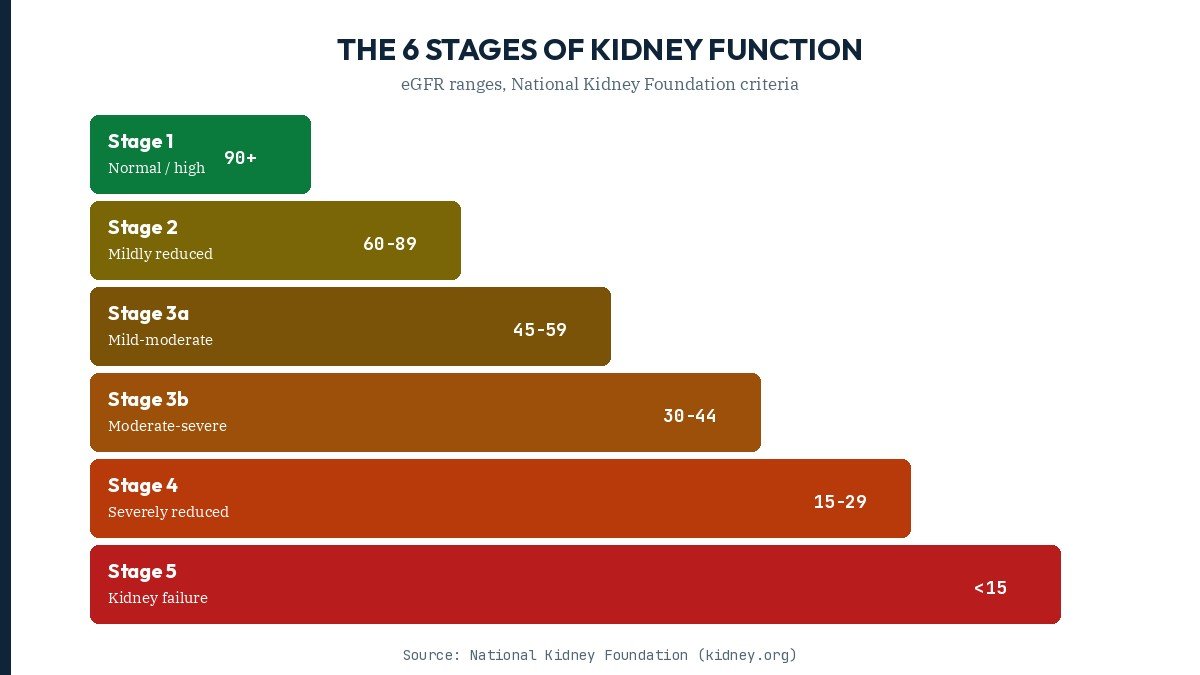
Once you have an eGFR number, the next question is almost always “is that bad?” The honest answer depends on the stage it falls into, and — just as importantly — whether it stays there on a repeat test three months later, since a single reading is never enough to diagnose CKD on its own.
| Stage | eGFR Range | What It Means |
|---|---|---|
| Stage 1 | 90+ | Normal or high function. Only classified as CKD if other damage markers (like protein in urine) are also present. |
| Stage 2 | 60–89 | Mildly reduced. Often normal for age alone; becomes CKD only with other evidence of kidney damage. |
| Stage 3a | 45–59 | Mild-moderate reduction. Usually managed by a primary care doctor. |
| Stage 3b | 30–44 | Moderate-severe reduction. Often triggers a nephrology referral. |
| Stage 4 | 15–29 | Severely reduced. Close nephrology monitoring needed. |
| Stage 5 | Below 15 | Kidney failure range. Dialysis or transplant planning typically begins. |
Staging also considers protein in urine (albuminuria), not eGFR alone — this table reflects eGFR criteria specifically [2][5].
A single low reading rarely means what people fear it means — dehydration or hard exercise the day before a blood draw can shift the number meaningfully on its own.
Creatine vs. Creatinine: The Mix-Up I Hear Constantly
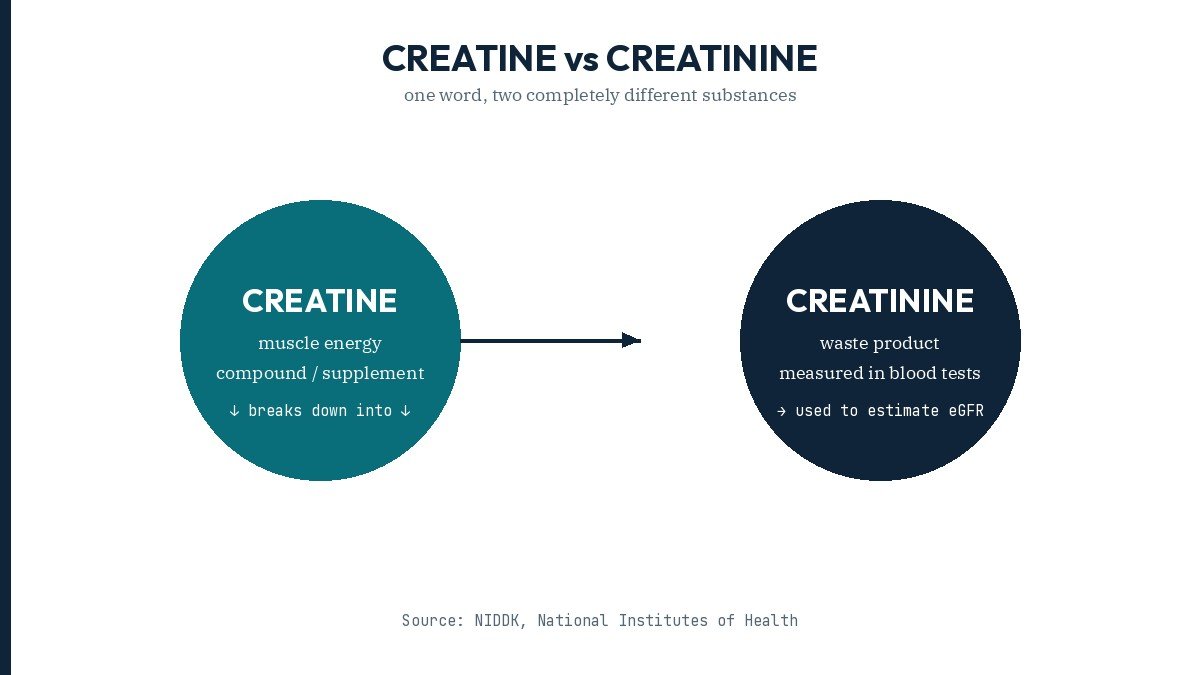
A compound your muscles use for energy, popular as a workout supplement. Doesn’t directly indicate kidney health.
The waste product left over when creatine breaks down. This is what’s measured in blood tests to estimate kidney function.
Here’s the part that actually causes confusion in practice: taking a creatine supplement can raise your creatinine level on a blood test, simply because you’re generating more of the breakdown product — without your kidneys doing anything differently at all. If you’re on a creatine supplement and your creatinine comes back slightly elevated, that’s often the explanation, not a kidney problem. Our creatine and blood test guide goes deeper into how long this effect lasts and what to do before a test.
What Else Can Skew Your Results
Creatinine isn’t purely a kidney number — several common factors move it independent of actual filtration:
- Muscle mass — more muscle naturally means more creatinine production, which can make eGFR appear lower in muscular individuals without any kidney issue.
- Recent intense exercise — can temporarily raise creatinine for 24-48 hours.
- High protein intake or creatine supplements — both increase the raw material creatinine is made from. Our taurine and your medications guide covers another supplement with its own documented interactions worth knowing if you take several at once.
- Dehydration — concentrates blood values generally, including creatinine. Our zinc deficiency and your medications guide covers another lab-relevant nutrient story worth knowing.
- Certain medications — some genuinely reduce kidney function, while others simply interfere with the lab measurement itself. If you’re managing several prescriptions, the Integrative Interaction Checker tool can help cross-check what you’re on against known kidney-relevant interactions.
⚠ Why Context Matters
A bodybuilder on a high-protein diet and a creatine supplement, and a sedentary person eating minimal protein, can show meaningfully different creatinine levels with identical actual kidney function. This is exactly why a single number should never be interpreted in isolation from context.
When to Actually Act on a Result
- Don’t panic over one reading — ask your doctor about repeating the test, ideally without recent intense exercise or dehydration beforehand.
- If you take creatine supplements, mention this when discussing an elevated creatinine result.
- Persistently low eGFR across two or more tests, three months apart, is what typically prompts further evaluation for chronic kidney disease.
- If you have diabetes, high blood pressure, or a family history of kidney disease, ask about more frequent monitoring — our Complete Guide to Blood Pressure covers a closely related risk factor.
- Bring a copy of your actual lab report to your next appointment — our Blood Report Decoder can help you understand the other values on the same panel.
If a medication is part of why you’re checking kidney function in the first place, the Complete Guide to Medicine Safety is a good broader resource. If fatigue or other symptoms prompted this check, the free Which Nutrient Deficiency Do You Have? tool is worth exploring too, and if cost is a factor in staying on top of kidney-relevant medications, our Generic Medicines: The Price Truth guide could genuinely help.
Quick Glossary
The actual, directly-measured rate at which your kidneys filter blood — eGFR is the everyday estimate of this, calculated from creatinine rather than measured directly.
The concentration of creatinine in your blood, measured via a standard blood draw and reported in mg/dL.
Protein (albumin) detected in urine, used alongside eGFR for full CKD staging — a marker this calculator does not include.
Chronic Kidney Disease Epidemiology Collaboration equation — the research consortium and formula family this calculator’s 2021 version is based on.
A standardized body surface area used to normalize eGFR results so they’re comparable across people of different sizes.
Your Privacy: What Happens to Your Data
Every calculation this kidney function calculator performs happens directly in your browser using JavaScript. Nothing you enter — your creatinine, age, or sex — is sent to any server, logged, or stored anywhere by Sehatsphere.
The optional “Save This Result” feature stores your values only in your own browser’s local storage, so you can track a trend over time on this device. This data never leaves your device and isn’t accessible to us. There is no email requirement anywhere on this page, for any feature.
What This Calculator Can’t Do
It can’t account for acute kidney injury, unusual muscle mass, amputation, pregnancy, or extremes of body size — situations where creatinine-based formulas are known to be less reliable, and where a cystatin C-based or measured GFR test is often used instead.
It isn’t designed for patients already on dialysis, and it can’t replace an actual lab-confirmed, doctor-reviewed result. Use it to understand what a number means and to prepare better questions for your doctor or pharmacist — not as a substitute for either of them.
If your result here is flagged, our high creatinine levels guide goes deeper into causes and next steps, alongside the National Kidney Foundation’s explainer on creatinine.
The Bottom Line
- Enter your creatinine, age, and sex — no email, no signup.
- This kidney function calculator returns your eGFR (CKD-EPI 2021) and CKD stage instantly.
- Creatine (supplement) and creatinine (kidney marker) are different things — but taking one can shift the other on a lab report.
- A single low reading isn’t a diagnosis. Dehydration, creatine, muscle mass, and recent meals can all shift the result.
- Context — hydration, muscle mass, supplements, repeat testing — matters as much as the single number, and chronic stress that raises blood pressure is worth managing too; our Mental Stress Guide covers that connection.
Frequently Asked Questions
eGFR (estimated Glomerular Filtration Rate) is a calculated estimate of how well your kidneys filter waste from your blood, expressed in mL/min/1.73m². It’s derived from your creatinine level, age, and sex.
An eGFR of 90 or above is generally considered normal kidney function, though this can vary slightly with age. Between 60 and 89 may still be normal for older adults if no other signs of kidney damage are present.
Creatine is a compound your muscles use for energy, commonly taken as a supplement. Creatinine is the waste product created when creatine breaks down, and it’s what’s actually measured in blood tests to estimate kidney function. They’re related but serve completely different purposes.
This tool uses the current 2021 CKD-EPI creatinine equation, the standard recommended by the National Kidney Foundation and American Society of Nephrology. It’s accurate for the formula itself, but your actual lab-reported eGFR may use a standardized assay this tool can’t replicate exactly, so this is an educational estimate, not a diagnostic result.
Muscle mass, recent intense exercise, high protein or creatine supplement intake, dehydration, and certain medications can all raise creatinine independent of actual kidney function.
Chronic Kidney Disease stages range from Stage 1 (normal or high function, eGFR 90+) to Stage 5 (kidney failure, eGFR below 15), with each stage reflecting progressively reduced filtering capacity.
A single low reading isn’t automatically alarming, since factors like dehydration or recent exercise can temporarily lower it. Persistently low readings across repeat tests are what typically prompt further evaluation.
Yes. Some medications, including certain NSAIDs, ACE inhibitors, and specific antibiotics, can affect creatinine levels or actual kidney function, which is one reason dose adjustments are sometimes needed based on eGFR.
For healthy adults without risk factors, kidney function is often checked as part of routine annual bloodwork. Those with diabetes, hypertension, or a family history of kidney disease may need more frequent monitoring per their doctor’s guidance.