 SehatSphere.com
Taurine and Your Medications: The Surprising 2025 Study That Debunked the Anti-Aging Hype
- A 2023
Columbia University-led study in Science found taurine levels decline with age and that supplementation extended healthy lifespan in mice by roughly 10–12%. - A 2025 NIH National Institute on Aging study directly challenged that premise, finding taurine levels generally increased or stayed constant with age across humans, monkeys, and mice — concluding taurine is unlikely to be a reliable aging biomarker.
- The real medication concern isn’t the walked-back longevity story — it’s that a standard energy drink carries ~1,000 mg of taurine, within the dose range studied in humans, and most people never connect that habit to their prescriptions.
- Taurine has a documented, monitoring-worthy interaction with lithium (it may slow lithium clearance, raising levels) and a theoretical one with blood pressure medication (it has its own mild BP-lowering effect).
- Taurine hasn’t been discredited outright — it’s still studied clinically to support heart function in congestive heart failure.
- India’s FSSAI regulates these drinks as “caffeinated beverages,” with a caffeine cap and a mandatory warning label — worth knowing before treating any can as risk-free.
- Diabetes medications (metformin, DPP-4 inhibitors) show no known risk interaction — early animal research even hints at a possible metabolic synergy, though this hasn’t been tested in humans yet.
- Pregnant and breastfeeding readers get one genuine sex-specific consideration, and it isn’t about taurine dosage — it’s about the caffeine that almost always comes packaged alongside it.
- 1. The Science Timeline, in Order
- 2. What Taurine Actually Is
- 3. Where It’s Actually Hiding
- 4. Medications Worth Checking Against
- 5. Pregnancy & Breastfeeding
- 6. Your Daily Taurine Intake Calculator
- 7. Two Scenarios I See Often
- 8. Myth vs. Fact
- 9. A Safer-Use Checklist
- 10. Quick Glossary
- 11. Quick Knowledge Check
- 12. FAQs
- 13. References
1. The Science Timeline, in Order
Patients ask about taurine differently than most supplements — usually citing “the study” without being able to name it, just that lifespan and mice were involved. That study is real, and so is the 2025 finding that walked much of it back. What almost never comes up in the same conversation is that taurine and your medications share more overlap than the longevity headlines suggest, particularly if lithium or blood pressure medication is part of your routine.
The compound behind 2023’s biggest longevity headline is sitting in your energy drink fridge — and in your medication cabinet’s blind spot.
2. What Taurine Actually Is
Taurine is a conditionally essential amino sulfonic acid, found naturally in meat and fish and produced enzymatically in the body from cysteine. It concentrates in the heart, brain, eyes, and skeletal muscle — an unusual cluster of tissue types for one small molecule, which partly explains why researchers keep finding new things it might touch.
| 2023 study claimed | 2025 NIH study found |
|---|---|
| Taurine levels decline measurably with age | Taurine levels generally increased or stayed constant with age |
| Declining taurine may drive aging processes | Low circulating taurine is unlikely to be a reliable aging biomarker [2] |
| Supplementation extended healthy lifespan ~10–12% in mice | Animal lifespan finding not directly retested, but its premise (age-related decline) was challenged |
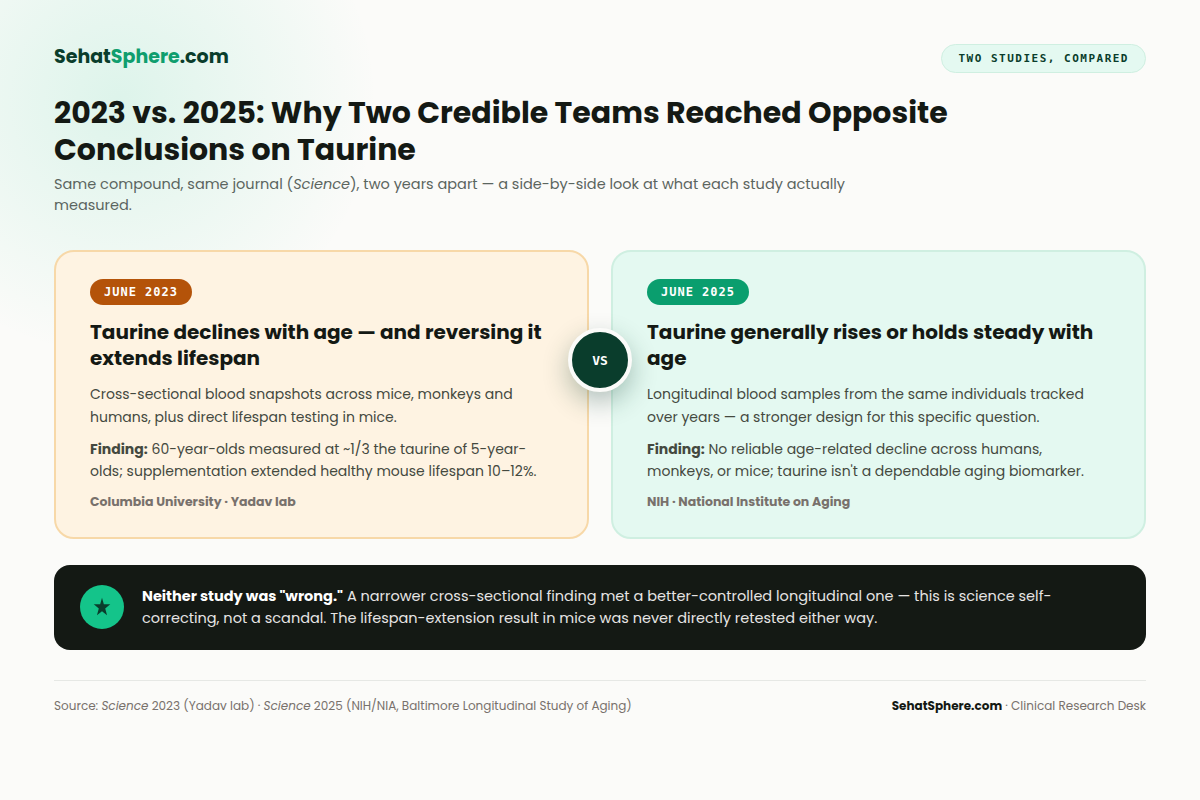
Same compound, same journal, two years apart — what each team actually measured, side by side.
The 2025 NIH researchers didn’t say taurine is useless — they said the reason everyone started taking it may have been built on an incomplete picture.
Why two credible teams reached opposite conclusions
This is the part most coverage skips, and it’s genuinely more useful than picking a side. The 2023 team measured taurine primarily through cross-sectional snapshots and a specific set of animal models, then tested supplementation directly in mice. The 2025 NIH team analyzed longitudinal blood samples across humans, monkeys, and mice using different reference ranges and a broader age-matched cohort — a methodologically stronger design for the specific claim of “taurine declines with age.”
It didn’t re-test the supplementation-extends-lifespan finding directly, though. This isn’t one study being “wrong” — it’s an earlier, narrower finding meeting a later, better-controlled one, which is exactly how science is supposed to self-correct. The mistake was the speed at which supplement marketing ran with the first version.
How taurine actually works inside your cells
Setting the aging debate aside, taurine’s basic cellular biology is well established and worth understanding on its own terms — because it’s this biology, not the longevity headline, that actually explains why medications interact with it at all.
Taurine helps regulate cell volume and ion balance, keeping potassium and magnesium inside cells while keeping sodium outside — a housekeeping role that indirectly affects how excitable tissue like neurons and heart muscle behaves [7]. In the liver, taurine conjugates with bile acids to form bile salts that support fat digestion, a role so essential that newborns rely on taurine almost exclusively for it before their own synthesis pathways mature — one reason taurine is added to virtually every infant formula on the market.
In heart muscle specifically, taurine helps regulate calcium release from the sarcoplasmic reticulum and modulates the sodium-calcium exchanger in cell membranes, producing measurable effects on how forcefully the heart contracts and how it responds to rhythm disturbances [7]. This is the same calcium-handling machinery several cardiovascular and antiarrhythmic medications are designed to influence, which is part of why the interaction list further down isn’t theoretical hand-waving. Taurine also has a genuine antioxidant role, neutralizing reactive aldehydes like malondialdehyde that accumulate as byproducts of oxidative stress.
One mechanism still being actively researched rather than settled: taurine appears to have partial agonist activity at GABA-A receptors, the same inhibitory neurotransmitter system several sedatives and anti-anxiety medications target. This doesn’t yet translate into a confirmed clinical interaction, but it’s a plausible reason some people report drowsiness — or, less often, the opposite — at high intake, and an area worth more human research before firm guidance is possible.
3. Where It’s Actually Hiding
Most people who’d never call themselves “taurine users” are taking a meaningful dose several times a week without realizing it:
Studies on taurine’s effects generally use 1.5–6 grams daily — meaning two energy drinks can already land in that studied range, unintentionally.
That ~1,000 mg figure isn’t a rough industry average either — it’s the standardized amount in a single 250 ml (8.4 fl oz) can under most major brands’ own published ingredient disclosures, meaning the “one can, one gram” rule of thumb holds up whether the can comes from a US shelf or an Indian one.
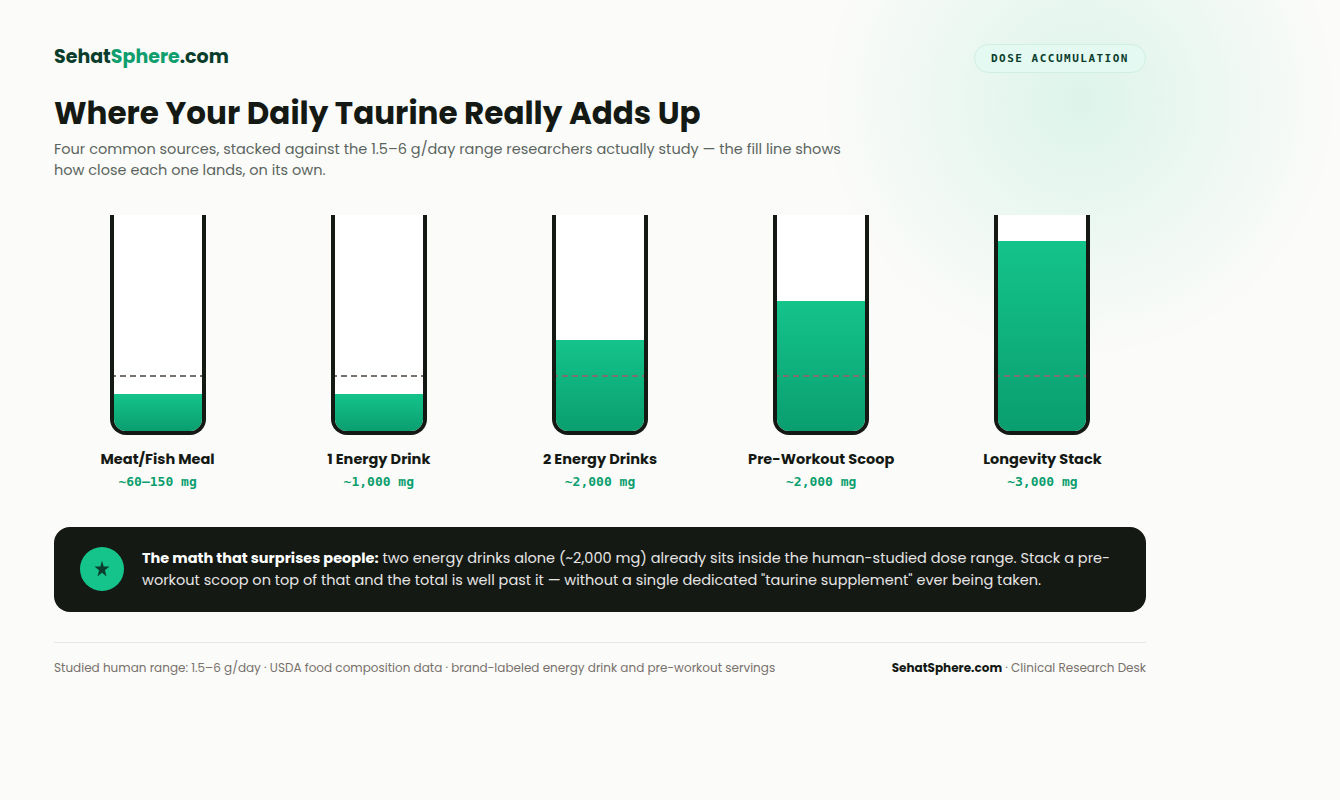
Two energy drinks alone already lands inside the human-studied dose range — before a single dedicated supplement is ever taken.
The FSSAI angle nobody writes about
Here’s something most taurine and your medications content — almost all of it written for a US audience — never mentions: India was among the first countries to formally regulate energy drinks as a category [6]. FSSAI doesn’t even let manufacturers call them “energy drinks” on the label — the official category is “caffeinated beverages,” specifically because the “energy” framing was considered misleading.
Caffeine is capped between 145 and 300 mg per litre, taurine and other amino acids must stay within prescribed per-serving limits, and every can is legally required to carry a warning against use by children, pregnant or breastfeeding women, and anyone caffeine-sensitive [6].
An Indian-market can is already somewhat more conservatively dosed than the “grab six and go” energy drink culture seen elsewhere — but the label warning exists precisely because FSSAI itself doesn’t consider these drinks risk-free, which is worth remembering the next time the can is marketed as basically a vitamin water with a kick.
4. Medications Worth Checking Against
Lithium (bipolar disorder)
This is the interaction I take most seriously. Taurine may slow the rate at which lithium clears from the body, which can raise circulating lithium levels over time — a moderate, monitoring-worthy interaction, not a reason for panic, but a real one [3]. Lithium has a notoriously narrow therapeutic window, so anything that nudges levels upward deserves a conversation with whoever manages that prescription.
Blood pressure medication (ACE inhibitors, beta-blockers, diuretics)
Taurine has shown a mild blood-pressure-lowering effect in several human studies — genuinely useful in some contexts, but combined with medication doing the same job, it can theoretically push blood pressure lower than intended, causing dizziness or lightheadedness [4].
Heart rhythm and cardiovascular medication
The Cleveland Clinic Journal of Medicine notes taurine has documented, if incompletely understood, effects on catecholamines like norepinephrine and epinephrine — the same signaling pathways several cardiovascular medications are designed to influence [5]. This is the same hormonal system covered in our Does Anger Raise Blood Pressure guide, and the reason chronic mental stress and taurine intake can end up pushing on the same physiological lever from different directions.
Interestingly, taurine is also studied therapeutically in congestive heart failure to support left ventricular function — a reminder that this is a genuinely bioactive compound, not an inert one.
Diabetes medications (metformin, DPP-4 inhibitors)
Unlike lithium and blood pressure medication, this one isn’t a caution — it’s a genuinely interesting research direction worth knowing about, with the right caveat attached. A 2025 study in Scientific Reports found that adding taurine alongside metformin and a DPP-4 inhibitor (sitagliptin) improved glucose and fatty-acid metabolism markers beyond what the two diabetes medications achieved on their own, and also improved liver fat accumulation on tissue analysis [8].
The catch: this was an 8-week study in diabetic mice, not people. It’s a legitimate, mechanistically plausible signal — not a reason to start stacking taurine onto a diabetes regimen expecting a human-equivalent effect, since no clinical trial has confirmed this translates to people yet. If you’re managing type 2 diabetes and curious about taurine, this is worth raising with your endocrinologist as an open research question, not adding on your own.
Managing more than one of these? The Integrative Interaction Checker, or the Medication + Lifestyle Checker, cross-checks a full list faster than piecing it together article by article. If your prescriber orders a lithium level check, our Blood Report Decoder can help you actually read what comes back. And since cardiovascular risk from stimulant-heavy habits is rising sharply in younger adults, our Heart Attack in Young Adults guide is worth a read if energy drinks are a daily fixture.
The realistic risk pattern isn’t a single supplement decision — it’s someone on lithium or blood pressure medication drinking two energy drinks a day for focus, never once connecting that habit to either prescription, because the can doesn’t read like a medication interaction.
5. Pregnancy & Breastfeeding
This is the one part of the taurine conversation with a genuine sex-specific angle, and it’s almost never addressed in the same breath as the longevity headlines.
Taurine is considered conditionally essential for infants specifically because a newborn’s own synthesis pathway isn’t mature enough to meet demand — which is exactly why taurine is added to virtually every infant formula on the market, and why breast milk naturally carries meaningful amounts of it.
That’s led some to assume more maternal taurine automatically means a better-developed baby. A 2023 analysis from the Seychelles Child Development Study measured taurine levels in both mothers and newborns’ cord blood, then tracked the children’s growth and cognitive development to 20 months — and found no meaningful association between higher taurine levels and better outcomes [9]. The likely explanation: this study population ate a lot of fish, so baseline taurine status was already high across the board, leaving no real shortfall for extra taurine to correct. It’s a useful, honest data point that mirrors the 2023-vs-2025 pattern from earlier in this guide — more of something isn’t automatically better once you’re not actually deficient in it.
The practical caution for pregnant or breastfeeding readers isn’t really about taurine in isolation — it’s about the product category it usually arrives in. Energy drinks combine taurine with concentrated caffeine, and FSSAI’s own mandatory warning label (covered above) already flags pregnant and breastfeeding women specifically, in line with most international health authorities’ general caffeine-in-pregnancy guidance. A plain taurine supplement without caffeine is a different, lower-concern question than an energy drink habit during pregnancy — but neither has been specifically studied for safety in pregnant or breastfeeding women, so both are worth a direct conversation with an obstetrician rather than a personal judgment call.
6. Your Daily Taurine Intake Calculator
A quick, educational way to see where taurine and your medications might actually overlap — not a clinical dosing tool.
7. Two Scenarios I See Often
Illustrative patterns from pharmacy-counter conversations, not published case reports.
A patient stable on lithium for years starts two daily energy drinks to manage work fatigue, entirely unrelated to any longevity interest. Months later, a routine lithium level runs higher than their usual baseline, and the prescribing psychiatrist works through diet, hydration, and kidney function before anyone thinks to ask about energy drinks specifically.
Someone on a beta-blocker for blood pressure adds a gram-level taurine supplement after seeing a longevity podcast clip, without connecting it to their existing prescription. They notice more dizziness standing up over the following week and assume it’s unrelated, rather than two blood-pressure-lowering inputs stacking on top of each other.
8. Myth vs. Fact
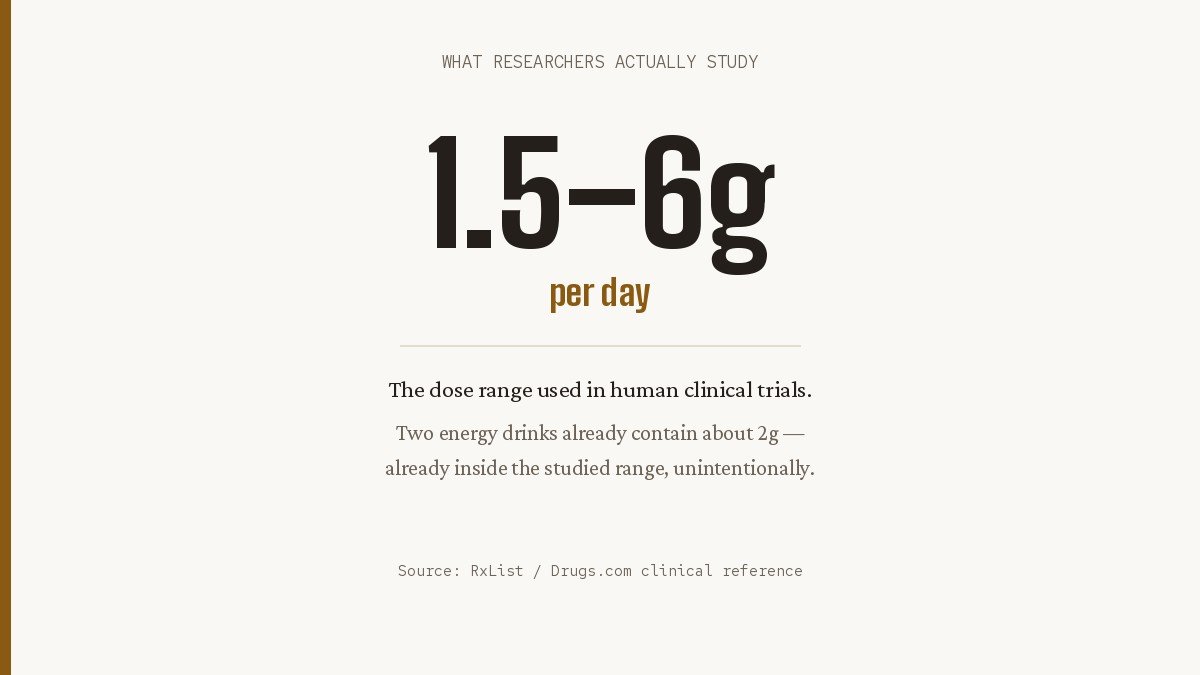
The range researchers actually study — and how quickly a couple of energy drinks lands inside it.
The 2023 study proved taurine reverses aging in humans.
The lifespan extension was shown in mice; the human-aging-biomarker premise was directly challenged by 2025 NIH research [2].
Energy drinks are just caffeine, so taurine doesn’t count.
A standard can carries roughly 1,000 mg of taurine — within the dose range used in human clinical studies.
Taurine has no known medication interactions.
It carries a documented, moderate interaction with lithium and a theoretical one with blood pressure medication.
Since the 2025 study, taurine is now considered useless.
It’s still studied therapeutically for heart failure support — the walk-back was about the aging-biomarker story, not the whole compound.
Taurine comes from bull semen or testicles, which is why it’s in “energy” drinks.
The name comes from Latin taurus (bull) because it was first isolated from ox bile in 1827 — commercial taurine today is synthetically manufactured, not bull-derived, and chemically identical either way.
9. A Safer-Use Checklist
If taurine — supplement or energy drink — is staying in the routine, here’s the realistic version of managing taurine and your medications together, without giving anything up entirely:
- Add up energy drinks and supplements together as one total taurine intake, not two separate habits.
- If you’re on lithium, tell your prescriber before making taurine a regular habit, and ask about level monitoring.
- If you’re on blood pressure medication, check your BP a few times in the first week of any new taurine habit.
- Start at the lower end of studied doses rather than stacking multiple sources at once.
- Don’t assume “more” replicates the debunked 2023 headline — the dose-response relationship in humans isn’t established.
- If fatigue is the real problem you’re solving for, the free Which Nutrient Deficiency Do You Have? tool is worth ten minutes before reaching for another can.
If taurine’s cardiovascular angle is part of why you’re interested, our Heart Rate Fluctuation and Blood Pressure Fluctuation guides cover the broader picture, and our Early Signs of a Weak Heart guide touches on the same left-ventricular function taurine is studied for clinically. For the full framework I use with every patient managing multiple medications, see the Complete Guide to Medicine Safety — and if timing or dosing mistakes are a recurring theme in your routine, our Medicine Mistakes guide covers the patterns I see most often.
If it’s actually longevity you’re chasing rather than an energy fix, general biological-age tracking measures something considerably more grounded than a single amino acid. Other adaptogen and “trending supplement” guides worth cross-referencing before you stack anything new: Ashwagandha, Moringa, Sauna, and Cold Plunge — several of which touch the same catecholamine pathway taurine does.
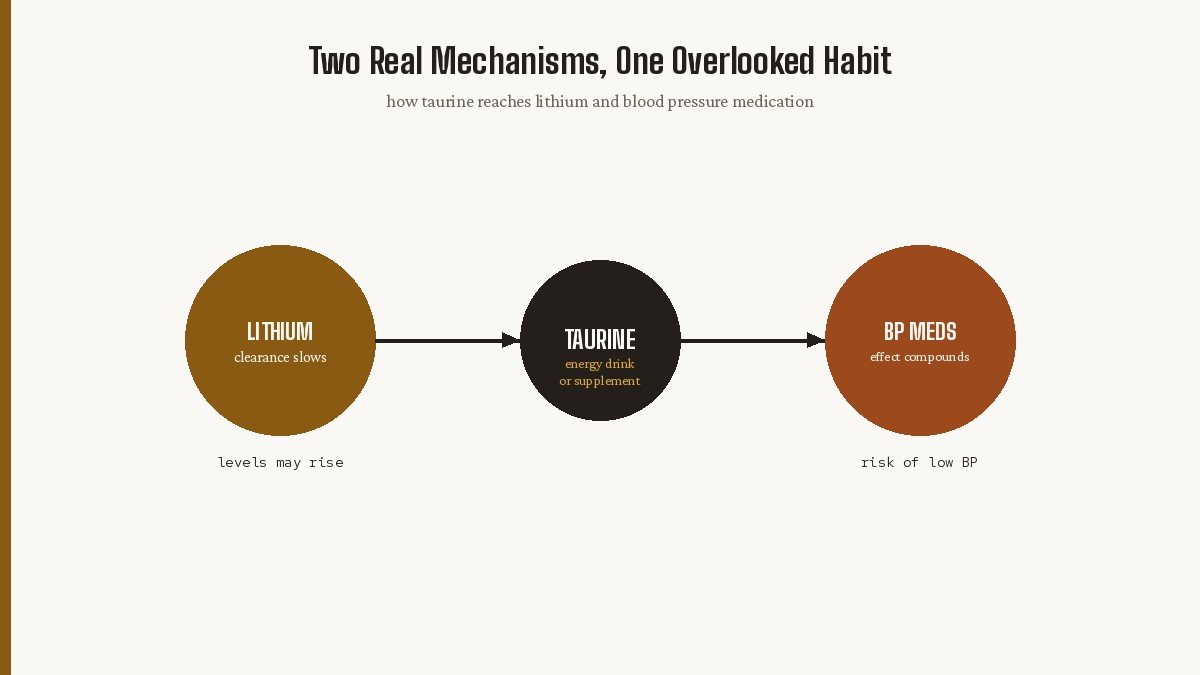
Two real, moderate mechanisms — not headline-worthy on their own, but worth knowing before your next energy drink.
10. Quick Glossary
Catecholamines
A group of hormones and neurotransmitters, including epinephrine and norepinephrine, involved in the body’s stress response and blood pressure regulation.
NAD+ / NMN
NAD+ is a coenzyme involved in energy production and DNA repair that declines with age; NMN is a supplement precursor some take to try to raise NAD+ levels, often alongside taurine in longevity stacks.
Therapeutic window
The range between a medication’s effective dose and its toxic dose. Lithium has a notably narrow one, which is why small level changes matter clinically.
Biomarker
A measurable substance in the body used to indicate a biological state — in this case, whether taurine levels reliably indicate biological aging, which the 2025 study questioned.
Conditionally essential
A nutrient the body can normally make on its own, but not always in sufficient amounts — such as during infancy, illness, or high physiological demand — meaning dietary or supplemental intake becomes necessary in those situations.
Sarcoplasmic reticulum
A specialized structure inside muscle cells (including heart muscle) that stores and releases calcium to trigger contraction — one of the sites where taurine has a measurable, documented effect.
Taurine isn’t the only trending “and your medications” story on this site — our Sea Moss, Glutathione, and Proffee guides cover different mechanisms entirely, each worth a look if you’re stacking more than one trending habit at once. Explore the rest of the Free Health Tools Library, or read more about our editorial process on About Us.
11. Quick Knowledge Check
Three questions to confirm the mechanisms above actually stuck — not a graded exam, just a gut check.
12. Frequently Asked Questions
What is taurine, exactly?
Taurine is a conditionally essential amino acid found naturally in meat and fish, and produced by the body from cysteine. It concentrates in the heart, brain, eyes, and muscles.
Did the 2023 study really show taurine extends lifespan?
A 2023 Science study led by Columbia University researchers found taurine levels declined with age in mice, monkeys, and humans, and that supplementation extended healthy lifespan in animals by roughly 10 to 12 percent.
What did the 2025 NIH study find?
Scientists at the National Institute on Aging analyzed blood samples across species and found taurine levels generally increased or stayed constant with age, contradicting the core premise of the 2023 study and concluding taurine is unlikely to be a reliable aging biomarker.
Does taurine in energy drinks count as a supplement dose?
Yes. A standard energy drink can contain around 1,000 mg of taurine, which is within the range studied in human trials, meaning regular energy drink consumption is effectively an unmonitored taurine supplement habit.
Can taurine interact with lithium?
Yes. Taurine may slow the rate at which lithium is cleared from the body, potentially raising lithium levels, which is a moderate, monitoring-worthy interaction for anyone on lithium for bipolar disorder.
Is taurine safe with blood pressure medication?
Use caution. Taurine has a mild blood-pressure-lowering effect in some studies, which combined with ACE inhibitors, beta-blockers, or diuretics could theoretically cause an excessive drop in blood pressure.
How much taurine is in a typical energy drink?
Most mainstream energy drinks list around 1,000 mg of taurine per standard can, though this varies by brand and can size.
Should I stop taking taurine supplements?
Not necessarily. Short-term use up to 3 to 6 grams daily is generally considered safe for most healthy adults. The bigger issue is unmonitored use alongside interacting medications, not taurine itself.
Is taurine used medically for anything?
Yes. Taurine has been studied clinically to support left ventricular function in patients with congestive heart failure, which is a different context from casual longevity supplementation.
What’s a safe way to try taurine if I’m on medication?
Disclose it to your prescriber, especially if you take lithium or blood pressure medication, start at a low dose, monitor blood pressure for the first week, and count energy drinks as part of your total taurine intake, not a separate category.
Is taurine safe during pregnancy or while breastfeeding?
Taurine itself is naturally present in breast milk and is added to infant formula, so it isn’t inherently dangerous. The real caution is the energy drink category it usually comes packaged in, since FSSAI and most health authorities advise pregnant and breastfeeding women against the caffeine those drinks also contain. A plain taurine supplement is a separate, lower-concern question best confirmed with an obstetrician.
Does taurine interact with diabetes medications like metformin?
No known risk interaction is documented. A 2025 mouse study actually found taurine improved glucose and fat metabolism when combined with metformin and a DPP-4 inhibitor, but this hasn’t been confirmed in human trials, so it isn’t a reason to self-add taurine to a diabetes regimen without medical guidance.
Is synthetic taurine different from the taurine naturally found in meat and fish?
No. Taurine used in supplements and energy drinks is manufactured synthetically, but it’s chemically identical to the taurine your body produces or gets from food — the “bull semen” rumor is a myth based on the compound’s 1827 discovery in ox bile, not its modern source.
Does taurine affect men and women differently?
There’s no strong evidence of a clinically meaningful difference between men and women for the interactions covered in this guide, such as with lithium or blood pressure medication. The one genuine sex-specific consideration is pregnancy and breastfeeding, covered separately above.
The Bottom Line
Taurine and your medications aren’t a dramatic warning story — they’re a reminder that a viral headline and a genuine, moderate interaction risk can exist at the same time, in the same can. The 2023 study wasn’t fabricated and the 2025 rebuttal wasn’t a hit piece; this is what real science looks like while it’s still working itself out. The practical takeaway is smaller than either headline: know your total taurine intake, and if lithium or blood pressure medication is part of your routine, that total is worth mentioning out loud.
Why Trust This Guide
- “Taurine deficiency as a driver of aging.” Science. science.org
- “Is the nutrient taurine really a key to healthy aging?” NBC News, covering NIH National Institute on Aging research. nbcnews.com
- “Taurine: Side Effects, Uses, Dosage, Interactions, Warnings.” RxList. rxlist.com
- “Taurine Side Effects: Safety Profile, Interactions, and What to Watch For.” Nutrientic. nutrientic.com
- Caine JJ, Geracioti TD. “Taurine, energy drinks, and neuroendocrine effects.” Cleveland Clinic Journal of Medicine. 2016;83(12):895-904. ccjm.org
- “FSSAI Standards for ‘Caffeinated Beverages’ like Energy Drinks.” Food Safety Mantra. foodsafetymantra.com
- Schaffer SW, Ito T, Azuma J. “Clinical significance of taurine.” Amino Acids. 2013;46(1):1–5. link.springer.com
- Xiao T, et al. “Taurine as a supplement for treating type II diabetes mellitus with metformin and DPP4 inhibitor.” Scientific Reports. 2025;15:18019. nature.com
- Beggan LA, et al. “Associations between serum taurine concentrations in mothers and neonates and children’s anthropometrics and early neurodevelopment.” NeuroToxicology. 2023;99:43–49. sciencedirect.com