 SehatSphere.com
Proffee and Your Medications: The Morning Habit With a Hidden Thyroid Problem
- Proffee stacks two independently-documented absorption blockers into one drink — coffee alone reduces levothyroxine absorption by roughly 27–36% compared to water, before any protein is even added.
- A 2021 systematic review of 63 studies confirmed coffee’s effect is real and separate from calcium’s effect — dairy-based whey protein adds a second, distinct absorption problem through the calcium it carries.
- If you take the SSRI fluvoxamine, proffee’s caffeine can take roughly 11 times longer to clear your system than usual — one of the most dramatic interactions in this guide, and one almost nobody on the medication is warned about.
- Ciprofloxacin — not levofloxacin — is the fluoroquinolone antibiotic that meaningfully slows caffeine clearance; the two are often lumped together, but they don’t behave the same way here.
- Coffee can cut iron absorption from a meal or supplement by as much as 66% in one study — genuinely relevant if you’re also managing anemia.
- Starting estrogen-containing birth control measurably slows caffeine clearance too (half-life 5.4 → 7.9 hours in one trial) — part of why the same cup can hit differently after starting the pill.
- Pregnant readers get a real, numbers-based limit: ACOG considers under 200 mg of caffeine a day moderate — a large proffee habit can approach that on its own.
- None of this is a case against proffee — a 60-minute buffer around thyroid medication resolves almost every interaction covered here.
- 1. What Proffee Actually Is
- 2. The Double Absorption Problem
- 3. Iron, Anemia & Your Morning Cup
- 4. Other Medications to Check
- 5. Pregnancy & Breastfeeding
- 6. Two Scenarios I See Often
- 7. Myth vs. Fact
- 8. A Safer Timing Checklist
- 9. The Caffeine-Insulin Paradox
- 10. Your Daily Caffeine Tally
- 11. Quick Glossary
- 12. Quick Knowledge Check
- 13. FAQs
- 14. References
1. What Proffee Actually Is
Proffee — protein coffee — is coffee blended with a protein source, most commonly whey, milk protein, or a plant-based powder, sometimes with added collagen or creamer. The appeal is straightforward: one drink that handles caffeine and a meaningful chunk of daily protein at once, which is exactly why it’s become one of 2026’s fastest-growing beverage categories, with coffee chains now building entire menu sections around it. What most of that coverage skips is the actual clinical question this guide answers: how proffee and your medications interact once caffeine, dairy protein, and whatever you’re prescribed all land in the same 30-minute window.

The trend everyone’s morning routine has absorbed — including, quietly, your medication’s actual absorption.
Nutritionally, that convenience is real. Pharmacologically, it also means your morning cup went from “just caffeine” to “caffeine plus a concentrated protein-and-often-calcium load” — two separate variables now interacting with whatever you took, or are about to take, with breakfast. Proffee and your medications intersect most often, and most seriously, around one enormous overlap in daily life: morning thyroid medication, taken by a huge share of adults, almost always within the same 30-minute window as their first cup of coffee.
This isn’t a case against proffee. It’s the conversation I’d actually have with a patient who mentioned it in passing — because for nearly everything covered below, the fix is timing, not giving anything up.
2. The Double Absorption Problem
Here’s the part that rarely gets connected in one place, with actual numbers attached instead of a vague “keep them apart” warning.
The coffee half, measured directly
A controlled study measured serum levothyroxine (T4) levels after the same dose was taken with water versus with coffee. Coffee reduced the average T4 rise by 27–36% and cut the area under the concentration curve by a comparable margin, while also delaying the time to peak absorption by roughly 38–43 minutes [1]. This wasn’t a trace effect or a statistical footnote — it’s a documented, clinically meaningful reduction, caused by coffee compounds binding directly to levothyroxine in the gut before it can be absorbed, the same adsorption mechanism seen with dietary fiber and bran (which the same research found to be an even stronger interferer than coffee).
The protein half, a separate mechanism entirely
Separately, a published clinical case documented impaired thyroxine absorption in a hypothyroid patient linked directly to an over-the-counter whey protein supplement [2]. The likely culprit isn’t the protein itself but the calcium that rides along with it — dairy-based whey and many fortified plant proteins carry meaningful calcium, and calcium is independently confirmed to form an insoluble complex with levothyroxine at the acidic pH found in the stomach, which is why pharmacy guidance recommends separating levothyroxine from calcium sources specifically by at least 4 hours, not just the standard 60 minutes used for food generally [3].
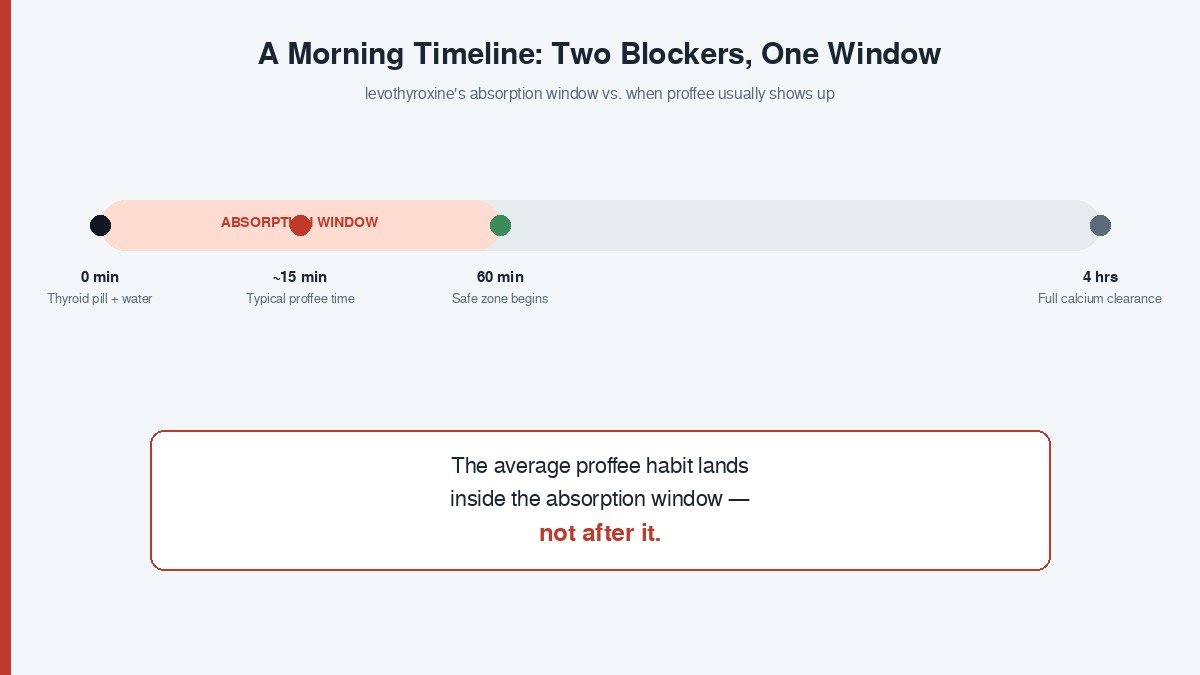
Two independently-confirmed absorption blockers, stacked into a single morning drink.
What the big-picture review confirms
A 2021 systematic review pulling together 63 studies on levothyroxine’s interactions with food and supplements confirmed both mechanisms are real and additive, not overlapping versions of the same effect — coffee interferes through direct binding, calcium interferes through complex formation, and taking them together (as proffee does, by design) doesn’t cancel either effect out [4].
Most people already know, vaguely, to keep their thyroid pill away from food. Almost nobody realizes the coffee itself was already working against that pill — before any protein was added to it.
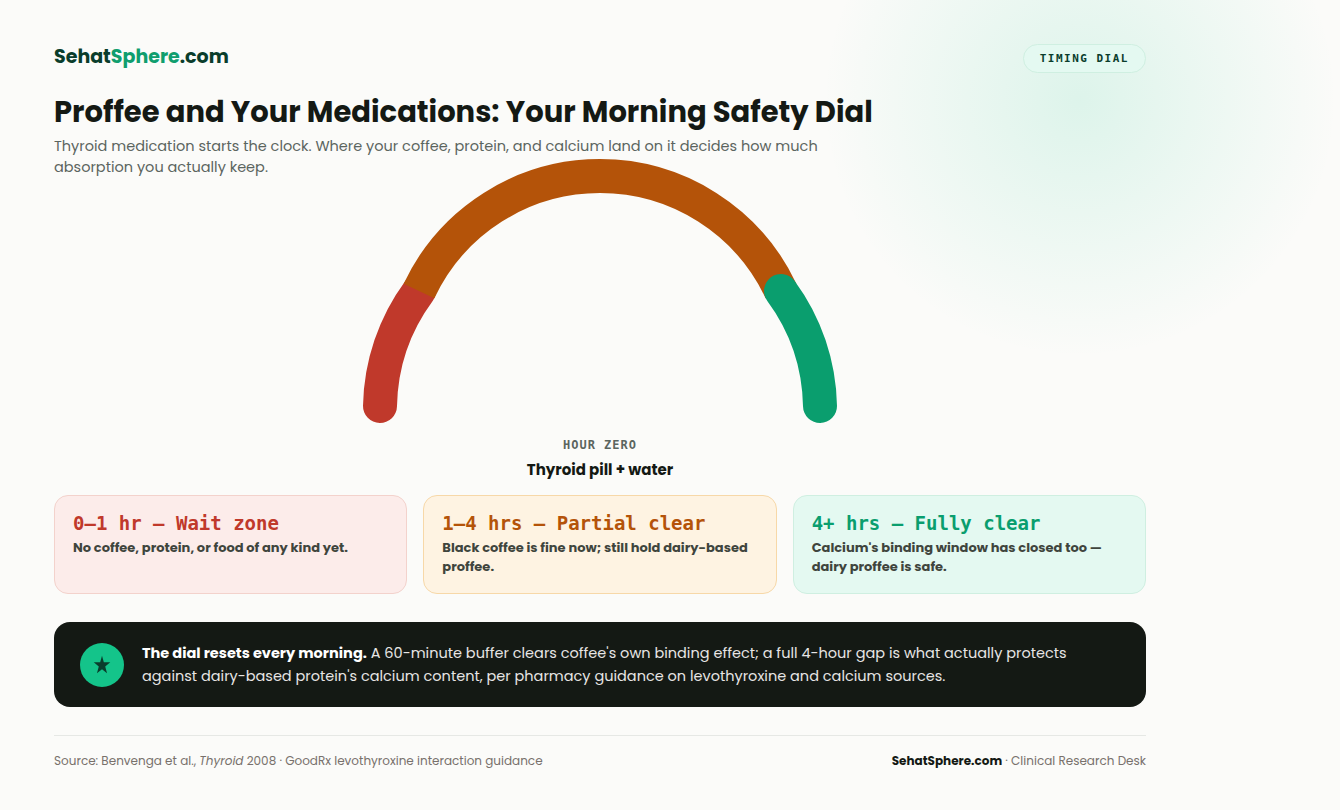
The whole day’s timing problem, on one dial — thyroid medication first, everything else at least 60 minutes behind it.
Put together: proffee isn’t introducing one new interaction risk, it’s stacking two already-documented ones — coffee’s direct-binding effect and protein’s calcium-driven effect — into a single drink, consumed at exactly the moment most people are also reaching for their thyroid medication.
3. Iron, Anemia & Your Morning Cup
This one rarely makes it into proffee coverage at all, but it’s arguably more relevant day-to-day than the thyroid interaction for anyone managing borderline iron levels — a genuinely common overlap, since hypothyroidism and iron-deficiency anemia frequently show up in the same patients.
Coffee and tea both contain polyphenols — tannins and chlorogenic acid among them — that bind non-heme iron (the plant-based form found in lentils, spinach, fortified cereals, and most iron supplements) in the gut and block its absorption. A controlled human study found iron absorption dropped by as much as 66% when an iron dose was taken alongside coffee, compared to water [5]. Non-heme iron already absorbs poorly on its own — roughly 17% under good conditions, versus about 25% for heme iron from meat and fish — so a 66% cut on top of that baseline is a meaningful loss, not a rounding error.
The general guidance is to separate coffee or tea from iron-rich meals and iron supplements by at least an hour where possible. Evidence here is genuinely mixed — some newer research suggests the effect is smaller with modern coffee-brewing methods and driven more by polyphenol content than caffeine itself — so this isn’t a reason to panic about a single cup, but it is a reasonable habit to build if a blood test has already flagged low iron or you’re on iron replacement therapy.
If fatigue, hair thinning, or brain fog is what sent you looking into proffee and your medications in the first place, our Iron Deficiency Anemia guide is worth reading before assuming more caffeine and protein is the fix rather than the thing quietly working against a fix already in progress.
4. Other Medications Worth Checking Against
Quinolone antibiotics — but specifically ciprofloxacin
This gets oversimplified a lot, so it’s worth being precise. Caffeine is cleared from the body almost entirely by one liver enzyme, CYP1A2, and certain fluoroquinolone antibiotics inhibit that same enzyme, slowing caffeine breakdown and letting it build up in the blood. But not all fluoroquinolones do this equally: laboratory testing of six fluoroquinolones found ciprofloxacin to be a real, if modest, CYP1A2 inhibitor, while levofloxacin showed essentially no meaningful inhibition of the same enzyme [6]. The two get grouped together constantly in casual health content, but if you’re on levofloxacin specifically, the caffeine-clearance concern that applies to ciprofloxacin doesn’t carry over the same way.
Tetracycline antibiotics (doxycycline)
If your proffee is dairy-based, the same calcium-complex mechanism affecting levothyroxine also reduces absorption of tetracycline-class antibiotics — a separate window from your antibiotic dose is worth keeping, the same way you would for a calcium supplement.
SSRIs, especially fluvoxamine
This is the single most dramatic interaction in this guide, and it’s almost never mentioned anywhere proffee is discussed. Fluvoxamine — an SSRI prescribed for OCD, anxiety, and depression — is one of the most potent CYP1A2 inhibitors used in medicine. In a controlled pharmacokinetic study, fluvoxamine reduced caffeine’s clearance from roughly 105 to 9.1 mL/min per kg — about an 11-fold drop — and extended caffeine’s elimination half-life from 4.9 hours to 55.9 hours [7]. That’s caffeine from a single cup still meaningfully present in the bloodstream more than two days later.
The same single-dose study didn’t detect a corresponding jump in subjective stimulant effects like jitteriness, which is a genuinely honest and important caveat — this wasn’t shown to make one cup feel dramatically stronger in the short term. But a repeated daily proffee habit against clearance slowed that dramatically is a different scenario than the single-dose test measured, and it’s exactly the kind of thing worth naming out loud to whoever prescribes fluvoxamine rather than assuming a lack of immediate jitters means there’s nothing to discuss.
Estrogen-containing birth control
This one has real numbers behind it too. A controlled study found that women on low-dose estrogen-containing oral contraceptives cleared caffeine markedly slower than non-users — half-life extended from 5.4 to 7.9 hours, with plasma clearance reduced by roughly 40% [8]. In practice, that means the same proffee habit that felt manageable before starting the pill can genuinely start to feel different — not because the drink changed, but because the body processing it did.
The broader mechanism tying all of this together
Fluvoxamine, ciprofloxacin, and estrogen-containing birth control are pharmacologically unrelated drugs used for entirely different conditions — but they show up in the same conversation because all three slow the same CYP1A2 enzyme that clears caffeine, just to wildly different degrees (roughly 11-fold for fluvoxamine, modest for ciprofloxacin, about 1.5-fold for birth control). Coffee itself also raises stomach pH and can form absorption-blocking complexes with a range of other medications, which is part of why so many seemingly unrelated drug classes show up on coffee-interaction lists in the first place [9].
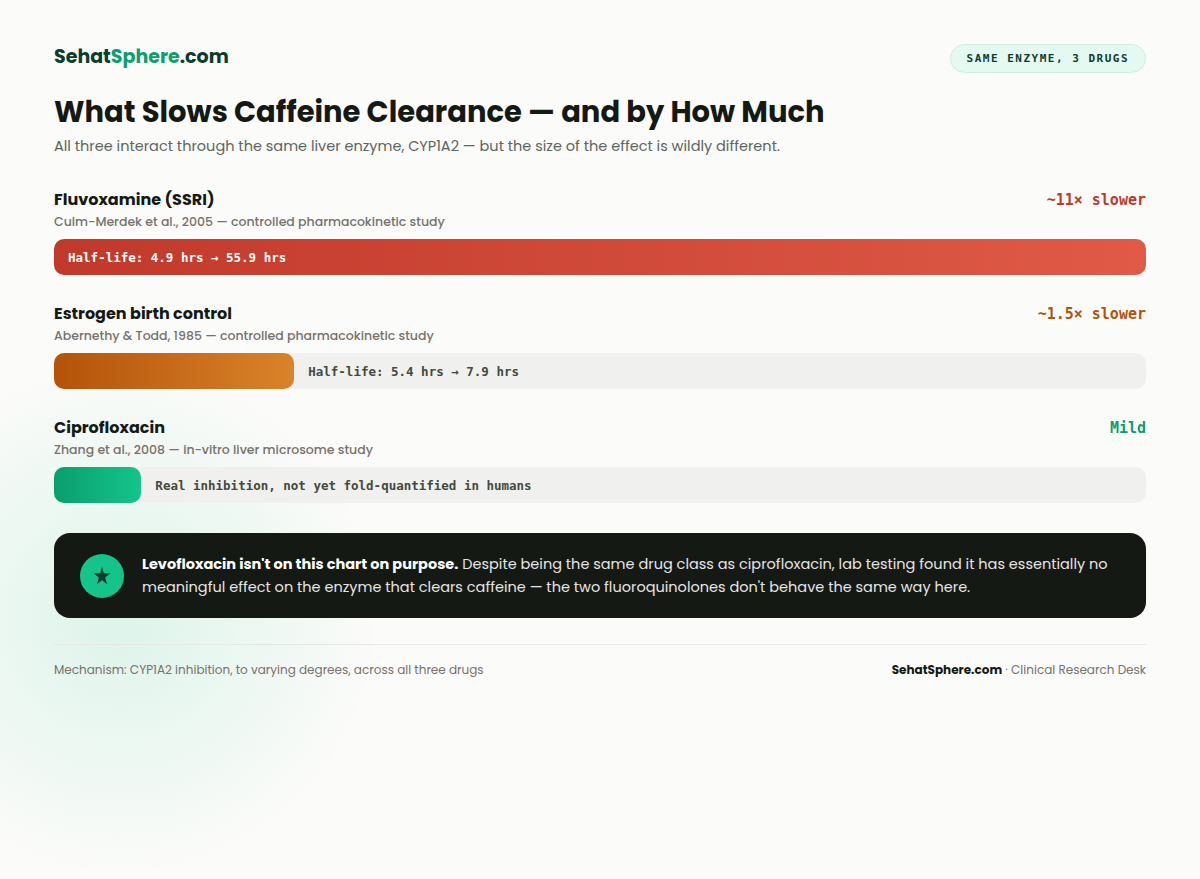
Same enzyme, three completely different medications, three very different sizes of effect.
General caffeine ceiling
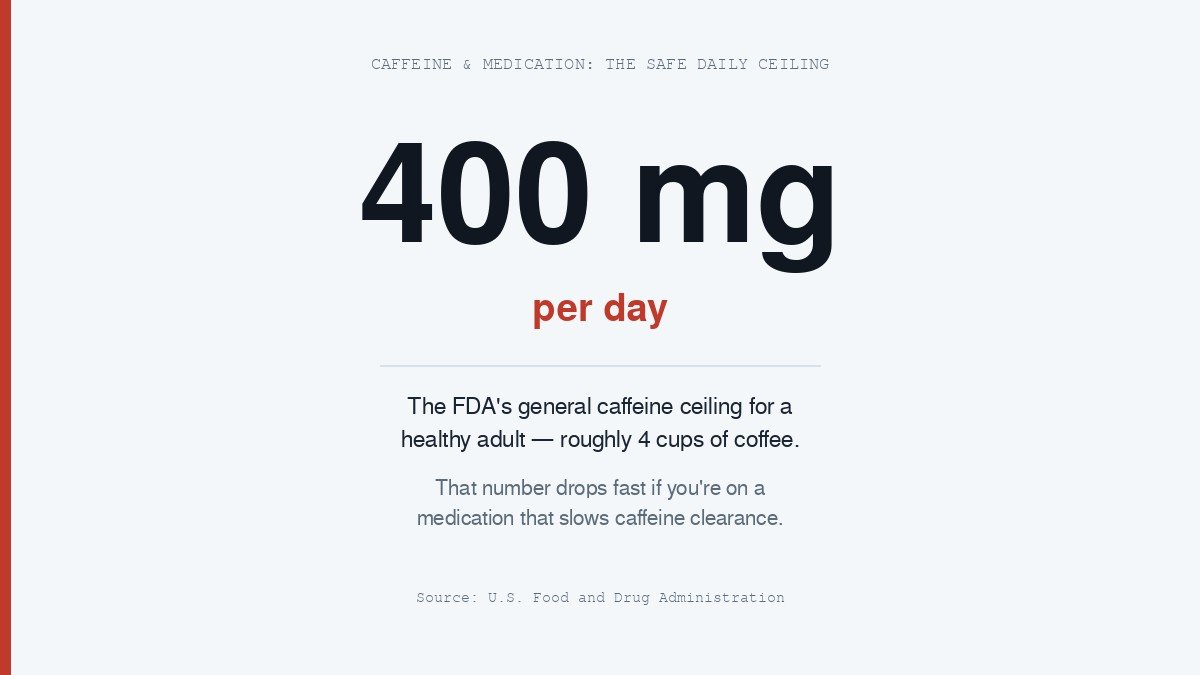
The FDA considers up to 400 mg of caffeine daily — roughly four cups of brewed coffee — generally safe for a healthy adult [10]. A large proffee habit stacked on top of other caffeine sources can approach that ceiling faster than people expect, especially before factoring in any medication above that slows how quickly caffeine actually leaves the body.
Managing more than one of these at once? The Integrative Interaction Checker is built to cross-check a full medication list faster than piecing it together from separate articles. If you’re already tracking an unusually fast or irregular resting heart rate, our Heart Rate Fluctuation guide covers what’s normal, and since cardiovascular risk from stimulant-heavy habits is rising sharply in younger adults, our Heart Attack in Young Adults guide is worth a read if proffee is a daily fixture.
The realistic failure mode here isn’t dramatic — it’s a slowly rising TSH over months attributed to “my thyroid medication just isn’t working as well anymore,” or unexplained jitteriness on a new prescription that never gets connected to the same daily habit sitting 20 minutes away from the pill instead of 60.
5. Pregnancy & Breastfeeding
Protein needs actually go up during pregnancy, so the protein half of proffee isn’t the concern here — the caffeine half is, and it comes with an actual published number rather than a vague “cut back” suggestion.
The American College of Obstetricians and Gynecologists considers caffeine intake under 200 mg per day to be moderate and not a major contributing factor to miscarriage or preterm birth, while noting that evidence at higher intakes remains less clear [11]. A single proffee made with a double shot or a large drip coffee can already land close to that number on its own, before counting tea, chocolate, or a second cup — which makes “just one proffee a day” a genuinely different guideline than “unlimited proffee, since it’s just coffee.”
Breastfeeding adds a separate wrinkle worth knowing: a newborn’s liver hasn’t yet developed the enzymes to clear caffeine efficiently, and caffeine’s half-life in a newborn or preterm infant can run as long as 120 hours, compared to roughly 3–7 hours in an adult — improving to around 14 hours by 3–5 months of age as the relevant enzyme systems mature [12]. Caffeine does cross into breast milk in small amounts, so a slow-clearing infant can end up with more sustained exposure from the same maternal cup than the “small amount” framing usually implies.
This isn’t a reason to eliminate proffee while breastfeeding, but it is a reason to keep total daily caffeine moderate and to watch for unusual fussiness or disrupted sleep in a very young infant rather than assuming amount consumed by the mother is the only variable that matters. The proffee-and-your-medications overlap here is really a proffee-and-your-baby’s-medications-metabolism overlap — worth mentioning to your pediatrician if you’re a heavy proffee drinker.
6. Two Scenarios I See Often
Illustrative patterns from pharmacy-counter conversations, not published case reports.
A patient on a stable levothyroxine dose for years starts a daily proffee habit as part of a new fitness routine, taken about 15 minutes after their thyroid pill “to save time.” Three months later, a routine TSH comes back elevated, and the instinctive assumption is that their dose needs increasing — when the more likely explanation is sitting in their tumbler.
Someone starts a short course of ciprofloxacin for a urinary tract infection and keeps their usual two-proffee-a-day habit without adjustment. They spend the week unusually jittery and can’t sleep, without connecting it to the antibiotic slowing their normal caffeine clearance.
A patient recently started on fluvoxamine for anxiety keeps their long-standing single morning proffee unchanged, since one cup never bothered them before. A week in, they notice they feel wired well into the evening — not from that morning’s cup specifically, but from several days of caffeine accumulating faster than an 11-fold slower clearance rate can clear it back out.
7. Myth vs. Fact
If I take my pill with water, coffee later doesn’t matter.
The separation window matters as much as the water — coffee 15 minutes later still lands inside the absorption window the research flags as a problem.
Plant-based protein avoids the thyroid absorption issue entirely.
It avoids the dairy-calcium piece specifically, but not coffee’s own direct-binding effect — plant-based proffee removes one variable, not both.
Switching to decaf solves the levothyroxine problem.
The compounds thought to bind levothyroxine — chlorogenic and tannic acids — are still present in decaf, since they aren’t removed by decaffeination; this hasn’t been directly tested head-to-head, but the timing gap likely still matters either way.
Ciprofloxacin and levofloxacin carry the same caffeine risk since they’re both quinolones.
Lab testing found ciprofloxacin meaningfully inhibits the enzyme that clears caffeine, while levofloxacin showed essentially no such effect [6].
A little jitteriness on a new medication is just stress, not the coffee.
It can be either, which is exactly why it’s worth mentioning to your pharmacist rather than assuming — CYP1A2-mediated caffeine interactions are well-documented enough to ask about specifically.
8. A Safer Timing Checklist
If proffee is staying in the routine regardless — which, realistically, it usually is — here’s the version of proffee and your medications that actually protects both:
- Take thyroid medication first thing, with plain water only, before anything else touches your system.
- Wait at least 60 minutes before any coffee, protein, or food generally — and closer to 4 hours if your proffee is dairy-based or calcium-fortified.
- Separate iron-rich meals or iron supplements from proffee by roughly an hour if you’re managing anemia.
- During any ciprofloxacin course, or if you’re starting fluvoxamine, ask your pharmacist about caffeine timing specifically, not just food timing.
- If you’ve recently started estrogen-containing birth control and proffee suddenly feels stronger, that’s a real, documented pharmacokinetic shift — not just in your head.
- Track total daily caffeine against the FDA’s 400 mg general guidance (200 mg if pregnant), lower still if you’re on a medication that slows its clearance.
- If thyroid symptoms or antibiotic effectiveness feel off after starting the habit, mention the timing before assuming a dose change is needed.
Caffeine’s effect on heart rate compounds with several of the same medications already discussed — worth watching if you’re already tracking your resting pulse.
For the broader framework I use with every patient managing multiple medications, see the Complete Guide to Medicine Safety, and if you already have a recent thyroid or iron panel in hand, the Blood Report Decoder can help you actually read it. Other trending “and your medications” stacks worth cross-referencing before adding more than one new habit at once: Sea Moss and Glutathione.
9. The Caffeine-Insulin Paradox Worth Knowing
There’s a second layer here worth understanding if you’re managing blood sugar, and it’s genuinely counterintuitive. In the short term, caffeine acutely reduces insulin sensitivity and can raise glucose concentrations for roughly 100 to 180 minutes after consumption, an effect linked to a caffeine-driven rise in epinephrine [13]. Yet population studies consistently associate long-term habitual coffee drinking with better insulin sensitivity and lower type 2 diabetes risk, and a 24-week randomized trial found no worsening of insulin resistance with sustained coffee intake [14].
Practically, this means a fasting glucose check — or a continuous glucose monitor reading — taken shortly after your morning proffee may run higher than your actual baseline, not because your control has worsened, but because of a temporary, well-documented caffeine effect. If you’re on diabetes medication, or you use a CGM and have noticed a repeatable post-proffee bump, our CGM and Medication guide covers how to tell a real trend from a caffeine-timing artifact before adjusting anything based on one reading.
The protein side works somewhat in the opposite direction: added protein alongside caffeine tends to blunt rapid glucose swings and supports satiety, which is part of why the format is popular with people managing weight or blood sugar in the first place. Neither effect cancels the other out completely — they’re just both real, and worth knowing rather than assuming only one direction applies.
10. Your Daily Caffeine Tally
A quick, educational way to see where your total caffeine intake actually lands — not a clinical dosing tool.
11. Quick Glossary
CYP1A2
A liver enzyme responsible for metabolizing caffeine and several medications. Drugs that inhibit it — like fluvoxamine and, to a lesser extent, ciprofloxacin — slow caffeine clearance and can raise its levels in the blood.
AUC (Area Under the Curve)
A measure of total drug exposure over time, used in absorption studies. A lower AUC after taking levothyroxine with coffee means less of the drug actually made it into the bloodstream.
Non-heme iron
The form of iron found in plants, fortified foods, and most supplements. It absorbs less efficiently than heme iron from meat and fish, and is more sensitive to inhibitors like coffee’s polyphenols.
Half-life
The time it takes for half of a substance to clear the body. Caffeine’s half-life is normally 3–7 hours in adults, but can extend dramatically with certain medications or in newborns.
Proffee isn’t the only trending “and your medications” story on this site — our Sea Moss and Glutathione guides cover entirely different mechanisms, each worth a look if you’re stacking more than one trending habit at once. Explore the rest of the Free Health Tools Library, or read more about our editorial process on About Us.
12. Quick Knowledge Check
Five questions to confirm the mechanisms above actually stuck — not a graded exam, just a gut check.
13. Frequently Asked Questions
What is proffee, exactly?
Proffee, short for protein coffee, is coffee blended with a protein source — usually whey, milk, or plant-based protein powder — consumed as a combined caffeine-and-protein morning drink.
Does coffee alone affect thyroid medication?
Yes. A controlled study found coffee reduced levothyroxine absorption by 27 to 36% compared to water, and a systematic review of 63 studies confirmed the effect is real and separate from any protein or calcium added to it.
Does whey protein interfere with thyroid medication too?
Yes, through a different mechanism. A published clinical case documented impaired thyroxine absorption in a hypothyroid patient linked to an over-the-counter whey protein supplement, most likely via the calcium it contains, which is known to bind levothyroxine directly.
How long should I wait between levothyroxine and proffee?
Standard guidance is to separate levothyroxine from coffee and food generally by at least 60 minutes, and from calcium sources specifically — including dairy-based protein — by closer to 4 hours.
Does proffee interact with antibiotics?
It can, depending on the specific antibiotic. Ciprofloxacin measurably inhibits the enzyme that clears caffeine, while levofloxacin does not show the same effect despite being in the same drug class. Dairy-based protein can also reduce absorption of tetracyclines like doxycycline through calcium binding.
Does proffee interact with antidepressants?
It can, most notably with fluvoxamine, an SSRI that is one of the strongest known inhibitors of the enzyme that clears caffeine — slowing clearance roughly 11-fold in one study. This is worth mentioning to your prescriber if proffee is a daily habit.
Is proffee safe with birth control pills?
Generally yes, but estrogen-containing birth control measurably slows caffeine clearance (half-life extended from about 5.4 to 7.9 hours in one study), meaning the same cup of proffee can hit harder and last longer than it did before starting the pill.
Does coffee affect iron absorption?
Yes. Coffee and tea contain polyphenols that bind non-heme iron in the gut, and one study found iron absorption dropped by as much as 66% when taken alongside coffee. Separating iron-rich meals or supplements from coffee by about an hour is a reasonable precaution if you’re managing anemia.
How much caffeine is considered safe daily?
The FDA considers up to 400 mg of caffeine a day, roughly four cups of brewed coffee, generally safe for a healthy adult, though this drops to under 200 mg during pregnancy and lower still for anyone on a medication that slows caffeine clearance.
Is proffee safe during pregnancy or while breastfeeding?
A moderate amount is generally considered acceptable — ACOG puts the threshold at under 200 mg of caffeine daily during pregnancy. While breastfeeding, a newborn’s much slower caffeine clearance (a half-life of up to 120 hours versus 3 to 7 hours in adults) means it’s worth keeping total daily caffeine moderate rather than assuming small amounts have no cumulative effect on the infant.
Does decaf coffee solve the thyroid medication problem?
Probably not entirely. The compounds thought to interfere with levothyroxine absorption — chlorogenic and tannic acids — aren’t removed by decaffeination, so the timing separation likely still matters even with decaf, though this hasn’t been directly studied head-to-head.
Should I stop drinking proffee if I’m on medication?
Usually not entirely — timing is the fix in most cases, not elimination. The main exceptions are active use of an interacting antibiotic, a new fluvoxamine prescription, or if your thyroid levels or iron status are already unstable.
Can proffee affect my blood sugar readings?
Yes, temporarily. Caffeine can acutely reduce insulin sensitivity and raise glucose for 100 to 180 minutes after consumption, which can show up as an unexpected bump on a fasting glucose test or CGM reading shortly after your morning cup, separate from your actual overall control.
What’s the safest way to fit proffee into a medication routine?
Take thyroid medication first thing with plain water, wait at least 60 minutes (longer for dairy-based proffee), separate it from iron supplements by about an hour, and check antibiotic- or antidepressant-specific caffeine guidance during any new prescription.
The Bottom Line
Proffee and your medications aren’t fundamentally incompatible — this is one of the more genuinely fixable interaction categories covered on this site, because the solution is almost entirely a timing adjustment rather than giving anything up. The part worth internalizing is that this wasn’t a new risk the trend created from scratch; it stacked several already-documented absorption and clearance problems — thyroid medication, iron, certain antibiotics, one specific SSRI, and birth control — into a single daily habit, which is exactly the kind of thing that’s easy to miss until a lab result or a prescription starts behaving strangely.
Why Trust This Guide
- Benvenga S, Bartolone L, Pappalardo MA, et al. “Altered Intestinal Absorption of L-Thyroxine Caused by Coffee.” Thyroid. 2008;18(3):293–301. liebertpub.com
- “Over-the-counter protein supplement resulting in impaired thyroxine absorption in a hypothyroid patient.” Endocrinology, Diabetes & Metabolism Case Reports. 2021. bioscientifica.com
- “Levothyroxine Interactions: Drugs, Diet, & More.” GoodRx. goodrx.com
- Wiesner A, Gajewska D, Paśko P. “Levothyroxine Interactions with Food and Dietary Supplements – A Systematic Review.” Pharmaceuticals. 2021;14(3):206. pmc.ncbi.nlm.nih.gov
- Hurrell RF, Reddy M, Cook JD. “Inhibition of non-haem iron absorption in man by polyphenolic-containing beverages.” British Journal of Nutrition. 1999;81(4):289–295. pubmed.ncbi.nlm.nih.gov
- Zhang L, Wei M, Zhao C, Qi H. “Determination of the inhibitory potential of 6 fluoroquinolones on CYP1A2 and CYP2C9 in human liver microsomes.” Acta Pharmacologica Sinica. 2008;29(12):1507–1514. nature.com
- Culm-Merdek KE, von Moltke LL, Harmatz JS, Greenblatt DJ. “Fluvoxamine impairs single-dose caffeine clearance without altering caffeine pharmacodynamics.” British Journal of Clinical Pharmacology. 2005;60(5):486–493. onlinelibrary.wiley.com
- Abernethy DR, Todd EL. “Impairment of caffeine clearance by chronic use of low-dose oestrogen-containing oral contraceptives.” European Journal of Clinical Pharmacology. 1985;28(4):425–428. link.springer.com
- “Coffee and medicine: Can it cause drug interactions?” Medical News Today. medicalnewstoday.com
- “What to know about antibiotics and caffeine.” Optum Perks, medically reviewed by Alex Nguyen, PharmD, RPh. perks.optum.com
- “Modulatory Effects of Caffeine and Pentoxifylline on Aromatic Antibiotics: A Role for Hetero-Complex Formation.” Molecules. 2021;26(12):3628. pmc.ncbi.nlm.nih.gov
- ACOG Committee Opinion No. 462. “Moderate Caffeine Consumption During Pregnancy.” American College of Obstetricians and Gynecologists. acog.org
- “Breastfeeding, Caffeine, and Energy Drinks.” InfantRisk Center, Texas Tech University Health Sciences Center. infantrisk.com
- “The acute effects of coffee consumption on blood glucose and its relationship with serum cortisol and insulin in females.” ScienceDirect. sciencedirect.com
- “The effect of coffee consumption on insulin sensitivity and other biological risk factors for type 2 diabetes: a randomized placebo-controlled trial.” ScienceDirect. sciencedirect.com