
 SehatSphere
Medication Safety · Deep Dive
Berberine and Your Medications
“Nature’s Ozempic” can quietly make your pain medication stop working
Berberine and your medications is a combination covered by dozens of nearly identical pharmacy blog posts, all repeating the same handful of warnings — diabetes medications, blood thinners, immunosuppressants. What’s almost never mentioned is a completely different kind of risk: berberine can silently make certain pain medications less effective, not more dangerous. That inversion is exactly why it gets missed.
Jump to: The codeine and tramadol problem · Diabetes medications · Transplant medications · Full interaction table · Test yourself · FAQ
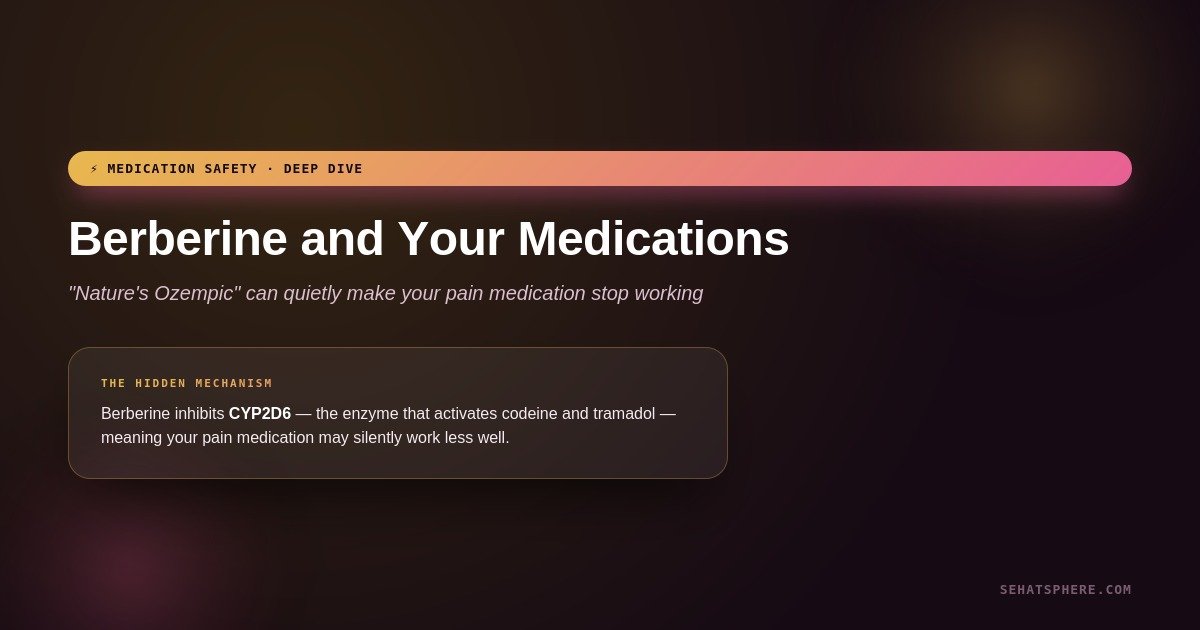
Quick answer: Berberine and your medications interact through several real, well-documented mechanisms. The one almost nobody covers: berberine inhibits the CYP2D6 enzyme that converts codeine and tramadol into their active pain-relieving form — meaning these medications can become quietly, silently less effective rather than triggering an obvious warning sign.[1] Separately, berberine’s real blood-sugar-lowering effect can compound with diabetes medication, and it has documented interactions with immunosuppressants used after organ transplants.[2]
Berberine and your medications: the codeine and tramadol problem
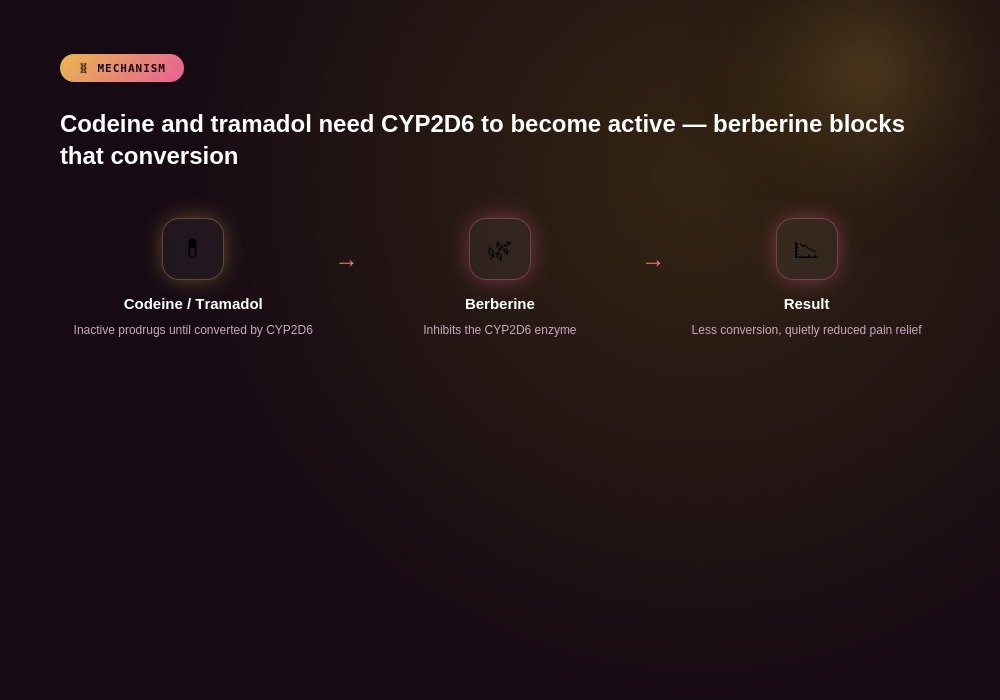
Here’s the mechanism almost every mainstream berberine article skips. Codeine and tramadol are both “prodrugs” — inactive on their own until an enzyme called CYP2D6 converts them into the active compounds that actually relieve pain.[1] Berberine has documented CYP2D6-inhibiting activity.[3] When that enzyme is suppressed, less of the prodrug gets converted, and the practical result is pain relief that quietly falls short — not a dramatic side effect, just medication that seems to stop working as well as it used to.
This is a genuinely different category of risk than most interaction warnings. Most of what gets discussed is “this combination is dangerous.” This one is “this combination might make you think your prescription needs a higher dose, when the real issue is a supplement quietly blocking its activation.” In my own counseling, this is exactly the kind of interaction patients never think to mention, because reduced pain control doesn’t feel like an obvious drug-interaction symptom — it feels like the pain is just worse.
Berberine and your medications: diabetes medications
To be fair to existing coverage, the diabetes-medication interaction is genuinely well documented and worth taking seriously. Clinical research has found berberine at 500mg three times daily produces blood-sugar-lowering effects broadly comparable to metformin.[2] That’s a real, clinically meaningful effect — and combined with an existing diabetes medication (metformin, a sulfonylurea, or insulin), it raises genuine hypoglycemia risk rather than just adding a mild extra nudge.[4] This part of the story is already covered extensively elsewhere; it’s included here for completeness, not because it’s the gap this guide is filling.
Berberine and your medications: transplant and immunosuppressant medications
Berberine has documented interactions with cyclosporine, an anti-rejection medication used after organ transplants, raising blood levels of the drug.[5] For anyone managing a transplant, medication levels are monitored within a narrow therapeutic window specifically because both too little and too much carry serious consequences — an unmonitored supplement shifting that level in either direction is a genuine, specific concern worth flagging to a transplant team directly, not just a general practitioner.
Berberine and your medications: full interaction table
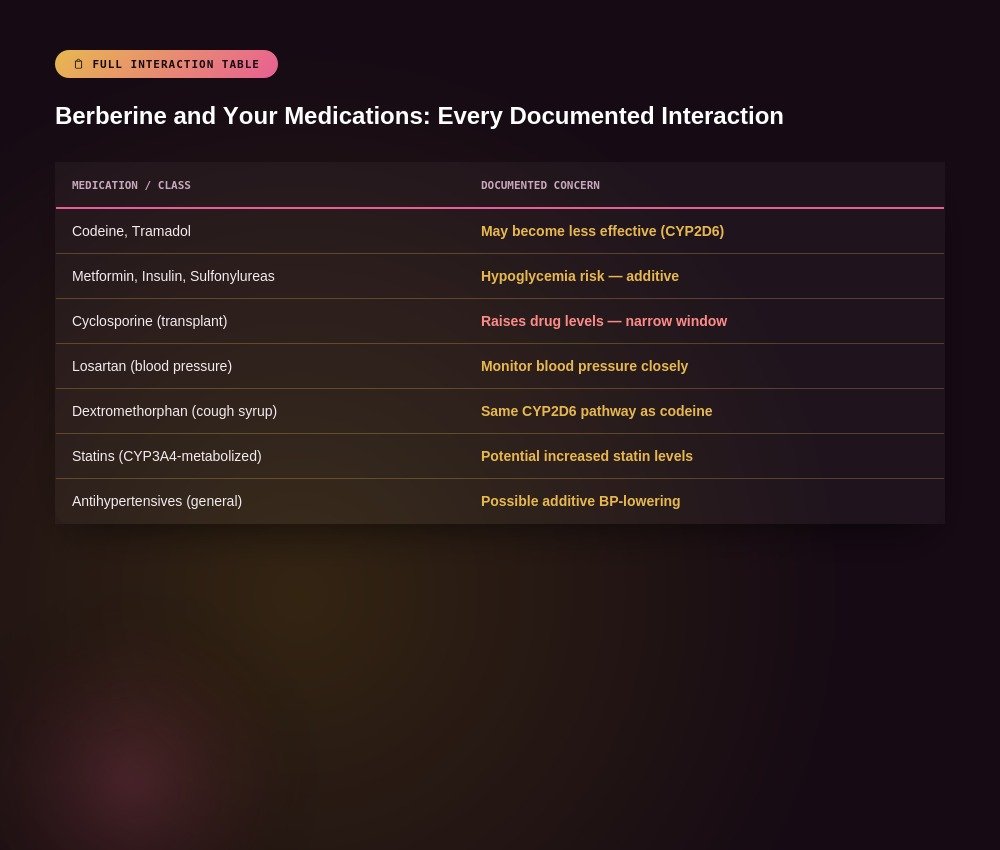
| Medication / Class | Documented Concern |
|---|---|
| Codeine, Tramadol | May become less effective — CYP2D6 inhibition |
| Metformin, Insulin, Sulfonylureas | Additive blood-sugar lowering — hypoglycemia risk |
| Cyclosporine (transplant) | Raises drug levels — narrow therapeutic window |
| Losartan (blood pressure) | CYP-mediated interaction, monitor blood pressure |
| Dextromethorphan (cough medicine) | Same CYP2D6 pathway as codeine |
| Statins (some, CYP3A4-metabolized) | Potential increased statin levels |
| Antihypertensives (general) | Possible additive blood-pressure-lowering effect |
Berberine and your medications: what the marketing gets wrong
“Nature’s Ozempic” is a comparison worth examining directly rather than dismissing outright. Ozempic and Wegovy are both semaglutide, a GLP-1 receptor agonist, FDA-labeled and dosed with precision for specific conditions.[6] Berberine is not a GLP-1 drug and doesn’t work through that mechanism at all — its blood-sugar effects come through AMPK activation and gut microbiota changes, a genuinely different pathway that happens to produce a partially overlapping outcome.[2] The comparison isn’t meaningless — the metformin-comparable glucose effect is real — but “nature’s Ozempic” implies a substitution relationship that the pharmacology doesn’t actually support.
Berberine and your medications: understanding CYP2D6 poor metabolizers
There’s a genuinely useful parallel here from pharmacogenomics that most berberine coverage never draws. Some people are born with naturally low CYP2D6 activity — a genetic trait called being a “poor metabolizer.” Clinical research has long established that poor metabolizers get significantly less pain relief from codeine specifically, because they can’t convert enough of it into its active form.[1] Berberine’s CYP2D6-inhibiting effect essentially creates a temporary, drug-induced version of that same poor-metabolizer state in someone who would otherwise convert codeine normally. This isn’t a rare, exotic mechanism — it’s the same well-studied pathway pharmacogenomic testing already screens for, just triggered by a supplement instead of genetics.
Berberine and your medications: the quality-control complication
Because berberine is regulated as a dietary supplement rather than a pharmaceutical, it isn’t required to undergo FDA pre-market safety and potency review the way prescription drugs are.[6] This matters specifically for the interactions discussed in this guide — a mislabeled or inconsistent dose makes it harder to predict how much CYP2D6 inhibition, or how much blood-sugar-lowering effect, a given product will actually produce. Third-party certification (USP or NSF seals) doesn’t prove clinical effectiveness, but it does meaningfully reduce the risk of a product containing more or less berberine than its label claims — a genuinely practical distinction when the interactions involved are dose-dependent.
Berberine and your medications: gastrointestinal side effects complicate the picture further
Independent of any medication interaction, berberine causes gastrointestinal side effects — diarrhea, constipation, abdominal discomfort — in roughly a third of people, especially when starting out.[2] This matters for the interaction picture too: GI upset can itself affect how well other oral medications are absorbed, adding a second, less-discussed layer to an already complex interaction profile. Starting at a lower dose than the standard three-times-daily regimen, and increasing gradually, is a reasonable way to reduce this risk while also giving your body — and your prescriber — more time to notice any medication-effectiveness changes before committing to a full dose.
Two scenarios worth reading
Scenario one: someone recovering from surgery on a standard tramadol prescription starts berberine the same week for general metabolic support, and finds their usual dose isn’t controlling pain the way it used to — assuming their pain has simply worsened, rather than connecting it to a supplement started the same week, and asking their doctor for a stronger prescription when the real fix would be pausing the berberine. Scenario two: someone on metformin for type 2 diabetes adds berberine specifically because of “nature’s Ozempic” branding, without adjusting their metformin dose or increasing blood sugar monitoring — and experiences unexplained dizziness and shakiness weeks later that takes some detective work to trace back to the combination.
Berberine and your medications: a closer look at the losartan and statin interactions
Beyond the headline codeine finding, several other documented interactions deserve more than a passing mention. Losartan, a widely prescribed blood pressure medication, is metabolized through pathways that berberine can influence, meaning combined use warrants closer blood pressure monitoring rather than assuming the two simply coexist neutrally.[5] Certain statins metabolized through CYP3A4 face a similar dynamic — berberine’s enzyme-inhibiting profile can theoretically raise statin blood levels, which matters most for people already managing statin-related muscle symptoms, a topic covered in depth in SehatSphere’s guide to the SAMSON trial findings on statin muscle pain.
Berberine and your medications: who should be most cautious
Pulling every thread in this guide together, a few groups deserve particular attention rather than general caution. Anyone on a regular opioid-based pain regimen involving codeine or tramadol should treat berberine as something to flag specifically, not casually mention. Anyone managing diabetes with medication should increase blood sugar monitoring frequency for at least the first few weeks after starting berberine, given how genuinely comparable its effect is to metformin at standard doses. Anyone post-transplant on cyclosporine should treat this as a conversation for their transplant team specifically, given the narrow therapeutic window involved. Outside these groups, berberine’s risk profile is generally more modest, though the GI side effects and quality-control concerns discussed above still apply broadly.
Three myths worth retiring
Myth: “It’s called nature’s Ozempic, so it must work the same way.” Berberine and semaglutide reach a partially overlapping outcome through entirely different mechanisms — AMPK activation and gut microbiota shifts versus GLP-1 receptor activation. Myth: “If a supplement makes my medication less effective, I’d definitely notice.” The codeine/tramadol interaction is specifically insidious because reduced pain control doesn’t read as an obvious “something interacted” signal — it just feels like more pain. Myth: “Herbal supplements from traditional medicine systems have already been checked against modern drugs.” Berberine’s traditional use in Chinese and Ayurvedic medicine predates every medication on this list — a long history of traditional use says nothing about a 21st-century prescription drug interaction.
What I actually tell patients
- On codeine, tramadol, or dextromethorphan-based cough medicine? Watch for reduced pain or symptom control after starting berberine — it may be the supplement, not a worsening condition.
- On metformin, insulin, or another diabetes medication? Increase blood sugar monitoring frequency when starting berberine, given its genuinely metformin-comparable effect.
- Managing a transplant on cyclosporine? Do not add berberine without your transplant team’s specific input — this is not a general-practitioner-level conversation.
- On a statin or blood pressure medication? Mention berberine use at your next check-in as a routine precaution.
- Choosing a product? Third-party tested (USP or NSF-certified) berberine reduces the risk of mislabeled dosing, though it doesn’t eliminate the interaction risks discussed here.
Test yourself
1. What happens when berberine is combined with codeine or tramadol?
2. What enzyme does berberine inhibit that affects codeine?
3. Is berberine the same mechanism as Ozempic?
Berberine and your medications: the bottom line
The pattern across this entire guide series holds true here too: a viral supplement gets scrutinized for whichever risk was discovered and repeated first — in berberine’s case, the diabetes-medication and transplant-drug warnings — while a quieter, differently-shaped risk sits underneath, missed because it doesn’t fit the usual “dangerous combination” template. The codeine and tramadol interaction isn’t dangerous in the traditional sense — it’s insidious precisely because it isn’t. Nothing here means avoiding berberine. It means understanding that “nature’s Ozempic” is pharmacologically active enough to interfere with how your body activates certain pain medications, and treating that with the same seriousness as any other genuine drug interaction, regardless of how quietly it presents.
Berberine and your medications: FAQ
Can berberine make my pain medication stop working?
Yes — berberine inhibits CYP2D6, the enzyme that activates codeine and tramadol, which can reduce their pain-relieving effect.
Is berberine really “nature’s Ozempic”?
No. It works through a different mechanism (AMPK activation and gut microbiota changes) that produces a partially overlapping, metformin-comparable blood sugar effect — not the same pathway as GLP-1 drugs.
Can I take berberine with metformin?
Use caution and increase blood sugar monitoring. Berberine has a real, metformin-comparable glucose-lowering effect that can compound and cause hypoglycemia.
Is berberine safe for transplant patients?
Not without direct input from your transplant team. Berberine raises cyclosporine levels, a narrow-therapeutic-window immunosuppressant.
What is berberine?
A bioactive compound found in plants like goldenseal, barberry, and Oregon grape, used traditionally in Chinese and Ayurvedic medicine, now popular for blood sugar and metabolic support.
Does berberine actually work for blood sugar?
Clinical research shows a real effect broadly comparable to metformin at standard doses, though it is not a substitute for prescribed diabetes treatment.
What other medications does berberine affect?
It has documented interactions with losartan, some statins, and dextromethorphan-based cough medicines through similar enzyme pathways.
How do I choose a safe berberine supplement?
Look for third-party testing certification (USP or NSF), which reduces mislabeled dosing risk, though it does not eliminate interaction risks.