
 SehatSphere
Medication Safety
Cycle Syncing and Your Medications
The one place the science actually works — and why it excludes birth control
Cycle syncing and your medications is a combination almost no wellness article addresses directly. Millions are syncing workouts and meals to their menstrual phase. Here’s the pharmacist’s version: where this logic is genuinely backed by science, and the one large group of people it was never actually studied on.
Jump to: The birth control irony · Where the science works · What’s documented · Test yourself · FAQ
Quick answer: Cycle syncing means timing your workouts, diet, and habits to the four phases of your menstrual cycle — menstrual, follicular, ovulatory, and luteal. It works to a meaningful degree for people with a natural, unmedicated cycle, but the same logic doesn’t map cleanly onto hormonal birth control users, since combination methods suppress the ovulation that produces those four phases in the first place.
Cycle syncing — timing workouts, food, and productivity to the four phases of the menstrual cycle — has become one of the defining wellness frameworks of the past two years, enough that NPR ran a segment specifically on the cultural debate around it. In my own counseling sessions, this is one of the few wellness trends patients bring up with genuine excitement rather than the usual skepticism reserved for supplements — probably because the underlying idea, that hormones genuinely fluctuate and affect how you feel, is completely true. The gap is what happens when this framework meets an actual prescription.
What most cycle-syncing content says: sync your workouts, food, and self-care to your four phases — follicular, ovulatory, luteal, menstrual. What a pharmacist adds: if you’re on hormonal birth control, you don’t have those four phases the way this content assumes — and that changes more than people realize.
Cycle syncing and your medications: the birth control irony
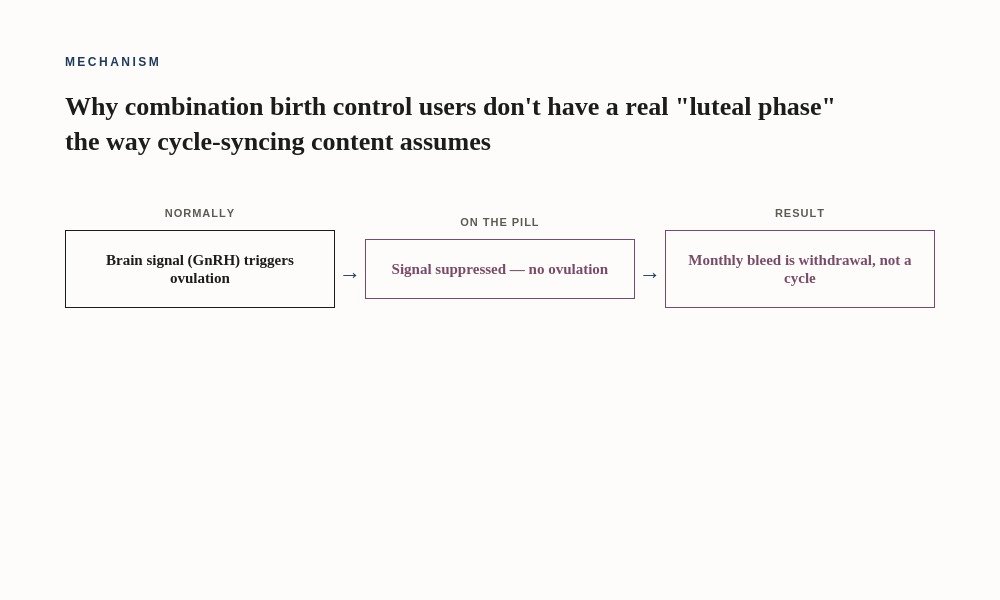
Combination hormonal birth control works by suppressing the signal from your brain (GnRH) that would normally trigger ovulation. No ovulation means no real follicular-to-luteal hormonal arc — the monthly bleed on the pill is a withdrawal response to stopping synthetic hormones for a week, not a sign of a natural cycle underneath.
If you’re on the combination pill, patch, or a hormonal IUD and following cycle-syncing advice built around your “luteal phase,” you’re syncing to a hormonal pattern your body isn’t actually producing.
This isn’t a safety issue — it’s a logic issue that almost no cycle-syncing content addresses directly, probably because it undercuts the entire premise for a huge share of the audience.
Where this logic actually has real science behind it
Here’s the genuinely interesting part almost nobody connects to the wellness trend: timing a medication specifically to the luteal phase is an established, guideline-recognized psychiatric treatment — just not for the reasons TikTok discusses it. For premenstrual dysphoric disorder (PMDD), taking an SSRI like sertraline, fluoxetine, or paroxetine only during the luteal phase — roughly the two weeks before your period — has been shown in multiple randomized controlled trials to work about as well as taking it every single day.[1][2] It’s a real, FDA-recognized dosing strategy, not a wellness reinterpretation of biology.
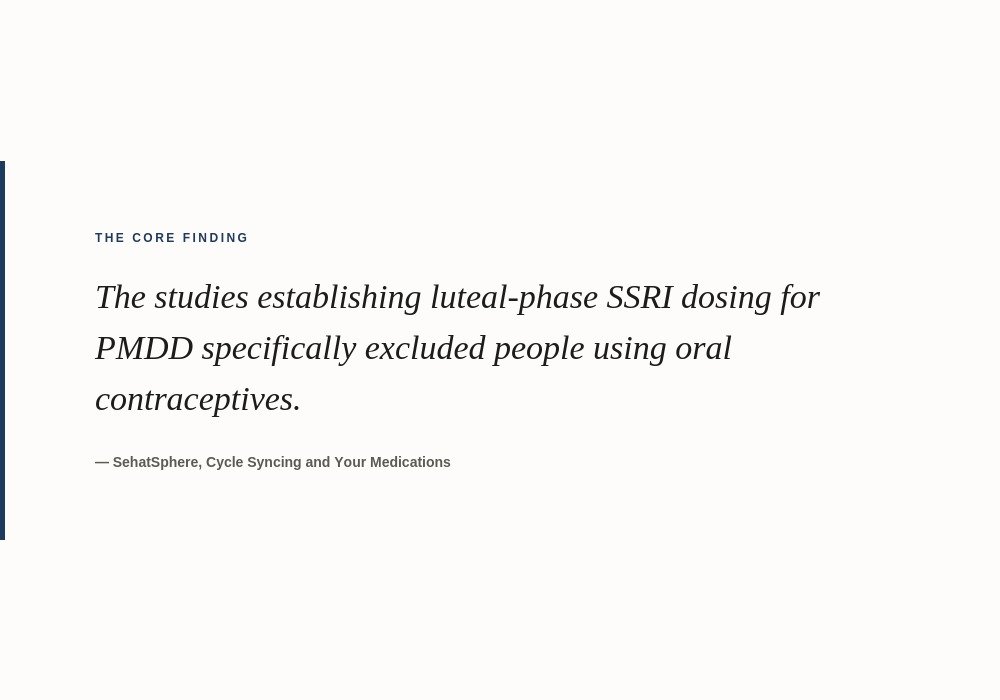
Here’s the twist that connects straight back to the birth control question above: the studies establishing luteal-phase SSRI dosing specifically excluded people using oral contraceptives.[3] The clinical evidence for the one place “cycle syncing” genuinely works in medicine doesn’t actually cover what happens if you’re also on the pill. I’ve had this exact conversation with patients — someone managing PMDD who’s also considering birth control for an unrelated reason, assuming the two approaches simply layer on top of each other, when the honest answer is that the combination hasn’t been well studied either way.
Cycle syncing and your medications: what’s actually documented
| Approach | Evidence status |
|---|---|
| Luteal-phase SSRI dosing for PMDD | Established, guideline-recognized |
| Pre-emptive NSAID timing for period pain | Reasonable evidence base |
| Iron intake timed to menstrual loss | Physiologically well-supported |
| Luteal SSRI dosing while also on birth control | Understudied — ask your prescriber |
| General workout/food “syncing” claims | Mostly unproven, low-risk to try |
Cycle syncing and your medications: pain relief timing
This is a genuinely useful, evidence-supported piece of cycle-aware medication timing. Prostaglandins — the compounds responsible for much of menstrual cramping — rise sharply right as bleeding starts. Starting an NSAID like ibuprofen or mefenamic acid a day or two before your period is expected, rather than waiting until pain is already severe, is a recognized strategy for getting ahead of prostaglandin-driven pain rather than chasing it.[4] This is one of the few pieces of “cycle timing” advice I give patients without much hesitation — the mechanism and the timing genuinely line up.
Cycle syncing and your medications: iron and other nutrients
Menstrual blood loss is a real, measurable driver of iron depletion, and it’s part of why iron deficiency is more common in menstruating women than in most other groups.[5] Being more deliberate about iron intake — whether through food or a supplement, ideally checked against an actual ferritin level rather than assumed — during and right after your period has a genuine physiological basis, unlike much of the more speculative “eat these foods in your follicular phase” content that circulates alongside it.
Two scenarios worth reading
Scenario one: someone with diagnosed PMDD has been managing symptoms well on luteal-phase sertraline for a year. They start a combination birth control pill for an unrelated reason without mentioning their PMDD dosing pattern to the prescribing doctor. Because the pill suppresses their natural ovulation, their body no longer has a distinct luteal phase to time the sertraline around, and their symptom control quietly falls apart without anyone connecting the two changes.
Scenario two: someone following cycle-syncing wellness content assumes their “luteal phase fatigue” explains ongoing tiredness, when a simple ferritin test would have caught genuine iron-deficiency anemia months earlier — the cycle-syncing framework became a plausible-sounding explanation that delayed an actual diagnosis.
Cycle syncing and your medications: three myths
Myth: “Every hormonal shift you feel is your cycle.” Sleep quality, stress, caffeine, and dozens of other factors genuinely overlap with cycle-related symptoms, and cycle syncing can become a catch-all explanation that crowds out other, sometimes more fixable, causes.
Myth: “If it’s natural, it’s automatically better documented.” The luteal-phase SSRI research discussed above is one of the better-studied examples of cycle-aware medication timing precisely because it went through formal clinical trials — not because it happened to align with a natural rhythm. Rigor comes from the research process, not from how “natural” an idea sounds.
Myth: “Cycle syncing is either completely legitimate or complete pseudoscience.” The honest picture sits in between: genuinely useful in a few specific, well-defined places, unproven in many others, and actively misleading for a meaningful share of people using hormonal birth control. Treating it as one monolithic claim — true or false — is what makes it hard to have a clear-eyed conversation about.
Cycle syncing and your medications: PMS versus PMDD
It’s worth being precise about which condition is actually being discussed, since the two get used interchangeably online. Premenstrual syndrome (PMS) — the milder, far more common experience of physical and emotional symptoms before a period — affects the large majority of menstruating people to some degree. Premenstrual dysphoric disorder (PMDD) is a distinct, more severe diagnosis affecting a smaller share, generally cited around 3 to 8 percent of people of reproductive age, involving symptoms serious enough to disrupt daily functioning. The luteal-phase SSRI evidence discussed throughout this piece is specifically PMDD research — it doesn’t mean everyone with typical PMS symptoms needs or would benefit from the same medication approach. If you’re unsure which category your symptoms fall into, that distinction is worth raising directly with a doctor rather than self-diagnosing from a symptom checklist online.
What cycle tracking apps get right — and where they mislead
Modern cycle-tracking apps are genuinely useful for predicting period timing and flagging real irregularities worth discussing with a doctor. Where they can mislead specifically in the medication context: many apps still generate “phase” predictions and content for users who’ve logged that they’re on hormonal birth control, essentially producing a synthetic luteal-phase narrative for a hormonal pattern that isn’t actually happening in the body.
Progestin-only methods: a different picture
Not all birth control suppresses ovulation the same way. Progestin-only pills, the hormonal IUD, and the implant vary in how consistently they stop ovulation — some progestin-only methods still allow ovulation to occur in a meaningful share of cycles, meaning the “no real luteal phase” point applies most strongly to combination estrogen-progestin methods specifically, not universally to every form of hormonal contraception.
This is exactly the kind of nuance that gets flattened into “birth control stops your cycle” online, when the honest picture depends on which specific method you’re using.
Cycle syncing and your medications: the bottom line
The wellness version of cycle syncing isn’t wrong to notice that hormones affect how you feel — that part is real. Where it goes astray is applying one unified framework to everyone, regardless of whether their hormonal pattern is natural, suppressed by birth control, or something in between. The one place this logic has genuine clinical backing — luteal-phase medication timing for PMDD — is also, ironically, the place with the biggest unanswered question for anyone also using hormonal contraception. None of this means avoiding cycle-syncing content or hormonal birth control — it means being specific about which claims apply to your actual hormonal situation, and bringing that specificity into the conversation with whoever manages your medications.
Cycle syncing and your medications: what I actually tell patients
- On hormonal birth control? Cycle-syncing content built around “your luteal phase” doesn’t map onto your actual hormone pattern — treat those specific claims skeptically.
- Managing PMDD? Ask your prescriber specifically about luteal-phase-only SSRI dosing — it’s a real, established option, not a compromise.
- On both an SSRI for PMDD and considering birth control? Say so explicitly — this specific combination is genuinely understudied, not necessarily unsafe.
- Period pain is predictable? Starting an NSAID a day or two early, rather than after pain peaks, has real evidence behind it.
- General “sync your workouts to your cycle” advice is low-risk to experiment with — just don’t let it substitute for checking an actual lab value like ferritin if you suspect a real deficiency.
Quick check
1. Why doesn’t cycle-syncing logic fully apply to combination birth control users?
2. Which medication timing strategy is genuinely established for PMDD?
3. What did the luteal-phase SSRI studies specifically exclude?
Cycle syncing and your medications: FAQ
Does cycle syncing work if I’m on birth control?
The general wellness advice around syncing to your “luteal phase” doesn’t map cleanly onto birth control users, since combination hormonal contraception suppresses the natural hormonal cycle it assumes you have.
Is luteal-phase dosing for PMDD medication actually real?
Yes — it’s a genuine, guideline-recognized treatment strategy supported by multiple randomized controlled trials, not a wellness trend interpretation.
Can I take luteal-phase SSRIs while on birth control?
Possibly, but this specific combination wasn’t included in the studies that established luteal-phase dosing. Discuss it explicitly with your prescriber rather than assuming.
Should I start pain medication before my period starts?
If your cycle is predictable and NSAIDs typically help, starting a day or two before expected pain onset is a reasonable, evidence-supported approach.
Do I need more iron during my period?
Many menstruating people benefit from attention to iron intake, ideally guided by an actual ferritin blood test rather than assumption alone.
Do all birth control methods stop ovulation the same way?
No — combination estrogen-progestin methods consistently suppress ovulation, while some progestin-only methods still allow ovulation in a meaningful share of cycles.
Can cycle-tracking apps mislead birth control users?
Yes — many apps still generate phase-based predictions for users on hormonal contraception, even though the underlying hormonal pattern isn’t actually occurring.
Is cycle syncing worth trying at all?
For general workout and food timing, it’s low-risk to experiment with. The important distinction is not letting it substitute for an actual diagnosis when something feels genuinely off.
What is cycle syncing, exactly?
Cycle syncing is the practice of adjusting exercise, diet, and daily habits to match the four phases of the menstrual cycle — menstrual, follicular, ovulatory, and luteal — based on the idea that hormone levels shifting across these phases affect energy, mood, and physical performance.
Does cycle syncing actually work?
The underlying premise — that hormones fluctuate and affect how you feel — is well established. Specific claims vary widely in evidence quality, from genuinely proven (luteal-phase PMDD medication timing) to largely unproven (general workout syncing).
What are the four phases of cycle syncing?
Menstrual (bleeding), follicular (after bleeding ends, energy typically rising), ovulatory (around mid-cycle), and luteal (the one to two weeks before the next period) — though this framework assumes a natural, unmedicated cycle.
Related reading
Sources
- AAFP — Intermittent Sertraline in Women with Severe PMDD
- Systematic Review — Intermittent SSRIs for Premenstrual Syndromes
- Medscape — PMDD Treatment and Management
- NIH PMC — Prostaglandins and Menstrual Pain Management
- World Health Organization — Anaemia Fact Sheet
This article is for general education only, not medical advice. Talk to your doctor or pharmacist about PMDD treatment options, birth control, or any medication timing questions specific to you.