
 SehatSphere
SEHATSPHERE · MEDICATION SAFETY
Melatonin and Your Medications
The Gene Nobody Mentions When They Talk About Blood Sugar
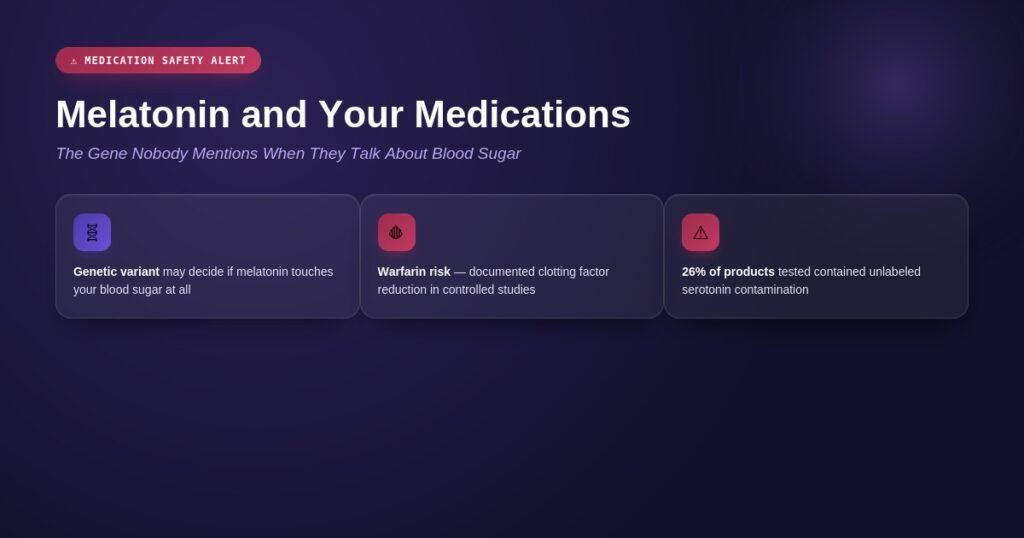
Over 3 million Americans take melatonin on any given night. The warfarin warning has been written a hundred times over. What almost nobody covers: your own genetics may decide whether melatonin nudges your blood sugar at all.
Melatonin and Your Medications: Why Everyone’s Taking It
Melatonin is one of the most popular over-the-counter sleep aids in the world — over 3 million Americans take it on any given night [1], and it’s sold without a prescription almost everywhere. In my own practice, it’s the single most common supplement patients mention almost as an afterthought — rarely listed on the actual medication form, usually surfacing only when I ask directly. That gap between “everyone takes it” and “almost nobody mentions it during a medication review” is exactly where the interactions in this guide tend to slip through.
WHAT MOST ARTICLES COVER
Warfarin interactions, sedation risk, “don’t mix with alcohol” — the same handful of facts, repeated everywhere.
WHAT THIS GUIDE ADDS
A genetic variant that may decide whether melatonin touches your blood sugar at all — plus the quality-control numbers that matter more than people realize.
The Dosing Problem Underneath Everything Else
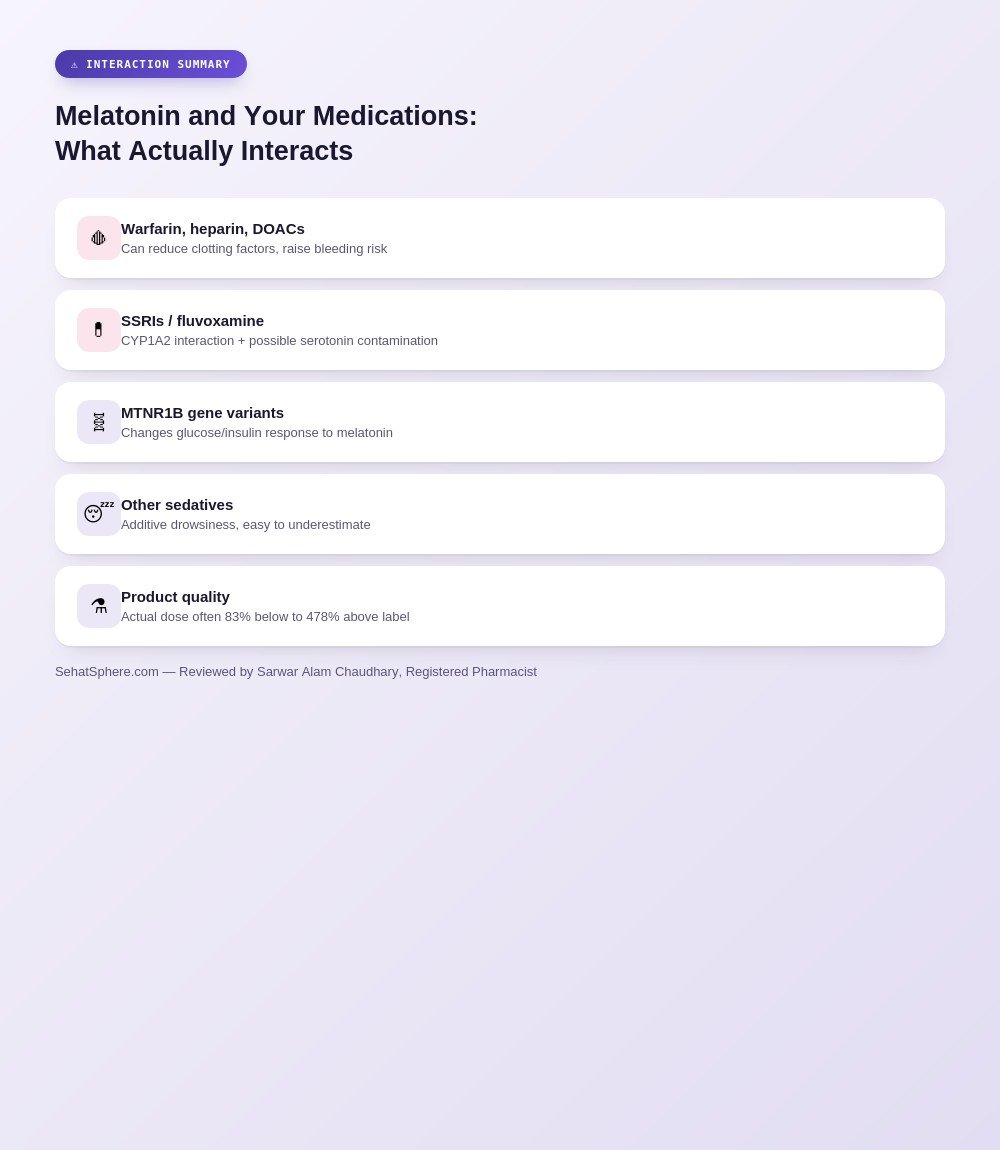
Before any interaction matters, there’s a more basic issue: you often don’t know how much melatonin you’re actually taking. A JAMA-published analysis of 25 gummy supplements found 22 of them contained amounts ranging from 74% to 247% of what the label stated — one product had no detectable melatonin at all [2]. A separate University of Guelph study of 31 products found actual content ranging from 83% below to 478% above the labeled dose [3]. Every interaction described below assumes a known dose — and for a meaningful share of products on the shelf, that assumption doesn’t hold.
03 The Gene Almost Nobody Mentions
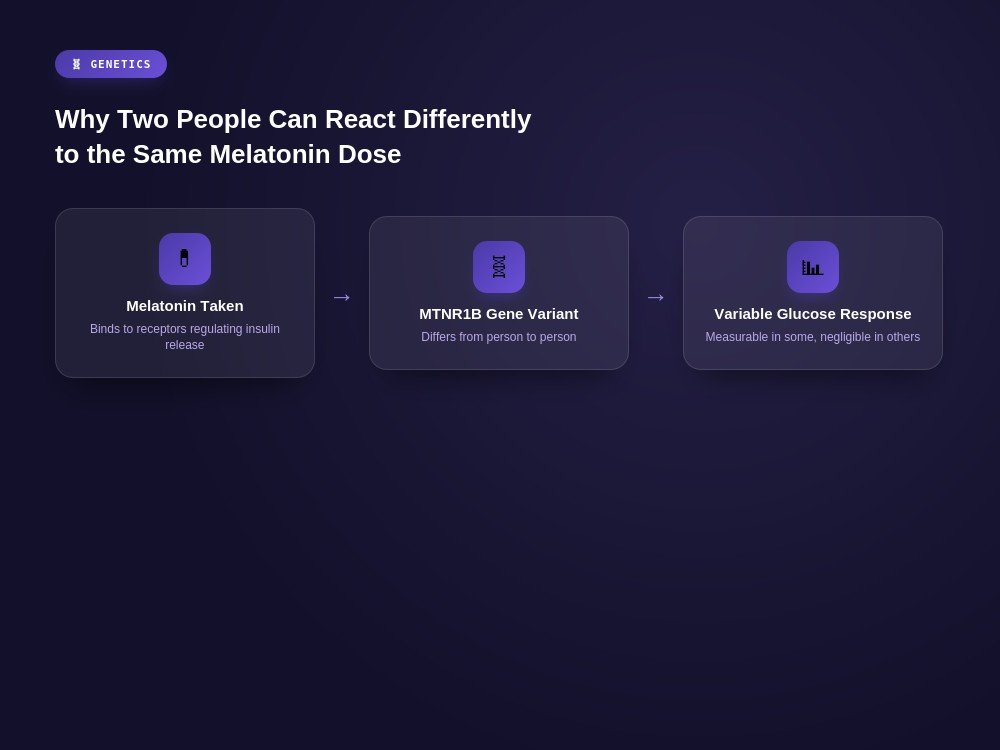
Melatonin doesn’t just help you sleep — it also binds to receptors involved in regulating insulin release, which is why some research links melatonin timing to blood sugar control. What’s missing from nearly every consumer article: a specific gene, MTNR1B, encodes the melatonin receptor most involved in this process, and common variants of this gene appear to change how a person’s insulin response reacts to melatonin — an NIH-registered clinical trial is studying this exact interaction using genotyped participants [4]. In plain terms: two people can take the identical dose of melatonin, and one may see a measurable shift in glucose handling while the other sees essentially none, depending on which version of this gene they carry.
This isn’t a reason to fear melatonin if you have diabetes or prediabetes — it’s a reason the advice “melatonin can affect blood sugar” is true but incomplete. If you monitor your glucose and notice a pattern after starting melatonin, this genetic variability is a plausible part of the explanation, worth mentioning to whoever manages your diabetes care rather than assuming it’s a universal, predictable effect.
Melatonin and Your Medications: Blood Thinners
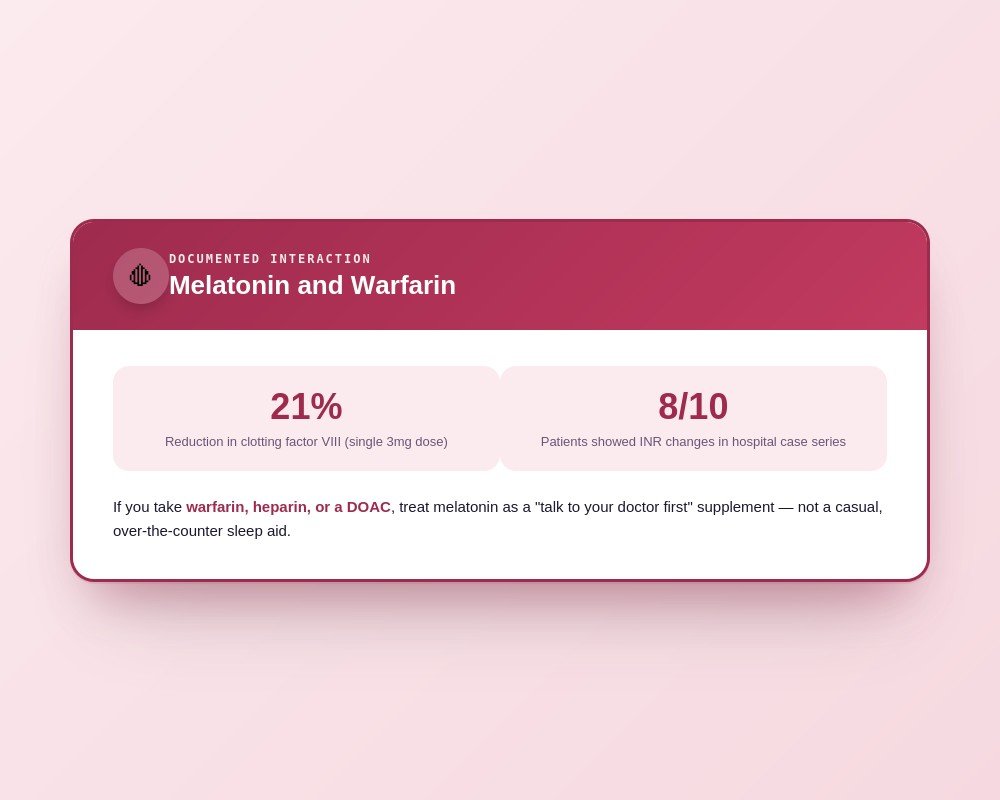
This is the interaction covered most often, and it’s covered often for good reason. Melatonin can measurably reduce clotting factors — a controlled study found a single 3mg dose decreased clotting factor VIII by 21% and fibrinogen by 15% compared to placebo [5]. A case series at Massachusetts General Hospital found 8 of 10 patients taking both warfarin and melatonin showed changes in INR or prothrombin time [6]. If you take warfarin, heparin, or a DOAC like apixaban or rivaroxaban, treat melatonin as a “talk to your doctor first” supplement, not a casual sleep aid.
The Serotonin Question — A Different Angle Than Usual
The same University of Guelph analysis that found dosing inaccuracies also tested for serotonin contamination — 26% of tested products contained unlabeled, detectable serotonin, a substance that isn’t supposed to be in a melatonin supplement at all [3]. Most coverage stops at “this is a quality-control failure.” Here’s the part I think matters more: if you’re already on an SSRI, SNRI, or another serotonergic medication, an unlabeled dose of actual serotonin in your “just melatonin” gummy is a second, hidden contributor to serotonin load — stacking on top of the already-known CYP1A2-mediated interaction between melatonin and drugs like fluvoxamine [7]. Two separate risk pathways, from a bottle that looks like it only does one thing.
Melatonin and Your Medications: If There’s a Child in the House
This is usually treated as a completely separate topic from adult drug interactions, but for a household where an adult takes prescription medication and a child has access to the same cabinet, it’s the same story. Calls to U.S. poison control centers for pediatric melatonin ingestion rose over 500% between 2012 and 2021 [8], driven largely by gummy formulations that look and taste like candy. Nearly 20% of those calls involved real symptoms — gastrointestinal or cardiovascular — and the same 2022 analysis found products with CBD present but no detectable melatonin at all [2]. If you keep melatonin in the same cabinet as any prescription medication and there’s a child in the house, that’s a storage decision worth revisiting today, not eventually.
Melatonin and Your Medications: Timing Matters More
Most people take melatonin whenever they remember, right before bed — but its effect depends heavily on when it’s taken relative to your body’s own natural melatonin rise, which typically begins a few hours before your usual bedtime. Taking it too late doesn’t just reduce effectiveness; it can shift your circadian rhythm in the wrong direction for shift workers or frequent travelers trying to adjust to a new time zone. In my experience, this is the single most common reason patients tell me “melatonin doesn’t work for me” — the timing, not the substance, was the issue.
Melatonin and Your Medications: Other Sedatives
Beyond the specific interactions already covered, melatonin’s calming effect can add to any other sedating medication — benzodiazepines, prescription sleep aids like zolpidem, and even some antihistamines used for sleep. This is a simple additive-sedation concern rather than a complex pharmacological one, but it’s easy to underestimate precisely because melatonin is sold as “natural.” Starting with a lower dose when combining it with any other sedating medication is a reasonable default, not an overreaction.
What “Natural” Doesn’t Mean Here
Melatonin is a hormone your body already produces, which is part of why it gets marketed and perceived as inherently gentle. Being a naturally occurring hormone doesn’t exempt a substance from dose-dependent effects, genetic variability, or interaction potential — the same is true of estrogen, cortisol, or insulin, all hormones nobody would casually call risk-free regardless of dose or context. The “natural equals harmless” framing is exactly what makes the gaps in this guide easy to miss in the first place.
Melatonin and Your Medications: Does Tolerance Build?
Unlike many sleep medications, melatonin doesn’t appear to cause the same pattern of tolerance or dependence in most short-to-medium-term use — a genuinely reassuring point that gets buried under all the interaction warnings. That said, long-term daily use in adults hasn’t been studied as extensively as the short-term data, and the honest answer for anyone using it nightly for months or years is that the research base thins out considerably beyond the first few months. If melatonin isn’t working as well as it once did, dosing inaccuracy or timing is a more likely explanation than tolerance — worth ruling out before assuming you need a higher dose. The through-line across this guide is the same point, repeated in different forms: melatonin’s reputation as a simple, gentle, “just try it” supplement undersells how much individual variation — genetic, product-quality, and medication-related — actually shapes what it does in your specific body.
Melatonin and Your Medications: Three Myths Worth Retiring
Myth: “More melatonin means better sleep.” Research on optimal dosing generally points toward lower doses (0.5-3mg) being as effective as higher ones for most people, with higher doses more associated with next-day grogginess than improved sleep quality. Myth: “Since it’s a hormone my body makes anyway, timing doesn’t matter much.” Timing relative to your natural circadian rhythm is arguably more important than dose for most people, as covered earlier in this guide. Myth: “Natural supplements don’t need FDA-level scrutiny.” The dosing and contamination data throughout this guide is a direct rebuttal to that assumption — the absence of pre-market FDA approval is precisely why independent testing exists and why it matters.
The CYP1A2 Enzyme, in Slightly More Depth
Melatonin is broken down primarily by a liver enzyme called CYP1A2. Anything that inhibits this enzyme — certain antidepressants like fluvoxamine most notably, but also some antibiotics like ciprofloxacin, and even high doses of caffeine in the opposite direction — changes how quickly melatonin clears your system. Fluvoxamine specifically can raise melatonin blood levels by a documented multiple of the normal amount, which is why it’s singled out repeatedly in clinical references rather than lumped in generically with “antidepressants” [7]. If you’re on fluvoxamine specifically, this is one of the more mechanistically well-understood interactions in this entire guide — not a vague caution, but a specific, quantifiable one.
“Millions of people use melatonin — often self-prescribed, often without mentioning it to anyone managing their actual medications. The gap isn’t the supplement itself. It’s the silence around it.”
Melatonin and Your Medications: Quick Check
1. What does the MTNR1B gene affect?
2. What percentage of tested products had unlabeled serotonin?
3. Melatonin’s effect on warfarin works mainly by:
Melatonin and Your Medications: Two Scenarios Worth Reading
Scenario 1: Someone on warfarin for a heart valve replacement starts melatonin for jet lag before a trip, without mentioning it at their next anticoagulation clinic visit. Their INR comes back elevated at the following check, and the clinic spends the visit trying to explain a change that a simple “I started a sleep supplement” would have clarified in seconds. Scenario 2: A parent on an SSRI keeps a bottle of melatonin gummies in the same drawer as their own medication for convenience. Their child, mistaking the gummies for candy, eats several — and the emergency room visit that follows is now a documented pattern repeated hundreds of thousands of times across poison control data [8]. Neither scenario involved a rare or exotic medication. Both involved a supplement treated as an afterthought.
Melatonin and Your Medications: Checking Product Quality
Given how inconsistent labeling has proven to be across independent testing, looking for third-party verification is a genuinely practical step, not an overcautious one. Seals from USP (United States Pharmacopeia), NSF International, or ConsumerLab indicate a product has been independently tested against its label claim — a meaningfully different standard than a supplement that has only been self-certified by its manufacturer. This matters more for melatonin specifically than for many supplements, given how directly the dosing inaccuracy documented earlier connects to genuine safety margins around medications like warfarin.
Melatonin in Older Adults and During Pregnancy
Melatonin production naturally declines with age, which is part of why it’s commonly recommended for older adults with sleep difficulty — but this population is also more likely to be on multiple medications simultaneously, which raises the odds of an interaction described elsewhere in this guide applying to any individual person. Polypharmacy, not melatonin itself, is usually the real complicating factor. During pregnancy and breastfeeding, melatonin hasn’t been studied thoroughly enough to establish clear safety data, and most clinical guidance defaults to avoiding it outside of a doctor’s specific direction — a “not established as safe” standard, not an “established as dangerous” one, but worth treating with the same caution either way.
Melatonin and Your Medications: Bringing It All Together
Step back from the individual interactions, and a single pattern runs through this entire guide: melatonin’s accessibility is exactly what makes it easy to overlook. It sits on a shelf next to vitamins, it’s sold without a prescription, and it’s often the one item on a person’s routine that never makes it onto an actual medication list. None of the specific risks covered here — warfarin interaction, contamination, genetic variability in glucose response, pediatric poisoning, CYP1A2 metabolism — require avoiding melatonin altogether. Every one of them is manageable with two things: knowing they exist, and saying them out loud to whoever manages your other medications. That second part is the one this guide can’t do for you, but it’s also the one that actually closes the gap between a widely used, easily accessible supplement and the specific way it might interact with the specific medications, genetics, and household situation that happen to be unique to you.
Melatonin and Your Medications: What I Actually Tell Patients
- Mention melatonin during every medication review, even though it’s “just a supplement” — this single habit closes most of the gaps in this guide.
- On warfarin, heparin, or a DOAC? Get explicit guidance before starting melatonin regularly.
- On an SSRI, SNRI, or fluvoxamine specifically? Ask your pharmacist about a third-party-tested brand to reduce contamination risk.
- Diabetes or prediabetes, and you notice a glucose pattern after starting melatonin? Mention it — genetic variability in response is real and worth factoring in.
- Any prescription medication and a child in the house? Store melatonin gummies separately, out of reach, the same way you would any medication.
Melatonin and Your Medications: FAQ
Can I take melatonin with warfarin?
Only with explicit guidance from your doctor. Melatonin can measurably reduce clotting factors, and case data shows real INR changes in patients taking both.
Does melatonin affect blood sugar for everyone the same way?
No — emerging research on the MTNR1B gene suggests the glucose/insulin effect of melatonin varies meaningfully based on genetic variants, not a single universal response.
Is it true some melatonin supplements contain serotonin?
Yes. A peer-reviewed analysis found unlabeled serotonin in 26% of tested products — a real quality-control issue, especially relevant if you take an SSRI or SNRI.
How much melatonin is actually in over-the-counter supplements?
Often not what the label says. Studies have found actual content ranging from 83% below to nearly 5 times above the stated dose.
Is melatonin safe to keep in a house with children?
Store it like any medication, out of reach. Pediatric poison control calls for melatonin rose over 500% in a decade, largely from candy-like gummies.
What time should I actually take melatonin?
Generally a few hours before your target bedtime, aligned with your body’s natural melatonin rise — not right when you get into bed, a common mistake that reduces effectiveness.
Can I combine melatonin with other sleep medications?
Melatonin’s sedating effect can add to other sleep aids, benzodiazepines, or sedating antihistamines. Start with a lower dose if combining, and check with a pharmacist.
What’s the ideal melatonin dose?
Research generally supports lower doses (0.5-3mg) working as well as higher ones for most people, with higher doses more linked to next-day grogginess than better sleep.
Should I look for a specific certification on the label?
Yes — USP, NSF International, or ConsumerLab seals indicate independent third-party testing against the label claim, which is meaningfully different from self-certified dosing.
Is melatonin safe during pregnancy?
It hasn’t been studied thoroughly enough to establish clear safety data. Most clinical guidance defaults to avoiding it without a doctor’s specific direction.
Which antidepressant has the strongest documented melatonin interaction?
Fluvoxamine specifically, through CYP1A2 enzyme inhibition, can raise melatonin blood levels by a well-documented multiple of the normal amount.
Why do older adults take melatonin more often?
Natural melatonin production declines with age. However, this population is also more likely to be on multiple medications, which raises interaction risk generally.
Melatonin and Your Medications: Sources
- [1] Bio Absorb Nutraceuticals — Melatonin Usage and Interaction Overview
- [2] ABC News / JAMA Research Letter — Melatonin Gummy Dosing Accuracy
- [3] Journal of Clinical Sleep Medicine — Serotonin and Melatonin Content Variability
- [4] NIH Clinical Trial NCT02642640 — Melatonin, MTNR1B Genotype, and Glucose Control
- [5] Melatonin and Clotting Factor Reduction — Controlled Study Data
- [6] Massachusetts General Hospital Case Series — Melatonin and Warfarin INR Changes
- [7] StatPearls / NCBI — Melatonin Pharmacology and CYP1A2 Metabolism
- [8] JAMA Pediatrics — Pediatric Melatonin Ingestion and Poison Control Trends
Medical disclaimer: This article is for general education only, not medical advice. Talk to your doctor or pharmacist before combining melatonin with blood thinners, antidepressants, or diabetes medication.