 SehatSphere.com
7 Early Warning Signs of a Weak Heart That Most Adults Ignore Until It’s Too Late
- A weakening heart rarely announces itself — it shows up as
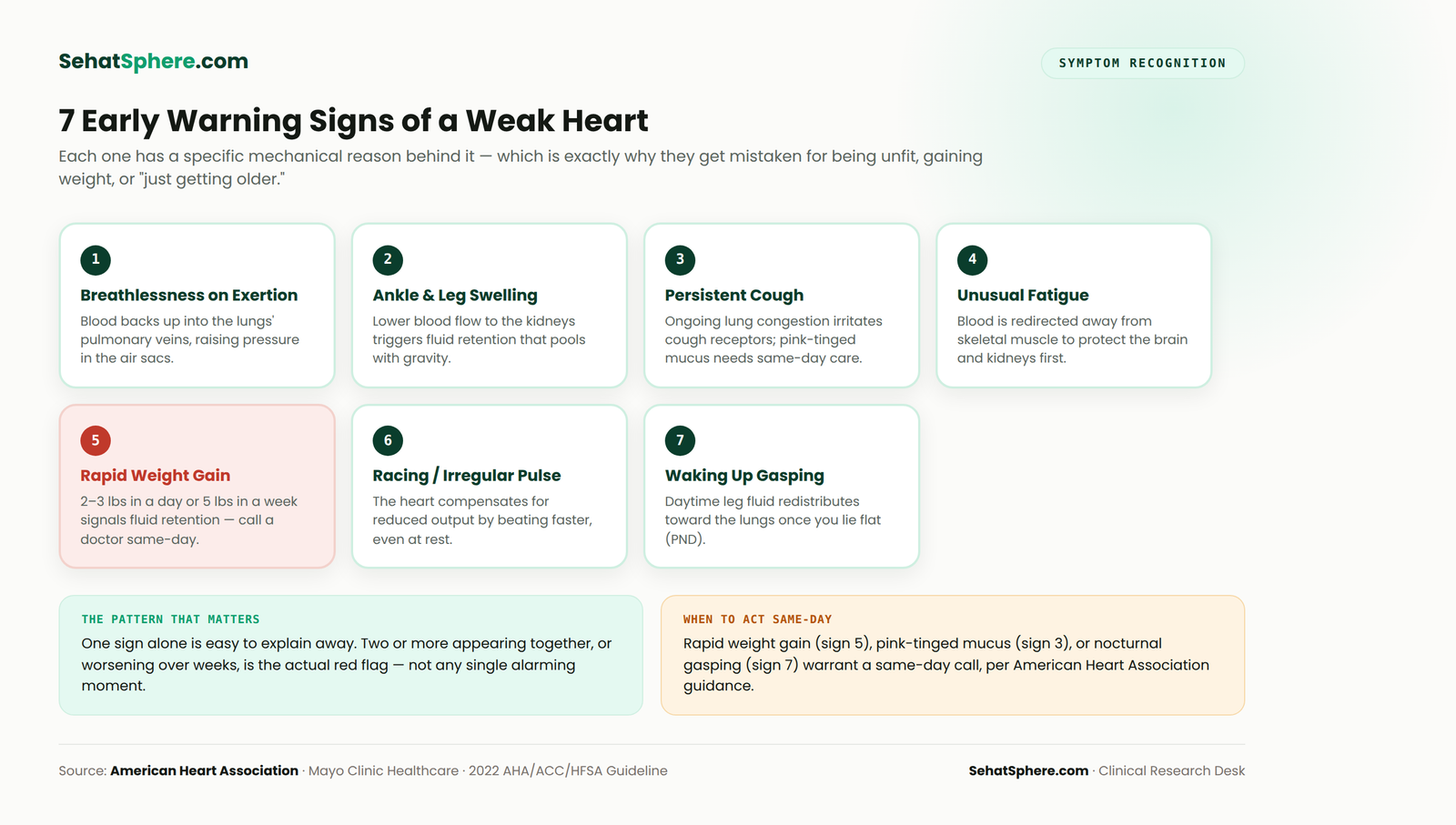
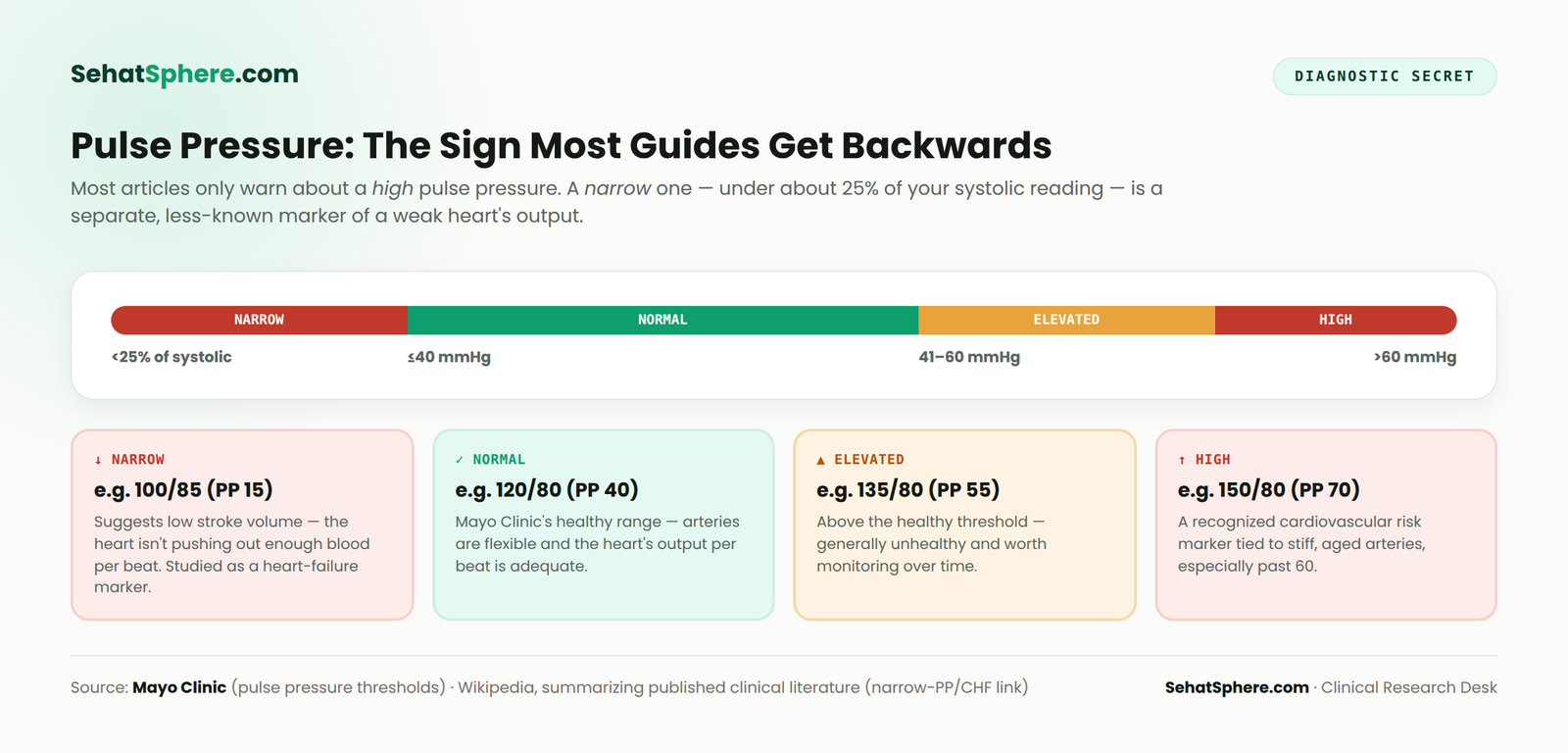
breathlessness on stairs, ankle swelling, or fatigue that gets blamed on age, weather, or being “out of shape” for months before anyone connects the dots. - Most consumer guides only warn about high pulse pressure. Fewer mention that an unusually narrow pulse pressure — under about 25% of your systolic number — is actually the more specific red flag for a heart that isn’t pumping enough blood per beat.
- A simple blood test most people never think to ask for — BNP or NT-proBNP — can flag heart strain before symptoms become obvious, and costs far less than an echocardiogram.
- Women more often develop heart failure with a normal-looking ejection fraction (HFpEF), which is one reason their symptoms get dismissed longer than men’s — and diabetes raises a woman’s heart-failure risk roughly five-fold, versus about two-fold in men.
- Gaining more than 2–3 lbs in a single day, or 5+ lbs in a week, is one of the American Heart Association’s own actionable red flags — not something to “watch for a few more days.”
- Rare but real: peripartum cardiomyopathy can develop in the last month of pregnancy through 5 months after delivery, and its symptoms — breathlessness, swelling, fatigue — are exactly the ones new mothers are told to expect anyway.

Why These Signs Get Missed
The efficiency of your heart’s pumping action is measured by a single number cardiologists lean on constantly: Ejection Fraction (EF) — the percentage of blood pushed out of the left ventricle with each beat.
| Category | Ejection Fraction | What It Means |
|---|---|---|
| HFpEF | 50% or higher | “Preserved” — the muscle contracts normally but is often stiff and doesn’t fill well |
| HFmrEF | 41–49% | “Mildly reduced” — a middle category added in the 2022 guideline update |
| HFrEF | 40% or lower | “Reduced” — the classic weak-pump pattern most people picture |
| HFimpEF | Improved | Was 40% or below, now measured above 40% after treatment |
Per the 2022 AHA/ACC/HFSA heart failure guideline, these four categories replaced a simpler two-way split, precisely because so many people —
(Related: our breakdown on Ultra-Processed Foods & Hidden Sugars covers the dietary side of how this strain builds up over years.)
The 7 Early Warning Signs
1. Breathlessness During Routine Activity (Exertional Dyspnea)
When the left ventricle can’t relax and fill properly, blood backs up into the pulmonary veins, raising pressure inside the tiny air sacs of your lungs. The result: stairs, brisk walking, or light housework leaves you noticeably more winded than they used to. This is the single most common early sign, and also the easiest to blame on being unfit, gaining weight, or “just getting older.”
2. Ankle, Foot, or Leg Swelling (Pitting Edema)
Reduced pumping efficiency lowers blood flow to the kidneys, which respond by holding onto more fluid. Gravity pulls that extra fluid down into your ankles and feet, leaving a visible dent when you press a finger into the skin for a few seconds. Per Mayo Clinic Healthcare guidance, less obvious companion signs — a persistent dry cough, abdominal bloating, and unexplained loss of appetite — often show up alongside this one and get missed just as easily.
3. Persistent Cough, Sometimes With Pink-Tinged Mucus
Ongoing fluid congestion in the lungs irritates the airway’s cough receptors continuously. When tiny capillaries under strain leak slightly, coughed-up mucus can take on a faint pink tinge — a sign that should prompt a same-day doctor visit rather than a wait-and-see approach.
4. Unusual Fatigue With Minor Exertion
To protect the brain and kidneys during reduced output, the body redirects blood away from skeletal muscle. The result is a heavy, disproportionate tiredness from tasks that shouldn’t be tiring at all — climbing one flight of stairs, carrying groceries, or getting dressed. Not sure whether fatigue like this is cardiac or nutritional? Our free 10-nutrient deficiency finder is a reasonable first differential check.
5. Rapid, Unexplained Weight Gain
The American Heart Association flags this as one of the most directly actionable warning signs of all: gaining more than 2–3 lbs in a single day, or more than 5 lbs in a week, points to worsening fluid retention and should be reported to a doctor immediately — not monitored for a few more days to “see if it settles.”
6. Racing or Irregular Resting Heart Rate
A weakening heart often compensates for reduced output by beating faster, even at complete rest. If your resting pulse feels consistently elevated, skips beats, or feels erratic, our Heart Rate Fluctuation guide walks through what counts as a normal day-to-day range versus what doesn’t.
7. Sudden Nocturnal Breathlessness (Waking Up Gasping)
Clinically called Paroxysmal Nocturnal Dyspnea, this happens when fluid that pooled in the legs during the day redistributes toward the lungs once you lie flat. Needing extra pillows just to breathe comfortably, or waking up gasping an hour or two after falling asleep, is a distinctive enough pattern that it’s worth mentioning to a doctor by name.
“If my ejection fraction comes back normal, my heart is fine.”
A “normal” EF (HFpEF) is actually the more common pattern in women and can still mean a stiff, poorly-filling heart — normal EF rules out one type of weakness, not all of them.
3. Check Your Risk
Tick anything you’ve noticed in the past two weeks. This is a rough awareness tool, not a diagnosis.
This tool is for general awareness only and can’t replace a doctor’s evaluation, an ECG, or an echocardiogram.
4. The NYHA Functional Classification
Cardiologists don’t just check for symptoms in isolation — they stage exactly how much those symptoms limit daily life, using the New York Heart Association (NYHA) scale, a system that’s been in clinical use for decades precisely because it maps so directly onto real-world function.
| Class | What It Means |
|---|---|
| Class I | No symptoms with ordinary physical activity. |
| Class II | Slight limitation; comfortable at rest, but ordinary activity causes fatigue or breathlessness. |
| Class III | Marked limitation; less-than-ordinary activity causes symptoms. |
| Class IV | Symptoms present even at rest; any activity increases discomfort. |
Most people who eventually get a heart failure diagnosis spent months in Class I or early Class II without realizing it — which is exactly why the 7 signs above matter more as a pattern over time than as any single alarming moment.
5. The Pulse Pressure Secret Most Guides Get Backwards
Pulse pressure is simply your systolic reading minus your diastolic reading — the “120” minus the “80” in a 120/80 reading, giving a pulse pressure of 40. Most health content stops at one warning: a high pulse pressure signals stiff, aged arteries.
Per Mayo Clinic, a pulse pressure of 40 mmHg or less is considered healthy, anything consistently above 40 is generally unhealthy, and above 60 mmHg is a recognized cardiovascular risk marker, especially in older adults. But for a weak heart specifically, the more clinically relevant secret runs the other way: a pulse pressure that is unusually narrow — commonly defined as under about 25% of the systolic number — can be a marker of low stroke volume and reduced cardiac output, and has been specifically studied as a warning sign in heart failure.
In other words: both a very wide and a very narrow pulse pressure deserve attention, for two different mechanical reasons — one about stiff arteries, the other about a heart that isn’t pushing out enough blood per beat.
📊 Pulse Pressure Calculator
Enter your blood pressure to see where your pulse pressure falls:
A single reading is a snapshot, not a diagnosis — blood pressure naturally varies through the day. Our Does Anger Raise Blood Pressure? guide covers some of the everyday swings worth knowing about.
6. The Blood Test Nobody Asks For
Most people have never heard of it, yet it’s one of the cheapest, fastest ways to flag heart strain before symptoms become undeniable: a blood test for BNP (B-type Natriuretic Peptide) or its longer-lived cousin, NT-proBNP. Your heart releases both hormones when its walls are stretched under pressure — the more strained the muscle, the higher the number.
| Marker | Normal | Suggests Heart Strain |
|---|---|---|
| BNP | Under 100 pg/mL | Over 100 pg/mL |
| NT-proBNP (under 75) | Under 125 pg/mL | Over 900 pg/mL |
| NT-proBNP (75 and older) | Under 450 pg/mL | Over 900 pg/mL |
An elevated result doesn’t automatically mean heart failure on its own — kidney disease, other heart conditions, and certain lung conditions can also raise these numbers — which is exactly why doctors pair it with an ECG or echocardiogram rather than relying on it alone. But as a first-line, inexpensive screening question to bring up proactively, especially if you’ve noticed two or more of the 7 signs above, it’s genuinely underused.
If you’re already tracking multiple lab values, our Blood Report Decoder can help make sense of a full panel alongside a BNP/NT-proBNP result.
7. Who’s at Greater Risk
| Risk Factor | Why It Matters |
|---|---|
| Prior heart attack | Damaged muscle tissue can no longer contract as effectively — see our Heart Attack in Young Adults guide. |
| Long-standing uncontrolled hypertension | Forces the left ventricle to work harder against constant resistance until the wall thickens and eventually weakens. |
| Diabetes or insulin resistance | Damages small blood vessels feeding the heart muscle itself over time. |
| Age above 60 | Cumulative wear on both the arteries and the muscle itself. |
| Obesity / sedentary lifestyle | Increases overall cardiac workload and is linked to more inflammatory strain — see our Ultra-Processed Foods guide for the dietary mechanism. |
| Family history of cardiomyopathy | Some structural heart-muscle conditions run in families independent of lifestyle. |
8. Why Women’s Heart Failure Often Gets Missed
This is a genuine, well-documented gap in how heart failure gets recognized — not a minor footnote. Women more commonly develop HFpEF (the “preserved ejection fraction” category from the table in section 1), where the muscle contracts normally but the ventricle walls are stiff and don’t fill properly. Men more commonly develop HFrEF, the classic weak-pump pattern, usually tied to coronary artery disease.
Because a woman’s ejection fraction so often looks technically “normal,” her breathlessness, fatigue, and swelling are more likely to be attributed to anxiety, deconditioning, or “just getting older” — the exact same 7 signs covered above, just taken less seriously for longer.
Per Harvard Health, diabetes raises heart-failure risk roughly five-fold in women, compared to about two-fold in men — one of the sharper sex-based risk differences in cardiology, and a reason diabetic women in particular shouldn’t dismiss the 7 signs above as unrelated to their heart.
Women also carry distinctive risk factors of their own that don’t apply to men at all: pregnancy-related cardiac stress (its own section just below), heart damage from certain breast cancer treatments, and a greater susceptibility to blood-vessel inflammation and dysfunction even without any visible arterial blockage on a standard angiogram. Overall outcomes reflect this gap — among adults aged 80–89, heart failure incidence runs at roughly 8% in women versus 6.6% in men.
9. Pregnancy & the Postpartum Window: Peripartum Cardiomyopathy
This is rare, but genuinely underappreciated: peripartum cardiomyopathy (PPCM) is heart-muscle weakness that develops specifically during the final month of pregnancy or within five months after delivery, most often affecting the left ventricle’s ability to pump efficiently.
Per Cleveland Clinic, it affects roughly 1 in 1,500 to 1 in 4,000 live births in the US, and occurs more frequently in women over 30 and in Black women. What makes it dangerous isn’t rarity — it’s camouflage: the warning signs (breathlessness at rest, excessive fatigue, swelling, a dry cough, lightheadedness on standing, trouble lying flat) overlap almost exactly with what every pregnancy and postpartum guide already tells new mothers to expect as normal.
Breathlessness that occurs at complete rest — not just with activity — heart palpitations, or real trouble lying flat to sleep, in the final weeks of pregnancy or the months after delivery, are worth raising with an obstetrician by name rather than assumed to be ordinary pregnancy fatigue. Early diagnosis meaningfully improves recovery outcomes.
10. The Underlying Causes: How a Heart Weakens
Heart-muscle failure rarely happens overnight — it’s the end point of gradual structural change, which is exactly why the signs in this guide tend to build slowly rather than appear all at once. The main clinical causes include:
- Coronary Artery Disease (CAD): Cholesterol plaques narrow the arteries feeding the heart muscle itself, starving sections of tissue of oxygen — the same mechanism explored in our Heart Attack in Young Adults guide.
- Chronic Untreated Hypertension: The left ventricle has to push harder against constant resistance, and the muscle wall eventually thickens, stiffens, and fails.
- Viral Myocarditis: Certain viral infections can directly inflame and damage the heart-muscle lining.
- Metabolic and Vascular Strain: Chronic high blood sugar and a diet heavy in ultra-processed foods scars blood vessels over time and raises baseline cardiac workload — see our Ultra-Processed Foods guide for the cellular mechanism.
- Unmanaged Chronic Stress: Sustained cortisol elevation keeps blood pressure and heart rate chronically raised — our Mental Stress guide covers the full mechanism and natural ways to bring it down.
- Valvular Heart Disease: A leaking (regurgitant) or narrowed (stenotic) valve forces the ventricle to either pump the same blood twice or push against extra resistance with every single beat. Over years, that constant mechanical overload is enough on its own to weaken the muscle, even when the coronary arteries themselves are completely clear — which is why a murmur picked up on a routine stethoscope exam is never something to brush off as incidental.
None of these causes act alone in most real cases — a person with long-standing hypertension who also develops CAD, for instance, is stacking two separate mechanical stresses onto the same ventricle, which is part of why heart failure risk climbs so much faster with each additional untreated condition rather than simply adding up.
11. Medications & Supplements Worth Knowing About
Certain everyday habits and supplement choices put extra, avoidable strain on a heart that’s already working harder than it should. If you use cold exposure or sauna sessions regularly, our Cold Plunge and Your Medications guide covers what the cold-shock reflex does to a heart on beta-blockers specifically — a combination worth understanding before you try it, not after.
Berberine, sometimes marketed as “nature’s Ozempic” for its metabolic effects, carries its own real drug-interaction profile — our Berberine and Your Medications guide covers the full interaction picture before you add it to a regimen that includes any heart or blood-sugar medication.
Anyone managing several medications alongside a heart condition should cross-check everything together rather than one drug at a time — the Medication + Lifestyle Checker and the Integrative Interaction Checker are both built specifically for that kind of combined check, and our Complete Guide to Medicine Safety covers the broader principles of taking multiple medicines safely.
12. Dietary Protocol: What to Eat & Avoid
Reducing cardiac workload and keeping fluid balance stable both start with what’s on your plate. This isn’t about a single miracle food — it’s about which everyday choices add strain and which take it away.
| Eat More Of | Why |
|---|---|
| Magnesium-rich leafy greens (spinach, kale) | Supports stable electrical signaling in heart-muscle cells. |
| CoQ10 food sources (organ meats, mackerel, seeds) | Feeds the mitochondria that power each heart-muscle contraction. |
| Soluble fiber (oats, legumes) | Reduces overall vascular resistance, lowering the heart’s workload. |
| Cut Back On | Why |
|---|---|
| Ultra-processed added sugars | Sudden insulin surges scar blood vessel walls over time — see our Ultra-Processed Foods guide. |
| Industrial high-sodium foods | Drives immediate fluid retention and spikes blood pressure. |
| Excess caffeine | Raises resting heart rate, forcing an already-strained heart to work harder. |
13. 7-Day Heart Monitoring Plan
The American Heart Association recommends every at-risk person keep a simple self-check routine. This doesn’t replace a doctor-supervised action plan — it supplements one.
| Day | Action |
|---|---|
| Day 1 | Record your baseline weight and resting heart rate. |
| Day 2 | Cut back added sodium; check labels on packaged food. |
| Day 3 | Light, doctor-approved walk if you have no red-flag symptoms. |
| Day 4 | Check ankles for swelling; press gently and note any indentation. |
| Day 5 | Re-weigh yourself at the same time as Day 1; compare the numbers. |
| Day 6 | Review all current medications and supplements for interactions. |
| Day 7 | Book a follow-up if weight rose 2+ lbs, or any of the 7 signs above appeared. |
14. Quick Quiz
15. Frequently Asked Questions
What is the earliest sign of a weak heart muscle?
Unexplained breathlessness during routine daily tasks — walking, climbing stairs — is usually the earliest and most common sign, triggered by fluid backing up into the pulmonary veins.
How do you know if your heart is struggling to pump blood?
Key markers include persistent ankle/foot swelling, disproportionate fatigue with minor exertion, and waking up gasping for breath (Paroxysmal Nocturnal Dyspnea).
Can a weak heart muscle recover or reverse?
It depends on the cause. Stunned or “hibernating” heart muscle from reduced blood flow can show meaningful recovery with proper medical management; scarring from a heart attack is generally permanent, though the heart can still be supported effectively.
Why does a weak heart cause ankle and leg swelling?
Reduced pumping efficiency lowers blood flow to the kidneys, which retain more fluid. Gravity pulls that extra fluid down into the feet and ankles.
What blood test can flag a weak heart before symptoms appear?
BNP or NT-proBNP — inexpensive blood tests that rise when the heart wall is under stretch and strain, often before symptoms become obvious.
Is a high or a low pulse pressure worse for the heart?
Both deserve attention for different reasons. A high pulse pressure (over 60 mmHg) points to stiff arteries; an unusually narrow one (under about 25% of systolic) can signal low cardiac output specifically.
Why do women’s heart failure symptoms get missed more often?
Women more commonly develop HFpEF, where the ejection fraction looks technically normal even though the heart isn’t filling properly — which means the same 7 warning signs are more likely to be attributed to something else.
What is peripartum cardiomyopathy?
A rare form of heart-muscle weakness that develops in the final month of pregnancy or within 5 months after delivery, affecting roughly 1 in 1,500 to 1 in 4,000 live births in the US.
How much weight gain in a short time signals worsening heart failure?
Per the American Heart Association, gaining more than 2–3 lbs in a single day, or more than 5 lbs in a week, signals worsening fluid retention and should be reported to a doctor immediately.
What dietary habits put the most strain on a weakening heart?
Consistent ultra-processed sugar and high-sodium intake drives vascular scarring and fluid retention, forcing structural overload on an already-strained heart.
The Short Version
A weak heart rarely announces itself loudly — breathlessness, swelling, fatigue, rapid weight gain, a racing resting pulse, and nighttime gasping are the 7 signs worth tracking as a pattern, not waiting on individually. Pulse pressure matters in both directions — high points to stiff arteries, unusually narrow points to low cardiac output — and a simple BNP/NT-proBNP blood test can flag strain before symptoms become undeniable. Women are more likely to have a technically “normal” ejection fraction even with real heart failure, which is exactly why their symptoms get dismissed longer, and pregnancy through the fifth postpartum month carries its own rare but real risk. None of this replaces a doctor, an ECG, or an echocardiogram — it’s a reason to ask the right questions sooner rather than later.
Why Trust This Guide
More From SehatSphere
- American Heart Association. Warning Signs of Heart Failure — the 2–3 lb/day, 5 lb/week weight-gain rule.
- American College of Cardiology. 2022 AHA/ACC/HFSA Heart Failure Guideline: Key Perspectives — HFrEF/HFmrEF/HFpEF/HFimpEF ejection-fraction categories.
- Mayo Clinic. Pulse Pressure: An Indicator of Heart Health? — normal (≤40 mmHg) and high-risk (>60 mmHg) pulse pressure thresholds.
- Wikipedia, summarizing published clinical literature. Pulse Pressure — the <25%-of-systolic definition of a low/narrow pulse pressure and its link to congestive heart failure.
- Cleveland Clinic. B-Type Natriuretic Peptide (BNP) — normal ranges and heart-failure-suggestive cutoffs for BNP and NT-proBNP.
- Harvard Health Publishing. Heart Failure Symptoms in Women: How They’re Different — HFpEF prevalence in women, the diabetes risk-multiplier difference, and age-80–89 incidence figures.
- Cleveland Clinic. Peripartum Cardiomyopathy — incidence, timing window, and commonly-missed warning signs.
- Mayo Clinic Healthcare. Heart Failure Signs and Risk Factors People May Not Be Aware Of.