
🌾 SehatSphere Trend Check · The Complete Guide
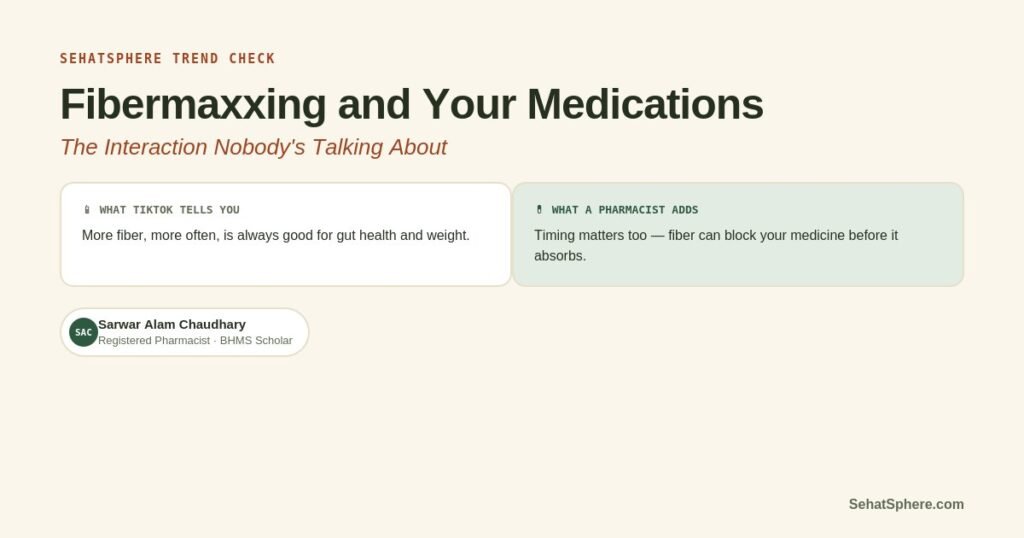
Fibermaxxing and Your Medications
The Interaction Nobody’s Talking About
TikTok’s biggest nutrition trend of 2026 is genuinely good advice — with one silent catch that no dietitian video mentions: fiber can block your medicine before it even reaches your bloodstream. Everything you need to fibermaxx safely, in one place.
What Is Fibermaxxing, and Why Is It Everywhere Right Now?
Fibermaxxing means deliberately maximizing your fiber intake throughout the day — loading meals with beans, whole grains, seeds, fruit, and vegetables instead of treating fiber as an afterthought. It’s not a new nutrient discovery; it’s fiber finally getting the spotlight protein has had for years, and by several accounts a direct reaction to “protein-maxxing” fatigue — creators and dietitians alike started asking what the next-most-neglected nutrient was, and fiber won by a landslide.
Google’s own 2026 trend data shows fiber searches at an all-time high, with “fibermaxxing” search interest up 115% in the last 90 days alone. Major outlets — Mayo Clinic, NPR, Healthline, Forbes, CNBC — have all covered it, largely favorably. On TikTok, it shows up as “plant challenges” (can you eat 30 different plants this week?), giant salad bowls, and overnight chia puddings — the aesthetic is deliberately maximalist.
📱 What TikTok tells you
Pile on the beans, oats, chia, and veggies. More fiber, more often, is basically always good — for gut health, weight, cholesterol, blood sugar.
💊 What a pharmacist adds
All true — but if you take a daily medicine, when you eat that fiber matters as much as how much. Fiber can physically bind to certain drugs in your gut before they’re absorbed.
The Real Science of Why Fiber Works
Fiber isn’t one thing — it’s a category of plant carbohydrates your body can’t digest, which is exactly why it’s useful. As it moves through your gut mostly intact, it does four distinct jobs worth understanding, not just taking on faith:
It feeds your gut bacteria. Fiber that reaches your colon is fermented by gut microbes into short-chain fatty acids (SCFAs) like butyrate — compounds that nourish the cells lining your gut, calm inflammation, and appear to influence everything from immune function to mood via the gut-brain axis — the same immune-modulation territory covered in SehatSphere’s Is Boosting Immunity Even The Right Goal?
It slows glucose absorption. Soluble fiber thickens the contents of your gut, physically slowing how fast sugar from a meal reaches your bloodstream — which is why a high-fiber meal produces a gentler blood sugar curve than the same calories with the fiber stripped out.
It binds cholesterol precursors. Soluble fiber binds bile acids (which your liver makes from cholesterol) in the gut, forcing your liver to pull more cholesterol out of your blood to make replacement bile acids — a genuine, measurable LDL-lowering mechanism, not a marketing claim.
It triggers fullness signals. Fiber-rich meals trigger satiety hormones like GLP-1 and PYY more strongly than low-fiber meals of the same calorie count, which is the actual mechanism behind fiber’s reputation for supporting weight management.
The Documented Benefits
This isn’t empty hype. Higher fiber intake is genuinely linked to better blood sugar control, lower LDL cholesterol, improved gut bacteria diversity, longer satiety, and a reduced long-term risk of heart disease, type 2 diabetes, and colorectal cancer. Population studies also associate higher fiber intake with lower all-cause mortality — people who eat more fiber tend to live longer, on average, independent of other factors researchers have controlled for. (If longevity markers interest you, SehatSphere’s Biological Longevity Audit tool covers this territory in more depth.)
Most adults fall well short of recommended intake — only about 5% of people meet daily fiber targets, and the average adult in a Western diet eats just 10–16 grams a day against a 25–38 gram target. So the underlying push behind fibermaxxing, closing that gap, is medically sound. The trend’s instinct is right even where its execution sometimes runs ahead of the evidence.
The Risks Everyone Already Warns About
Every major outlet correctly flags the same three risks. Ramping up too fast — jumping from 15g to 50g overnight overwhelms gut bacteria that haven’t adapted, causing bloating, gas, and cramping that has nothing to do with anything being “wrong” with you. Not drinking enough water — fiber pulls water into the gut, and without enough fluid intake this worsens constipation instead of relieving it. Going to genuine extremes — some creators tout 50g+ days, well past what most digestive systems adjust to comfortably even with a gradual ramp.
If you have IBS, inflammatory bowel disease, gastroparesis, or have had recent gut surgery, a sudden fiber spike can worsen symptoms meaningfully and needs your doctor’s input before you start.
06 🎯 The Part No Fibermaxxing Article Mentions
Search “fibermaxxing” and you’ll find dozens of dietitian-reviewed articles on bloating, hydration, and gradual ramp-up. Almost none mention that fiber is a well-documented cause of reduced drug absorption — a real pharmacology issue, not a fringe theory. Soluble fiber forms a gel in the gut that can physically trap medication molecules before they’re absorbed into the bloodstream, and insoluble fiber speeds up gut transit, shortening the window your body has to absorb a dose at all.
Not All Fiber Behaves the Same Way
This nuance explains why the interaction happens at all. Soluble fiber — found in oats, psyllium, chia, beans, and citrus — dissolves in water to form a thick gel. That gel is exactly what traps medication molecules and slows their release into the gut wall, which is why psyllium husk supplements carry the strongest interaction warnings. Insoluble fiber — wheat bran, vegetable skins, whole grains — doesn’t gel the same way, but it speeds up how quickly food (and anything dissolved with it) moves through your gut, shortening the absorption window instead. Most fibermaxxing meals mix both types, which is healthy for digestion but means both interaction mechanisms can be in play at once.
The Complete Medication Interaction Table
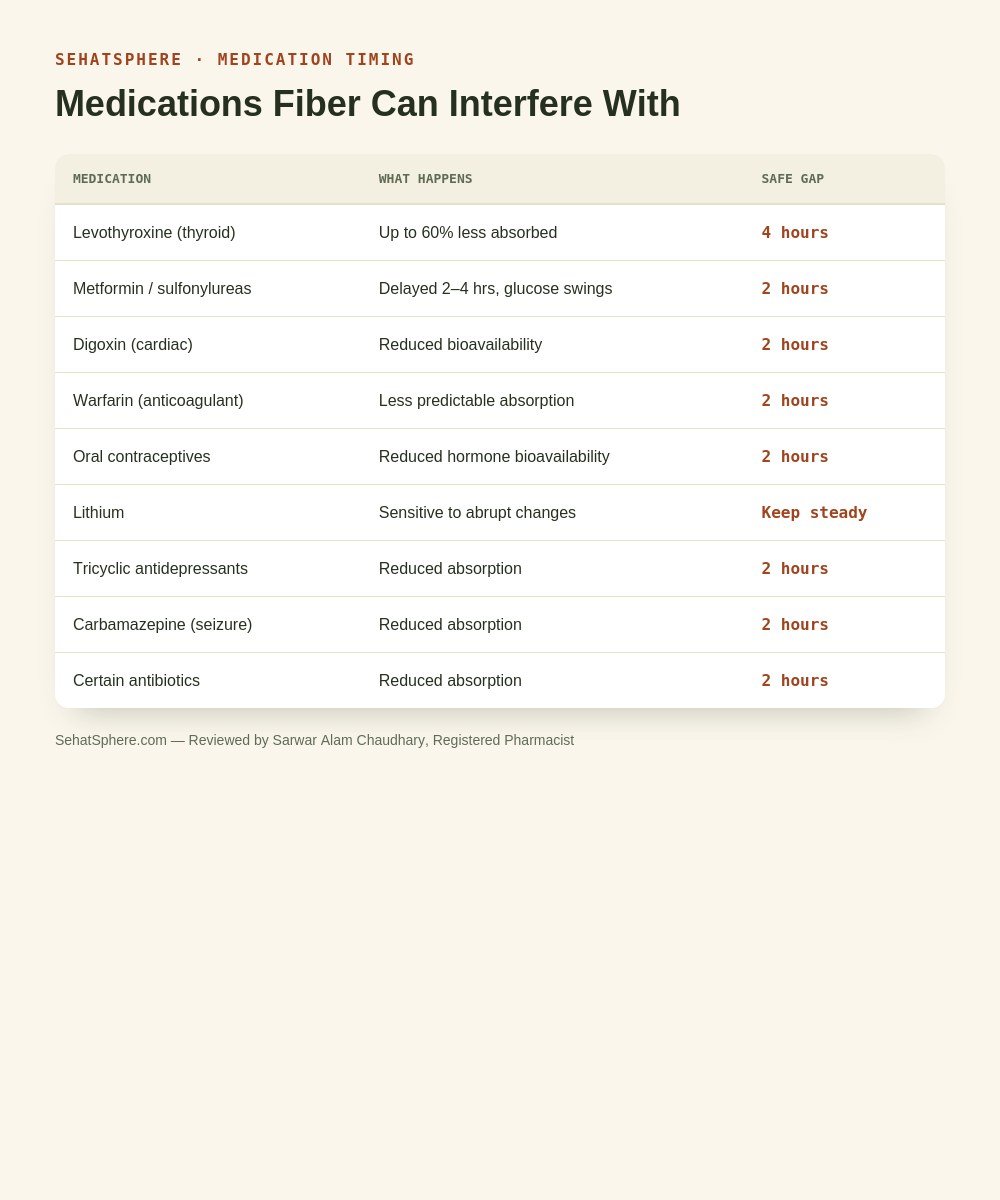
| Medication | What Happens | Safe Gap |
|---|---|---|
| Levothyroxine (thyroid) | Strongest interaction — up to 60% less absorbed | 4 hours |
| Metformin / sulfonylureas | Absorption delayed 2–4 hrs, glucose swings | 2 hours |
| Digoxin (cardiac) | Reduced bioavailability — narrow safety margin | 2 hours |
| Warfarin (anticoagulant) | Reduced, less predictable absorption | 2 hours |
| Oral contraceptives | Reduced hormone bioavailability | 2 hours |
| Lithium | Sensitive to abrupt intake changes | Keep steady |
| Tricyclic antidepressants | Reduced absorption documented | 2 hours |
| Carbamazepine (seizure) | Reduced absorption documented | 2 hours |
| Certain antibiotics | Reduced absorption with some classes | 2 hours |
This applies most strongly to concentrated fiber supplements (psyllium, methylcellulose, inulin) and very high-fiber meals eaten close to dosing — not to normal background fiber in an ordinary diet. Levothyroxine’s interaction is the best-documented and most clinically significant; it’s specifically called out on official FDA prescribing information.
Your Safe Fibermaxxing Protocol, Week by Week
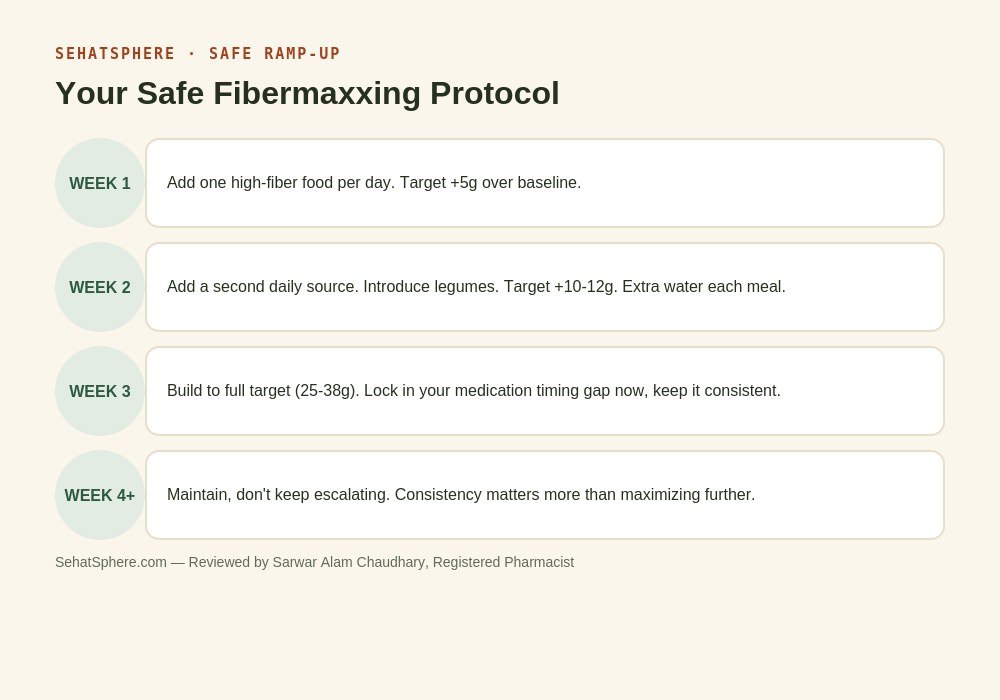
The two mistakes that cause almost every bad fibermaxxing experience — jumping too fast, and ignoring medication timing — both have the same fix: a deliberate ramp.
- Week 1: Add one high-fiber food per day (a handful of chia in your existing breakfast, an extra vegetable at dinner). Target +5g over your current baseline.
- Week 2: Add a second daily source. Introduce legumes at one meal. Target +10–12g over baseline. Drink an extra glass of water for every fiber-rich meal.
- Week 3: Build toward your full target (25–38g depending on age and sex, see the chart below). If you take any medication from the table above, lock in your dosing-to-fiber gap now, and keep it consistent daily.
- Week 4 onward: Maintain, don’t keep escalating. More isn’t automatically better past your target — consistency matters more than maximizing further.
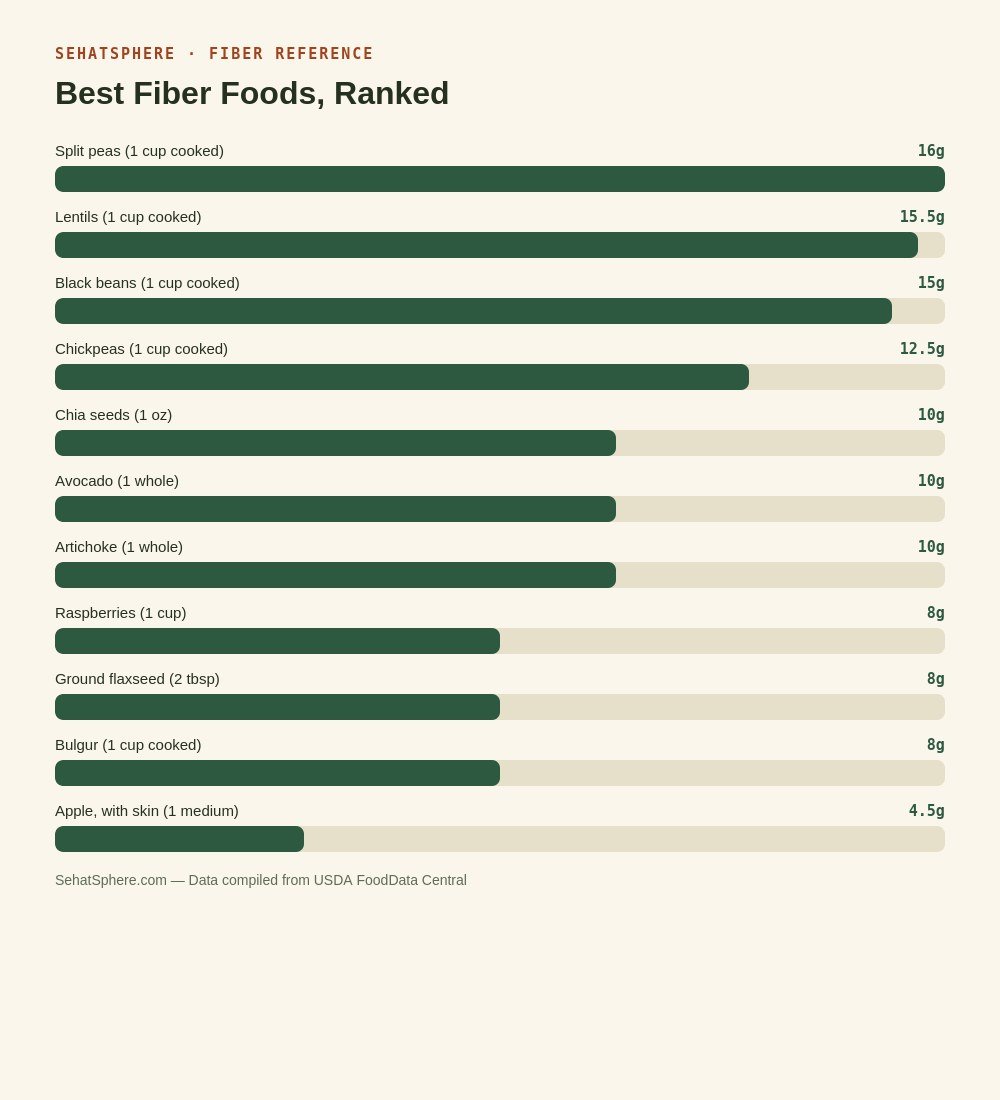
Best Fiber Foods, Ranked
| Food | Serving | Fiber |
|---|---|---|
| Split peas (cooked) | 1 cup | 16g |
| Lentils (cooked) | 1 cup | 15.5g |
| Black beans (cooked) | 1 cup | 15g |
| Chickpeas (cooked) | 1 cup | 12.5g |
| Chia seeds | 1 oz (2 tbsp) | 10g |
| Avocado | 1 whole | 10g |
| Artichoke | 1 whole | 10g |
| Raspberries | 1 cup | 8g |
| Ground flaxseed | 2 tbsp | 8g |
| Bulgur (cooked) | 1 cup | 8g |
| Apple (with skin) | 1 medium | 4.5g |
Three foods — a cup of lentils, a cup of raspberries, and an apple — already gets you to 28g, the general adult daily value, without touching a supplement.
Fiber Supplements Compared
When food alone doesn’t close the gap, supplements are a reasonable bridge — but they’re not interchangeable, and this is exactly where medication timing matters most, since supplements are far more concentrated than an equivalent food serving.
Psyllium husk (Metamucil-type) — natural, soluble, forms the strongest gel of any common supplement. Best studied, but also carries the strongest medication-binding evidence — the one to be most deliberate about timing with.
Methylcellulose (Citrucel-type) — semi-synthetic, soluble, doesn’t ferment in the gut, so it causes noticeably less gas than psyllium. A gentler starting choice for a sensitive gut.
Inulin / FOS (chicory root — common in “gut health” bars and drinks) — a strong prebiotic, but ferments heavily, meaning it’s the most likely of the four to cause bloating at high doses.
Wheat dextrin (Benefiber-type) — soluble, dissolves clear and tasteless, generally the mildest option, useful for people who want fiber without changing how a drink tastes or looks.
How Much Fiber Do You Actually Need?
| Group | Daily Target |
|---|---|
| Women, 19–50 | 25–28g |
| Men, 19–50 | 31–34g |
| Women, 51+ | ~21g |
| Men, 51+ | ~30g |
| Children | 14–25g (age-dependent) |
Most adults currently get just 10–15g a day — so the gap fibermaxxing is trying to close is real, even if “50 grams a day” isn’t the actual medical target for most people.
Common Fibermaxxing Myths, Busted
Myth: “More fiber is always better.” False past your target — extreme intake (50g+) mostly adds bloating without added benefit, and can reduce absorption of minerals like iron, zinc, and calcium if taken to genuine excess. If you’re curious whether you’re already running low on any of these, SehatSphere’s Nutrient Deficiency Symptom Finder is a free starting point.
Myth: “You need a supplement to fibermaxx properly.” False — as the table above shows, three ordinary whole foods can hit a full day’s target. Supplements are a bridge, not a requirement.
Myth: “All fiber is the same.” False — soluble and insoluble fiber do genuinely different jobs in your body, as covered above, and most health goals need both, not just whichever one is trending in a video.
Myth: “Fiber timing with medication is only a concern for elderly people.” False — the interactions apply at any age; older adults are simply statistically more likely to already be on an affected medication.
🌿 The Ayurvedic Angle
Classical Ayurveda arrived at a version of this centuries before TikTok: fibrous whole foods (sabūt anaj, phal, and shaak) were always the base of the diet, not an add-on — but timing relative to medicine (aushadh sevan kaal) was just as deliberate. The general Ayurvedic instruction to take many herbal formulations on an empty stomach, away from heavy meals, lines up surprisingly well with the modern pharmacological advice above — two very different frameworks arriving at the same practical answer.
The Indian Diet Advantage
A traditional Indian thali is, structurally, already close to a fibermaxxing plate — dal (lentils), sabzi (vegetables), a whole-grain roti, and salad, several times a week, without needing a trend name for it. The gap most Indian diets actually have isn’t fiber awareness, it’s consistency — white rice, refined maida, and low-fiber snacking crowding out what a traditional plate already got right. If you’re eating a fairly traditional home-cooked thali most days, you may be closer to your fiber target than the trend’s messaging assumes — the medication-timing advice above still applies just as much, since dal and roti are genuinely high in exactly the fiber types that matter for absorption.
Fibermaxxing If You Have Diabetes or Heart Disease
These two groups have the most to gain from fibermaxxing — and also the highest odds of being on an interacting medication, which makes doing this deliberately rather than casually genuinely worth it. (If you track blood pressure at home, SehatSphere’s guides on normal ranges by age and common monitor errors are useful companions.)
Diabetes: Soluble fiber’s blood-sugar-slowing effect is one of its best-studied benefits, and higher fiber intake is independently linked to better long-term glucose control. But if you’re on metformin or a sulfonylurea, the 2-hour separation from the table above isn’t optional advice — it’s the difference between steady glucose control and unpredictable swings, since both the drug and the fiber are competing for the same absorption window.
Heart disease / high cholesterol: Soluble fiber’s cholesterol-binding effect is genuinely useful alongside statin therapy, not a replacement for it. If you also take digoxin or warfarin, the timing gap matters more here than almost anywhere else in this guide, given how narrow those drugs’ safety margins are — this is worth a specific conversation with your cardiologist, not just your general practitioner, if you’re increasing fiber substantially.
How to Track Your Fiber Without Obsessing Over It
You don’t need to weigh every meal. A simpler approach: check the nutrition label’s “Dietary Fiber” line on packaged foods once a week to build a rough mental map of what your regular meals already contain, then consciously add one fiber-dense food (from the ranked list above) to whichever meal is currently lowest. Most food-tracking apps calculate fiber automatically if you’re already logging meals for another reason — you don’t need a separate system, just a glance at a number you’re probably already recording.
Quick Glossary
Soluble fiber — dissolves in water, forms a gel; slows digestion and binds cholesterol precursors.
Insoluble fiber — doesn’t dissolve; adds bulk and speeds gut transit.
SCFA (short-chain fatty acid) — a compound gut bacteria produce by fermenting fiber; nourishes the gut lining.
Bioavailability — the proportion of a drug dose that actually reaches your bloodstream intact.
Prebiotic — a fiber type specifically chosen by gut bacteria as fuel, like inulin.
Narrow therapeutic range — a drug where the effective dose and the harmful dose are close together, like digoxin or warfarin, making absorption changes riskier.
What Doctors and Dietitians Actually Agree On
Strip away the disagreements about exact gram targets, and there’s real consensus across every clinical source in this guide: fiber is under-consumed almost everywhere, the health case for closing that gap is solid, the ramp needs to be gradual with adequate water, and anyone on regular medication should build in a timing buffer rather than treating fiber and pills as unrelated parts of the day. Nothing in fibermaxxing is inherently risky when done this way — the risk is entirely in the gap between a 60-second video and a full picture.
Fibermaxxing During Pregnancy or Breastfeeding
Fiber needs actually rise slightly during pregnancy (closer to 28g daily is commonly advised), and it can genuinely help with a common pregnancy complaint — constipation from iron supplements and hormonal changes. The same gradual-ramp, plenty-of-water approach applies. The one addition: if you’re on prenatal vitamins or an iron supplement, keep the same 2-hour separation logic from the table above, since fiber can reduce iron absorption too — take your iron and your fiber-heavy meal a couple of hours apart rather than together.
✅ The Bottom Line
Fibermaxxing deserves the hype — most people genuinely are under-eating fiber, and the health case for closing that gap is real. The trend isn’t wrong; it’s just incomplete. Ramp up gradually, drink enough water, and if you take any regular medication, build in the timing gap from the table above. That’s the entire difference between doing this trend well and doing it by accident.
Frequently Asked Questions
The questions people ask once they realize fibermaxxing and medication timing can collide:
Can I still fibermaxx if I take daily medication?
Yes, in almost all cases — you just need to separate timing. It’s rarely a reason to avoid fiber, only a reason to be deliberate about when you eat it relative to your dose.
Does this apply to fiber from food, or just supplements?
Both, but supplements (psyllium, inulin, methylcellulose) are more concentrated and pose a bigger risk than an ordinary high-fiber meal. A large fiber-heavy breakfast close to dosing still matters, especially for levothyroxine.
How do I know if fiber is affecting my medication?
You usually can’t tell from symptoms alone — it often shows up as an unexplained shift in routine blood tests (like TSH for thyroid or INR for warfarin). SehatSphere’s Blood Report Decoder tool can help you understand what a shift in those numbers actually means. If you’ve started fibermaxxing and your next lab result looks off, mention the timing change to your doctor.
What is fibermaxxing exactly?
A 2026 nutrition trend, popularized on TikTok, of deliberately maximizing daily fiber intake through whole foods like beans, whole grains, seeds, fruits, and vegetables — sometimes with added fiber supplements.
Is fibermaxxing safe for older adults?
Generally yes, and often especially beneficial, but older adults are more likely to be on exactly the medications in the table above — making the timing gap more important, not less.
Can too much fiber cause nutrient deficiencies?
At genuine extremes (50g+ daily, sustained), fiber can modestly reduce absorption of minerals like iron, zinc, and calcium — another reason “more is always better” isn’t quite right.
What’s the difference between soluble and insoluble fiber, in one line?
Soluble fiber gels and slows things down (better for cholesterol and blood sugar); insoluble fiber bulks up stool and speeds transit (better for regularity).
Should I take my medication before or after a high-fiber meal?
Before, as a default — most guidance separates dosing from fiber intake by taking the medicine first, then waiting the recommended gap before a high-fiber meal or supplement.
📚 Sources
- FDA/DailyMed — Official Levothyroxine Prescribing Information
- Mayo Clinic Press — Is Fibermaxxing Good for You?
- NPR — The Fibermaxxing Trend Has Real Benefits
- The People’s Pharmacy — Levothyroxine and Fiber
- NIH/PMC — Metformin and Supplemental Fiber Interaction
- Google — Summergeist 2026 Trends Report
- MyFoodData — Foods Highest in Dietary Fiber (USDA data)
Medical disclaimer: This article on fibermaxxing and medication timing is for general education only, not medical advice. Never change how or when you take a prescribed medicine without talking to your doctor or pharmacist first.