

The Complete Guide to Blood Pressure: All 5 Categories, Causes & When to Worry
Every number, every category, in one reference — with links to the full story behind each.
Patients rarely ask me what a “normal” blood pressure actually is until they’re already holding a reading that worries them. This guide is the reference I wish more people had before that moment — the official categories, what actually moves the numbers day to day, and direct links to the deeper guides on this site covering fluctuation, anger, and heart-attack risk specifically.
The Official Blood Pressure Categories
| Category | Systolic (mm Hg) | Diastolic (mm Hg) |
|---|---|---|
| Normal | Below 120 | and Below 80 |
| Elevated | 120–129 | and Below 80 |
| Stage 1 Hypertension | 130–139 | or 80–89 |
| Stage 2 Hypertension | 140 or higher | or 90 or higher |
| Hypertensive Crisis | Above 180 | and/or Above 120 |
Source: American Heart Association [1]. A crisis-range reading with chest pain, shortness of breath, or vision changes needs emergency care immediately.
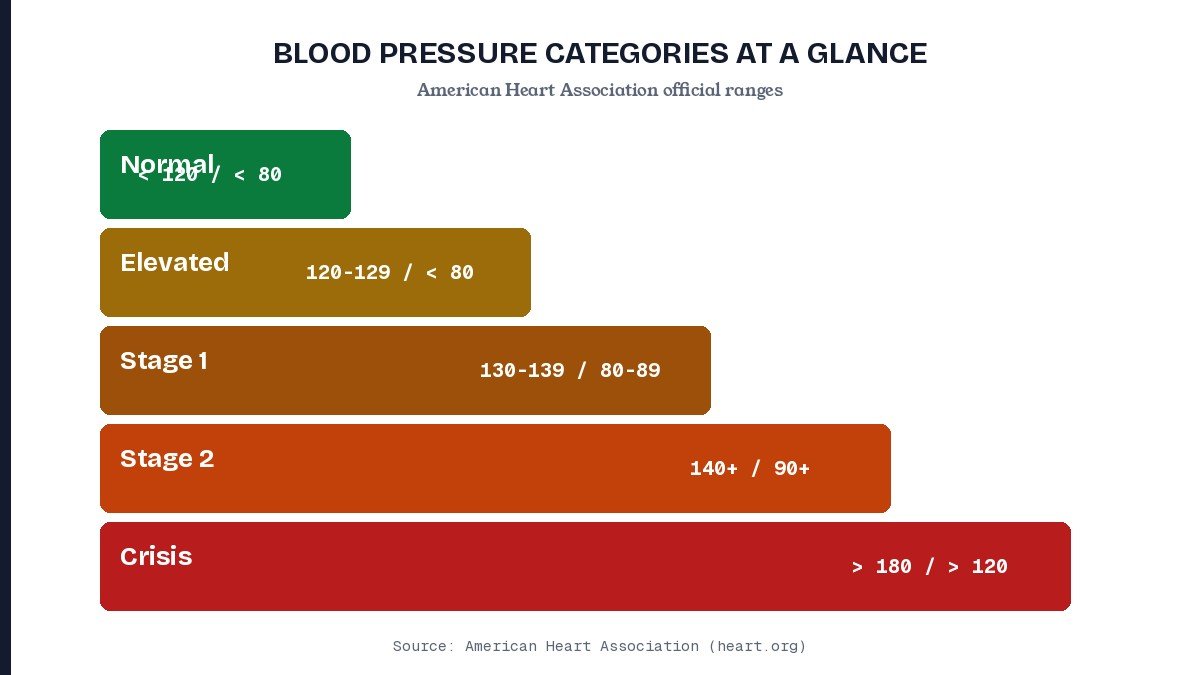
The same categories, visualized — worth saving for quick reference.
What Actually Raises Blood Pressure
Before reaching for the reasons a single reading might be high, it helps to separate the factors that shift blood pressure temporarily from those that raise it persistently over time.
Genetics and age
Family history meaningfully raises risk, and arteries naturally stiffen with age, which is why blood pressure tends to climb gradually across adulthood even in otherwise healthy people.
Sodium intake
Excess dietary sodium causes the body to retain more fluid, increasing blood volume and pressure. This is a major reason ultra-processed foods — which are typically sodium-dense — are so closely tied to hypertension risk.
Weight and metabolic health
Excess body weight increases the workload on the heart and is closely linked to insulin resistance, which independently raises blood pressure. This overlap is part of why GLP-1 weight management has become relevant to blood pressure control for many patients.
Sleep and stress
Poor sleep and chronic stress both keep the nervous system in a heightened state, which sustains elevated blood pressure over time rather than allowing it to settle overnight. Our Mental Stress guide covers reduction techniques that have a measurable downstream effect here.
Underlying conditions and medications
Kidney disease, thyroid disorders, and certain medications — including some NSAIDs, decongestants, and hormonal contraceptives — can raise blood pressure as a side effect. If you’re checking whether a supplement or medication combination might be a factor, the Medication Constellation tool is built for exactly this cross-check.
White Coat vs. Masked Hypertension
Two clinical patterns worth knowing if your readings seem inconsistent between settings:
White coat hypertension is when blood pressure runs high specifically in a clinical setting — often from genuine anxiety about the appointment — while home readings stay normal. Masked hypertension is the opposite and more concerning pattern: normal readings at the doctor’s office, but elevated readings at home, meaning it can go undetected during routine visits [5].
This is precisely why home monitoring matters as a complement to clinical readings, not a replacement for them.
Choosing a Home Blood Pressure Monitor
Not every device on the market is equally accurate. A few things worth checking before buying:
- Upper-arm cuffs over wrist monitors — arm cuffs are consistently more accurate; wrist devices are more sensitive to positioning errors.
- Validated device lists — look for devices independently validated for clinical accuracy rather than relying on marketing claims alone.
- Correct cuff size — an undersized cuff on a larger arm reads artificially high, and vice versa.
- Bring it to your next appointment — comparing your home device against a clinical reading once confirms it’s reasonably accurate.
🩺 Quick Category Checker
Enter a reading to see which category it falls into.
Systolic vs. Diastolic, Explained Simply
The top number, systolic pressure, measures the force in your arteries when your heart contracts and pushes blood out. The bottom number, diastolic pressure, measures the force when your heart relaxes between beats [2]. Both matter — a reading can fall into a higher category based on either number alone.
Beyond the single-reading categories above, research has linked significant visit-to-visit blood pressure variability — not just the average number — to independently higher cardiovascular risk, including stroke and heart failure [4]. This is part of why fluctuation itself, not only elevated averages, is worth tracking.
Managing Blood Pressure: The General Framework
Treatment for elevated readings typically starts with lifestyle changes, with medication added based on category and individual risk factors:
Dietary approach (DASH)
The DASH diet — rich in fruits, vegetables, whole grains, and low-fat dairy while limiting sodium — remains the most evidence-backed dietary pattern for blood pressure control, with measurable drops in systolic pressure documented within weeks of consistent adherence [1]. If mineral intake is part of your strategy, our Sea Moss and Your Medications guide covers the potassium angle specifically, since potassium-rich foods are a core part of the DASH approach.
Physical activity
Regular aerobic activity — even brisk walking most days — has a genuine blood-pressure-lowering effect independent of weight loss. If you’re exploring recovery-adjacent practices like sauna or cold plunge alongside exercise, both have real cardiovascular effects worth understanding if you’re also managing blood pressure medication.
Medication, when needed
Stage 2 hypertension, and Stage 1 with additional risk factors like diabetes or kidney disease, typically calls for medication alongside lifestyle changes. If you’re newly on blood pressure medication and want to understand the full safety picture, our Complete Guide to Medicine Safety and the Medication + Lifestyle Checker are the right next stops.
The Complete SehatSphere Blood Pressure Library
This guide covers the reference numbers. For the deeper stories behind why your own readings move the way they do, these are the full guides:
How to Measure Blood Pressure Correctly at Home
A poorly-taken reading can be off by 10 mm Hg or more — enough to shift categories entirely. The American Heart Association recommends:
- Sit in a chair with your back supported, feet flat on the floor — not on a couch or bed edge.
- Rest your arm on a table so the cuff sits at heart level.
- Stay quiet and still for 5 minutes before measuring.
- Avoid talking during the reading, and don’t measure right after caffeine, exercise, or a full bladder.
- Take two readings, one minute apart, and record both [3].
When to Actually Worry
A reading above 180/120 mm Hg accompanied by chest pain, shortness of breath, back pain, numbness, weakness, vision changes, or difficulty speaking is a hypertensive emergency. Call emergency services immediately — do not wait to see if it comes down on its own [1].
Without those symptoms, the AHA recommends waiting a minute, remeasuring, and calling your doctor if the second reading is still in crisis range. Occasional elevated readings from stress, caffeine, or a stressful appointment are common and not automatically an emergency — context and symptoms matter more than a single number.
If your own readings fluctuate more than you’d expect, the full Blood Pressure Fluctuation guide walks through the 12 most common causes and a practical 7-day stabilization plan. For a broader medication-safety framework, see the Complete Guide to Medicine Safety, and if you’re managing multiple prescriptions, the Medication Constellation tool can cross-check your full list.
Frequently Asked Questions
What is considered normal blood pressure?
According to the American Heart Association, normal blood pressure is below 120 systolic and below 80 diastolic (under 120/80 mm Hg).
What is the difference between systolic and diastolic pressure?
Systolic (the top number) measures pressure when your heart beats; diastolic (the bottom number) measures pressure when your heart rests between beats.
What is a hypertensive crisis?
A reading above 180 systolic and/or above 120 diastolic. If accompanied by chest pain, shortness of breath, vision changes, or difficulty speaking, it’s a hypertensive emergency requiring immediate emergency care.
Why does blood pressure fluctuate throughout the day?
Blood pressure naturally rises and falls with activity, stress, meals, sleep, and body position. Significant or unexplained fluctuation can also point to an underlying condition worth discussing with a doctor.
Can anger or stress really raise blood pressure?
Yes, acutely. Anger and acute stress trigger a surge of stress hormones that temporarily raise blood pressure, and frequent episodes may contribute to longer-term cardiovascular strain.
Is fluctuating blood pressure linked to heart attack risk?
Significant blood pressure variability has been associated with increased cardiovascular risk in research, including in younger adults, making it worth monitoring rather than dismissing as normal noise.
How do I measure blood pressure correctly at home?
Sit with your back supported, feet flat on the floor, arm supported at heart level, stay quiet for 5 minutes beforehand, and avoid talking during the measurement, per American Heart Association guidance.
What blood pressure reading means I should call a doctor immediately?
Above 180/120 mm Hg, especially with chest pain, shortness of breath, back pain, numbness, weakness, vision changes, or difficulty speaking, warrants calling emergency services immediately.
How often should I check my blood pressure?
For most adults monitoring at home, once daily at a consistent time is reasonable; your doctor may recommend more frequent checks if you’re adjusting medication or have unstable readings.
The Bottom Line
Blood pressure is one number pair that genuinely rewards paying attention to — not through anxiety over every fluctuation, but through knowing the categories, measuring it correctly, and understanding what’s actually driving your own readings. This guide is the map; the linked posts above are where the real depth lives.
If mental stress is a regular trigger for you, our Mental Stress guide covers reduction techniques beyond blood pressure alone. If you’re checking whether you’re missing a nutrient that affects cardiovascular health, the free Nutrient Deficiency Symptom Finder is worth ten minutes, and our Taurine and Your Medications guide covers a specific mineral with its own real blood-pressure interaction.
For a broader look at cardiovascular aging beyond blood pressure alone, the free Biological Age Test is worth exploring. Explore the full Free Health Tools Library, or read about our editorial standards on About Us.
Sources
- “Understanding Blood Pressure Readings” & “Life’s Essential 8 – How to Manage Blood Pressure.” American Heart Association. heart.org
- “Blood pressure chart: What your reading means.” Mayo Clinic. mayoclinic.org
- “How to Manage Blood Pressure Fact Sheet.” American Heart Association, Life’s Essential 8. heart.org
- “Visit-to-visit Variability of Blood Pressure and Risk of Stroke: Results of the Kailuan Cohort Study.” PMC, National Institutes of Health. ncbi.nlm.nih.gov
- “White coat hypertension.” Mayo Clinic. mayoclinic.org
Medical Disclaimer: This article is for educational purposes and reflects general pharmacist guidance, not individualized medical advice. Always consult your doctor about your specific blood pressure readings and treatment plan.