 SehatSphere.com
Sea Moss and Your Medications: A Pharmacist’s Warning
Sea moss comes up in my pharmacy more than almost any other supplement right now — usually from patients who started it for “gut health” after seeing it on their feed, not because a doctor recommended it. Most of the time I’m not worried. But does sea moss interact with medications? For thyroid, blood pressure, diabetes, and blood-thinning drugs specifically — yes, in ways most influencer content never mentions.
Key takeaways:
- Sea moss’s iodine content varies unpredictably batch to batch, which can destabilize thyroid medication like levothyroxine.
- It can also amplify blood pressure drugs, diabetes medication, and interfere with blood thinners like warfarin.
- It isn’t dangerous for everyone — but if you take any daily prescription, it deserves more caution than a TikTok recipe suggests.
What Sea Moss Actually Is
Sea moss, technically Chondrus crispus and often sold interchangeably with Irish moss, is a red algae harvested along Atlantic coastlines. It gets blended into a gel, dried into capsules, or turned into gummies, and marketed as a source of “92 of the 102 minerals your body needs” — a claim that shows up on nearly every label and has never been independently verified against any single product.
Strip away the marketing and what you actually have is a mineral-dense sea vegetable, genuinely rich in iodine, potassium, calcium, and magnesium. That’s not nothing. But “mineral-dense” cuts both ways — it’s exactly why sea moss and your medications deserve a real conversation, not just enthusiasm.
What’s Actually In Sea Moss
| Component | What It Does |
|---|---|
| Iodine | 4–7 mcg per gram of dried sea moss — highly variable by source |
| Potassium | Naturally high; relevant for blood pressure medication |
| Calcium & magnesium | Present in meaningful amounts, generally low-risk |
| Vitamin K | Relevant for anyone on warfarin |
| Carrageenan (fiber) | The natural gel-forming compound that gives sea moss its texture |
| Trace heavy metals | Arsenic, cadmium, lead, mercury — absorbed from seawater, varies by sourcing |
No two jars are guaranteed to match. Unlike a levothyroxine tablet, dosed to the microgram and tested for consistency batch after batch, a jar of sea moss gel has no such guarantee — you genuinely don’t know how much iodine (or heavy metal) is in your spoonful, and neither does the seller.
The Iodine Problem Nobody’s Actually Measuring
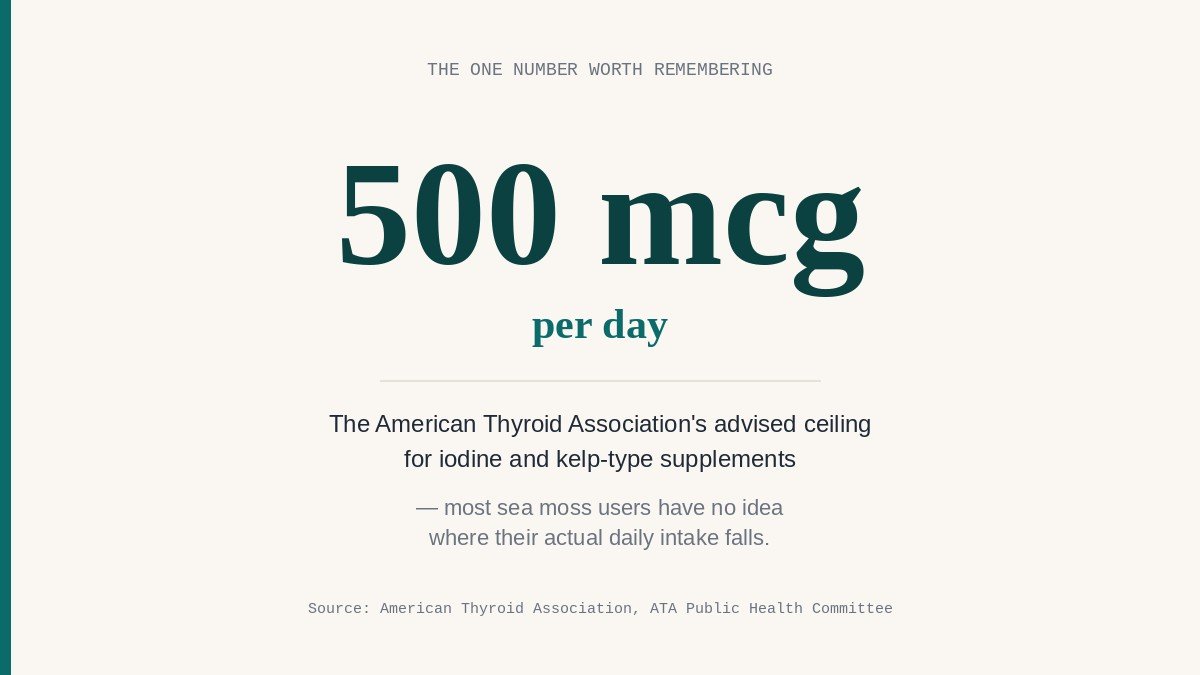
The Tolerable Upper Intake Level for iodine is 1,100 micrograms a day — and the American Thyroid Association specifically advises against iodine or kelp supplements exceeding 500 micrograms daily.
This matters because of two named physiological effects in endocrinology literature: the Wolff-Chaikoff effect, where a sudden iodine surge temporarily shuts thyroid hormone production down, and the Jod-Basedow effect, where excess iodine triggers the opposite — overproduction, especially in people with nodular thyroid disease. Sea moss can theoretically push either direction, and because dosing is inconsistent, it’s genuinely hard to predict which one you’ll get.
Northwestern Medicine advises anyone taking thyroid medication who wants to try sea moss to get a baseline thyroid lab before starting, then a follow-up six to eight weeks later — specifically because “taking additional iodine can alter your medication dosage.”
Medications Sea Moss Can Actually Interact With
| Medication | Concern | Why |
|---|---|---|
| Thyroid (levothyroxine, methimazole) | Most documented interaction | Variable iodine load can blunt or exaggerate hormone effects |
| Blood pressure (ACE inhibitors, potassium-sparing diuretics) | Potassium amplification | Sea moss is naturally potassium-rich |
| Diabetes (insulin, metformin) | Possible hypoglycemia risk | Seaweed fiber can modestly lower blood sugar |
| Blood thinners (warfarin) | INR fluctuation | Contains vitamin K, the same nutrient warfarin patients must keep consistent |
If you take levothyroxine, separate it from sea moss by at least four hours to reduce absorption interference — don’t treat the timing as optional. And this same mineral-interaction logic applies broadly; it’s the same principle covered in our Blood Pressure Fluctuation guide — potassium is good for most people, until it’s compounding with a drug already designed to raise it.
If you’re managing more than one of these medications at once, the Medication Constellation interaction tool is a faster way to cross-check a full list.
What To Read Next
- Complete Guide to Medicine Safety: The broader framework for using medicines safely alongside supplements.
- Moringa & Your Medications: Another mineral-dense supplement with its own interaction profile.
- Ashwagandha & Your Medications: How this popular adaptogen interacts with common prescriptions.
The Heavy Metal Angle Most Sea Moss Content Skips
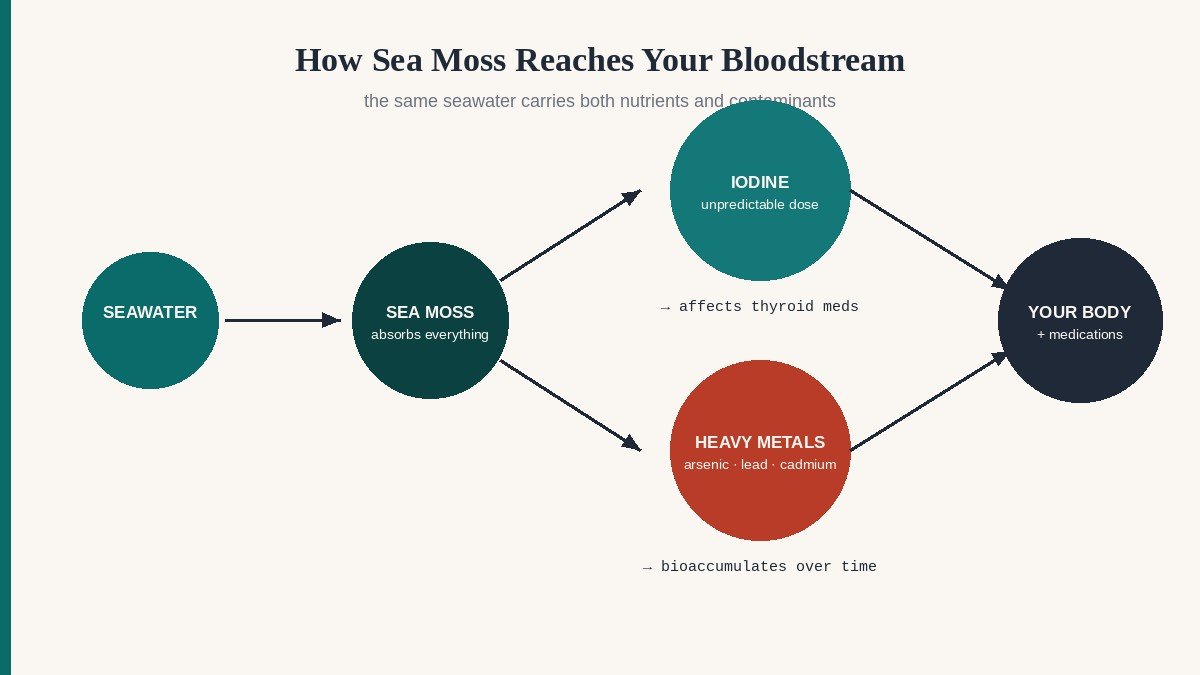
Iodine gets most of the attention, but it’s only half the risk profile. Sea moss grows by absorbing whatever is dissolved in the surrounding seawater — arsenic, cadmium, lead, and mercury right alongside the potassium and calcium being marketed on the label. A 2025 study covered by National Geographic found regular seaweed consumption is associated with measurable heavy metal accumulation, with researchers flagging kidney dysfunction, neurological effects, and elevated cancer risk at higher intake levels.
The European Food Safety Authority conducted a formal dietary exposure assessment specifically on seaweed, heavy metals, and iodine intake, concluding that seaweed consumption is genuinely relevant to overall heavy metal exposure and needs continued monitoring. Most sea moss sold through social media or small sellers isn’t independently tested for either iodine or heavy metals.
Most sea moss content addresses iodine risk or heavy metal risk, rarely both together. But they compound: someone eating sea moss daily for its iodine is, by definition, also increasing heavy metal exposure at the same rate — with no label telling them either number.
Who Should Avoid Sea Moss Entirely
- Hashimoto’s or Graves’ disease — autoimmune thyroid conditions are especially sensitive to iodine swings.
- Warfarin without regular INR monitoring — the vitamin K content is harder to manage without lab tracking.
- Reduced kidney function — both the potassium load and heavy metal clearance become more relevant.
- Pregnancy or breastfeeding — iodine sensitivity is heightened; check with your doctor first.
- Already taking kelp, iodized salt supplements, or a high-dose multivitamin with iodine — don’t stack iodine sources.
Why Some Doctors Are Cautious About Sea Moss
This isn’t blanket dismissal — it’s a specific, reasonable set of concerns:
- Untested, unregulated dosing. Two jars of gel from different sellers can have very different iodine and mineral content, with no standardization.
- Limited direct clinical research. Most of the evidence cited for sea moss comes from broader seaweed or iodine research, not trials on sea moss itself.
- Unverified sourcing. Heavy metal bioaccumulation risk depends entirely on where and how it was harvested — information most sellers don’t provide.
- Marketing outpacing evidence. Claims like “92 of 102 minerals” sound precise but aren’t independently verified per product.
Myths I Hear Constantly
“It’s natural, so it can’t interact with medication.”
Natural just means it came from a plant or algae, not that it’s pharmacologically inert. Grapefruit is natural too, and it’s one of the most-flagged food-drug interactions in pharmacy.
“More is better — a heaping spoonful is fine.”
This is where most of the risk actually lives. A modest, consistent amount is very different from the overflowing tablespoon shown in most content.
“If it were dangerous, it would be regulated.”
Dietary supplements in most markets, including the US and India, aren’t pre-approved for safety the way prescription medications are.
What I Actually Tell Patients
If someone is already taking sea moss, or clearly plans to regardless, here’s the realistic harm-reduction version:
- Buy only from a brand that publishes third-party lab results for iodine and heavy metals — not just a marketing claim.
- Start with half a teaspoon of gel, not a heaping spoonful, and hold there for two weeks before increasing.
- If you’re on levothyroxine, take sea moss at least four hours apart from your dose.
- Ask for baseline thyroid labs before starting, and a follow-up around six to eight weeks in.
- Skip it entirely if you have Hashimoto’s, Graves’ disease, unmonitored warfarin use, or reduced kidney function.
- Never stack it with kelp, iodized salt supplements, or a high-dose multivitamin containing iodine.
Not sure what nutrients you’re actually low on before adding something new? The Nutrient Deficiency Symptom Finder is a better starting point than guessing from a trend.
Frequently Asked Questions
What is sea moss, exactly?
Sea moss (Chondrus crispus, also called Irish moss) is a red algae harvested along Atlantic coastlines, sold as raw dried thallus, gel, capsules, or gummies.
Does sea moss actually work for what it claims to help with?
Evidence is thin. Most claims rest on its mineral and fiber content rather than direct clinical trials on sea moss itself. It’s closer to a mineral-dense food than a proven therapeutic supplement.
Can I take sea moss with levothyroxine?
Talk to your doctor first. Its iodine content can shift thyroid hormone production in either direction, which can destabilize a carefully titrated dose.
How much iodine is actually in sea moss?
Roughly 4 to 7 micrograms per gram of dried sea moss, but this varies significantly by species, harvest region, and processing.
Does sea moss interact with blood pressure medication?
Potentially. It’s naturally potassium-rich, which can amplify the effect of ACE inhibitors and potassium-sparing diuretics.
Is sea moss safe with metformin or insulin?
Use caution. Seaweed-derived fiber can modestly lower blood sugar, which combined with insulin or metformin could increase hypoglycemia risk.
Can sea moss affect blood thinners like warfarin?
Yes. It contains vitamin K, which can interfere with warfarin’s mechanism and potentially alter INR levels if intake is inconsistent.
Is the heavy metal risk in sea moss actually significant?
It depends entirely on sourcing. Sea moss bioaccumulates arsenic, cadmium, lead, and mercury from seawater. Third-party tested products carry meaningfully lower risk.
Who should avoid taking sea moss?
People with Hashimoto’s or Graves’ disease, unmonitored warfarin use, reduced kidney function, or who are pregnant should avoid it or check with a doctor first.
Why don’t some doctors recommend sea moss?
Concerns include unregulated dosing, limited direct clinical research on sea moss itself, unverified sourcing, and marketing claims that outpace the evidence.
What’s actually in sea moss?
Mainly iodine, potassium, calcium, magnesium, vitamin K, and carrageenan fiber — along with trace heavy metals absorbed from seawater.
How do I take sea moss more safely if I’m on medication?
Choose a third-party tested brand, start with a small dose, separate it from your medication by at least 4 hours, and get baseline and follow-up labs if you’re on thyroid, blood pressure, diabetes, or blood-thinning medication.
The Bottom Line
Sea moss and your medications aren’t automatically incompatible — plenty of people use it thoughtfully alongside a stable regimen without issue. What’s worth pushing back on is the framing that it’s risk-free just because it’s algae instead of a pill. If you’re on thyroid, blood pressure, diabetes, or blood-thinning medication, the honest answer is: probably fine in moderation, from a tested source, with your doctor looped in.
- Staiger B. Sea Moss – Levothyroxine Interaction Details. HelloPharmacist. hellopharmacist.com
- Health Benefits and Risks of Sea Moss: What You Should Know. Northwestern Medicine. nm.org
View All References (6) ▾
- ATA Statement on the Potential Risks of Excess Iodine Ingestion and Exposure. American Thyroid Association. thyroid.org
- Sea moss has become a billion-dollar health trend. Is it worth the hype? National Geographic. nationalgeographic.com
- Dujardin B, et al. Dietary exposure to heavy metals and iodine intake via seaweeds. EFSA Journal, 2023. pmc.ncbi.nlm.nih.gov
- Iodine – Consumer. Office of Dietary Supplements, National Institutes of Health. ods.od.nih.gov
Why Trust This Guide?