 SehatSphere.com
Creatine and Your Blood Test: Why Your “Kidney Problem” Might Just Be Muscle
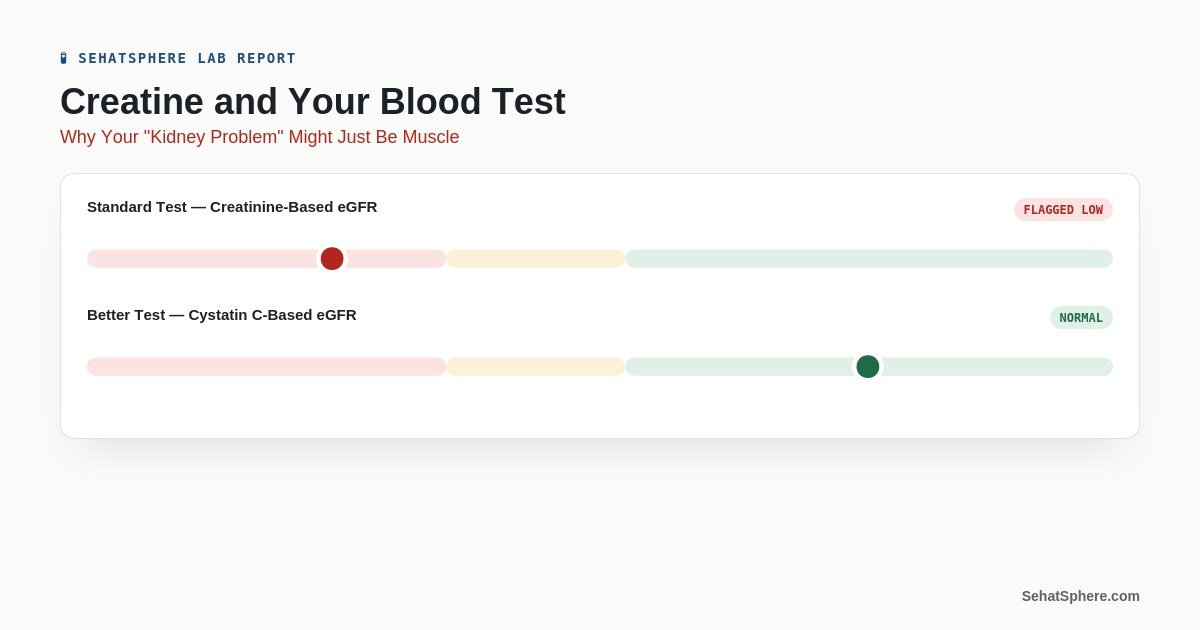
Creatine is one of the fastest-growing supplements of 2026, and almost nobody taking it knows it can flag a routine blood test as a kidney problem that isn’t real. Understanding creatine and blood test results together is the entire point of this guide. The lab value changes. The kidney behind it does not.
Key takeaways:
- Creatine converts into creatinine daily — the exact marker doctors use to calculate kidney function (eGFR). More creatine intake pushes creatinine up and calculated eGFR down, without any real change in kidney health.
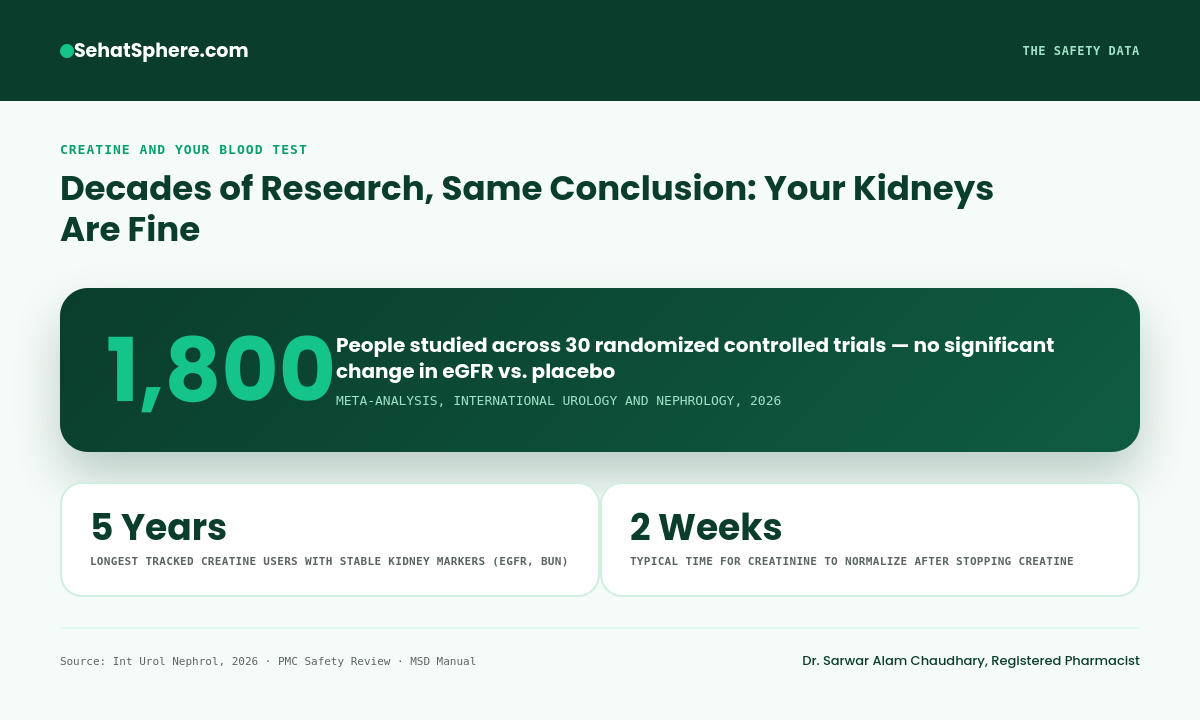
- Long-term studies, including up to 5 years of use and a 30-trial meta-analysis (1,800 people), show no real kidney damage in healthy adults at standard doses.
- A different test — cystatin C — measures kidney function independent of muscle mass and creatine, and gives a more accurate picture for supplement users.
- Real symptoms (swelling, blood in urine, persistent nausea) are never “just creatine” — those need medical attention regardless of what’s in your lab report.
- What’s actually happening
- How long to stop before testing
- Kidney vs. liver: different questions
- Real kidney warning signs
- The better test nobody mentions
- Real medication interactions
- Creatine for women
- Hair loss: the evidence
- Which type of creatine
- Questions people don’t ask out loud
- Quick self-check
- FAQs
Creatine and Blood Test: What’s Actually Happening
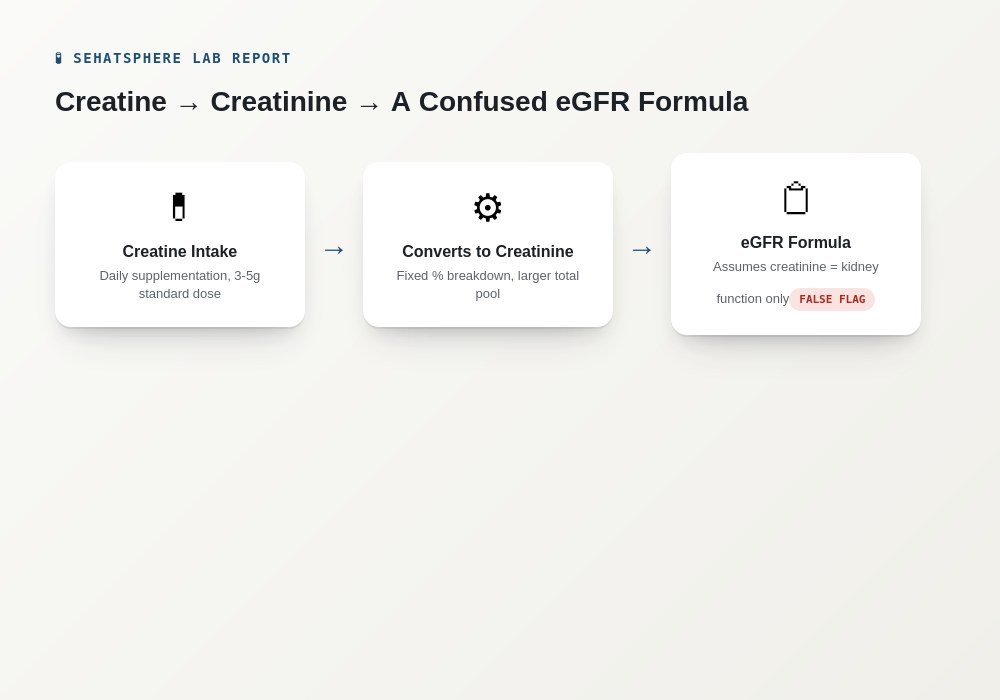
Your body converts a fixed percentage of the creatine you take in into creatinine — a waste product — every single day, roughly 1.6–1.7% of your total creatine pool. Your kidneys normally filter this out without issue. The standard eGFR (estimated glomerular filtration rate) formula doctors use to judge kidney health is calculated from your blood creatinine level, on the assumption that creatinine only comes from ordinary muscle turnover.
Add a creatine supplement, and that assumption breaks. More creatine intake means a larger total creatine pool, which produces more absolute creatinine output — pushing measured creatinine up and calculated eGFR down, mimicking exactly what reduced kidney function looks like on paper, even though your real kidneys never slowed down at all.
This matters more in 2026 than ever, because creatine has crossed over from a niche bodybuilding supplement into mainstream daily use, including many first-time users who’ve never had a “flagged” lab result before and don’t have context for what it means. Very few common supplements are metabolized into a compound that a standard organ-function test happens to measure directly — creatine is somewhat unique in that its waste product is the exact marker doctors use to judge kidney health.
The Same Kidneys, Two Different “Results”
| Test Used | Result |
|---|---|
| Standard creatinine-based eGFR | Flagged Low |
| Cystatin C-based eGFR | Normal |
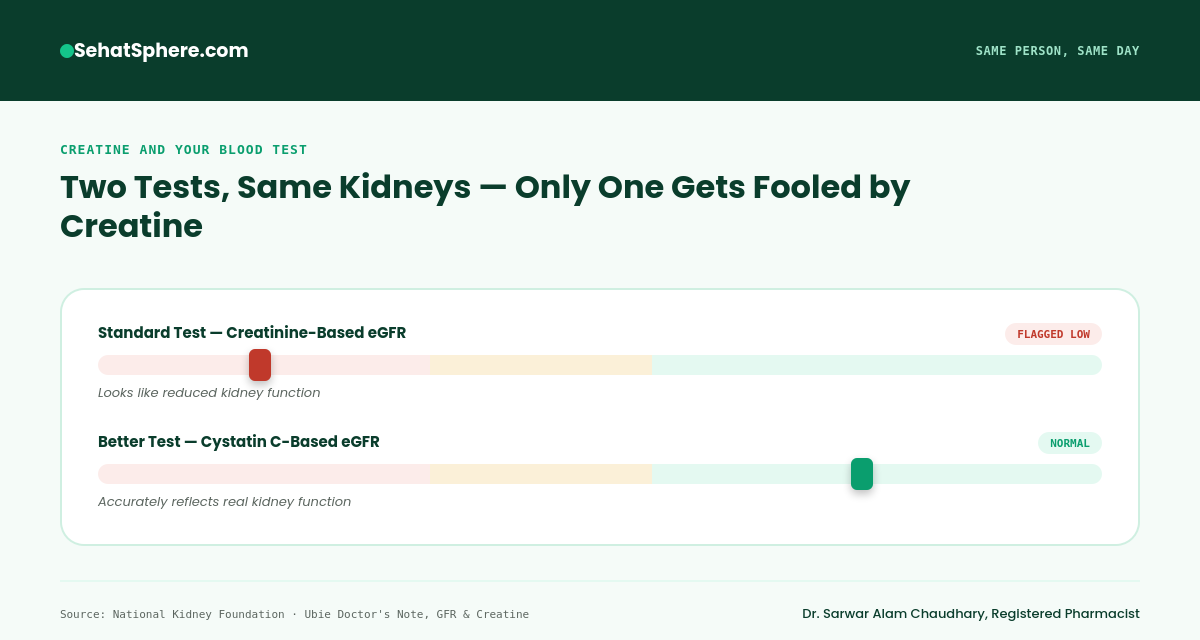
Same person, same day, same kidneys — two different lab methods disagree because only one of them is fooled by creatine. Long-term studies, including one following creatine users for up to five years and a meta-analysis of 30 randomized controlled trials (1,800 people), confirm no actual decline in kidney function markers at standard doses. The number moves; the organ doesn’t.
Creatine and Blood Test Timing: How Long to Stop Before Testing
Different clinical sources give different windows, worth knowing upfront rather than pretending there’s one universal number.
| Source Guidance | Recommended Pause |
|---|---|
| Conservative / minimal | 24–48 hours |
| Moderate | 3–5 days |
| Most cautious | 7–14 days |
The safest practical answer: tell your doctor you take creatine before the test, rather than guessing a stopping window yourself. They can interpret an elevated creatinine correctly, request cystatin C instead, or advise a specific pause based on why you’re being tested.
Kidney Tests vs. Liver Tests: Not the Same Question
This distinction gets lost constantly. Creatine reliably elevates creatinine (a kidney marker). It does not meaningfully affect ALT or AST (liver enzymes) in healthy adults — mild AST shifts some people see are generally from exercise itself, not creatine. If your upcoming panel is liver-only, there’s typically no need to stop. If kidney markers are involved, that’s when timing and disclosure matter.
Real Kidney Warning Signs
An elevated creatinine alone, in an otherwise healthy person on creatine, is usually harmless. These signs are different and deserve prompt medical attention regardless of supplement use: sudden swelling in your legs, ankles, or around your eyes; blood in your urine or unusually dark urine; persistent nausea, vomiting, or loss of appetite; uncontrolled high blood pressure; or severe, sudden changes in urination. Creatine explains a number on a page — it does not explain symptoms in your body.
The Better Test Nobody Mentions: Cystatin C
Cystatin C is a kidney function marker filtered independently of muscle mass and largely unaffected by creatine supplementation. For athletes, bodybuilders, or anyone regularly using creatine, requesting a cystatin-C-based eGFR alongside — or instead of — the standard creatinine-based test gives a genuinely more accurate picture. Most labs can run this on request; it’s simply not the default, so it doesn’t get ordered unless you or your doctor specifically ask.
Honest nuance: cystatin C research specifically in creatine users is limited to a couple of small trials, with mixed results — one showed a decrease with supplementation, another showed no significant change over 2 years. It remains the better available option, just not a perfectly settled one.
What To Read Next
- Blood Report Decoder: Free tool to understand any lab value, including creatinine.
- Nutrient Deficiency Symptom Finder: Check if fatigue has a different, real cause.
- Complete Guide to Medicine Safety: The broader framework this guide sits inside.
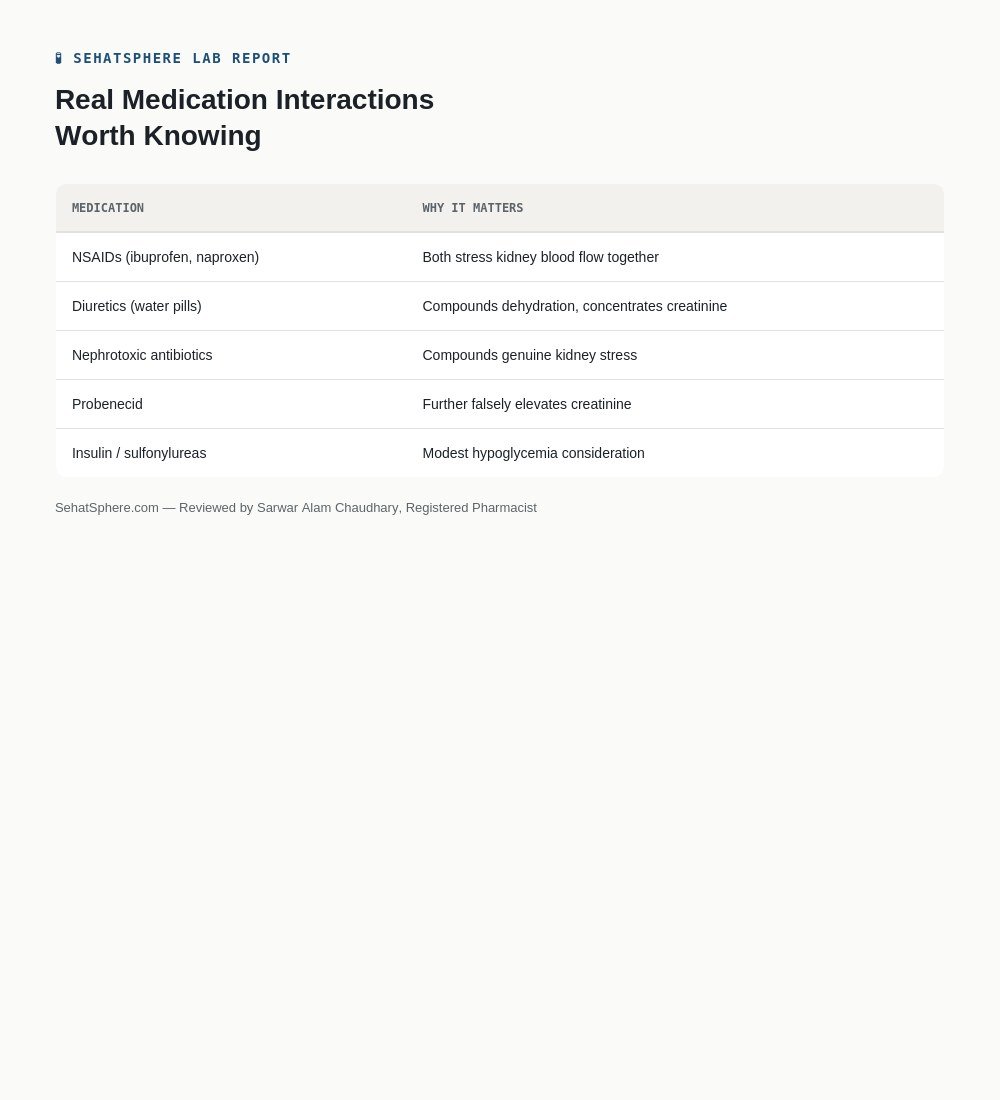
Real Medication Interactions Worth Knowing
| Medication | Why It Matters |
|---|---|
| NSAIDs (ibuprofen, naproxen) | Both stress kidney blood flow; regular high-dose use alongside creatine adds real strain |
| Diuretics (water pills) | Compounds dehydration risk, concentrating creatinine further |
| Nephrotoxic antibiotics (gentamicin, vancomycin) | Can compound genuine kidney stress, not just lab-value confusion |
| Probenecid | Can further falsely elevate creatinine readings |
Worth noting: these are theoretical, physiologically-reasoned cautions based on how creatine and each drug class separately affect the kidneys, not findings from large randomized trials combining creatine with each medication specifically. No well-documented direct chemical interaction exists — these are additive-strain concerns. If you’re on any of these regularly, mention your creatine use to your doctor.
Creatine for Women: What’s Actually Different
“Creatine for women” searches have risen sharply as awareness spreads, and the physiology genuinely differs slightly — women naturally store somewhat less intramuscular creatine than men, which is part of why the benefits (strength, bone health, cognitive support) can feel proportionally noticeable. The blood-test caveat above applies identically regardless of sex — creatinine elevation is about creatine intake and muscle turnover, not hormones. Pregnant or breastfeeding women should still consult a doctor before starting, as with any new supplement.
Hair Loss: What the Evidence Actually Shows
The creatine-hair-loss fear traces back to one small 2009 rugby-player study that found a rise in DHT (a hormone linked to pattern hair loss) — a study never robustly replicated at scale. Newer, more rigorous randomized controlled trials specifically designed to test hair outcomes are now underway to settle this properly. Until stronger evidence says otherwise, the honest answer is: a plausible hormonal mechanism exists, but strong causal evidence for actual hair loss in humans currently does not. If you have a strong family history of pattern baldness and are concerned, that’s a reasonable conversation to have with a doctor before starting, not a settled reason to avoid creatine entirely.
Loading Phase or Just Start Low?
A “loading phase” (commonly around 20g/day split through the day, for 5–7 days) saturates muscle creatine stores faster, before dropping to a 3–5g daily maintenance dose. Skipping the load and starting directly at 3–5g/day reaches the same saturation point — just over roughly 3–4 weeks instead of days. Neither approach is unsafe; loading simply trades a slightly higher short-term dose for faster results. A higher loading dose does mean a temporarily larger creatinine bump — worth knowing if a blood test happens to fall during that window.
Who Should Be Extra Careful
The general safety picture above applies to healthy adults. People with pre-existing kidney disease, a single kidney, on dialysis, or with poorly controlled diabetes should treat creatine as a “discuss with your doctor first” decision, since in these groups, a rising creatinine is far more likely to reflect a real change worth tracking closely, not just a harmless lab artifact. Older adults with age-related kidney decline fall into a similar category, partly because baseline kidney reserve is already lower, and partly because they’re statistically more likely to already be on one of the interacting medications above.
Adolescents should have a specific conversation with a pediatrician rather than following adult dosing by default, since most safety research to date has been conducted in adult populations.
Which Type of Creatine — Does It Change Your Blood Test Picture?
Creatine monohydrate remains the most researched, most clinically validated form by a wide margin, and everything in this guide is based on monohydrate research specifically. Other forms — creatine HCL, ethyl ester, buffered creatine, creatine nitrate — are marketed on claims of better absorption or less bloating, but none have the decades of safety and blood-marker research monohydrate has. If lab-result predictability matters to you, sticking with well-studied monohydrate at a standard 3-5g dose is the more evidence-backed choice.
Myth: “You have to cycle on and off creatine for your kidneys’ sake.” Fact: No strong evidence requires cycling for kidney safety in healthy adults. Myth: “Creatine is a steroid.” Fact: It’s a naturally occurring compound your body already makes from amino acids, with no hormonal steroid structure.
Quick Self-Check
Tick anything that applies to you, and see what it suggests.
Frequently Asked Questions
Does creatine really damage your kidneys?
Long-term studies in healthy adults, including up to five years of use and a 30-trial meta-analysis of 1,800 people, show no real kidney damage at standard doses. When people research creatine and blood test results together, the confusion comes from a lab number (creatinine) rising, which is different from actual organ damage.
How long before a blood test should I stop taking creatine?
Guidance ranges from 24 hours to 14 days depending on the source. The most reliable approach is telling your doctor you use creatine so they can interpret results correctly or order a cystatin-C test instead.
What is cystatin C and why does it matter for creatine users?
It’s a kidney function marker largely unaffected by muscle mass or creatine use, giving a more accurate picture than standard creatinine-based tests for anyone supplementing.
Does creatine affect liver function tests?
Not meaningfully in healthy adults. The elevation pattern associated with creatine is specific to kidney markers, not liver enzymes.
Is creatine safe for women?
Yes, the safety profile is the same as for men. Women naturally store somewhat less intramuscular creatine, which is part of why benefits can feel proportionally noticeable.
Does creatine cause hair loss?
The evidence is weak and based on one small, unreplicated 2009 study showing a DHT increase. Newer trials are underway, but strong causal evidence for actual hair loss doesn’t currently exist.
Do I need a loading phase?
No – it just reaches full muscle saturation faster (days instead of weeks). A steady 3-5g daily dose reaches the same endpoint without it.
How quickly does creatinine go back to normal after stopping creatine?
Typically within days to about two weeks. If it stays elevated well beyond that window, that’s worth a follow-up conversation with your doctor.
The Bottom Line
Creatine is one of the most well-studied, genuinely safe supplements available, backed by decades of research including trials running up to five years with no kidney damage in healthy adults. The confusion around creatine and blood test results isn’t about your kidneys failing — it’s about a lab formula that was never designed to account for supplemental creatine. The fix isn’t avoiding creatine or panicking over a flagged result; it’s a ten-second disclosure to your doctor or lab before your next blood draw. Real symptoms always deserve attention. A number on a page, in an otherwise healthy person taking creatine, usually doesn’t.
- MSD Manual. Creatine Safety Overview. msdmanuals.com
- National Kidney Foundation. Creatinine Testing. kidney.org
- Impact of creatine supplementation on kidney health: a systematic review and meta-analysis. International Urology and Nephrology, 2026.
View All References (5) ▾
- A short review of the most common safety concerns regarding creatine ingestion. PMC
- SingleCare. Creatine Interactions With Medications. singlecare.com