
 SehatSphere
The Complete Guide to Medicine Safety
Every medicine you’ll ever take follows the same handful of safety principles. This is the master guide that ties them all together — global evidence, real pharmacy-counter observations, and links to deep-dive guides on every major medicine category.
Quick Answers
The global picture: why medicine safety matters
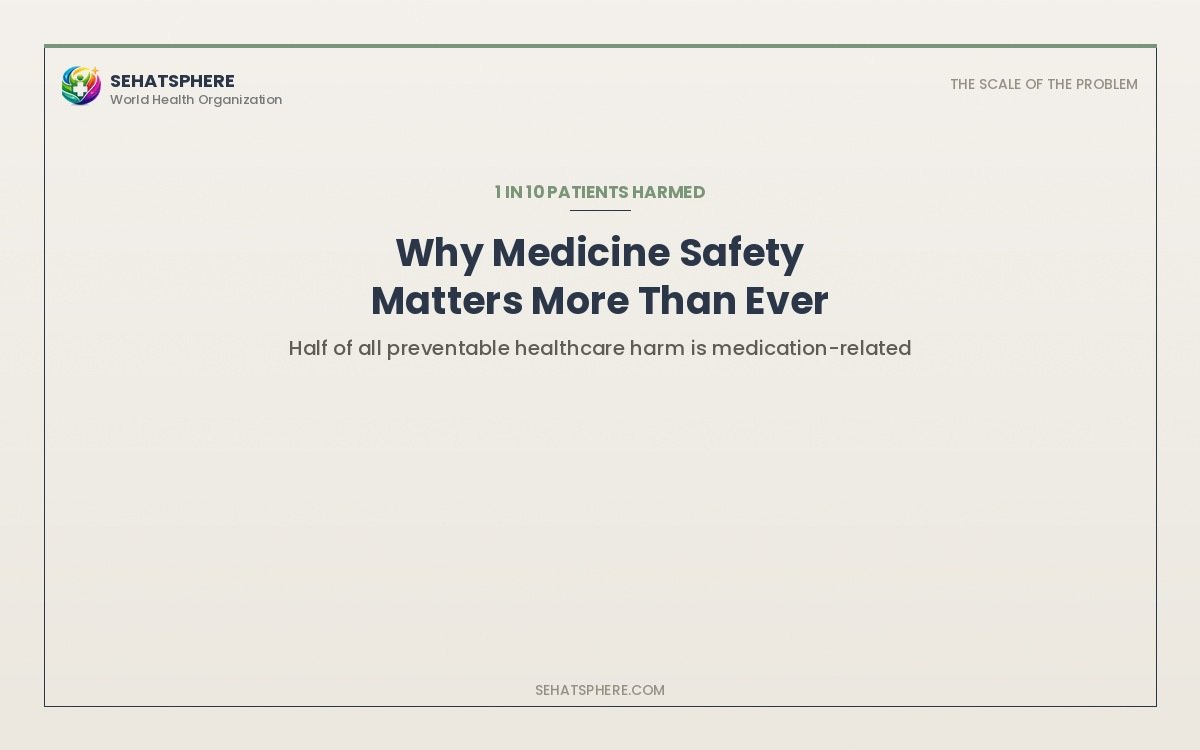
Medicine safety isn’t a niche concern — it’s one of the largest, most overlooked sources of preventable harm in healthcare worldwide. According to the World Health Organization, around 1 in every 10 patients is harmed in healthcare, and more than 3 million deaths occur annually due to unsafe care.
According to the WHO’s official Patient Safety fact sheet, medication-related harm affects 1 out of every 30 patients in healthcare, with more than a quarter of this harm considered severe or life-threatening. Most of it is entirely preventable — not through negligence, but through better understanding of a handful of core principles.
This guide brings together everything SehatSphere has published on medicine safety — antibiotics, thyroid medicine, blood pressure treatment, diabetes management, statins, dengue-related medicine safety, and weight-loss drugs — into one place, alongside the universal rules that apply across almost all of them.
India’s specific picture adds urgency to this global data. A 2025 South-East Delhi study found 36.4% of adults had self-medicated with antibiotics in just three months. India also carries over 101 million diagnosed diabetics (ICMR-INDIAB), an estimated 10.95% of the population living with thyroid disorders, and statin prescription rates that remain far below high-income countries despite comparable rates of high cholesterol. Each of these numbers represents millions of individual decisions made daily — about timing, about stopping, about combining medicines — often without the specific guidance this series aims to provide.
5 universal rules for medicine safety
Across every guide on this site, the same patterns keep appearing. These five rules apply to almost any medicine you’ll ever be prescribed.
Rule 1: Never stop abruptly without asking
Whether it’s an antibiotic course, a blood pressure tablet, or a statin, sudden stopping can trigger rebound effects, antibiotic resistance, or symptom relapse that a gradual, supervised change would have avoided entirely. Clonidine (a BP medicine) is a particularly stark example — abrupt stopping can trigger a dangerous spike in blood pressure within hours.
Rule 2: A “normal” reading often means the medicine is working
Not that you’re cured. This single misunderstanding — mistaking treatment success for a green light to stop — is behind more premature medicine-stopping across this entire guide than any other single cause, from blood pressure to cholesterol to diabetes management.
Rule 3: Timing is drug-specific, not universal
Thyroid medicine needs a genuinely empty stomach. Metformin needs food to avoid stomach upset. Some statins need evening dosing due to short half-lives; others don’t care what time you take them. Assuming one timing rule applies to every medicine is a common, entirely avoidable mistake.
Rule 4: Interactions depend on the exact drug, not just the class
Grapefruit is genuinely dangerous with simvastatin and atorvastatin, but has no meaningful effect on rosuvastatin — despite all three being statins. The same logic of “check your exact drug, not just its category” applies across calcium channel blockers, antibiotics, and beyond.
Rule 5: Any change belongs to a conversation with your doctor
Dose changes, timing changes, or stopping altogether should never be a solo decision based on how you feel that particular day. Every guide in this series exists precisely because that instinct — reasonable as it feels in the moment — is what leads to most of the preventable harm described above.
Every mistake in this guide comes from the same root cause: treating a specific medicine like a generic one. The details always matter.
— Dr Sarwar Alam Chaudhary, Registered BHMS ,Pharmacist
Polypharmacy: when medicines start colliding
The more medicines someone takes, the more the maths of safety changes. In developed countries, 30-40% of people over 65 take five or more medicines daily, and 12% take ten or more. Research shows 1 in 6 elderly patients is at risk of a significant drug interaction, and one study found 85.3% of elderly patients on multiple medicines had at least one potential drug-drug interaction on file.
This is exactly why WHO’s Global Patient Safety Challenge specifically names polypharmacy as one of its three priority action areas, alongside high-risk situations and transitions of care (like hospital discharge). A medicine that’s perfectly safe alone can behave very differently once three or four others are added — and each new prescription increases that complexity, not just adds to it.
- 📋Keep one updated list of everything you take — prescription, OTC, and supplements — and show it to every doctor you see
- 💊Ask specifically: “does this interact with anything I’m already taking?” every time something new is added
- 🏥Ask your pharmacist for a periodic medicine review, especially after any hospital stay
Special populations: pregnancy, children, and older adults
The guides on this site are written for general adult use, but three groups need extra caution with almost every medicine category above.
Pregnancy
Many common medicines need dose changes or complete avoidance during pregnancy — thyroid medicine doses typically rise 30-50% immediately once pregnancy is confirmed, and several drug classes (including some blood pressure medicines and most statins) are avoided outright due to effects on fetal development. Never assume a medicine you’ve taken safely before remains safe once pregnant — always confirm with your doctor as soon as you know, and don’t wait for your next scheduled appointment if the medicine is one of the higher-risk categories.
Children
Dosing for children is calculated by weight, not age, and “adult” medicines are very often entirely inappropriate. A UK study found only 30% of parents correctly dosed children’s paracetamol when tested. Never estimate a child’s dose from an adult tablet.
Older adults
As covered above under polypharmacy, older adults face compounding risk from multiple medicines, plus age-related changes in how the body processes drugs. Oversedation, confusion, and fall risk are frequently under-recognised as medicine side effects in this age group rather than “just getting older.”
Compare every medicine category at a glance
Before the deep dives, here’s the entire picture in one table — the single biggest risk and the one fact worth remembering for each category.
| Category | Biggest risk | Key fact |
|---|---|---|
| Antibiotics | Stopping early builds resistance | 90% symptom burden in one trial matched placebo timing patterns |
| Thyroid medicine | Coffee cuts absorption 29-36% | Wait 60 min before tea/coffee, 4hrs from iron/calcium |
| Blood pressure medicine | Stopping when “normal” | Morning vs night barely matters (TIME trial, 21,104 patients) |
| Diabetes medicine | Hypoglycemia during weight loss | Same dose + better sensitivity = danger without adjustment |
| Statins | Stopping over muscle pain | 90% of statin symptoms matched placebo (SAMSON trial) |
| Dengue/fever medicine | NSAIDs increase bleeding risk | Paracetamol only; avoid Combiflam, Disprin, Meftal-Spas |
| GLP-1 (Mounjaro/Ozempic) | Nausea from wrong eating pattern | Small, protein-first meals reduce side effects significantly |
| General medicine safety | Sharing & self-prescribing | Half of all preventable healthcare harm is medication-related |
Over-the-counter medicine: the safety net people skip
Many of the mistakes across this guide start with a medicine that never needed a prescription in the first place. OTC painkillers, antacids, and cold remedies feel “safe by default” simply because they don’t require a doctor’s signature — but they carry real interaction and overdose risks, especially when combined with prescription medicines covered elsewhere in this guide.
- 🔍Check active ingredients, not just brand names — many cold/fever combination products contain paracetamol you might already be taking separately
- 💊NSAIDs (ibuprofen, aspirin) interact with blood pressure medicine, blood thinners, and carry their own bleeding risks — they’re not “just” pain relief
- 🩺Tell your doctor about every OTC product you take regularly — it genuinely changes the interaction picture
Hidden ingredient overlaps to watch for
| Product type | Hidden overlap risk |
|---|---|
| Cold & flu combos | Often already contain paracetamol – check before adding a separate fever tablet |
| Combination painkillers | Combiflam contains ibuprofen + paracetamol, not paracetamol alone |
| Multivitamins | Can contain iron/calcium, affecting thyroid medicine absorption if timed together |
Antibiotics: the resistance crisis nobody explains practically
Common antibiotic mistakes are quietly fuelling one of the biggest global health crises of our time. A 2025 Delhi study found 36.4% of adults had self-medicated with antibiotics in just three months — most often for colds and flu, which antibiotics don’t even treat. Stopping a course early doesn’t mean you’re cured; it leaves the strongest bacteria behind to multiply.
- ✅Always finish the full prescribed course, even if you feel better
- ❌Antibiotics do nothing for colds, flu, or viral fever
- 🚫Never share leftover antibiotics with family members
“If I feel better, the infection must be gone, so I can stop early.”
Feeling better means the weakest bacteria are dead — the strongest survivors are exactly what a full course is designed to eliminate.
Thyroid medicine: the coffee mistake nobody warns about
Thyroid medicine (Thyronorm, Eltroxin, levothyroxine) absorption drops sharply with food — bioavailability falls from 79% fasting to 64% with food. The bigger, India-specific problem: coffee and tea reduce absorption by 29-36%, and most people have chai within minutes of their morning tablet.
- ⏰Wait 60 minutes before any tea, coffee, or food
- 💊Keep a 4-hour gap from iron, calcium, or magnesium supplements
- 🔄Stick to one brand consistently; switching needs a doctor’s review
“As long as I take it once a day, exact timing around food doesn’t matter much.”
Bioavailability drops from 79% fasting to 64% with food — a genuinely large difference for a hormone that needs to stay steady daily.
Blood pressure medicine: the timing myth, busted
You’ve probably heard BP medicine works better at bedtime. The TIME trial — 21,104 patients, 5.2 years, British Heart Foundation-funded — found no statistically significant difference between morning and evening dosing. What actually matters: never stopping because a reading looks normal, and knowing which drugs (like clonidine) are dangerous to stop abruptly.
- ⏰Pick a consistent time you’ll remember, not a specific “best” time
- ⚠️Never stop abruptly — especially clonidine, which can cause rebound hypertension
- 🍊Amlodipine is safe with grapefruit; some other CCBs are not
“Taking BP medicine at night protects your heart significantly better than morning.”
The TIME trial found no statistically significant difference — 390 vs 362 events across 21,104 patients over 5.2 years.
Diabetes medicine: the hypoglycemia danger during weight loss
Diabetes reversal is real for some — the DiRECT trial found 46% remission through supervised weight loss. But almost no “reversal” article mentions the medicine-safety side: as your body improves, your existing dose can become too strong, causing dangerous low blood sugar. India carries over 101 million diabetics (ICMR-INDIAB), many now attempting exactly this kind of lifestyle-driven improvement.
- 📉Losing weight on insulin or sulfonylureas? Tell your doctor before you start, not after
- 🍬Learn the 15-15 rule for treating low blood sugar
- 📊Metformin carries much lower hypoglycemia risk than insulin or glimepiride
“Diabetes reversal means I can stop all medicine forever, no monitoring needed.”
Remission requires ongoing maintenance and monitoring — it can return if old habits do, and medicine changes during the transition need close supervision.
Statins: the SAMSON trial that changed everything
Between half and three-quarters of people prescribed a statin stop within two years, usually citing muscle pain. The SAMSON trial (Imperial College London, published in NEJM) found 90% of that symptom burden was also present on placebo — a nocebo effect, not the drug. Real statin-related muscle symptoms do exist, in about 1 in 10 people, and are verifiable through a supervised stop-restart trial.
- 🔬Muscle pain on a statin is usually nocebo, not pharmacology — but it’s worth confirming with your doctor
- 🍊Simvastatin and atorvastatin require complete grapefruit avoidance; rosuvastatin doesn’t
- ❌A normal cholesterol reading means the statin is working, not that you’re cured
Dengue & monsoon fever: the medicine cabinet danger
During monsoon fever season, the biggest mistake isn’t which fever to suspect — it’s reaching for the wrong tablet before you know. NSAIDs (Combiflam, Disprin, Meftal-Spas) increase bleeding risk if you have dengue, sometimes severely. Paracetamol alone (Crocin, Dolo) is the only fever medicine considered safe until you’re tested.
- ✅Paracetamol only — Combiflam, Disprin, and Meftal-Spas all carry real risk
- 🩺Get tested if fever doesn’t improve within 24-48 hours
- 📊Know your platelet danger zones: below 20,000 is a medical emergency
“Any fever tablet is fine as long as it brings the temperature down.”
NSAIDs like Combiflam and Disprin can worsen bleeding risk specifically in dengue, even though they work fine for ordinary fever.
GLP-1 medicines (Mounjaro, Ozempic): eating around the side effects
GLP-1 drugs are increasingly common for weight management and diabetes in India. Most side effects — nausea, constipation — come down to eating pattern, not the drug itself. Small, protein-first meals, eaten slowly, dramatically reduce discomfort compared to normal-sized meals eaten at the usual pace.
- 🍽️Smaller, protein-first meals reduce nausea significantly
- 💧Hydration and fibre help manage constipation, a very common side effect
- 📉Combined with insulin or sulfonylureas, hypoglycemia risk rises — see the diabetes section above
“Nausea on these medicines just means my body is rejecting the drug.”
Most nausea comes from eating too much, too fast, or too fatty a meal — not the medicine failing. Eating pattern changes usually resolve it.
General medicine mistakes: the everyday errors
Beyond specific drug categories, some mistakes cut across everything: taking medicine on an empty stomach when it needs food (or vice versa), storing medicines incorrectly (heat and humidity degrade many tablets faster than people realise), mixing multiple medicines without checking interactions, and ignoring expiry dates. These small errors are behind a surprising share of preventable harm, precisely because they feel too minor to think twice about.
Quick reference: alcohol & common interactions by category
A single table pulling together the interaction guidance scattered across every guide above.
| Category | Alcohol | Key interaction to know |
|---|---|---|
| Antibiotics | Avoid with metronidazole/tinidazole specifically | Most others: no direct danger, but slows recovery |
| Thyroid medicine | Generally low risk | Coffee, iron, calcium all block absorption |
| Blood pressure medicine | Can enhance blood-pressure-lowering effect | Grapefruit varies by exact drug |
| Diabetes medicine | Can cause dangerous low sugar with insulin/sulfonylureas | Weight loss changes dose needs |
| Statins | Generally low risk in moderation | Grapefruit varies sharply by exact statin |
The pattern across almost every category: alcohol interactions and food/supplement interactions depend on the exact drug, not the general category — which is exactly why this guide links to a full, drug-specific breakdown for each one.
How to actually read a prescription and medicine label
A surprising number of medicine mistakes come down to simply not reading the label carefully. Every prescription and package carries the same core information, once you know where to look.
- 🔤Generic name vs brand name: the generic name (e.g., paracetamol) tells you what’s actually inside, regardless of which brand you’re holding — this is how you catch accidental double-dosing across products
- ⏱️Frequency abbreviations: OD (once daily), BD (twice daily), TDS (three times daily), SOS (as needed) — misreading these is a common, avoidable error
- 🍽️“With food” vs “empty stomach” instructions exist for a specific pharmacological reason — skipping them isn’t a minor shortcut
- 📅Expiry dates matter more for some medicines (like insulin, eye drops, and antibiotics after reconstitution) than others
Universal red flags: when any medicine reaction needs urgent care
Regardless of which medicine is involved, certain symptoms should always prompt urgent medical attention rather than a wait-and-see approach.
Mild nausea, slight drowsiness, a headache that eases within a day or two of starting something new.
Difficulty breathing, facial or throat swelling, widespread rash, severe dizziness or fainting, chest pain, or any sudden, severe symptom after a new medicine or dose change.
Allergic reactions in particular can escalate quickly and don’t always follow the same pattern as a previous, milder reaction to the same drug class.
The psychology of why we get medicine safety wrong
Two guides on this site — statins and antidepressant-style discontinuation patterns — point to the same underlying issue: expectation shapes experience. The SAMSON trial showed that 90% of statin symptoms were also felt on a placebo pill, driven by a genuine neurological “nocebo” effect, not the drug’s pharmacology.
Beyond nocebo, a few other biases show up repeatedly across every guide in this series: optimism bias (“this won’t happen to me” when skipping a dose), present bias (the inconvenience of taking a tablet today outweighs an abstract future risk), and the “feels fine, must be fine” heuristic that drives people to stop treatment the moment symptoms improve. None of these are failures of willpower — they’re predictable patterns of human cognition, which is exactly why structured systems (reminders, pill organisers, pharmacist check-ins) work better than relying on memory or motivation alone.
Medicine safety quick check
1. If you feel muscle pain on a statin, what does the SAMSON trial suggest is most likely happening?
2. Is morning or night better for blood pressure medicine?
3. What should you drink with your thyroid tablet in the morning?
Try SehatSphere’s Free Health Tools
Two tools that pair with almost every guide above — both free, no signup needed to start.
Blood Report Decoder
Paste any lab values — sugar, cholesterol, thyroid, platelets — for an instant breakdown.
Open Tool →Your personal medicine safety checklist
Everything in this guide, condensed into one practical list you can actually use.
- ✅Keep one written or phone list of every medicine, supplement, and OTC drug you take
- ✅Know your specific drug’s timing rule — don’t assume it’s the same as another medicine you take
- ✅Never stop anything abruptly because you feel better or a reading looks normal
- ✅Check interactions (grapefruit, alcohol, other drugs) for your exact medicine, not just its general class
- ✅Set reminders — pill organisers, phone alarms — rather than relying on memory
- ✅Ask for a medicine review if you’re taking 5 or more regularly, especially after a hospital stay
- ✅Learn your medicine’s red flags, and act on them immediately rather than waiting
- ✅Bring every question to your doctor or pharmacist — don’t rely on assumptions or forum advice
Frequently Asked Questions
What is the single most common medicine safety mistake?
Stopping a medicine because a reading looks normal or symptoms improve. Across antibiotics, blood pressure medicine, and statins, this single misunderstanding causes more harm than almost anything else covered in this guide.
How common is preventable medication harm globally?
According to the WHO, around 1 in 10 patients is harmed in healthcare, and half of all preventable harm is medication-related, costing an estimated $42 billion globally each year.
Is timing the same for every medicine?
No. Thyroid medicine needs an empty stomach, some statins need evening dosing due to their half-life, and blood pressure medicine timing barely matters at all. Always check the specific guide for your medicine.
Are grapefruit interactions the same across drug classes?
No. Within calcium channel blockers, amlodipine is safe with grapefruit while felodipine isn’t. Within statins, simvastatin and atorvastatin require avoidance while rosuvastatin doesn’t. Always check your exact drug.
Who writes SehatSphere’s medicine safety guides?
Sarwar Alam Chaudhary, a practising Registered Pharmacist also pursuing BHMS, drawing on real patterns observed at the pharmacy counter, combined with citations from peer-reviewed trials and official health bodies.
Should I stop my medicine if I read something concerning online?
No. Always discuss concerns with your doctor or pharmacist before making any change. This guide is for education, not a substitute for personalised medical advice.
What is polypharmacy and why does it matter?
Polypharmacy means taking five or more medicines regularly. It matters because each additional medicine increases interaction risk exponentially, not just additively — 30-40% of people over 65 experience this, and 1 in 6 face a significant interaction risk.
Do children need different medicine safety rules than adults?
Yes. Children’s doses are calculated by weight, not age, and many adult medicines are entirely inappropriate for children. Never estimate a child’s dose by splitting an adult tablet.
What are universal red flags that need emergency care with any medicine?
Difficulty breathing, facial or throat swelling, widespread rash, severe dizziness or fainting, and chest pain after any new medicine or dose change should always prompt immediate medical attention.
Why do people stop medicines even when they’re helping?
Common cognitive patterns like optimism bias and the “feels fine, must be fine” heuristic drive early stopping. These are predictable, common patterns of human thinking, not failures of willpower.
How often should I review all my medicines with a doctor or pharmacist?
At least annually if you take multiple regular medicines, and always after any hospital stay or when a new medicine is added, since interactions change with every addition.
What should be on my personal medicine list?
Every prescription medicine, over-the-counter drug, and supplement you take regularly, including doses and timing, kept updated and shown to every doctor you see.
Are over-the-counter medicines really as safe as they seem?
Not automatically. OTC painkillers and cold remedies carry real interaction and overdose risks, especially combined with prescription medicines. Always check active ingredients and tell your doctor what OTC products you use regularly.
Do medicine safety rules change during pregnancy?
Yes, significantly. Thyroid medicine doses typically rise 30-50% once pregnancy is confirmed, and several drug classes including most statins are avoided outright. Confirm with your doctor immediately once pregnancy is known.
How is this guide different from generic AI-generated health content?
Every fact traces to a named source (WHO, peer-reviewed trials, official health bodies), and personal-experience claims are explicitly labelled as professional observation from a practising pharmacist, not presented as clinical fact.
Bringing it all together
Eight medicine categories, one set of underlying patterns. Whether it’s an antibiotic course, a thyroid tablet, a blood pressure pill, or a statin, the same handful of mistakes explain most of the preventable harm covered in this guide: stopping too early, misunderstanding what a “normal” result means, assuming one timing rule fits every drug, missing an interaction specific to your exact medicine, and making a change alone instead of with your doctor.
None of this requires memorising pharmacology. It requires treating each medicine as specific — reading the guide that matches what you actually take, asking the questions this series raises, and building the small habits (a written list, a consistent time, a pharmacist check-in) that make safety automatic rather than something you have to remember under pressure.
The goal of every guide on this site is the same: not to make you afraid of your medicine, but confident enough to use it exactly right.
— Sarwar Alam Chaudhary, PharmacistHow this guide was built
Every fact in this guide traces back to a named, verifiable source — WHO fact sheets, peer-reviewed trials like SAMSON and TIME, official bodies like the British Heart Foundation and ICMR — rather than being paraphrased from other websites. Where a claim comes from personal observation (“what I see at the pharmacy counter”), it’s labelled as exactly that: professional experience, not a substitute for a clinical study.
This guide will be revisited as new evidence emerges, new SehatSphere guides are published, and as India-specific data continues to be released by ICMR and other national health bodies. If you spot something that needs updating, that’s exactly the kind of feedback that keeps a resource like this genuinely useful rather than static.
Written by Sarwar Alam Chaudhary
A practising pharmacist who is also pursuing BHMS and works in a hospital setting — every guide linked in this master page comes from real patterns seen at the pharmacy counter, backed by peer-reviewed evidence. More about the author →