
Free eGFR Calculator From Creatinine: CKD-EPI 2021 & CrCl
One creatinine result, two very different clinical questions answered instantly: your CKD-EPI 2021 kidney-disease stage, and a weight-corrected Cockcroft-Gault number for medication dosing — no email, no signup, no fake reviews.
Calculate Your eGFR & CrCl
Enter your latest creatinine, age, sex, weight, and height — takes about 20 seconds
Lab Value & Demographics
Body Metrics — for the CrCl half only
Used to work out your Ideal Body Weight (Devine formula), which decides whether the CrCl calculation uses your actual, ideal, or adjusted weight — explained in full below.
| Stage | eGFR Range | What It Means |
|---|
Important
This tool estimates kidney function for educational purposes and does not diagnose anything or replace a lab-confirmed, doctor-reviewed result. Always confirm any dosing decision with a pharmacist or physician.
SehatSphere Renal Function Summary
Generated using the CKD-EPI 2021 and Cockcroft-Gault equations · Reviewed format by Dr. Sarwar Alam Chaudhary, Registered Pharmacist
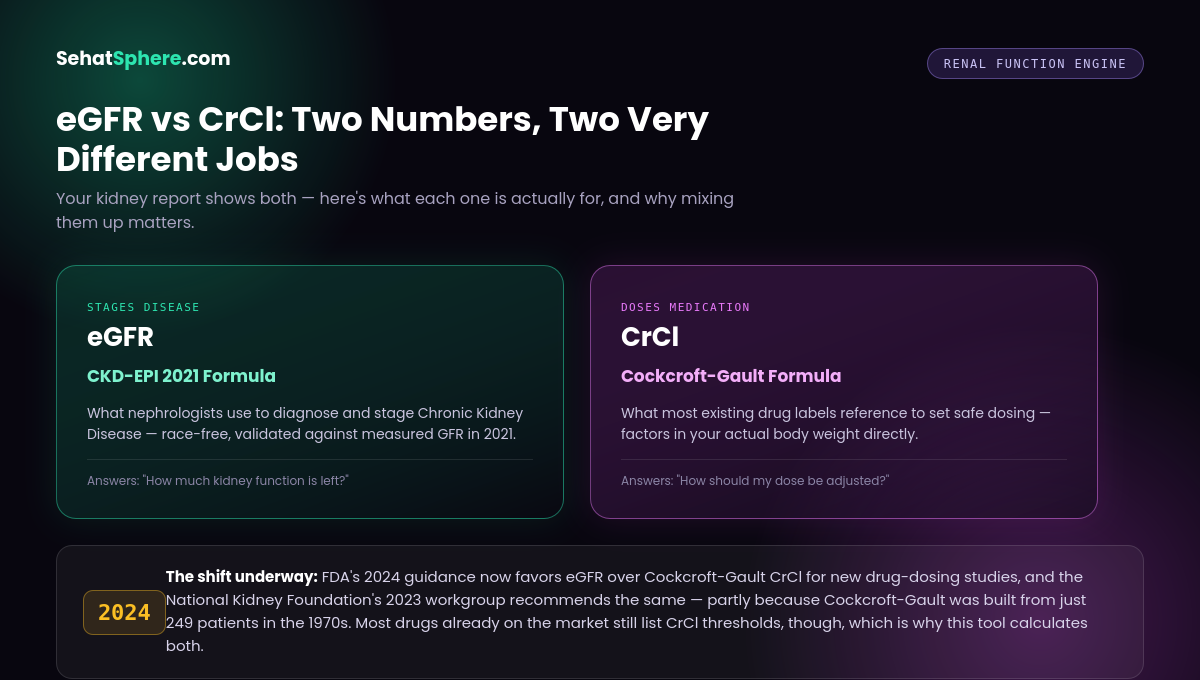
A single creatinine number on a lab report doesn’t mean much on its own — it has to be run through a formula before it becomes useful, and which formula you use changes the answer you’re looking for. This eGFR calculator from creatinine runs your result through both of the two formulas that actually matter in practice: the 2021 CKD-EPI equation, which is what nephrologists use to diagnose and stage Chronic Kidney Disease, and the Cockcroft-Gault equation, which is what most existing drug labels still reference to set a safe medication dose. Most calculators online give you one or the other. This one gives you both, explains which weight figure belongs in the dosing half of the calculation — a detail almost every other free calculator skips — and tells you honestly which one is more relevant to whatever question brought you here.
Key Takeaways
- eGFR (CKD-EPI 2021) stages kidney disease. CrCl (Cockcroft-Gault) sets drug doses. They answer different questions and can legitimately give different numbers for the same person.
- The 2021 CKD-EPI formula removed the race coefficient used in older eGFR equations, after research found it overestimated kidney function in Black patients and delayed care.
- Cockcroft-Gault needs your actual body weight — but not always your actual weight. Whether the formula should use your actual, ideal, or adjusted weight depends on how far your weight is from ideal, and this calculator works that out automatically.
- The FDA (March 2024) and the National Kidney Foundation workgroup (November 2024) have both recommended moving medication-dosing decisions toward race-free eGFR and away from Cockcroft-Gault CrCl — but most drugs already on the market still list CrCl thresholds, which is why this tool still calculates it.
- Dehydration, high muscle mass, a high-protein meal, and creatine supplements can all shift your creatinine reading without any real change in kidney function.
eGFR vs. CrCl: Why This Calculator Gives You Two Numbers
Patients are often handed a lab report with an eGFR value already calculated by the lab, then told by their pharmacist that their dose was adjusted based on a different number entirely — their CrCl. That’s not a contradiction. It’s two formulas built for two different jobs, both derived from the same serum creatinine value.
eGFR (Estimated Glomerular Filtration Rate), calculated here using the 2021 CKD-EPI creatinine equation published in the New England Journal of Medicine, standardizes your filtration rate to a body surface area of 1.73m² — roughly the size of an average adult. That standardization is exactly what makes it useful for staging disease and comparing kidney function across a population, regardless of how tall or heavy any one person is.
CrCl (Creatinine Clearance), calculated here using the Cockcroft-Gault equation, deliberately does the opposite — it is not standardized to body surface area, because a drug dose has to clear your actual kidneys, at your actual size, not a hypothetical average-sized person’s. That’s why Cockcroft-Gault asks for your weight and this tool asks for your height too — to work out which version of your weight the formula should actually use.
If you’re trying to understand a diagnosis or a CKD stage on a lab report, the eGFR number is the one that matters. If you or your pharmacist are working out a safe dose of a renally-cleared medication — many antibiotics, some diabetes drugs, several blood thinners — the CrCl number is usually the one the drug’s label was written against. Our guide to common antibiotic dosing mistakes covers several real cases where this distinction changed the correct dose.
How the CKD-EPI 2021 Formula Actually Works
Every eGFR calculator from creatinine has to make a judgment call about which formula version to use, because eGFR equations have changed meaningfully over the past two decades. This tool uses the current standard: the 2021 CKD-EPI creatinine equation, validated against directly measured GFR in a large, diverse cohort and published in the New England Journal of Medicine by Inker and colleagues.
The formula takes your serum creatinine, divides it by a sex-specific constant (kappa), raises the result to a sex-specific power (alpha), applies an age-decay factor, and — for women — applies a small final multiplier to account for average differences in muscle mass and creatinine production between sexes. None of that math needs to make sense to you; the calculator above does it instantly. What matters clinically is what changed in 2021: this version has no race coefficient.
⚠ Why removing race from the formula mattered
Earlier CKD-EPI and MDRD equations included a coefficient that assigned a higher calculated eGFR to Black patients for an identical creatinine, age, and sex — based on an assumption about average muscle mass that doesn’t hold at the individual level. In practice, this meant some Black patients’ kidney disease looked less severe on paper than it actually was, which delayed nephrology referrals, transplant eligibility, and medication dose adjustments for real people. The 2021 race-free equation was developed specifically to correct this, and it is now the standard recommended by the National Kidney Foundation and the American Society of Nephrology.
How Cockcroft-Gault Works — and Why It’s Still Around
If CKD-EPI 2021 is the newer, more accurate formula, a fair question is why this calculator bothers with Cockcroft-Gault at all. The honest answer: because most drug labels were never rewritten. The Cockcroft-Gault equation was published by Cockcroft and Gault in 1976, derived from a study of just 249 white male patients — a demographic and sample size that would not meet today’s standards for a formula this consequential. Yet decades of subsequent drug trials used Cockcroft-Gault CrCl to set their dosing thresholds, so that’s the number that the package insert for many of your medications still refers to.
Cockcroft-Gault multiplies age, weight, and a creatinine-based term together, then applies a 0.85 correction for women — a correction that, per the National Kidney Foundation, was originally estimated rather than measured from actual female patient data. It’s an imperfect, dated formula. It also happens to still be the formula that decides whether your antibiotic dose gets reduced this week, which is exactly why a genuinely useful eGFR calculator from creatinine has to calculate it alongside eGFR, not instead of it.
The Weight Nuance Most Calculators Get Wrong
Here’s the detail that separates a Cockcroft-Gault calculation done correctly from one done carelessly: Cockcroft-Gault was never meant to simply take whatever number is on your bathroom scale. Using raw actual body weight in someone with obesity can overestimate their true drug clearance, because fat tissue clears drugs far less efficiently than lean tissue — and using a generic “ideal” weight in someone who is genuinely underweight underestimates their clearance in the opposite direction.
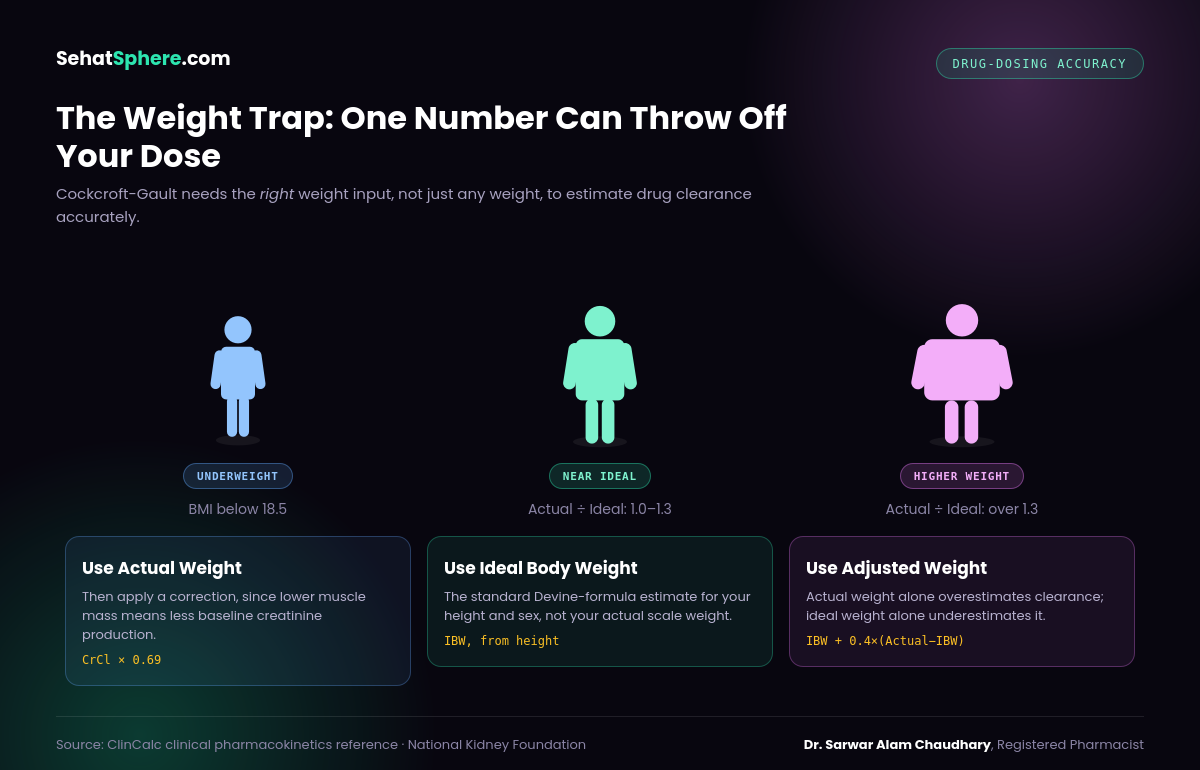
The widely used clinical pharmacokinetics convention — the same one this calculator applies automatically — compares your actual weight to your Ideal Body Weight (calculated from your height using the Devine formula) as a ratio, then picks a weight basis accordingly:
- Actual weight below ideal (ratio under 1.0): use actual body weight. If your BMI is also under 18.5, a further ×0.69 correction is applied, since lower muscle mass genuinely means lower baseline creatinine production.
- Actual weight within 30% of ideal (ratio 1.0–1.3): use Ideal Body Weight, not your scale weight — this is the most commonly missed step in DIY CrCl calculations.
- Actual weight more than 30% above ideal (ratio over 1.3): use Adjusted Body Weight — Ideal Body Weight plus 40% of the difference between actual and ideal — which corrects for the fact that some, but not all, of the extra tissue is metabolically active.
The calculator above works out your ratio automatically and tells you exactly which basis it used and why, right under your results — no guessing, and no silent substitution of one number for another the way most calculators do.
The 2024 Shift: Why Cockcroft-Gault Is Slowly Being Retired
This is the kind of detail that rarely makes it into a patient-facing calculator, but as a pharmacist, it’s genuinely one of the more consequential regulatory changes in renal dosing in years. In March 2024, the FDA issued its final guidance on pharmacokinetic studies in patients with impaired renal function, recommending that new drug trials assess renal impairment using race-free eGFR rather than Cockcroft-Gault CrCl. In November 2024, the National Kidney Foundation’s workgroup published a formal consensus statement in the American Journal of Health-System Pharmacy recommending the same shift for medication-related decisions across US healthcare settings.
Neither change makes Cockcroft-Gault obsolete overnight. Every drug already on the market was studied and dosed using CrCl, and updating a decades-old package insert is a slow regulatory process. What it does mean is that the direction of travel is clear: newer drugs are increasingly being studied and dosed using eGFR, while older, established drugs will continue to reference CrCl for years to come. A calculator that only gives you one of the two numbers is already behind where clinical practice is heading — which is exactly why this one gives you both, together, every time.
The 5 Stages of Chronic Kidney Disease, Explained
Once you have an eGFR number, the next question is almost always “is that bad?” The honest answer depends on the stage it falls into, and — just as importantly — whether it stays there on a repeat test three months later, since a single reading is never enough to diagnose CKD on its own.
| Stage | eGFR Range | What It Generally Means |
|---|---|---|
| G1 — Normal | 90 or above | Normal or high kidney function. Only classified as CKD if other damage markers (like protein in urine) are also present. |
| G2 — Mildly Decreased | 60–89 | Mild reduction. Often normal for age alone; becomes CKD only with other evidence of kidney damage. |
| G3a — Mild-Moderate | 45–59 | Usually managed by a primary care doctor. Medication doses may start needing adjustment. |
| G3b — Moderate-Severe | 30–44 | Often triggers a nephrology referral. Several drug doses require reduction at this stage. |
| G4 — Severely Decreased | 15–29 | Close nephrology monitoring. Many renally-cleared drugs need significant dose changes or substitution. |
| G5 — Kidney Failure | Below 15 | Dialysis or transplant planning typically begins, alongside symptoms and other lab values. |
Chronic kidney disease is formally defined as reduced kidney function or other evidence of kidney damage present for three months or longer — one low eGFR reading, especially after an illness, dehydration, or a high-protein meal, is not on its own a diagnosis. If your calculated eGFR here looks lower than you expected, the honest next step is a repeat test, not a diagnosis based on a single free online tool.
What Can Throw Off Your Creatinine Reading (and Why It Matters Here)
Because both eGFR and CrCl are calculated entirely from your serum creatinine, anything that shifts creatinine without actually changing your kidney function will shift both results too. As a pharmacist, these are the ones I see catch patients off guard most often:
- Dehydration. Reduced blood flow to the kidneys and blood concentration can temporarily raise creatinine, making eGFR look artificially lower. If you were unwell, fasting, or hadn’t had much water before your blood draw, it’s worth retesting once rehydrated. Our guide to fluctuating blood pressure covers several of the same dehydration triggers.
- Creatine supplements. Creatine converts to creatinine in muscle tissue, and can meaningfully raise a lab creatinine reading in someone taking it regularly for training. Our creatine and blood test guide goes deeper into how long this effect lasts and what to do before a test.
- High muscle mass. Creatinine is a byproduct of muscle metabolism, so a muscular individual will naturally run a higher creatinine and a slightly lower calculated eGFR than a less muscular person with genuinely identical kidney function — a real limitation of every creatinine-based formula, including both used here.
- A large, recent high-protein meal. Cooked meat in particular can transiently raise creatinine for a few hours after eating, which is why most labs recommend testing in a fasted or near-fasted state.
- Certain medications and supplements. Some drugs affect creatinine measurement or kidney handling without reflecting true damage. If you’re taking anything alongside a diuretic, our apple cider vinegar and your medications guide covers one commonly overlooked example involving potassium and dehydration together.
Who Should Use This eGFR Calculator From Creatinine
- Anyone who just received a creatinine or eGFR result and wants to understand what stage it falls into before their next appointment.
- Patients on a renally-cleared medication (many antibiotics, some diabetes and heart-failure drugs, several blood thinners) who want to understand why their dose might change as kidney function shifts.
- Caregivers helping an older family member track kidney function over several tests, using the Save Result and trend-graph features above.
- Pharmacy and nursing students who want to see the CKD-EPI 2021 and Cockcroft-Gault formulas actually applied, including the often-skipped weight-selection step.
Your Privacy: What Happens to Your Data
Every calculation this eGFR calculator from creatinine performs happens directly in your browser using JavaScript. Nothing you enter — your creatinine, age, weight, or height — is sent to any server, logged, or stored anywhere by Sehatsphere.
The optional “Save This Result” feature stores your values only in your own browser’s local storage, so you can track a trend over time on this device. This data never leaves your device and isn’t accessible to us. There is no email requirement anywhere on this page, for any feature.
What This Calculator Can’t Do
It can’t account for acute kidney injury, unusual muscle mass, amputation, pregnancy, or extremes of body size — situations where creatinine-based formulas are known to be less reliable, and where a cystatin C-based or measured GFR test is often used instead.
It isn’t designed for patients already on dialysis, and it can’t replace an actual lab-confirmed, doctor-reviewed result. Use it to understand what a number means and to prepare better questions for your doctor or pharmacist — not as a substitute for either of them.
If your result here is flagged, our high creatinine levels guide goes deeper into causes and next steps, alongside the National Kidney Foundation’s explainer on creatinine and MedlinePlus’s creatinine blood test overview.
The Short Version
- Enter your creatinine, age, sex, weight, and height — no email, no signup.
- This calculator returns two numbers: eGFR (CKD-EPI 2021, for staging) and CrCl (Cockcroft-Gault, for dosing).
- It automatically works out whether the CrCl half should use your actual, ideal, or adjusted weight, and tells you which one it used.
- Regulators are shifting toward eGFR for new drugs, but most current drug labels still reference CrCl — so this tool gives you both.
- A single low reading isn’t a diagnosis. Dehydration, creatine, muscle mass, and recent meals can all shift the result.
Frequently Asked Questions
A normal eGFR is 90 mL/min/1.73m² or higher. Between 60 and 89 can still be normal for your age, but combined with other markers of kidney damage it’s classified as Stage 2 CKD. Below 60 for three months or more is chronic kidney disease regardless of other findings.
This eGFR calculator from creatinine uses the 2021 CKD-EPI creatinine equation, which combines your serum creatinine, age, and biological sex — with no race coefficient — to estimate your filtration rate standardized to a body surface area of 1.73m².
Most existing FDA drug labels set their renal dosing thresholds using Cockcroft-Gault CrCl, because that’s what was available when those drugs were approved. CrCl also isn’t standardized to 1.73m² body surface area, reflecting your actual filtration capacity rather than a population-adjusted number.
Yes. Dehydration reduces blood flow to the kidneys and concentrates the blood, which can temporarily raise serum creatinine and lower calculated eGFR. Rehydrating and retesting is standard practice before acting on a single unexpectedly low result.
Yes. Creatine supplements convert to creatinine in muscle tissue, raising serum creatinine and making an eGFR calculator from creatinine show a lower number than your true kidney function. Stopping creatine for several days before a test, if possible, is generally recommended.
Stage 3 CKD means an eGFR between 30 and 59, split into Stage 3a (45-59, mild-to-moderate) and Stage 3b (30-44, moderate-to-severe). Stage 3a is usually managed by a primary care doctor; Stage 3b often triggers a nephrology referral.
Dialysis or a kidney transplant is typically considered when eGFR falls below 15, classified as Stage 5 CKD — though the decision also depends on symptoms, potassium levels, and fluid status, not the eGFR number alone.
Height and weight are used only for the Cockcroft-Gault CrCl half of the result. Cockcroft-Gault estimates total filtration in mL/min rather than per body-surface-area, so it needs an actual weight — and which version of your weight it should use depends on how far you are from your ideal weight.
If your actual weight is below your ideal weight, actual weight is used. Within 30% above ideal, ideal body weight (from the Devine formula) is used instead. More than 30% above ideal, an adjusted body weight formula is used to avoid overestimating clearance in people with obesity.
Yes. The 2021 CKD-EPI equation, published in the New England Journal of Medicine, removed the race coefficient used in earlier CKD-EPI and MDRD equations, which had overestimated kidney function in some Black patients and delayed specialist referral and transplant listing.
The FDA’s March 2024 final guidance and the National Kidney Foundation workgroup’s November 2024 consensus both recommend race-free eGFR over Cockcroft-Gault for medication decisions, partly because Cockcroft-Gault came from just 249 white male patients in a single 1976 study. Most current drugs still list CrCl thresholds, which is why this tool calculates both.
No. eGFR and CrCl formulas assume some ongoing native kidney filtration, and dosing for dialysis patients is handled differently, factoring in the dialysis schedule. Please rely on your nephrology team’s guidance instead.
Yes. Creatinine is a muscle metabolism byproduct, so someone with significantly more muscle mass will naturally produce more creatinine and can show a lower calculated eGFR despite normal kidney function — a known limitation of any creatinine-based formula.
Yes. Use the mg/dL / µmol/L toggle next to the creatinine field before entering your number — the calculator converts internally, so you don’t need to do the math yourself.