
Free Integrative Interaction Checker: Ayurveda, Homeopathy & Allopathy
Real, individually cited interactions between Ayurvedic herbs, homeopathic remedies, everyday supplements, and prescription drugs — not a guess, and not hidden behind a fake five-star rating.
Check Your Combination
Add one or more natural therapies and one or more prescription drugs, then check
Natural Therapy / Homeopathy
Prescription Medication
Important
This tool is educational and covers a curated, cited set of interactions — it is not an exhaustive drug-interaction database and does not replace a pharmacist or physician review of your full medication list. Always disclose every herb, remedy, and supplement you take to your prescriber.
SehatSphere Integrative Interaction Report
Generated using the SehatSphere Integrative Interaction Checker · Reviewed format by Dr. Sarwar Alam Chaudhary, Registered Pharmacist ·
Most people run one search at a time — “Ashwagandha and thyroid,” “turmeric and blood thinners” — and end up with a different confident-sounding answer on every site. This integrative interaction checker exists to do that same check properly: real, individually researched interactions between Ayurvedic herbs, homeopathic remedies, everyday supplements, and prescription drugs, each backed by an actual citation you can click through and read yourself, not a database of invented “clinical references” that lead nowhere.
Key Takeaways
- “Natural” and “safe to combine” are not the same claim. Ayurvedic herbs and allopathic drugs frequently compete for the same liver enzymes; that’s chemistry, not brand loyalty.
- Homeopathic remedies at standard potencies (30C and above) are diluted past the point of containing any detectable original molecule — which is exactly why they carry essentially no known chemical drug-interaction risk, whatever you believe about how they work.
- This tool currently has real, cited data for 29 specific combinations across cardiovascular, endocrine, CNS, and infectious-disease drugs. That’s a deliberately honest number, not an inflated one — a combination not shown here simply isn’t in our verified list yet.
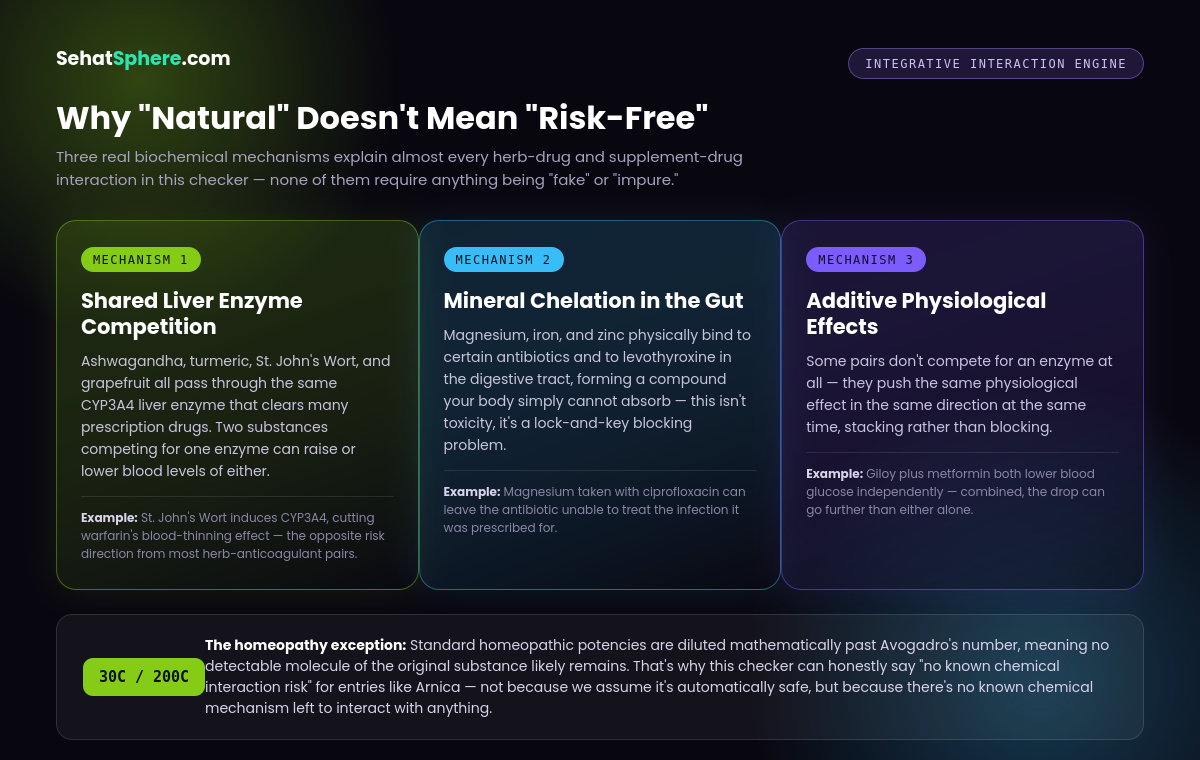
- Three real mechanisms explain almost every entry: shared liver (CYP450) metabolism, mineral chelation blocking drug absorption, and additive effects on the same receptor or pathway.
- The apple cider vinegar and PPI entry in this checker deliberately does not say ACV “neutralizes” the drug — that claim is pharmacologically overstated, and we corrected it here the same way we corrected it in our full Apple Cider Vinegar and Your Medications guide.
Why “Natural” Isn’t Automatically Safe
According to the World Health Organization’s Medication Without Harm initiative, polypharmacy — the concurrent use of multiple medications, herbs, or supplements — is a leading cause of preventable adverse drug events worldwide. The biggest myth this checker exists to correct is the idea that “because it’s natural, it’s automatically safe to combine with anything.”
Botanical extracts like Ashwagandha, Turmeric, and St. John’s Wort contain genuinely active biochemical compounds. Once ingested, several of them compete for the exact same Cytochrome P450 (CYP450) liver enzymes that process cardiovascular, thyroid, and psychiatric medications — the same enzyme family, doing the same job, regardless of whether the substance came from a pharmacy or a farm. As detailed in our Ashwagandha Thyroid Interactions guide, this competition can push a prescription drug’s blood level up to toxic territory or down to ineffective territory.
How Ayurveda, Homeopathy, and Allopathy Actually Interact (or Don’t)
Lumping “natural remedies” together is part of the problem — Ayurvedic herbs, homeopathic potencies, and dietary supplements interact with prescription drugs through genuinely different mechanisms, and treating them identically produces bad advice in both directions.
Ayurvedic herbs and concentrated botanical extracts contain real, measurable phytochemicals. Some — like curcumin in high-dose turmeric extract, or hypericin and hyperforin in St. John’s Wort — are potent enough to change how your liver metabolizes other drugs, or to affect platelet function directly. These interactions are chemistry, and they’re the ones with the strongest published evidence in this checker.
Homeopathic remedies at classical potencies (30C, 200C, and higher) are diluted so far past Avogadro’s number that, mathematically, no molecule of the original substance is likely to remain in the dose. Whatever view you take of how homeopathy works, this specific chemistry fact is why standard-potency homeopathic remedies carry essentially no known risk of a chemical drug interaction — genuinely different from a crude herbal extract at pharmacological doses, even when both are derived from the same plant (Arnica montana crude extract and Arnica 30C are not comparable in this respect).
Dietary supplements split into two very different interaction types: minerals like magnesium, iron, and zinc physically bind to certain drugs in the gut (chelation), blocking absorption entirely rather than causing a toxic reaction; while others like melatonin, St. John’s Wort, and grapefruit affect a drug’s blood level through receptor or enzyme effects, more like a herb than a mineral.
The 3 Golden Rules of Integrative Timing
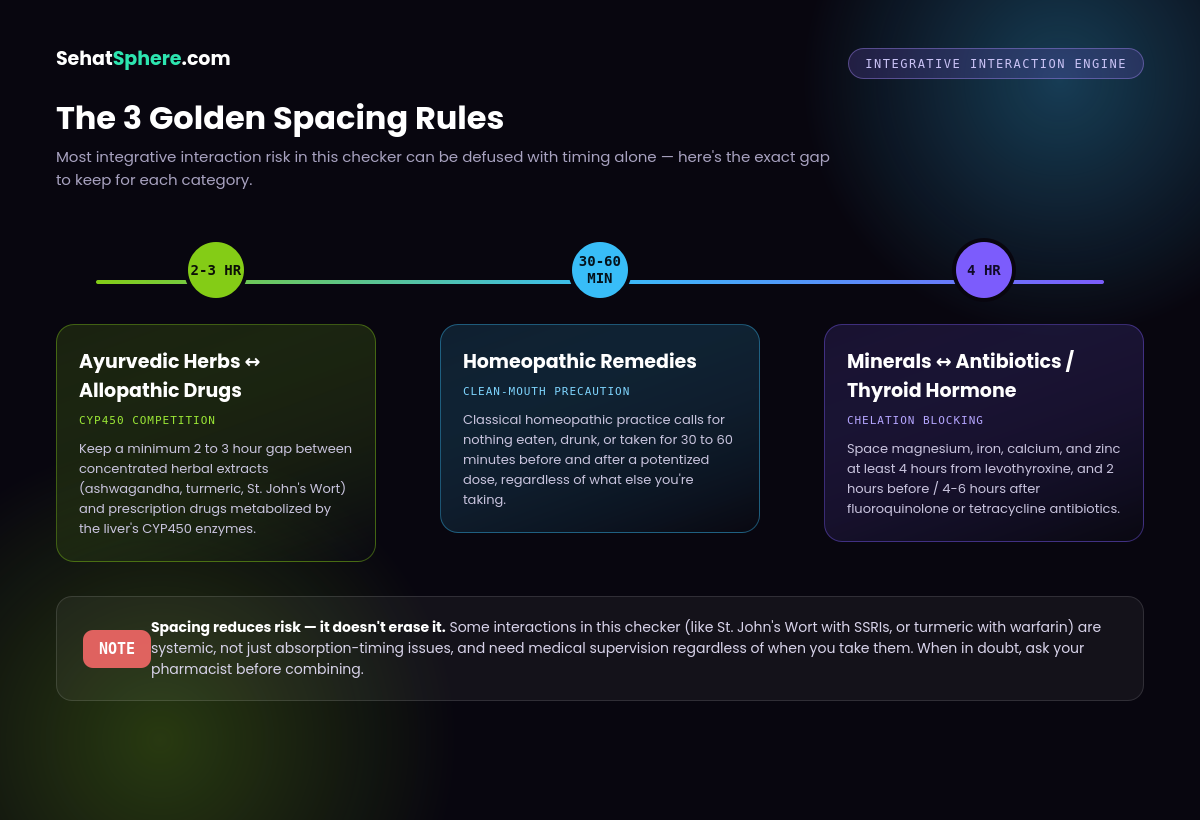
- The 2-3 Hour Ayurvedic-Allopathic Rule: Because several Ayurvedic herbs and allopathic drugs share the same CYP450 metabolic pathway, a minimum 2-3 hour gap reduces the chance of one altering the other’s blood level.
- The 30-60 Minute Homeopathic Clean-Mouth Rule: Classical homeopathic practice holds that potentized remedies act through the oral mucosa rather than gastric chemistry, so the conventional precaution is a clean mouth — nothing eaten, drunk, or taken — for 30 to 60 minutes before and after a dose.
- The 4-Hour Mineral-Chelation Rule: Minerals like magnesium, iron, and zinc bind to certain antibiotics and to levothyroxine in the gut. The NIH Office of Dietary Supplements recommends taking fluoroquinolone or tetracycline antibiotics at least 2 hours before, or 4 to 6 hours after, a magnesium-containing supplement — a similar 4-hour gap is the standard precaution for iron, calcium, and levothyroxine.
What This Tool Covers, Honestly
Every combination in this checker’s database is backed by a real, checkable source — a peer-reviewed study, a case report, or an official health-authority safety notice. Where the evidence is a single case report or an animal/preclinical study rather than a large human trial, we say so directly in the result card rather than presenting every entry with the same false confidence.
We chose accuracy over the appearance of completeness. The old version of this tool let you select from more than 300 possible herb-drug combinations while only ~20 had any real data behind them — several with citation links that led nowhere. This version covers fewer combinations on paper, but every single one is genuinely real, which is the only version of “comprehensive” that actually protects you.
Who Should Use This Integrative Interaction Checker
- Anyone taking a prescription medication who also uses Ayurvedic herbs, homeopathic remedies, or everyday supplements like magnesium, melatonin, or ACV.
- Patients managing thyroid disease, diabetes, or a clotting disorder — the three areas with the strongest documented interaction evidence in this tool.
- Caregivers coordinating multiple therapies for an older family member, where polypharmacy risk is highest.
- Pharmacy, nursing, and BHMS/BAMS students who want to see real citations rather than textbook generalizations for these specific combinations.
Your Privacy: What Happens to Your Data
Every check this tool performs happens directly in your browser using JavaScript. Nothing you select — no herb, remedy, or drug name — is sent to any server, logged, or stored anywhere by Sehatsphere. There is no email requirement anywhere on this page, for any feature.
What This Tool Can’t Do
It can’t account for your specific dose, your other health conditions, or interactions between more than two substances at once. It covers a curated set of well-documented combinations, not the full universe of possible herb-drug or homeopathy-drug pairs — a “no result” here is not the same as a “confirmed safe” from your doctor.
It can’t replace your pharmacist or physician reviewing your complete medication and supplement list. Use it to prepare better questions for that conversation, not to skip it. For a broader look at how supplements and drugs interact, our Apple Cider Vinegar and Your Medications guide and Magnesium and Your Medications guide go deeper on two of the most-searched pairs.
The Short Version
- Add your herbs/remedies and your prescription drugs, then check — no email, no signup.
- Every match shown has a real citation. A “not found” result means it isn’t documented yet, not that it’s safe.
- Ayurvedic herbs interact through shared liver enzymes. Homeopathic remedies at standard potencies carry essentially no chemical interaction risk. Minerals interact by blocking drug absorption (chelation).
- Three timing rules cover most cases: 2-3 hours (Ayurveda-allopathy), 30-60 minutes clean mouth (homeopathy), 4 hours (mineral chelation).
- Always tell your doctor and pharmacist about every herb, remedy, and supplement you take — not just your prescriptions.
Frequently Asked Questions
Generally yes, if spaced correctly. Classical homeopathic practice holds that potentized remedies act via the oral mucosa rather than gastric chemistry, so a 30-60 minute gap with a clean mouth before and after the remedy is the conventional precaution, keeping the two clearly separated in time.
A minimum 2 to 3 hour gap is the standard pharmacist recommendation, because several Ayurvedic herbs and allopathic drugs are processed by the same liver CYP450 metabolic enzymes, and taking them together can raise or lower blood levels of one or both.
There is a real documented risk. A 2022 case report in the journal Cureus described a patient who developed thyrotoxicosis and a dangerous heart arrhythmia after long-term ashwagandha use alone. Combined with levothyroxine, the theoretical concern is additive thyroid overstimulation.
This is a documented risk. A published case report followed a woman who developed dangerously low potassium after drinking apple cider vinegar daily for six years. Potassium-wasting diuretics like furosemide compound this same risk, so this combination needs medical monitoring.
Not at the same time. Magnesium binds to fluoroquinolone antibiotics and tetracyclines in the gut, blocking absorption. The NIH Office of Dietary Supplements recommends taking these antibiotics at least 2 hours before or 4 to 6 hours after a magnesium-containing supplement.
Polypharmacy is the concurrent use of multiple medications, herbs, or supplements. The World Health Organization’s Medication Without Harm initiative identifies it as a leading cause of preventable adverse drug events, since risk rises with every additional substance added to a regimen.
Yes, and this is one of the best-established herb-drug interactions in the literature. St. John’s Wort affects serotonin reuptake on its own; combined with an SSRI like sertraline, it can cause a dangerous buildup of serotonin known as serotonin syndrome.
Yes. Grapefruit juice inhibits the CYP3A4 liver enzyme responsible for clearing certain statins, including atorvastatin, from the blood, which can let the drug build up to levels associated with severe muscle breakdown (rhabdomyolysis).
Yes. New Zealand’s medicines safety authority documented a real case where a patient’s INR spiked above 10 within weeks of starting a concentrated turmeric supplement while on warfarin. This applies to concentrated supplements, not ordinary culinary turmeric in food.
Yes, as far as current evidence shows. Standard homeopathic potencies (30C and above) are diluted so far past Avogadro’s number that no detectable molecule of the original plant remains, so there’s no known pharmacological mechanism for it to interact with anticoagulants.
It can. Tinospora cordifolia (Giloy) has shown blood-glucose-lowering activity in pharmacological studies, and combining it with metformin or insulin has a plausible additive effect that could push blood sugar unexpectedly low. Monitoring glucose more closely is a reasonable precaution.
Iron, calcium, and magnesium all bind to levothyroxine in the gut and form a compound your body can’t absorb, making the thyroid medication less effective. The standard recommendation is to separate these supplements from levothyroxine by at least 4 hours.
There is a documented, if less common, concern. WHO pharmacovigilance data includes several suspected cases of melatonin potentiating warfarin’s effect on INR, including some with bleeding complications, even though the exact mechanism isn’t fully established.
Raw and standard garlic preparations contain allicin-derived compounds with real antiplatelet activity, linked to bleeding case reports with anticoagulants. Interestingly, a controlled study on aged garlic extract specifically found it did not significantly affect warfarin’s anticoagulant activity — the exact preparation changes the risk.