
 SehatSphere
Medication Safety
Ashwagandha and Your Medications
The rare psychiatric reaction that gets buried under the thyroid warning
Ashwagandha and your medications is a combination almost every viral post skips past entirely. Ashwagandha has become one of TikTok’s biggest supplement stories — over 4.6 million views and growth north of 27,000% in a single year, outpacing nearly every other wellness trend tracked this year. Most safety coverage stops at the well-known thyroid warning. Here’s the angle that’s barely mentioned anywhere: a documented interaction with one specific class of antidepressant that can trigger a manic episode, not just a mild side effect.
Jump to: The MAOI mania risk · The thyroid warning, briefly · The real blood sugar mechanism · Test yourself · FAQ
Quick answer: Ashwagandha and your medications interact in ways that go well beyond the thyroid caution most people have heard of. Ashwagandha has a documented interaction with MAOI antidepressants that can trigger manic episodes — a serious psychiatric reaction that gets almost no coverage compared to the thyroid and surgery warnings that dominate search results.[1]
Ashwagandha, an adaptogenic herb used in Ayurvedic medicine for centuries, has become genuinely mainstream in the past two years — Spate’s TikTok trend data puts it among the platform’s fastest-growing supplement categories, alongside a broader wave of “clean” nootropics and stress-support products.[2] In my own practice, given the dual pharmacist and BHMS background this site is built on, ashwagandha is one of the few supplements where patients assume the Ayurvedic origin automatically means no real interaction risk — an assumption worth correcting directly.
Ashwagandha and your medications: the MAOI mania risk
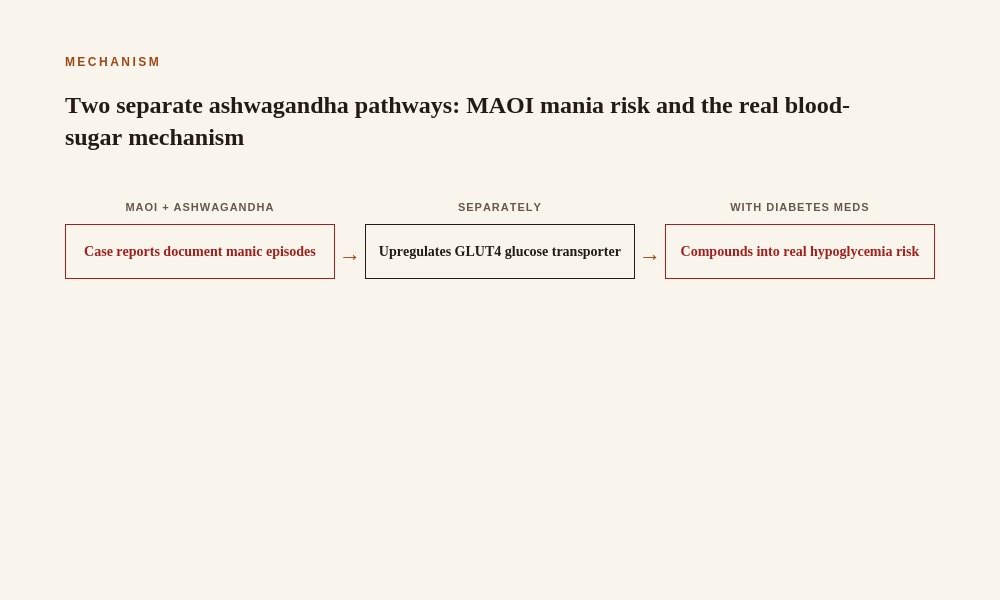
Here’s the interaction almost no mainstream coverage leads with. Ashwagandha has been documented to interact with monoamine oxidase inhibitor (MAOI) antidepressants — phenelzine, tranylcypromine, and the selegiline patch among them — with case-level reports describing manic episodes triggered by the combination.[1] This isn’t the same category of risk as feeling “a bit jittery” — a manic episode is a significant psychiatric event, and the fact that this specific interaction shows up almost exclusively in clinical Q&A archives rather than in the wellness-blog coverage driving ashwagandha’s popularity is exactly the kind of gap this guide exists to close.
MAOIs are prescribed less often than newer antidepressants, but they remain a real, active treatment option for depression that hasn’t responded to other medications. Someone on an MAOI who picks up an ashwagandha gummy because “it’s just an adaptogen” has no obvious reason to connect the two — the marketing language around ashwagandha almost never mentions psychiatric medication at all.
Ashwagandha and your medications: the thyroid warning, briefly
To be fair to existing coverage, the thyroid interaction is genuinely well documented and worth repeating rather than skipping. Ashwagandha can directly stimulate thyroid hormone production, and case reports describe previously healthy people developing clinical thyrotoxicosis after increasing their dose — resolving only after stopping the herb.[3] If you take levothyroxine or have any diagnosed thyroid condition, this is a real, established caution, not a theoretical one — it’s simply not the part of the story that’s missing from the conversation.
Ashwagandha and your medications: the real blood sugar mechanism
Most consumer content says ashwagandha “can affect blood sugar” without explaining how, which makes the caution easy to dismiss as vague. The actual mechanism is more specific: ashwagandha appears to upregulate GLUT4, a glucose transporter, and increase insulin receptor activity — genuinely improving insulin sensitivity, which is part of why it’s marketed for metabolic health.[4] That mechanism is a real benefit for some people, but it’s also precisely why combining it with insulin or an oral hypoglycemic medication like metformin or a sulfonylurea carries a genuine, mechanistically specific hypoglycemia risk — not a vague “might lower blood sugar a bit” caution.
Ashwagandha and your medications: surgery and sedatives
Ashwagandha’s calming, GABA-adjacent effects mean it can potentiate sedatives, benzodiazepines, and general anesthesia — anesthesiology guidance generally recommends stopping it 1–2 weeks before any planned surgery, alongside other herbal supplements.[5] Combined with the blood-sugar mechanism above, perioperative fasting plus ashwagandha’s insulin-sensitizing effect creates a specific, compounding risk for intraoperative hypoglycemia in anyone also on a diabetes medication — a detail that rarely gets mentioned even in surgery-specific ashwagandha guidance.
Ashwagandha and your medications: two scenarios worth reading
Scenario one: someone on an MAOI for treatment-resistant depression, stable for over a year, starts an ashwagandha gummy recommended by a friend for stress relief — never mentioning it at their next psychiatric appointment because it “isn’t a real medication.” Weeks later they present with symptoms their psychiatrist initially can’t connect to anything, until the supplement comes up almost by accident. Scenario two: someone with type 2 diabetes on metformin adds ashwagandha for sleep and stress, and starts experiencing unexplained shakiness and lightheadedness in the afternoons — genuine hypoglycemia from a mechanistically real interaction, not a coincidence, but one that took weeks to identify because neither the patient nor their initial doctor visit connected a “natural supplement” to a blood sugar symptom.
Three myths worth retiring
Myth: “Ayurvedic origin means it’s gentler than pharmaceutical options.” Ashwagandha’s active withanolide compounds are pharmacologically potent enough to measurably shift thyroid hormone levels, blood glucose, and CNS activity — the traditional-medicine origin doesn’t change the underlying pharmacology or reduce interaction risk. Myth: “If a supplement doesn’t require a prescription, it’s been checked for drug interactions.” Ashwagandha’s MAOI interaction comes from clinical case reports and pharmacology literature, not from any regulatory pre-market interaction screening the way prescription combinations are checked. Myth: “Adaptogens balance whatever needs balancing, so they can’t cause a problem.” The “adaptogen” framing describes a marketing category, not a pharmacological guarantee — a substance that shifts thyroid hormone, blood glucose, and CNS activity in one direction for one person can just as easily be too much of a shift for someone already on medication affecting the same systems.
A note on quality and dosing consistency
Ashwagandha supplements vary considerably in the concentration of active withanolides between brands, and even between batches of the same product — a genuine complication for anyone trying to predict how a given dose will interact with their medications.[4] Standardized extracts (commonly labeled with a specific withanolide percentage) offer more predictable dosing than raw root powder, which matters more than usual here given how dose-dependent the thyroid and blood-sugar effects appear to be in the case reports available. If you’re on any of the medications discussed in this guide, a standardized, third-party-tested product is a genuinely practical safety step, not just a quality preference.
What I actually tell patients
- On an MAOI, including the selegiline patch? This is a real, serious interaction — don’t start ashwagandha without talking to your prescriber first.
- On levothyroxine or have a thyroid condition? Ashwagandha can directly raise thyroid hormone levels — this caution is well established and worth taking seriously.
- On insulin, metformin, or another diabetes medication? The blood-sugar interaction is mechanistically real, not vague — watch for hypoglycemia symptoms if you start ashwagandha.
- Have any surgery scheduled? Stop ashwagandha 1–2 weeks beforehand and tell your anesthesiologist you were taking it, even if you already stopped.
- None of this means avoiding ashwagandha altogether — it means treating it with the same seriousness as any other pharmacologically active substance, Ayurvedic origin or not.
Test yourself
1. What serious reaction has been documented with ashwagandha and MAOIs?
2. What is the actual mechanism behind ashwagandha’s blood sugar effect?
3. How long before surgery should ashwagandha generally be stopped?
Ashwagandha and your medications: what “adaptogen” actually means pharmacologically
The term “adaptogen” gets used loosely in wellness marketing, but it has a real, narrower pharmacological meaning worth understanding before assuming it applies to your situation. An adaptogen is generally defined as a substance that helps the body maintain physiological stability under stress, without a single fixed direction of effect — which sounds reassuring, but actually explains why ashwagandha’s interactions cut in multiple directions depending on what else is happening in your system. The same property that makes it “balancing” for someone with mild, generalized stress is exactly what makes it unpredictable when layered onto a system already being deliberately pushed in one direction by medication — an MAOI deliberately altering neurotransmitter levels, insulin deliberately lowering blood glucose, thyroid hormone deliberately raising metabolic rate. Ashwagandha doesn’t distinguish between “helping” and “compounding” in these situations; it simply exerts the same physiological pull it always does, and whether that lands as balance or excess depends entirely on the baseline it’s added to.
Ashwagandha and your medications: the bottom line
Step back from the individual interactions, and the pattern matches what shows up across viral supplement trends generally: the safety conversation tends to concentrate around whichever caution was discovered or discussed first — in ashwagandha’s case, the thyroid warning — while equally serious risks for a different, smaller group get far less attention. The MAOI interaction discussed at the top of this guide is rare in the sense that few people take MAOIs, not in the sense that the reaction itself is mild. None of this means avoiding ashwagandha. It means treating a genuinely bioactive herb with the same seriousness you’d apply to any other substance capable of shifting thyroid hormone, blood glucose, and psychiatric medication response — and mentioning it, specifically, at your next medication review.
Ashwagandha and your medications: FAQ
Can ashwagandha cause mania?
In combination with MAOI antidepressants specifically, case reports describe manic episodes. This is a documented, serious interaction, not a common general side effect of ashwagandha alone.
Is ashwagandha safe with thyroid medication?
Use real caution. Ashwagandha can directly raise thyroid hormone levels and has caused thyrotoxicosis in documented cases. Talk to your doctor if you take levothyroxine.
Does ashwagandha actually lower blood sugar?
Yes, through a specific mechanism involving GLUT4 glucose transporter upregulation and improved insulin receptor activity, which can compound with diabetes medications.
Do I need to stop ashwagandha before surgery?
Yes, generally 1-2 weeks beforehand, due to sedative and blood-sugar effects that can complicate anesthesia and perioperative fasting.
What is ashwagandha used for?
Ashwagandha is an adaptogenic herb from Ayurvedic medicine, commonly used for stress support, sleep, and as a general wellness supplement.
Is ashwagandha safe just because it’s natural?
No. “Natural” doesn’t mean risk-free — ashwagandha is pharmacologically active with real, documented interactions across multiple medication categories.
Why does dosing consistency matter for ashwagandha?
Active withanolide concentration varies between brands and batches, making effects less predictable, especially relevant for the dose-dependent thyroid and blood-sugar interactions.
Can ashwagandha interact with regular antidepressants, not just MAOIs?
The most serious documented psychiatric interaction is specifically with MAOIs. Other antidepressant classes carry different, generally less severe theoretical concerns worth discussing with your prescriber.
How is ashwagandha’s blood sugar effect different from just “affecting” blood sugar?
It works through a specific, documented mechanism (GLUT4 upregulation and insulin receptor activity), not a vague or unexplained effect.