 SehatSphere.com
The Blood Pressure Medicine Timing Myth, Busted
You’ve probably heard BP medicine works better taken at night. That advice came from a real, large study — but the largest, most rigorous trial ever conducted since has directly contradicted it. Here’s the full story, plus two mistakes that matter far more than the clock.
Key takeaways:
- A 2019 Spanish study (Hygia) claimed a dramatic 45% cardiovascular benefit from night dosing — it’s why “take it at night” spread so widely.
- The 2022 TIME trial (21,104 patients, 5.2 years) and 2024 BedMed trials found no meaningful difference — and raised real questions about Hygia’s methodology.
- What actually matters: taking it every day, and never stopping just because a reading looks normal.
- Diuretics are a genuine timing exception — but for sleep comfort, not heart protection.
- Clonidine is dangerous to stop abruptly. Grapefruit advice is oversimplified for amlodipine specifically.
- A dry cough affects up to 1 in 3 people on ACE inhibitors — and most never connect it to their BP pill.
What I Actually See With BP Patients
Two patterns show up again and again at the pharmacy counter — and neither is about morning versus night.
Both patterns are genuinely risky — just not for the reason most people assume. To explain why, it helps to understand exactly where the “take it at night” advice came from, and why the science has since moved past it.
Why “Take It at Night” Became Common Advice
The theory had real biology behind it. In people without hypertension, blood pressure follows a predictable 24-hour rhythm: it surges after waking, peaks around midday, and “dips” by 10–20% during sleep. People whose blood pressure fails to dip at night — called non-dippers — carry a higher cardiovascular risk. Since heart attacks also cluster in the early morning hours, some researchers reasoned that dosing medication in the evening might restore healthy nighttime dipping and offer extra protection right when risk is highest.
In 2019, this theory got dramatic support. The Hygia Chronotherapy Trial, led by Dr. Ramón Hermida at the University of Vigo, Spain, followed more than 19,000 hypertension patients for six years, randomly assigning half to morning dosing and half to bedtime dosing. The results, published in the European Heart Journal, were striking:
| Outcome (bedtime vs. morning dosing) | Reported Reduction |
|---|---|
| Heart attack, stroke, heart failure, or artery procedures | ~45% lower risk |
| Cardiovascular death specifically | 56% lower risk |
| Stroke risk alone | 49% lower risk |
Hermida told reporters at the time that “the same medication ingested at different times of the day actually has different pharmacological properties, behaving like totally different medications.” Given the size of the claimed benefit, this single study reshaped how doctors worldwide talked about BP medicine timing — and it’s the direct source of most “take your pills at bedtime” advice still circulating today.
The TIME Trial’s Answer
A single-study finding this dramatic invited scrutiny — especially since some researchers questioned whether Hygia’s unusual design (repeated 48-hour ambulatory monitoring visits for every participant) could have introduced bias. So the British Heart Foundation funded a purpose-built trial to settle it properly.
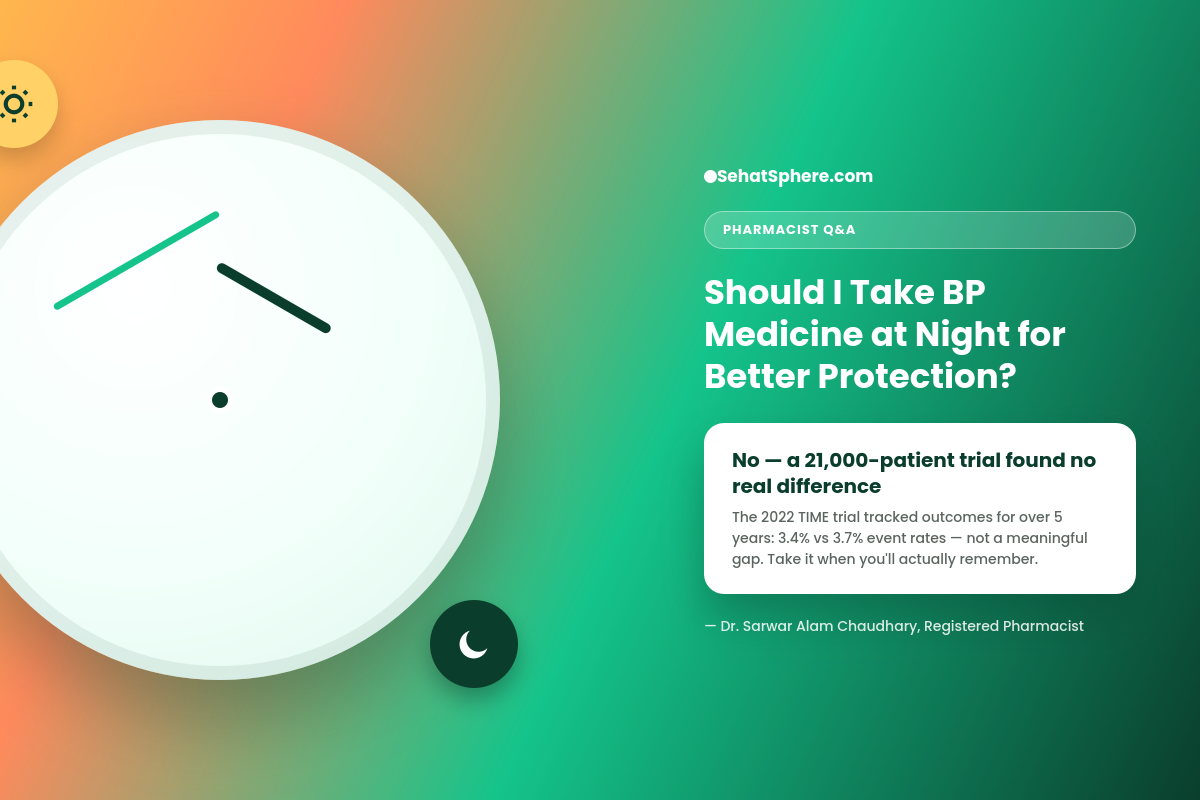
The TIME trial, led by Professor Thomas MacDonald at the University of Dundee, enrolled 21,104 patients across the UK between 2011 and 2018. Unlike Hygia, it used a fully decentralised design — participants self-enrolled online and were simply asked to take their usual antihypertensive medication either between 6–10am or 8pm–midnight, then followed for a median of 5.2 years.
| Group | Vascular Death / Heart Attack / Stroke |
|---|---|
| Morning dosing | 390 patients (3.7%) |
| Evening dosing | 362 patients (3.4%) |
That gap — 3.4% versus 3.7% — was not statistically significant. Professor MacDonald called TIME “one of the largest cardiovascular studies ever conducted,” stating plainly: “the trial clearly found that heart attack, stroke, and vascular death occurred to a similar degree, regardless of the time of administration.” Professor Bryan Williams, Chair of Medicine at UCL and a TIME steering committee member, added that the results “should reassure patients that they can take their medication when it suits them.”
One secondary finding worth noting: people in the evening-dosing group were slightly less likely to experience falls, but more likely to report needing the bathroom at night — a clue that becomes important later in this guide.
Myth: “Taking BP medicine at night protects your heart significantly better.” Fact: The largest, most rigorous trial ever done found no meaningful difference. Take it whenever you’ll actually remember, consistently.
Confirmed Again in 2024
TIME wasn’t the final word either — researchers wanted to know if the result held in more vulnerable populations, including frail elderly patients who weren’t well represented in earlier trials. At the 2024 European Society of Cardiology Congress, Professor Scott Garrison from the University of Alberta presented results from two more trials: BedMed, in the general primary-care population, and BedMed-Frail, conducted specifically in nursing-home residents.
Both trials found the same thing: no difference in major cardiovascular events or safety between evening and morning dosing — even among frail, elderly nursing-home patients, who are typically the group most sensitive to medication timing effects. Three large, independently-run trials now agree, across very different patient populations.
What Actually Matters More Than Timing
If timing barely moves the needle, what does? Two things, consistently: taking it every single day without skipping, and never stopping on your own just because a reading looked normal. A normal reading on medicine means the medicine is working — not that you’re cured. Across TIME, roughly 70% of participants stuck to their assigned dosing schedule for the full 5+ years, which researchers noted was itself a more meaningful predictor of good outcomes than which half of the day they chose.
- Pick a time you’ll realistically remember — pairing it with brushing your teeth or a meal works well
- Use a 7-day pill organiser if you take multiple tablets
- Never stop because you “feel fine” — talk to your doctor first
Missed a Dose? It Depends Which Drug
Generic advice says “take it when you remember” — incomplete. Some BP medicines are far more forgiving than others if a dose slips by.
| Medicine | If You Miss a Dose |
|---|---|
| Amlodipine | Long half-life (30–50 hours); BP rises gradually, not sharply. Take when remembered. |
| Lisinopril | ~12-hour half-life; take by early afternoon if remembered, otherwise skip to tomorrow. |
| Losartan | Clears a bit faster than lisinopril; the same skip-if-late approach applies. |
| Clonidine | Never skip or stop suddenly — can trigger rebound hypertension within hours. |
The standard rule applies across all of them: if it’s close to your next scheduled dose, skip the missed one entirely — don’t double up to “catch up.”
The Real Timing Exception: Diuretics
Everything above is about heart protection, where TIME and BedMed settled the debate. But there’s one genuine, well-established exception to “timing doesn’t matter” — and it’s not about your heart at all.
Diuretics (water pills) like hydrochlorothiazide and furosemide lower blood pressure by helping your kidneys remove excess salt and fluid through urine. Taken in the evening, their effect peaks a few hours later — right when you’re trying to sleep. This causes nocturia (frequent nighttime urination), which genuinely disrupts sleep quality.
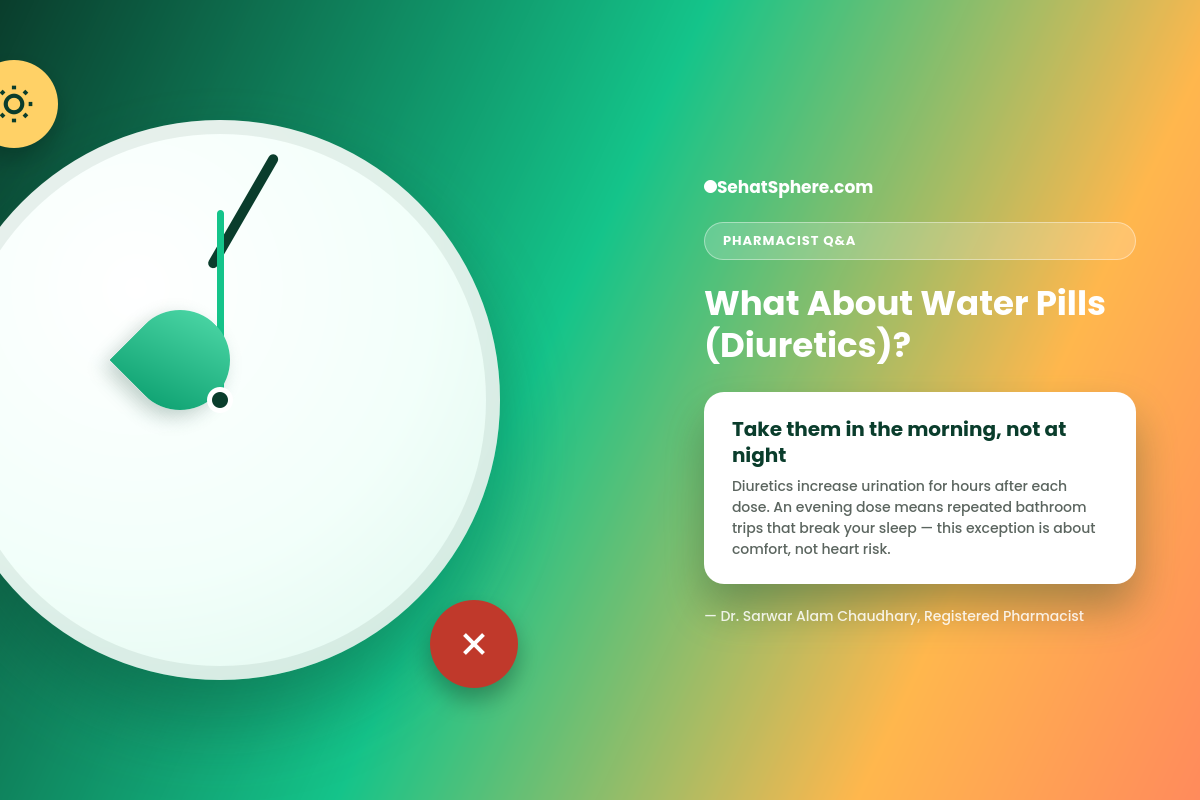
The practical fix is simple: take diuretics first thing in the morning, with breakfast. If you’re prescribed a twice-daily dose, take the second dose no later than 4pm. This isn’t about cardiovascular risk — it’s purely about not breaking your sleep with repeated bathroom trips.
What To Read Next
- Why Does Blood Pressure Fluctuate? 12 hidden causes and a 7-day control plan.
- Does Anger Raise Blood Pressure? The scientific truth, and a 5-step fix.
- 7 Early Signs of a Weak Heart: Subtle symptoms most adults dismiss as stress.
Why You Should Never Stop Abruptly
This is the single most important message in this guide. Some BP medicines — particularly clonidine — work by calming the part of your nervous system (the sympathetic nervous system) that raises blood pressure. Stop it suddenly, and that system can snap back hard, flooding your body with adrenaline and noradrenaline. Doctors call this rebound hypertension; documented cases show severe BP and heart rate spikes within hours of abrupt discontinuation, occasionally severe enough to require emergency care.
Any change to your BP medicine — stopping, reducing, or switching — should happen gradually and only with your doctor’s guidance. Most other BP medicines are gentler if stopped abruptly, but there’s no good reason to test which category yours falls into by trial and error.
Grapefruit and BP Medicine, Sorted Properly
Another area where oversimplified advice causes confusion. Grapefruit contains compounds that block an enzyme in your gut wall called CYP3A4, which normally breaks down certain medicines before they fully absorb. Block that enzyme, and more of the drug reaches your bloodstream than intended — sometimes dangerously more. Calcium channel blockers carry the most attention here, but the risk is not equal across the class.
| Medicine Class | Grapefruit Risk |
|---|---|
| Felodipine, nifedipine, nisoldipine | High — avoid grapefruit entirely |
| Amlodipine | Specifically studied, no significant effect on levels |
| ACE inhibitors, ARBs, beta-blockers, diuretics | Generally safe with grapefruit |
The amlodipine finding isn’t a one-off. Multiple independent pharmacokinetic studies — including a placebo-controlled crossover trial in 20 healthy men — measured amlodipine blood levels with and without grapefruit juice and found no clinically meaningful change. This is also confirmed directly in amlodipine’s official FDA prescribing information, which states co-administration with grapefruit juice had no significant effect on its pharmacokinetics. Felodipine, by contrast, can see blood levels rise several-fold with regular grapefruit intake — a real, dangerous difference within the very same drug class.
Myth: “All calcium channel blockers are dangerous with grapefruit, including amlodipine.” Fact: Amlodipine has been specifically studied and repeatedly cleared — even though felodipine, from the same drug class, genuinely does carry risk.
The Persistent Cough Nobody Connects to Their BP Pill
If you’re on an ACE inhibitor (lisinopril, enalapril, ramipril, perindopril) and have developed a dry, tickling cough, it’s very likely the medicine, not a lingering cold. The mechanism is well understood: ACE inhibitors block an enzyme that also breaks down a substance called bradykinin in your airways. When bradykinin accumulates, it irritates the throat and triggers a persistent cough reflex.
How common is it? Estimates vary by study design, but a comprehensive CHEST journal review put the range at 5–35% of users. A network meta-analysis covering 135 randomised trials and over 45,000 patients found ACE inhibitors carry roughly 2.2 times the cough risk of placebo, and about 3.2 times the risk of ARBs (a related but different drug class). In one head-to-head comparison specifically in people with known prior ACE-inhibitor cough, switching to telmisartan (an ARB) resulted in a 15.6% cough recurrence, compared to 60% for those who stayed on lisinopril.
- Onset is highly variable — anywhere from hours after the first dose to months later
- It’s more common in women and in non-smokers
- It is not dose-dependent — lowering the dose usually doesn’t help
- It typically won’t resolve on its own while you continue the drug
The only reliable fix is switching to a different drug class — usually an ARB — with your doctor. Cough syrup or allergy medicine won’t help, because the cause isn’t infection or allergy; it’s a direct pharmacological effect of the drug itself.
One Nuance: Beta-Blockers and Morning Risk
Not every expert fully rules out an exception. Some physicians still note that certain beta-blockers, like metoprolol, were historically studied with night dosing in mind, based on older research suggesting heart attack risk clusters in the early morning hours — the same “morning surge” phenomenon mentioned earlier. In principle, evening dosing could blunt that surge slightly more than morning dosing.
In practice, most BP medications today are formulated to last a full 24 hours in your system regardless of when you take them, which is a large part of why TIME and BedMed found timing didn’t matter overall. If your doctor has specifically instructed you to take a particular BP medicine at a particular time, that instruction is personalised to you and should take priority over general guidance like this article.
See a Doctor, or Just Adjust? An Honest Framework
| Usually Fine, Adjust Yourself | See Your Doctor |
|---|---|
| Switching dosing time for convenience | Any thought of stopping medicine on your own |
| Persistent dry cough (mention it, don’t panic) | Severe headache, chest pain, or fainting |
| Mild dizziness that settles within days of starting | A BP reading far outside your normal range |
| — | Missing a clonidine dose |
Quick Self-Check
Tick anything that applies to you — if you check more than one, it’s worth a conversation with your pharmacist or doctor before your next refill.
Frequently Asked Questions
Is it better to take BP medicine morning or night?
The largest trial ever conducted on this question (TIME, 21,104 patients, 2022) found no statistically significant difference in heart attack, stroke, or death risk between morning and evening dosing. Two further 2024 trials (BedMed and BedMed-Frail) confirmed this again, even in frail elderly patients. Pick whichever time you’ll consistently remember.
Why did doctors used to recommend taking it at night?
A 2019 Spanish study (the Hygia Chronotherapy Trial) reported a dramatic 45% reduction in cardiovascular events with bedtime dosing. It was a large, widely-publicized study that shaped years of advice — but its unusual methodology was later questioned, and it hasn’t been replicated by the larger, independently-run TIME and BedMed trials.
Can I stop taking BP medicine once my reading is normal?
No. A normal reading while on medicine usually means the medicine is working, not that you’re cured. Stopping without medical guidance can cause blood pressure to rise again, sometimes sharply.
What happens if I miss a dose?
It depends on the drug. Amlodipine and lisinopril are relatively forgiving of a single missed dose given their half-lives. Clonidine is not — never skip or stop it abruptly, as it can trigger dangerous rebound hypertension within hours.
Should diuretics (water pills) be taken at a specific time?
Yes — in the morning, ideally with breakfast. This isn’t about heart protection like the morning/evening debate above; it’s to avoid nocturia (needing to urinate repeatedly at night) from an evening dose disrupting your sleep.
Is grapefruit safe with amlodipine?
Yes — multiple dedicated pharmacokinetic studies, and amlodipine’s own FDA prescribing information, confirm grapefruit juice has no significant effect on its levels. Other calcium channel blockers like felodipine and nifedipine do carry real, dangerous risk with grapefruit.
Why do I have a dry cough since starting my BP medicine?
ACE inhibitors cause a persistent dry cough in an estimated 5–35% of users, caused by a buildup of a substance called bradykinin in the airways. It’s a known class effect, not a cold, more common in women, and usually resolves by switching to an ARB under your doctor’s guidance.
Does the ACE-inhibitor cough go away if I lower my dose?
Usually not. Unlike many side effects, this cough isn’t dose-dependent, so reducing the dose typically doesn’t help. Switching to a different drug class is the more reliable fix.
Why is clonidine different from other BP medicines?
Clonidine works centrally on your nervous system to suppress the signals that raise blood pressure. Stopping it abruptly can cause that suppressed system to rebound sharply, a well-documented phenomenon called rebound hypertension, sometimes requiring emergency treatment.
How common is high blood pressure globally?
An estimated one billion people worldwide have high blood pressure, and it’s the leading modifiable risk factor for cardiovascular disease.
Is there any BP medicine where timing genuinely still matters for the heart?
Not according to the current best evidence. Some physicians note a theoretical rationale for certain beta-blockers given older research on morning heart-attack risk, but this hasn’t overturned the overall trial evidence. If your doctor has given you specific timing instructions, follow those, since they’re personalised to your case.
The Bottom Line
Morning-versus-night is the wrong question — three large, independent trials now agree the answer barely matters for your heart. What actually protects you: taking your medicine every single day, never stopping because a reading looked normal, and knowing that one drug (clonidine) genuinely can’t be stopped abruptly. Diuretics are the one real timing exception, but for sleep, not survival. Everything else — grapefruit, the mystery cough — is detail worth knowing, not detail worth losing sleep over.
- British Heart Foundation. The TIME Trial. bhf.org.uk
- Mackenzie IS, et al. Cardiovascular outcomes with evening versus morning dosing (TIME study). The Lancet, 2022. thelancet.com
- European Society of Cardiology. Evening vs. morning dosing: no differences seen (BedMed/BedMed-Frail, 2024). escardio.org
View All References (7) ▾
- Hermida RC, et al. Bedtime hypertension treatment improves cardiovascular risk reduction (Hygia Chronotherapy Trial). European Heart Journal, 2019.
- Vincent J, et al. Lack of effect of grapefruit juice on the pharmacokinetics of amlodipine. Br J Clin Pharmacol, 2000. PubMed
- ACE inhibitor-induced cough incidence review. CHEST Journal. chestnet.org
- Network meta-analysis of ACEI-induced cough vs ARB/CCB. PMC