
SehatSphere Diagnostic Note
BP Machine Reading Wrong? 🩺
5 Reasons Home Monitors Give False Highs
Before you panic about a scary number — rule these five technique errors out first.
The short version — why your BP machine reading is wrong
A wrong cuff size or a cuff worn over a sleeve can each push your reading up by 5–50 mmHg — enough to turn a normal number into a “hypertensive” one. Most sudden scary home readings are a technique problem, not a new medical one.
1. Your cuff is the wrong size
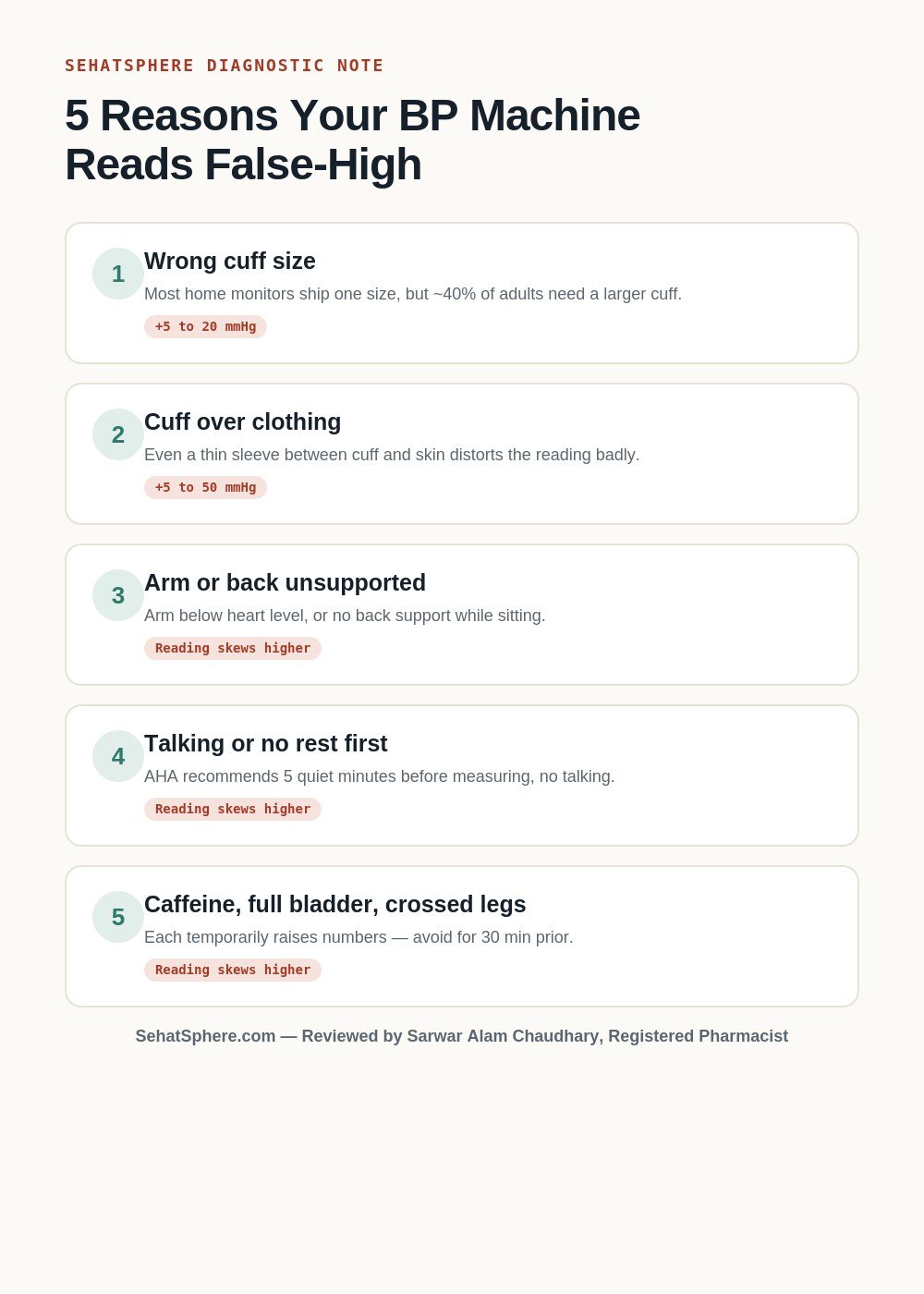
The single biggest source of error. A Johns Hopkins trial found that using a standard cuff on someone who needed a larger one overestimated systolic pressure by 5–20 mmHg — enough to misclassify someone as hypertensive who isn’t. Most home monitors ship with only one “regular” size, but roughly 40% of adults need a larger cuff.
Fix: measure your upper-arm circumference midway between elbow and shoulder, and check it against the cuff’s printed size range.
2. The cuff is over your clothing
Measuring through a sleeve — even a thin one — is one of the most common at-home mistakes, and clinical sources note it can add anywhere from 5 to 50 mmHg depending on the fabric. The cuff needs to sit directly on bare skin.
Fix: roll the sleeve above the elbow, or take your arm out of it — don’t just push a tight sleeve up, which can constrict the arm.
3. Your arm or back isn’t supported
An unsupported arm, held up by muscle effort, or positioned below heart level skews the reading higher. The same goes for sitting without back support or with feet dangling instead of flat on the floor.
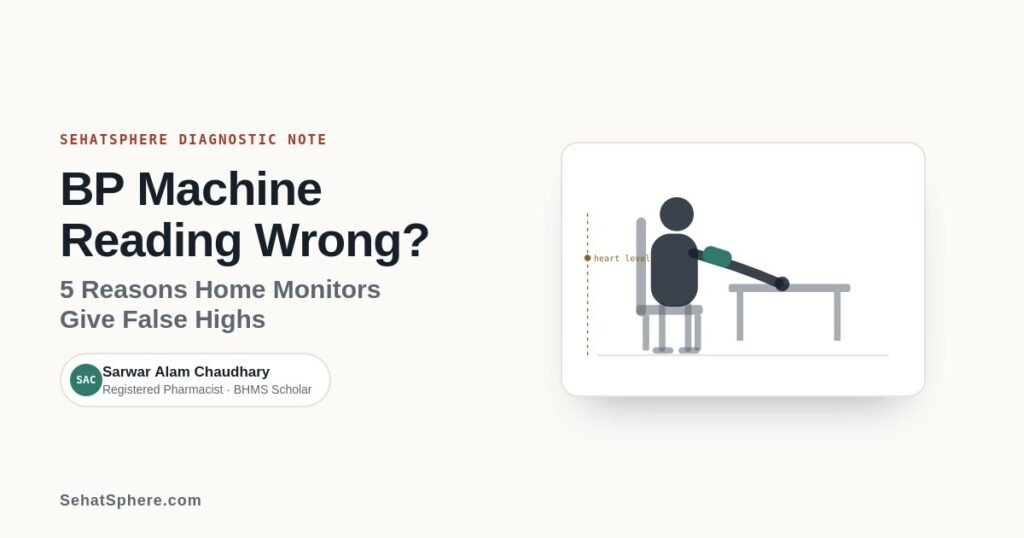
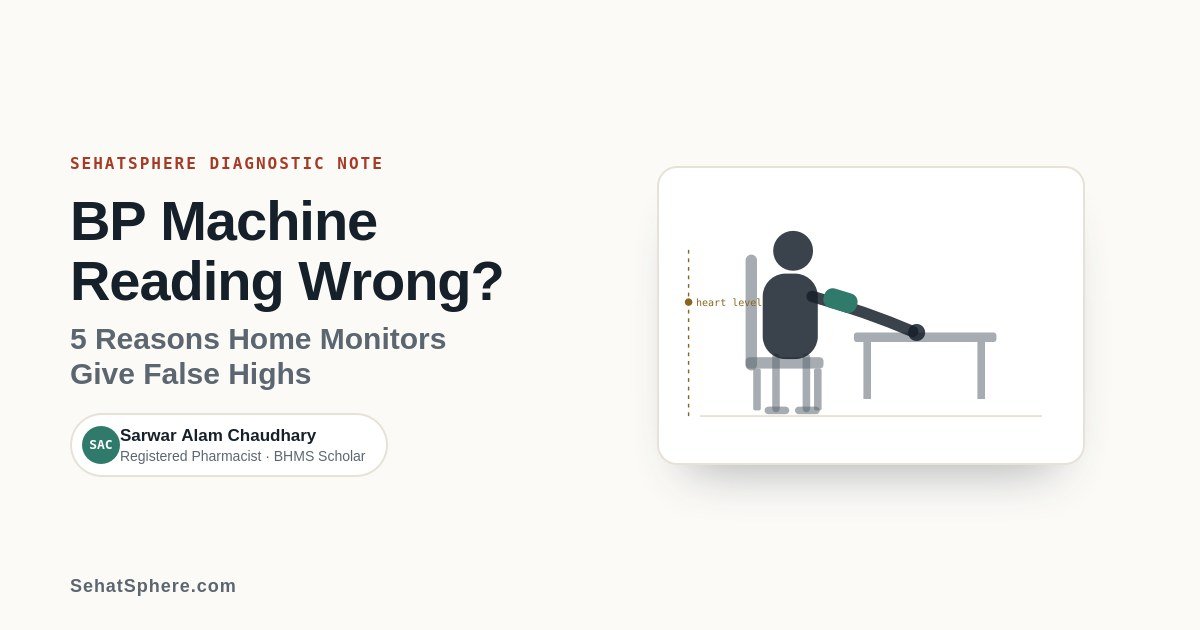
Fix: back support, feet flat, arm resting on a table so the cuff sits roughly at heart level — as in the diagram above.
4. You talked, moved, or didn’t rest first
Talking during the measurement, or taking it right after walking in from outside, both raise the reading. The American Heart Association recommends sitting quietly for at least 5 minutes before measuring.
Fix: sit still and silent for 5 minutes first — no phone, no conversation mid-reading.
5. Caffeine, a full bladder, or crossed legs
Coffee, smoking, alcohol, or exercise within 30 minutes of measuring can all temporarily raise your numbers — so can a full bladder or crossed legs, both documented in AHA home-monitoring guidance.
Fix: empty your bladder, uncross your legs, avoid caffeine/exercise for 30 minutes before checking.
✅ Before You Call It a BP Machine Reading Wrong
- Correct cuff size, worn on bare skin
- Back supported, feet flat, arm at heart level
- Rested quietly for 5 minutes, not talking
- No caffeine, smoking, or exercise in the last 30 minutes
- Take two readings, 1 minute apart, and note both
Ruled all five out and the number is still high? That’s real information for your doctor — not a faulty machine.
🔍 Also Worth Knowing
Left arm or right arm — does it matter?
A difference under 5 mmHg between arms is normal. 5–10 mmHg is worth monitoring, and more than 10 mmHg should be checked by a doctor — one study linked a gap over 10 mmHg to a 38% higher risk of cardiovascular problems over 13 years. Best practice: check both arms once, then always use the arm with the higher reading for future checks.
Why is my second reading always lower?
This is normal and expected, not a device fault. Your first reading carries a small “white-coat” bump from the act of measuring itself; that effect fades by the second reading, 1–2 minutes later, as your cardiovascular system settles. It’s exactly why the checklist above tells you to take two readings and note both — the second is usually the more representative one.
Frequently Asked Questions
A few more things people ask when their BP machine reading looks wrong:
Can a wrong cuff size really change a diagnosis?
Yes. The Johns Hopkins trial found nearly 40% of participants were misclassified as hypertensive when measured with a one-size-fits-all cuff instead of one matched to their arm size.
Should I trust my home monitor over my doctor’s reading?
Use both. A validated home monitor used correctly is valuable for tracking trends over time, but a single home reading shouldn’t override your doctor’s in-clinic assessment, especially for medication decisions.
How do I know if my monitor is “validated”?
Validated automatic monitors have been tested against clinical standards for accuracy. A searchable list is available at validatebp.org.
What reading should actually worry me?
A single high reading after a technique error usually isn’t an emergency. Readings at or above 180/120, especially with chest pain, shortness of breath, or vision changes, need urgent medical attention regardless of technique.
How often should I check my BP at home?
For general tracking, once daily at a consistent time is usually enough. If you’re newly diagnosed or adjusting medication, your doctor may ask for readings twice daily, morning and evening, for a week or two.
What is “white coat hypertension”?
It’s when readings are higher in a clinical setting than at home, caused by the anxiety of being examined. It’s a real, well-documented phenomenon and one of the main reasons doctors value home monitoring alongside clinic readings.
My monitor shows an error symbol instead of a number — what does that mean?
Usually a movement error, a cuff that isn’t snug, or a very irregular heartbeat the device couldn’t read cleanly. Reposition, stay still, and retake it before assuming the device is faulty.
📚 Sources
Medical disclaimer: This guide to a BP machine reading wrong is for general education only and is not medical advice. Always confirm unusual or persistently high readings with your doctor.