
Medicine Mistakes: 7 Common Errors That Could Harm You
These aren’t careless-people mistakes — they’re the ones I see careful, well-meaning people make every week. Here’s what actually goes wrong, and why it matters more than it seems.
Working in a hospital pharmacy, you notice something quickly: medicine mistakes are rarely made by careless people. They’re made by otherwise attentive, well-meaning people who simply were never told the specific detail that mattered. This guide covers the nine mistakes I see most often — not to alarm anyone, but because each one is genuinely easy to fix once you know it’s happening.
- Stopping antibiotics early once symptoms improve
- Self-adjusting BP or diabetes medicine without a doctor
- Accidental paracetamol double-dosing from combo products
- Ignoring food-timing instructions (before/after meals)
- Sharing prescription medicine with family members
- Using expired medicines, assuming they’re “still fine”
- Not disclosing the full medicine list to every doctor
- Splitting or crushing pills that shouldn’t be altered
- Storing medicine wrong — heat and moisture degrade it faster than the expiry date suggests
Why Medicine Mistakes Happen So Often
Medicines come with printed instructions, but most people are handed a strip of tablets with a verbal “twice a day after food” and nothing more. The reasoning behind the instruction — why timing matters, why the full course matters, what else might interact — almost never gets explained.
Without that reasoning, instructions feel arbitrary, and arbitrary instructions are the first thing people bend when life gets busy or symptoms improve. Understanding why a rule exists is what actually makes people follow it — which is the approach this whole guide takes.
There’s also a language and time factor that’s very real in busy clinics and pharmacies: the person handing over the medicine often has only a few seconds per patient, and the detailed counselling that should accompany a prescription simply doesn’t fit into that window. The result is that most people leave with the medicine but without the context, and that gap is where the mistakes below quietly take root.
The 9 Medicine Mistakes I See Most Often

Mistake 1
Stopping Antibiotics Early High Risk
Feeling better after two or three days means symptoms have improved — it doesn’t mean every targeted bacterium is gone. The toughest, most resistant ones are often still present, and stopping early gives them room to rebound.
Repeated early stopping across a population is also a major contributor to antibiotic resistance, which is exactly why doctors emphasize finishing the full course even when you feel completely fine partway through.
📋 From the Counter
A patient once reused an old antibiotic strip for a fresh fever, assuming “same symptom, same medicine.” Tests later showed it was viral fever — the antibiotic was unnecessary, offered no benefit, and simply added an avoidable side-effect risk on top of the actual illness.
Mistake 2
Self-Adjusting Chronic Disease Medication High Risk
Stopping or reducing blood pressure or diabetes medication because readings “look normal now” is one of the most common mistakes I see — without realizing the normal reading is often the medication working, not the condition being gone.
These medications frequently need to be continued indefinitely or adjusted gradually under supervision, and stopping abruptly can cause readings to spike back up, sometimes worse than before treatment started.
Mistake 3
Accidental Paracetamol Double-Dosing High Risk
Paracetamol is included in a surprising number of combination products — cold and flu remedies, sinus medicine, sleep aids, and various pain relievers — often under names that don’t obviously say “paracetamol” on the front.
Taking a fever reducer and a cold medicine together, both containing paracetamol, is a genuinely common way to unintentionally exceed the safe daily limit, which matters because excess paracetamol specifically risks liver damage.
Mistake 4
Ignoring Food Timing Instructions Moderate
“Take after food” or “take on an empty stomach” isn’t a generic courtesy instruction — food can measurably change how much of a drug your body actually absorbs, in either direction depending on the medicine.
Taking a medicine at the wrong time relative to meals can mean getting significantly less benefit from the same dose, without ever realizing timing was the reason it seemed to “not work as well.”
Mistake 5
Sharing Prescription Medicine With Family High Risk
“Ye tumhe bhi kaam karega” is one of the most common — and most risky — habits I’ve seen. A prescription is written for one specific person’s diagnosis, allergies, weight, and other medications, not for a symptom in general.
The same symptom, like a headache or stomach pain, can have completely different underlying causes in two different people, meaning a medicine that helped one person can be ineffective or genuinely harmful for another.
Mistake 6
Using Expired Medicines Moderate
“Thoda toh chalega” is a understandable instinct, but potency can decline meaningfully past the printed expiry date, and for a small number of medications, the breakdown products that form aren’t simply weaker — they can be actively harmful.
This matters most for medicines treating serious or urgent conditions, where reduced potency at the wrong moment is a genuinely bad outcome, not just a minor inconvenience.
Mistake 7
Not Disclosing the Full Medicine List Moderate
Many people mention their main prescription to a new doctor but forget to mention the occasional painkiller, the daily vitamin, or the herbal supplement a relative recommended — assuming these don’t count as “real” medicine.
Vitamins and herbal supplements can interact with prescription drugs just as much as other medicines can, and a doctor can only account for interactions they actually know exist.
Mistake 8
Splitting or Crushing Pills That Shouldn’t Be Altered Moderate
Splitting a tablet to get a smaller dose, or crushing it to make swallowing easier, feels like a harmless workaround — but some tablets are specifically coated for slow, extended release, and breaking that coating can release the full dose all at once instead of gradually.
Before splitting or crushing any tablet, it’s worth a quick check with a pharmacist — some medicines are genuinely fine to split along a scored line, while others should never be altered from their original form.
Mistake 9
Storing Medicine Wrong Moderate
Keeping medicine strips in a kitchen cabinet, near a window, or in a humid bathroom exposes them to heat and moisture that can degrade potency well before the printed expiry date — a genuinely common issue in India’s climate.
A cool, dry drawer away from direct sunlight is a simple fix that protects a medicine’s full labeled shelf life, rather than assuming the expiry date alone guarantees the medicine is still at full strength.
Myth vs Fact
Myth: “If a medicine helped my friend or family member with the same symptom, it’s safe for me too.” Fact: The same symptom can come from different causes, and factors like allergies, other medications, and existing conditions change whether a medicine is genuinely safe for a specific person.
🧭 Managing Multiple Deficiencies or Conditions?
Our Deficiency Symptom Finder and Blood Report Decoder can help you organize symptoms and test values before your next doctor’s visit — useful groundwork alongside a proper medicine list.
Check Your Own Medicine Habits
Tick any of these that honestly apply to you or someone you manage medicines for. This is for awareness, not judgment.
Tick the boxes above to see your result.
This is for general awareness only — talk to your pharmacist or doctor about any specific medicine concerns.
Why Timing Actually Matters
Some medicines need an empty stomach because food physically slows their absorption, delaying or blunting the effect. Others specifically need food because they can irritate the stomach lining, or because fat in a meal actually helps absorb them better.
Iron and calcium supplements are a particularly common example of timing mattering — taking them alongside antacids, dairy, or tea can reduce absorption, which we’ve covered specifically in our iron deficiency guide.
| Medicine | Watch Out For | Why |
|---|---|---|
| Antibiotics (many types) | Dairy products | Calcium can bind to the drug and reduce absorption |
| Metformin (diabetes) | High-fiber supplements | Fiber can reduce how much is absorbed |
| Iron / Calcium supplements | Antacids, tea, coffee | Blocks or reduces mineral absorption |
| Thyroid medicine | Food in general | Usually needs a strictly empty stomach to absorb properly |
This is a general awareness reference, not a complete interaction list — always confirm specific timing with your pharmacist.
When in doubt, the timing printed on the label or explained by your pharmacist isn’t a suggestion — it’s usually based on how that specific drug behaves in the body, and skipping it can genuinely change how well the medicine works.
Of all the medicine mistakes covered in this guide, timing is probably the most invisible one, because nothing dramatic happens when you get it wrong — the medicine just quietly works less well, and it’s almost impossible to connect that reduced effect back to the timing without knowing to look for it.
The Medicine List Habit Worth Building
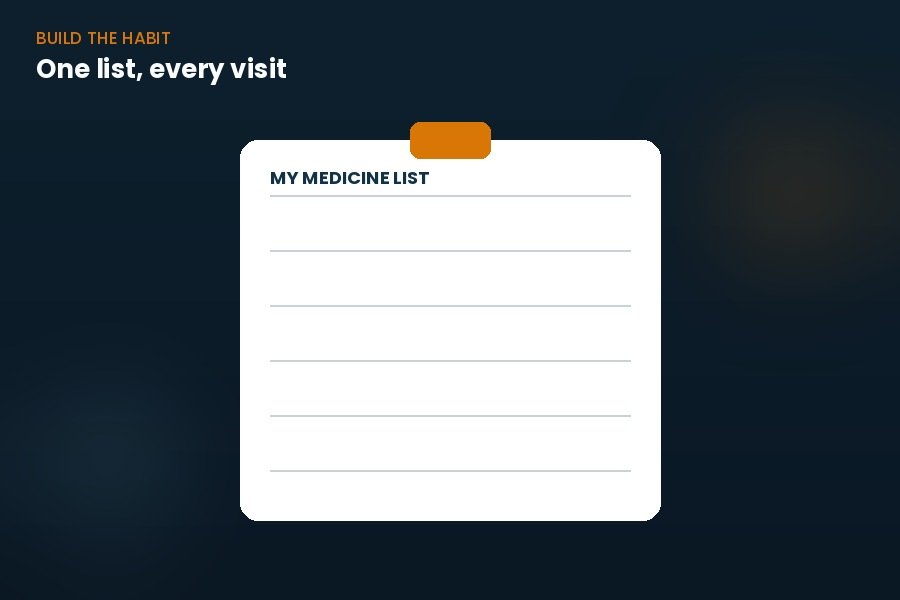
Keeping one written list — every prescription medicine, OTC drug, vitamin, and supplement, with dose and timing — and showing it at every doctor, pharmacy, or hospital visit is one of the single most effective habits for avoiding interactions.
| Include | Example |
|---|---|
| Prescription medicines | BP tablets, diabetes medicine, antibiotics |
| Over-the-counter drugs | Paracetamol, cold medicine, antacids |
| Vitamins & supplements | Vitamin D, iron, multivitamins, herbal products |
| Dose & timing | 500mg, twice daily, after food |
🖨️ Your Printable Medicine List Template
| Medicine Name | Dose | Timing | Prescribed For |
|---|---|---|---|
Keep one copy at home and a photo of it on your phone — it takes a few minutes to create and genuinely helps every healthcare provider you see make safer decisions about what to prescribe.
One more habit worth building: before leaving the pharmacy counter, take a moment to check that the medicine name, strength, and your name on the label match what you expected — a quick check that catches dispensing mix-ups before they leave the counter.
For a broader reference on avoiding medication errors, the U.S. FDA’s consumer guide on avoiding medication mistakes is a solid, freely available resource that reinforces many of these same principles.
When to Ask a Pharmacist vs a Doctor
Pharmacists are specifically trained on how medicines interact with each other, with food, and with supplements — questions like “can I take this with my BP tablet” or “is it okay with this antacid” are exactly what a pharmacist is best positioned to answer quickly.
Doctors are the right call for anything involving diagnosis, changing a treatment plan, or symptoms that feel new or worsening — a pharmacist can flag a concern, but adjusting the actual treatment is a doctor’s call.
Neither replaces the other, and using both appropriately — pharmacist for medicine-specific questions, doctor for the bigger clinical picture — is genuinely how the system is designed to work.
One underused fact worth knowing: in most places, you can walk up to a pharmacy counter and ask a medicine-interaction question without an appointment or a fee. For the everyday “is this combination okay” worries that drive a lot of the medicine mistakes in this guide, that free, immediate access is a genuinely valuable resource that most people never think to use.
The Short Version of Common Medicine Mistakes
- Stopping antibiotics early, self-adjusting chronic medication, and paracetamol double-dosing are the most common serious mistakes.
- Food timing genuinely changes how well many medicines work — it’s not a generic instruction.
- Sharing prescription medicine with family, even for the “same” symptom, carries real risk.
- Expired medicines can lose potency, and improper storage (heat, moisture) can degrade them even faster.
- Never split or crush a tablet without checking — some are specially coated for slow release.
- A written medicine list, shown at every visit, is one of the most effective habits for avoiding interactions.
- Pharmacists are the right first call for medicine-specific questions; doctors for treatment changes.
Frequently Asked Questions
Feeling better means symptoms have improved, not that all the bacteria have been cleared. Stopping early can let the toughest surviving bacteria rebound, and repeatedly doing this contributes to antibiotic resistance.
Yes. Paracetamol is included in many combination cold, flu, and pain products under different brand names, so taking more than one such product at a time is a common, genuinely accidental way to exceed the safe daily limit.
Yes, for many medicines. Food can slow, speed up, or reduce how much of a drug your body absorbs, which is exactly why the same medicine can work differently depending on timing relative to meals.
No. A prescription is written for one specific person’s condition, allergies, and other medications. The same symptom can have different causes, and sharing prescription medicine is a recognized, avoidable source of harm.
It varies by drug and storage conditions, but potency can decline meaningfully past the expiry date, and for a few medications, degradation products can form that aren’t simply “weaker” but potentially harmful.
Antacids change stomach acidity and can bind to certain minerals and drugs, reducing how much your body actually absorbs — which is why timing separation is often recommended for specific combinations.
Yes. Vitamins and herbal supplements can interact with prescription medications just as other drugs can, and your doctor can only account for interactions they actually know about.
Returning it to a pharmacy or a designated take-back location is generally the safest option, rather than throwing loose medicine in household trash or down the drain.
No, not universally. Tablets with a scored line are usually designed to be split safely, but extended-release or coated tablets can release their full dose at once if broken, which changes how the medicine works entirely.
Yes. Heat and humidity, common in kitchens and bathrooms, can degrade many medicines faster than their printed expiry date accounts for — a cool, dry drawer is a better choice.