
 SehatSphere
Medication Safety
Mouth Taping and Your Medications
The sleep-aid combination almost nobody warns you about
Mouth taping and your medications is a combination almost no viral safety warning addresses directly. #MouthTaping has over 24 million views, and most coverage focuses on sleep apnea as a diagnosed condition rather than on the medications millions of people are already taking on any given night. Here’s the angle that’s missing: what happens when you tape your mouth shut the same night you’ve taken a sedating sleep aid — prescription or over-the-counter, and often without realizing the two habits have anything to do with each other at all.
Jump to: Why sedatives change the risk · The OTC medications people miss · What’s documented · Test yourself · FAQ
Quick answer: Mouth taping — applying tape over the lips overnight to force nasal breathing — has no strong evidence of benefit and carries real risk on its own.[1] That risk increases specifically if you’ve taken any medication that sedates you or relaxes your throat muscles, since those same medications blunt the reflex that would normally wake you if your nose becomes blocked.
Mouth taping has been one of the most persistent viral sleep trends since 2023, promoted with claims that it reduces snoring, improves sleep quality, and even reshapes facial structure over time. In my own counseling, this is a trend patients mention almost in passing — “oh, I also started taping my mouth” — dropped into a conversation about a completely unrelated new prescription, as if the two things couldn’t possibly interact. A systematic review published in PLOS ONE examined the available research and found no evidence that mouth taping reduces snoring severity or improves sleep architecture in any measurable way.[1]
Mouth taping and your medications: why sedatives change the risk
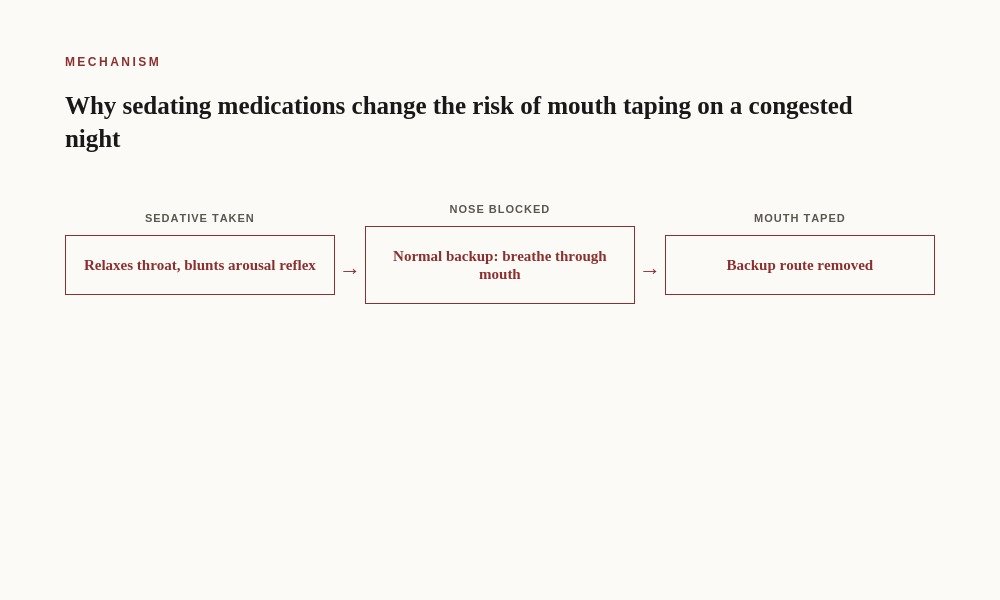
Here’s the mechanism almost nobody connects to the trend. Sedating medications — benzodiazepines, “Z-drug” sleep aids like zolpidem, opioids, and even common over-the-counter antihistamines — relax the muscles of your throat and blunt the arousal reflex that would normally wake you if breathing becomes difficult.[2][3] This is exactly why these medications are used cautiously, or avoided, in people with diagnosed sleep apnea — anesthesiology safety literature describes this effect bluntly: sedatives “preferentially decrease neural input to the upper airway dilating muscles, thereby directly promoting upper airway obstruction.”[4]
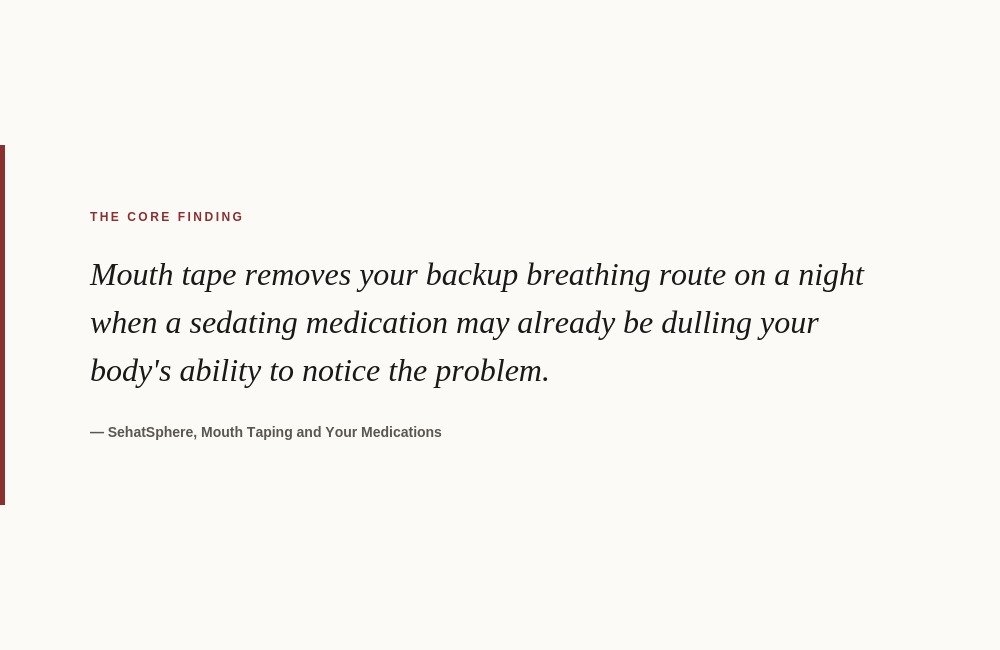
Under normal circumstances, if your nose gets blocked overnight — from allergies, a cold, or simple congestion — your body’s backup plan is to open your mouth and breathe through it. Mouth tape removes that backup plan on a night when a sedating medication may already be dulling your body’s ability to notice or respond to the problem. Neither factor alone is necessarily dangerous for a healthy adult. The combination is what deserves more attention than it’s getting.
Mouth taping and your medications: the OTC medications people miss
When people think about “sedating medications,” prescription sleeping pills usually come to mind first. The bigger blind spot is over-the-counter products — diphenhydramine (found in Benadryl and in nighttime formulas like Tylenol PM and ZzzQuil) is a sedating antihistamine with exactly the throat-relaxing, arousal-blunting profile described above.[5] Someone who wouldn’t think twice about taking a “harmless” allergy pill or nighttime cold medicine, and who has also started taping their mouth for the wellness benefits, has stacked two things that specifically compound each other — without either purchase requiring a prescription or a pharmacist conversation.
I’ve had this exact conversation with patients who were surprised to learn that a store-bought sleep aid falls into the same pharmacological category discussed in hospital anesthesia safety guidelines for people at risk of airway obstruction. One patient specifically remembered reaching for a strip of ZzzQuil during a bad cold, then taping her mouth the same night out of habit — two decisions that felt completely unrelated to her at the time, made minutes apart, without either one crossing her mind as connected to the other.
Mouth taping and your medications: what’s actually documented
| Medication category | Relevant effect |
|---|---|
| Benzodiazepines | Documented arousal-threshold blunting |
| Z-drugs (zolpidem, eszopiclone) | Throat muscle relaxation, mixed arousal effects |
| Opioids | Reduced airway muscle activity, respiratory depression |
| OTC antihistamines (diphenhydramine) | Same mechanism, rarely recognized by users |
| Melatonin (standard dose) | Mild sedation, lower-risk but not zero |
Mouth taping and your medications: who should be most cautious
Undiagnosed sleep apnea is common enough that the American Dental Association and multiple ENT specialists have specifically flagged mouth taping as risky for exactly this reason — you can’t rule out an obstruction problem you don’t know you have.[6] Layer a sedating medication, prescription or OTC, on top of an undiagnosed airway issue and unproven mouth restriction, and you have three unknowns stacking on the same night. If you snore heavily, wake up gasping, or have ever been told you might have sleep apnea, this combination is one to avoid entirely rather than experiment with.
Two scenarios worth reading
Scenario one: someone takes an over-the-counter nighttime cold medicine during a bad congestion week and, following their usual routine, also tapes their mouth before bed — not realizing the congestion that prompted the medicine in the first place is exactly the situation mouth taping is least equipped to handle safely. Scenario two: someone recently prescribed a short course of a benzodiazepine for acute anxiety starts a mouth-taping habit around the same time for unrelated wellness reasons, without either the prescriber or the patient connecting the two — because on paper, a sleep hack and an anxiety medication don’t look related at all.
What I actually tell patients
- Taking any sedating medication tonight — prescription or OTC (including diphenhydramine-based nighttime cold or allergy products)? Skip the mouth tape that night.
- Never tried mouth taping and currently congested for any reason? This is exactly the wrong night to start.
- Snore heavily or suspect undiagnosed sleep apnea? Treat mouth taping as off the table until that’s been evaluated, regardless of medication use.
- On a regular prescription sedative, benzodiazepine, or opioid? Mention any sleep-hygiene habits like mouth taping to your prescriber — it’s a reasonable, specific thing to disclose.
- The evidence for mouth taping’s actual benefits is thin regardless of medication use — this isn’t a habit with a strong upside to weigh against the risk.
Test yourself
1. What do sedating medications do that matters most for mouth taping?
2. Which common OTC product has this same sedating mechanism?
3. What does mouth tape remove on a congested night?
Mouth taping and your medications: three myths worth retiring
Myth: “It’s just tape, how risky can it be?” The tape itself is inert. The risk comes entirely from what it does functionally — removing a breathing route — combined with anything else that reduces your body’s ability to notice or respond to a breathing problem. Myth: “If I don’t have diagnosed sleep apnea, this doesn’t apply to me.” A meaningful share of sleep apnea cases are undiagnosed precisely because the person is asleep when it happens — the ADA and multiple ENT specialists have raised this exact concern about mouth taping specifically because you can’t rule out a risk you don’t know you have.[6] Myth: “Natural sleep hacks don’t interact with medications the way drugs do.” The interaction here isn’t chemical — it’s mechanical and physiological, and that makes it easy to overlook precisely because it doesn’t fit the usual mental model of a “drug interaction.”
What actually happens during an obstructive event
It’s worth understanding the sequence this guide is describing, rather than just the warning itself. During normal sleep, if your airway partially or fully obstructs — from nasal congestion, throat relaxation, or both — your body registers rising carbon dioxide and falling oxygen, and triggers a brief arousal: you stir, shift position, or briefly wake, restoring normal breathing before falling back asleep, often without remembering it. Sedating medications specifically blunt this arousal response — the mechanism repeatedly documented in the anesthesia and sleep-medicine literature cited throughout this guide.[2][7] Mouth tape doesn’t cause an obstruction on its own in a person with clear nasal passages, but it removes the alternate route that would otherwise let breathing continue if the nose becomes the problem.
A note on the “premium” and “gentle” mouth tape marketing
Newer mouth tape products marketed as “gentle,” “breathable,” or designed with a small center opening are often positioned as safer alternatives to solid tape. A more breathable material or a small opening changes the comfort and irritation profile, but doesn’t change the core mechanism this guide is about — if your nose is blocked and a sedating medication is on board, a small center hole is unlikely to provide the same unrestricted airflow as simply breathing through an open mouth. Marketing language about gentleness shouldn’t be read as a safety claim about this specific interaction.
Mouth taping and your medications: the India context
India’s own high burden of allergic rhinitis and seasonal congestion — driven by air quality, dust, and pollen exposure in many cities — makes the “blocked nose” half of this equation genuinely common rather than a rare edge case. Combine that with how easily sedating antihistamines and OTC cold-and-cough combinations are available without a prescription, and the specific scenario this guide describes — congestion plus a sedating medication plus a mouth-taping habit — is arguably more likely here than in markets with stricter OTC controls. If you live somewhere with predictable seasonal congestion, that’s a specific, practical reason to treat this guide’s caution as more than a rare hypothetical.
Mouth taping and your medications: FAQ
Is mouth taping safe with sleep medication?
Not recommended. Sedating sleep medications, prescription or OTC, blunt the reflex that would normally wake you if breathing becomes difficult, and mouth tape removes your backup breathing route.
Can I mouth tape if I took Benadryl or ZzzQuil?
Diphenhydramine, the active ingredient in these products, has the same throat-relaxing, sedating profile as prescription sleep aids — it’s safer to skip mouth taping on nights you’ve taken it.
What is mouth taping, exactly?
Mouth taping is applying adhesive tape over the lips overnight to force nasal breathing, based on claims it reduces snoring and improves sleep quality.
Does mouth taping actually work?
A systematic review found no evidence it reduces snoring severity or improves sleep architecture. The evidence does not support the viral claims.
Is mouth taping dangerous for sleep apnea?
Yes — multiple ENT and dental organizations warn against it specifically because many people have undiagnosed sleep apnea and wouldn’t know they’re at higher risk.
Can melatonin make mouth taping riskier?
Melatonin’s sedating effect is milder than benzodiazepines or Z-drugs, making it a lower-risk combination, though not necessarily zero-risk.
Does alcohol create the same risk as sedating medications?
Yes — alcohol relaxes throat muscles and impairs the same arousal reflex, making it another substance worth avoiding alongside mouth taping, especially in combination with any medication.
Are “breathable” or “gentle” mouth tapes safer with medication?
A gentler material changes comfort, not the core mechanism — if your nose is blocked and you’re sedated, a small opening doesn’t provide the same airflow as an open mouth.
How would I know if I have undiagnosed sleep apnea?
Heavy snoring, waking up gasping, morning headaches, and daytime fatigue despite adequate sleep hours are common signs worth discussing with a doctor before trying mouth taping.
Related reading
Sources
- PLOS ONE — Systematic Review of Mouth Taping for Sleep
- Anesthesia Patient Safety Foundation — Sedatives and Sleep Apnea
- NIH PMC — Opioids and Obstructive Sleep Apnea
- U.S. Pharmacist — Central Sleep Apnea and Sedative Medications
- NIH PMC — Benzodiazepine Receptor Agonists and Sleep Apnea Risk
- American Dental Association — Mouth Taping Safety Concerns
- European Respiratory Society — Sedatives and Arousal Threshold in Sleep-Disordered Breathing
This article is for general education only, not medical advice. Talk to your doctor or pharmacist before combining any sedating medication with sleep habits like mouth taping, and seek evaluation if you suspect undiagnosed sleep apnea.