 SehatSphere.com
Does Anger Raise Blood Pressure? The Scientific Truth & 5-Step Fix
Yes, anger raises blood pressure — that part isn’t controversial. What’s new is that a 2024 NIH-funded study finally showed how it damages your heart, a Harvard study measured exactly how dangerous a single outburst can be, a massive 154-study review just debunked the most common advice for dealing with it, and newer research shows anger doesn’t hit every heart the same way — men and women appear to pay for it in genuinely different currencies.
Key takeaways:
- A 2024 Columbia/NIH study found anger — specifically anger, not anxiety or sadness — directly impairs blood vessel function within minutes.
- A landmark Harvard meta-analysis of 9 studies found an angry outburst raises heart attack risk roughly 5-fold and stroke risk 3.6-fold in the following 2 hours.
- A 15-year study of over 3,300 young adults found the most hostile group had an 84% higher risk of developing hypertension by their 30s and 40s.
- Extreme anger can trigger “broken heart syndrome” (takotsubo cardiomyopathy) — and it hits postmenopausal women far more often than men.
- “Venting” your anger (punching bags, yelling it out) doesn’t help and may make things worse, according to a 2024 review of 154 studies.
- What actually works is boringly simple: techniques that calm your nervous system down, not rev it up.
Not a New Idea — But Newly Understood
The link between anger and heart disease isn’t a recent discovery. Since the 1950s, when researchers first described the “Type A personality” — competitive, hostile, easily angered — as a cardiovascular risk factor, doctors have suspected that how you handle anger affects your heart. Decades of observational studies since then have consistently linked anger, hostility, and frequent angry outbursts to higher rates of heart attack and stroke.
What those decades of observational data couldn’t explain was how anger actually damages the cardiovascular system. Correlation isn’t mechanism — and without understanding the biology, it was hard to know whether anger was truly causal, or just a marker of some other risk factor like poor sleep or heavy drinking. That gap started closing in 2024. If you’re already tracking your numbers because of a related concern, our Complete Guide to Blood Pressure is a useful baseline to read alongside this one.
The 2024 Study: How Anger Damages Your Blood Vessels
In May 2024, cardiologist Dr. Daichi Shimbo and colleagues at Columbia University Irving Medical Center published findings in the Journal of the American Heart Association, funded by the NIH’s National Heart, Lung, and Blood Institute. The study — part of a research program called PUME (Putative mechanisms Underlying Myocardial infarction onset and Emotions) — was designed to finally test which negative emotions actually damage blood vessels, and how.
Researchers recruited 280 healthy adults, ages 18 to 73 (average age 26), from the community around Columbia’s medical center in New York City. Every participant was screened to be genuinely healthy: no history of heart disease, stroke, high blood pressure, high cholesterol, or diabetes; no mental health diagnoses; not taking any prescription medications or supplements; and non-smokers. This mattered — it meant any effect the researchers found couldn’t be blamed on existing disease or medication.
After a 30-minute relaxation period with baseline measurements, participants were randomly assigned to one of four 8-minute tasks:
- Recall and describe a personal experience that made them angry
- Recall and describe an experience that made them anxious
- Read passages designed to induce sadness
- A neutral counting task (control group)
Researchers then measured endothelium-dependent vasodilation (EDV) — essentially, how well the inner lining of blood vessels can relax and widen, a key marker of vascular health and an early warning sign for atherosclerosis (arterial hardening) when impaired.
Only the anger group showed a statistically significant impairment in blood vessel dilation. The anxiety group showed a similar trend, but it wasn’t strong enough to rule out chance. The sadness group showed no significant effect at all, and no group showed evidence of cell injury or repair problems. In other words: not all negative emotions are equal — anger specifically appears to hit the blood vessels in a way anxiety and sadness don’t.
Outside experts called the finding important. Dr. Suzanne Arnold, a cardiologist at Saint Luke’s Health System uninvolved in the study, noted: “There’s plenty of data that have shown acute anger increases the risk for heart attacks, but the mechanism by which that happens is not really understood” — calling this study a step toward finally explaining it. NIH program officer Dr. Laurie Friedman Donze added that the study “helps fill a real knowledge gap and shows how this might occur.”
One honest limitation worth naming: because participants were young and free of existing disease, researchers don’t yet know whether the same effect appears — or is even stronger — in older adults already managing high blood pressure, diabetes, or heart disease. Shimbo’s team has said future studies will test exactly that.
How Fast Can Anger Trigger a Heart Attack?
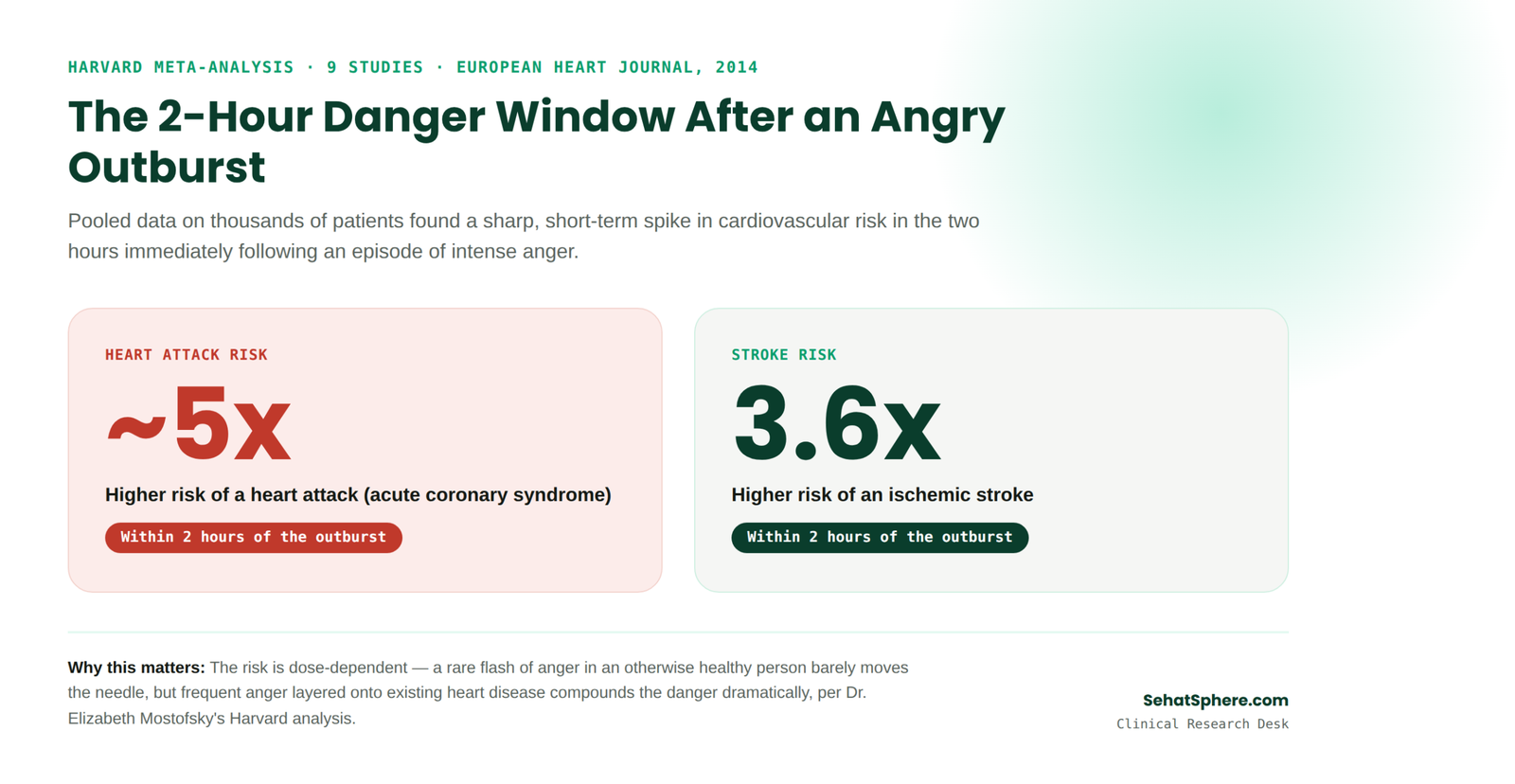
While the Columbia study explains the biology, an earlier and larger body of evidence already established exactly how dangerous a single outburst can be. In 2014, Dr. Elizabeth Mostofsky and colleagues at Harvard’s Cardiovascular Epidemiology Research Unit (Beth Israel Deaconess Medical Center / Harvard School of Public Health) published a systematic review and meta-analysis in the European Heart Journal, pooling data from nine separate studies covering thousands of patients across 18+ years and multiple countries.
| Event, in the 2 Hours After an Outburst | Risk Increase |
|---|---|
| Heart attack (MI / acute coronary syndrome) | ~5x higher (4.74-fold) |
| Stroke | ~3.6x higher |
Individual studies in the pooled analysis ranged more widely — heart attack risk between 2.4 and 7.3 times higher, stroke between 1.7 and 7.6 times higher — but the overall pattern held consistently despite the studies spanning very different countries, populations, and eras. Dr. Mostofsky was direct about what this does and doesn’t mean:
The researchers translated this into concrete numbers that show exactly how much frequency matters. Among people with low cardiovascular risk who get angry only about once a month, that adds roughly 1 extra heart attack per 10,000 people per year — a genuinely small number. But among people with high cardiovascular risk who experience 5 episodes of anger a day, the same math projects to around 657 extra heart attacks per 10,000 people per year. If you’re not sure which risk group you’re in, our guide on the 7 early warning signs of a weak heart covers the symptoms most people dismiss as ordinary stress.
The risk isn’t really about any single argument. It’s a dose-response relationship — occasional anger in an otherwise healthy person barely moves the needle, while frequent anger layered onto existing heart disease compounds dramatically. Frequency and baseline risk multiply each other.
One additional, practically useful finding: a companion analysis found that patients already taking beta-blockers (a common blood pressure medication) had a measurably reduced chance of a cardiac event following an angry outburst compared to patients not on the medication. This doesn’t mean beta-blockers should be started specifically for anger — that’s a decision for your own doctor — but it’s a reasonable data point if you’re already managing both hypertension and a hot temper.
Cardiologist Dr. James O’Keefe, commenting separately on this line of research, explained the biology in plain terms: anger triggers stress hormones that raise blood pressure and pulse, constrict blood vessels, and make platelets “stickier” — directly increasing the risk of the blood clots that cause heart attacks. This kind of sudden cardiac event isn’t limited to older adults, either — our guide to heart attacks in young adults looks at why cases in people under 45 have been climbing.
What’s Actually Happening in Your Body
Putting the Columbia and Harvard findings together gives a fairly complete picture of what an anger episode does to your cardiovascular system in real time:
- Stress hormone surge: Adrenaline and noradrenaline flood your bloodstream within seconds, part of the “fight or flight” response
- Blood pressure and heart rate spike: Both rise acutely, sometimes sharply, during the anger episode itself
- Blood vessels constrict: Vasoconstriction reduces vessel diameter, raising resistance and pressure further
- Platelets become “stickier”: Raising short-term clot risk — directly relevant to the 2-hour heart attack window Mostofsky’s team found
- Endothelial function drops: The Columbia study’s specific contribution — the blood vessel lining itself becomes less able to relax and dilate properly
Researchers describe how strongly someone’s cardiovascular system reacts to a stressor — measured as spikes in blood pressure, heart rate, and vascular resistance — as cardiovascular reactivity (CVR). This isn’t just a lab curiosity. The strongest evidence for it comes from the CARDIA study (Coronary Artery Risk Development in Young Adults), which followed 3,308 Black and white participants for 15 years, from their early-to-mid 20s into their late 30s and 40s. Researchers scored each person’s baseline hostility and time-urgency/impatience, then tracked who went on to develop high blood pressure.
The results, published in JAMA in 2003 by lead author Dr. Lijing L. Yan, showed a clear dose-response pattern: participants in the highest hostility quartile had an 84% higher risk of developing hypertension over the follow-up period compared to the least hostile group, with the second-highest quartile still carrying a 38% higher risk. Time urgency and impatience showed the identical pattern (84% higher risk at the top end, 47% at moderate levels). By ages 33 to 45, roughly 15% of the group had developed hypertension, and the angriest, most impatient participants made up a disproportionate share. Notably, depression and anxiety showed no significant relationship with hypertension risk in the same analysis, reinforcing that anger behaves differently from other negative emotions. For what a healthy trajectory should look like over the decades, see our guide on normal blood pressure by age.
This is the mechanism behind Dr. Shimbo’s “chronic injuries” comment — a single angry moment causes a temporary, reversible dip in vascular function. Repeated, frequent anger, the theory goes, means repeated temporary injuries that may not fully heal between episodes, eventually contributing to the kind of permanent arterial damage (atherosclerosis) that raises long-term heart attack and stroke risk — and, per the CARDIA data, to hypertension itself developing in the first place, not just temporary spikes on top of an already-normal reading. The same chronic stress-hormone elevation that drives this pattern has also been separately implicated in metabolic changes like insulin resistance, another reason chronic anger deserves more attention than a single bad afternoon.
Do Men and Women Pay Differently for the Same Anger?
Almost all of the research above studied men and women together, without separating the results. When researchers do look specifically at sex differences, a genuinely interesting — and clinically useful — pattern shows up: anger and stress don’t appear to damage the male and female cardiovascular system through quite the same route.
In men: suppressed anger is the bigger red flag
A controlled laboratory study in the Annals of Behavioral Medicine by Claus Vögele and colleagues put 28 women and 26 men through a battery of stress tasks — mental arithmetic, an interpersonal challenge, a frustrating motor test, cold-water exposure — while measuring cardiovascular reactivity and each person’s tendency to suppress anger (“anger-in”) versus express it. The result was a sharp gender split: in men, elevated hypertension risk combined with habitually suppressing anger produced the single highest cardiovascular reactivity of any group tested. In women, differences in anger suppression made no measurable difference at all. For a man already trending toward high blood pressure, bottling anger up appears to be its own distinct risk factor.
In women: acute emotional stress hits the heart’s wiring differently
The opposite pattern shows up when researchers look at how women’s hearts respond to a sudden, intense emotional shock. A 2023 review in Frontiers in Cardiovascular Medicine by Tessa Helman and colleagues found women carry a 2- to 4-fold higher risk of stress-triggered heart attacks than men, a 4-fold higher risk of mental-stress-induced cardiac ischemia in women 50 and under versus age-matched men, and — most strikingly — up to a 10-fold higher risk of takotsubo cardiomyopathy, commonly known as “broken heart syndrome.” The review points to greater microvascular dysfunction and a more pronounced stress-hormone response in women, and notes that endothelial function and vascular reactivity to mental stress — the exact marker the Columbia anger study measured — predicts major cardiac events in women but not men.
Takotsubo cardiomyopathy is a genuine, temporary form of heart muscle weakening that mimics a heart attack, and the Cleveland Clinic lists “extreme anger” explicitly among its documented emotional triggers, alongside grief, sudden fear, and intense shock. It predominantly affects women over 50 — researchers believe the loss of estrogen’s protective effect after menopause is part of why. Emotionally intense stressors account for roughly 40% of all cases.
None of this means men’s anger is somehow safer — the Harvard and CARDIA data above weren’t broken down by sex, and men remain at high absolute risk for anger-triggered cardiac events. What it does mean is that the reason anger is dangerous may genuinely differ by sex: in men, the data points more toward suppressed anger compounding an already-elevated baseline risk over years; in women, it points more toward acute emotional shocks having an outsized effect on the heart’s own microvascular and electrical wiring. Women’s heart disease already tends to look different for other reasons too — our guide on the early warning signs of a weak heart covers why women more often develop the “stiff heart” (HFpEF) pattern instead of the classic pump-failure pattern more common in men, and why a heart attack in a younger adult can present without the textbook chest-clutching symptom at all.
What To Read Next
- Why Does Heart Rate Fluctuate? The 12 hidden causes behind an unpredictable pulse.
- Is Your Home BP Machine Lying to You? Why a reading right after an argument can look artificially extreme — and when it’s genuinely accurate.
- Statin Muscle Pain: The SAMSON Trial: What a landmark trial revealed about “side effects” that weren’t from the drug at all.
- Complete Guide to Medicine Safety: Our master guide to using every medication correctly and safely.
The Venting Myth, Debunked
Here’s where most anger advice gets it backwards. The popular idea — punch a pillow, hit the gym hard, scream it out, even pay to smash plates in a “rage room” — assumes that anger is like pressure in a container that needs to be released. This idea is called the catharsis hypothesis, and it has shaped decades of casual advice about anger.
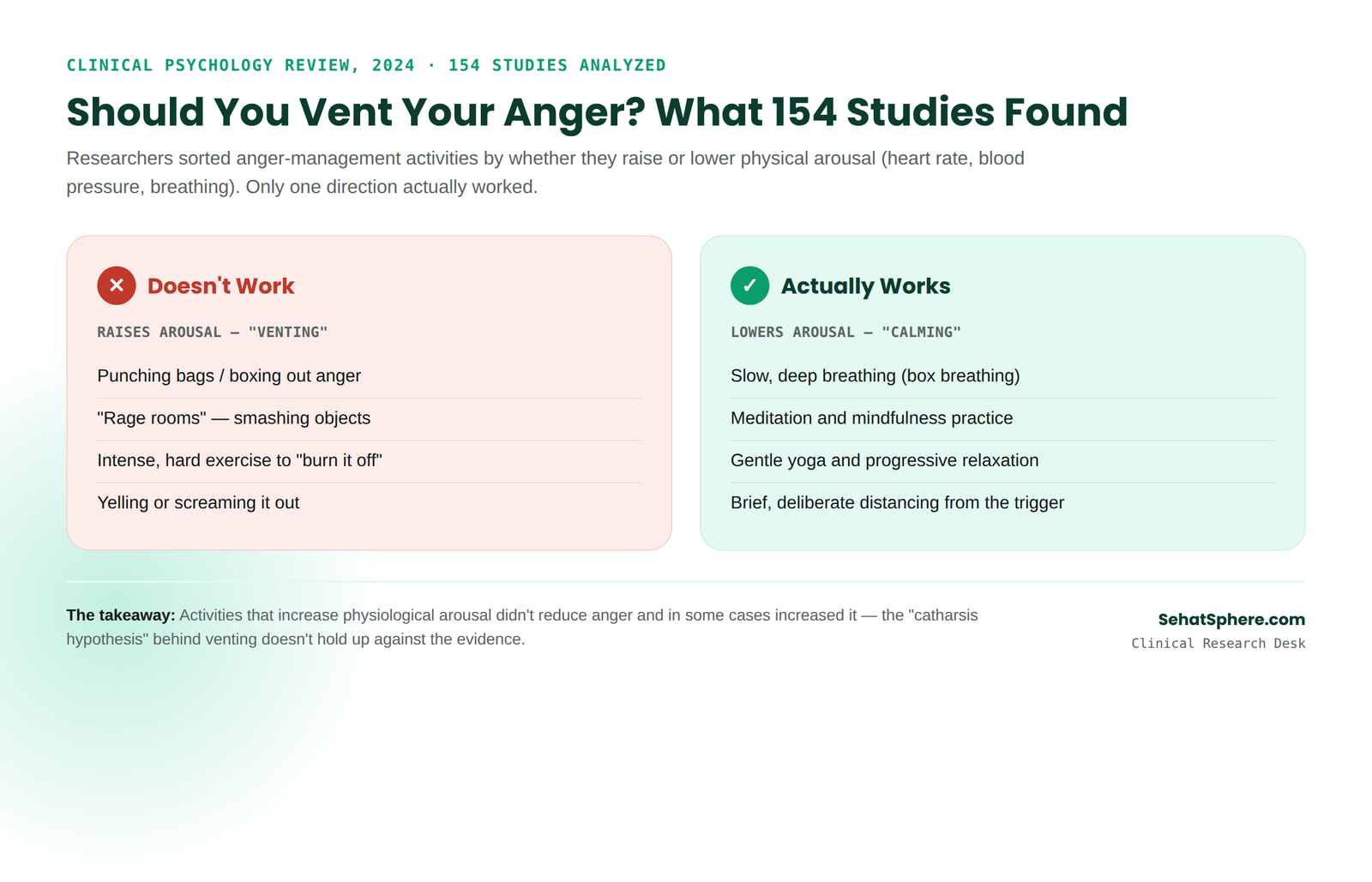
A 2024 review published in Clinical Psychology Review, analysing 154 separate studies, tested this directly by categorising anger-management activities into two groups: those that increase physiological arousal (heart rate, blood pressure, breathing rate) and those that decrease it.
| Approach | Effect on Anger |
|---|---|
| Deep breathing, muscle relaxation, yoga, meditation, mindfulness | Effectively reduced anger and aggression |
| Punching bags, jogging, cycling, “rage rooms” | Not effective — some evidence anger increased |
Myth: “Venting your anger — hitting something, yelling it out — helps you cool down.” Fact: A review of 154 studies found activities that increase physical arousal don’t reduce anger, and venting specifically tends to increase anger and aggression rather than release it.
This lines up precisely with Dr. O’Keefe’s comment on the Harvard heart-attack data: “Contrary to the urban myth that it’s best to express anger and get it out there, expressing anger takes a toll on your system and there’s nothing really cathartic about it.” Two entirely separate lines of research — one on cardiovascular risk, one on psychological outcomes — arrived at the same conclusion from different directions. If chronic stress rather than acute anger is your bigger day-to-day issue, our guide on managing mental stress naturally covers the same calming-not-arousing principle in more depth.
Occasional Anger vs. Chronic Anger
None of this research means you need to panic over a single argument. The NIH’s own summary of the Columbia findings is explicit on this point: a brief spurt of occasional anger is normal and generally has a benign impact on the heart. It’s recurring, frequent anger — the pattern, not the isolated incident — that the researchers flagged as the real concern, and it’s exactly the pattern the CARDIA study’s 15-year hostility data tracked to its logical end point: measurably higher rates of hypertension by middle age.
This distinction matters practically. If you got genuinely furious once this year over something that warranted it, that’s not the pattern this research is warning about. If you’re frequently, easily angered — multiple times a week, over relatively minor triggers — that’s the pattern worth addressing, both for your relationships and, per this research, for your arteries. If you’re already on medication for blood pressure, cholesterol, or another cardiovascular condition, chronic anger is worth mentioning at your next visit — our Complete Guide to Medicine Safety is a good place to start if you’re managing more than one prescription.
Not All Anger Is the Same
Most advice treats “anger” as one single thing. Decades of cardiology research suggest it isn’t — the pattern of how anger shows up in your life matters as much as any single episode.
| Pattern | What It Looks Like | Cardiovascular Relevance |
|---|---|---|
| Explosive (“anger-out”) | Short, intense outbursts — yelling, throwing things | The pattern behind Mostofsky’s 2-hour risk window |
| Suppressed (“anger-in”) | Bottling it up, rarely expressing it outwardly | Linked to persistently elevated reactivity, especially in men (see above) |
| Chronic hostility | A trait-level tendency toward cynicism and irritability | The CARDIA study’s own predictor — 84% higher hypertension risk at the top quartile |
The research on suppression versus expression is genuinely mixed — some studies link anger-in to worse outcomes, others find moderate anger-out associated with lower stress reactivity in certain groups, and as the gender-differences section above shows, the effect may not even be the same for men and women. What’s not supported by the evidence, as covered in the next section, is the popular idea that explosively expressing anger is the healthy alternative to suppressing it. The evidence points toward a third option: neither bottling up nor exploding, but actively down-regulating the physical response itself.
The 5-Step, Evidence-Based Fix
Based on what actually works per the 154-study review — arousal-decreasing techniques, not arousal-increasing ones — here’s a practical sequence for the moment anger hits, plus a habit worth building for the pattern over time.
1. Box breathing (the fastest reset)
Inhale slowly for a count of 4, hold for 4, exhale for 4, hold for 4, and repeat for 8–12 rounds (roughly 2 minutes). This technique — sometimes called “tactical breathing,” used in military and first-responder training — works by directly engaging the parasympathetic nervous system, the body’s built-in counter to the fight-or-flight response that anger triggers.
2. Name the physical sensation
Before reacting, notice what’s happening in your body — racing heart, tight jaw, flushed face. This brief pause creates space between the trigger and your response, and research on cardiovascular reactivity suggests that recognising the physical anger response early makes it easier to interrupt before it peaks.
3. Remove yourself from the trigger, briefly
Stepping away for even a few minutes reduces continued exposure to whatever is provoking the anger, giving the stress-hormone surge time to start subsiding rather than being continuously re-triggered.
4. Choose a genuinely calming activity, not a venting one
Per the evidence above: meditation, slow yoga, mindfulness, or simply continued slow breathing. Skip the punching bag, the intense run, or anything designed to “let it out” — the data suggests these keep arousal elevated rather than resolving it.
5. Build a longer-term outlet, if anger is frequent
If you recognise the chronic, frequent-anger pattern in yourself rather than an occasional flare-up, structured programs matter more than in-the-moment tricks. Cognitive behavioral therapy (CBT) for anger has real evidence behind it, and if anger consistently affects your relationships, work, or you suspect your blood pressure, it’s worth raising directly with your doctor — particularly if you already have hypertension or other cardiovascular risk factors, since this is exactly the population the Columbia researchers want to study next.
If you’re considering adding a calming herbal supplement (like ashwagandha) alongside an existing blood pressure or heart medication, check for interactions first — some combinations genuinely matter, and most people never think to ask.
Try the Integrative Interaction Checker →If anger regularly leads to actions you regret, affects your relationships or job, or you find yourself unable to calm down using the steps above, that’s a signal for professional support — a doctor, therapist, or anger-management program — rather than continuing to self-manage.
Quick Self-Check
Tick anything that’s been true for you over the past month — if several apply, it’s worth mentioning to your doctor, especially if you also have high blood pressure.
If that spiking-reading item applies to you, it’s genuinely useful information rather than a sign your equipment is broken — see our guides on wearable blood pressure accuracy and, for a cuff monitor specifically, why home BP readings can look unusually high right after a stressful moment.
Frequently Asked Questions
Does anger actually raise blood pressure?
Yes. Anger triggers a surge of stress hormones (adrenaline and noradrenaline) that acutely raise blood pressure and heart rate, and a 2024 study found it also impairs blood vessel function specifically, unlike anxiety or sadness.
Can a single angry outburst cause a heart attack?
Research suggests it can meaningfully raise short-term risk in people already vulnerable. A Harvard analysis found heart attack patients were over twice as likely to have had their heart attack within 2 hours of an angry episode, and over four times as likely after intense anger.
Is it healthy to vent my anger by exercising hard or hitting something?
No, according to a 2024 review of 154 studies. Activities that increase physical arousal, including venting-style activities like punching bags, didn’t reduce anger and in some cases increased it. Calming techniques like deep breathing and meditation were consistently more effective.
Is occasional anger dangerous for my heart?
No. NIH researchers were explicit that a brief, occasional angry episode is normal and generally has a benign impact on the heart. It’s frequent, recurring anger that’s linked to cumulative cardiovascular risk.
Can chronic anger actually cause high blood pressure to develop, not just spike temporarily?
Evidence suggests yes. A 15-year study of over 3,300 young adults (the CARDIA study) found the most hostile and impatient participants had an 84% higher risk of developing hypertension by their 30s and 40s, compared with the least hostile group — a dose-response pattern, not a coincidence.
Does anger affect women’s hearts differently than men’s?
The evidence suggests the risk shows up differently by sex rather than one being simply “safer.” In men, habitually suppressing anger combined with elevated hypertension risk produced the highest cardiovascular reactivity in one controlled study. In women, acute emotional stress is linked to a 2-4x higher risk of stress-triggered heart attacks and up to a 10x higher risk of takotsubo cardiomyopathy (“broken heart syndrome”).
Can anger literally cause “broken heart syndrome”?
Yes. Takotsubo cardiomyopathy, commonly called broken heart syndrome, is a real, usually temporary heart-muscle weakening that can mimic a heart attack. The Cleveland Clinic lists extreme anger among its documented emotional triggers, and it predominantly affects women over 50.
What’s the fastest way to calm down when angry?
Box breathing — inhale 4 counts, hold 4, exhale 4, hold 4, repeated for 8-12 rounds — engages your parasympathetic nervous system within about 2 minutes and directly counters the physiological anger response.
Do blood pressure medications protect against anger-triggered heart attacks?
A Harvard study found patients already on beta-blockers had reduced heart attack risk following angry outbursts compared to those not on the medication. This isn’t a reason to start beta-blockers for anger alone — discuss it with your doctor if you have other cardiovascular risk factors.
Why does anger affect the heart differently than anxiety or sadness?
A 2024 Columbia study found only anger caused a statistically significant impairment in blood vessel dilation among the negative emotions tested. Anxiety showed a similar but weaker trend; sadness showed no significant effect. The exact reason for this difference isn’t yet fully understood.
What is “Type A personality” and does it really predict heart disease?
Type A personality — competitive, hostile, easily angered — was first linked to cardiovascular disease risk in the 1950s. Decades of subsequent research have supported a link, particularly around the hostility and anger components specifically, more than general competitiveness.
Does suppressing anger instead of expressing it protect the heart?
Not straightforwardly, and the answer may depend on your sex. Research on “anger-in” versus “anger-out” suggests both extremes have downsides; one study found suppressed anger combined with hypertension risk was especially harmful in men but made no measurable difference in women. The evidence-based middle path is processing anger through calming techniques rather than either suppressing or explosively venting it.
Should I see a doctor about my anger?
If anger is frequent, affects your relationships or work, or you have existing high blood pressure or heart disease, it’s worth raising with your doctor. Structured approaches like cognitive behavioral therapy have real evidence behind them for chronic anger patterns.
The Bottom Line
Anger genuinely raises blood pressure, and 2024 research finally shows the mechanism — impaired blood vessel function that, with repetition, may contribute to lasting arterial damage. A 15-year study of young adults confirms this isn’t just a short-term spike: chronic hostility is linked to hypertension developing over the following decades. The risk isn’t identical for everyone — men appear to pay a particular price for suppressed anger, while women face a disproportionately higher risk of acute stress-triggered events, including “broken heart syndrome.” A single angry moment isn’t something to fear; it’s the pattern that matters, and Harvard data suggests even one intense outburst can meaningfully raise short-term heart attack risk in vulnerable people. The popular fix — venting it out — doesn’t hold up against 154 studies of evidence. What does: techniques that calm your nervous system down, practiced consistently.
- Mostofsky E, Penner EA, Mittleman MA. Outbursts of anger as a trigger of acute cardiovascular events: a systematic review and meta-analysis. European Heart Journal, 2014;35(21):1404-1410. Harvard School of Public Health summary
- Shimbo D, et al. Translational Research of the Acute Effects of Negative Emotions on Vascular Endothelial Health. J Am Heart Assoc, 2024. ahajournals.org
- NIH. NIH-funded clinical trial links frequent anger to increased risk of heart disease. nih.gov
- Yan LL, Liu K, Matthews KA, Daviglus ML, Ferguson TF, Kiefe CI. Psychosocial factors and risk of hypertension: the Coronary Artery Risk Development in Young Adults (CARDIA) Study. JAMA, 2003;290(16):2138-2148.
View All References (9) ▾
- American Heart Association. Anger’s role in heart attack risk may start in the arteries. heart.org
- The Conversation. Chilling out rather than blowing off steam is a better way to manage anger — new review of 154 studies. 2024. theconversation.com
- Columbia University Irving Medical Center. Why Anger Is Bad for Your Heart. cuimc.columbia.edu
- Vögele C, Jarvis A, Cheeseman K. Anger suppression, reactivity, and hypertension risk: gender makes a difference. Annals of Behavioral Medicine, 1997;19(1):61-69.
- Helman TJ, Headrick JP, Stapelberg NJC, Braidy N. The sex-dependent response to psychosocial stress and ischaemic heart disease. Frontiers in Cardiovascular Medicine, 2023.